Tag Archives: maritime disasters

Remembering History: Sinking of Lusitania (7 May 1915)

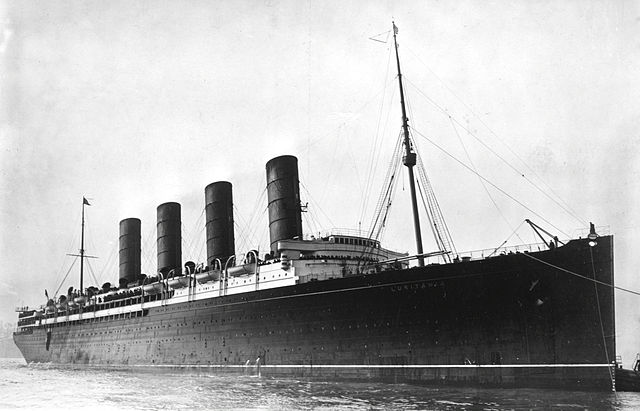
RMS Lusitania Coming Into Port (circa 1907-1913)
George Grantham Bain Collection, US Library of Congress, Digital Id cph.3g13287.
Public Domain

On 7 May 1915, the Cunard liner RMS Lusitania sailing from New York to Liverpool was torpedoed off Ireland and sank within 18 minutes. Of the 1,959 passengers and crew aboard, only 761 would survive. 128 of the passengers were American.

World War II had begun in 1914 between Britain, France, and Russia (including Belgium, Italy, Portugal, and Serbia) and Germany, Austria Hungary, and Turkey (then called Ottoman Empire). The United States, under President Woodrow Wilson, declared neutrality. Since the U.S. was a major trading partner with Britain, problems arose when Germany tried to quarantine the British Isles using mines.  Several American ships ended up being damaged or sunk as a result. In February 1915, Germany declared unrestricted submarine warfare around British waters. This meant any ship entering these waters were subject to being attacked and sunk by German forces.

To make this very clear, the German embassy in Washington had advertisements run in New York newspapers in early May 1915 that Americans traveling on British or Allied ships in war zones did so at their own risk. In one case, the announcement was on the same page as advertisement of the Lusitania sailing from New York to Liverpool.

Warning issued by Imperial German Embassy in Washington about travelling on RMS Lusitania.
Author Unknown
Public Domain/Wikimedia Commons

The British Admiralty issued warnings, due to merchant ships being sunk off the south coast of Ireland, to ships to avoid the area or take evasive action (zigzagging was advised). The British objected by pointing out that threatening to torpedo all ships was wrong, whether announced in advance or not. During her construction, subsidized by the British government, it was done with the proviso she could be converted to an armed merchant cruiser.

A compartment was also installed to for the purposes of carrying arms and ammunition if it were needed. Gun mounts were installed for deck cannons, but they were not installed. At the time of her sinking, she was not operating in any official capacity as an armed merchant cruiser. The Germans suspected the ship was being used to transport munitions and her repainting to a grey color was an attempt to disguise her (it was, but to make it harder to spot from a periscope).

The Lusitania was one of the fastest liners on the Atlantic capable of 25 knots (29 mph) with many refinements. With lifts, the wireless telegraph, electric lights, and more passenger space (and more sumptuous accomodations), traveling on the Lusitania or her sister ships Aquitania and Maurentania was considered a good experience by seasoned travelers. The fact that she traveled so fast makes it likely it was simply being in the right place and the right time for the German U-boat. She could not possibly have caught the speedy vessel otherwise (there are arguments about what speed Lusitania was doing at this time off Ireland).

Engraving of Lusitania Sinking by Norman Wilkinson, The Illustrated London News, May 15, 1915
Public Domain(Wikimedia)

Captain William Turner did not use zigzagging while in the area (many argue that it does not really work). The commanding officer of the U-boat,  Walther Schwieger, ordered one torpedo fired around 14:10 (2:10 pm). It struck the Lusitania on the starboard bow. A second explosion within the ship occurred and the ship began to founder starboard quickly. While the crew tried to launch the lifeboats, the severe list made it difficult and impossible in many cases. Only six of the forty-eight lifeboats would be launched. The ship sank in 18 minutes taking with her 1, 198 souls. Of the 764 that did survive (and that is a heroic tale of itself), three would die later from wounds sustained from the sinking. Though close to the coast, it would be some time before assistance arrived. Local fishing ships were the first to provide assistance, and later the naval patrol boat Heron. Other small ships provided assistance as well.

Aftermath

The sinking provoked international fury at Germany. Germany defended its actions saying the ship had been carrying contraband and was an armed auxiliary military cruiser. The reaction within Germany, Austria-Hungary and Turkey was criticism of the sinking. The German government tried to defend the sinking, even though she was not armed, by saying she was carrying contraband and they had warned this would happen. The official statements did not go over well in the United States or in Britain. Editorials in newspapers denounced what Germany had done calling for more to bring them to heel. It was hotly debated within the Wilson administration what to do. Wilson condemned what Germany had done but internally but William Jennings Bryan, the Secretary of State, argued for trying to convince both Britain and Germany to ratchet down some of the actions that had led to Lusitania sinking. Bryan was antiwar and like many did not want the U.S. getting involved in the European war.

Dead Wake: The Last Crossing of the Lusitania by Erik Larson

President Wilson would send three notes to Germany that made his position clear on the issue. First he said that Americans had the right to travel on merchant ships and for Germany to abandon submarine warfare on such vessels. Second, he rejected German arguments about Lusitania. This note caused Bryan to resign and was replaced by Robert Lansing. The third note was a warning that any subsequent sinkings would be “deliberately unfriendly.” That last one made it clear America’s position on the matter. While many wanted to stay out of the war, if the Germans did do it again they likely would find themselves at war with them.

The British government and press were not happy with Wilson over these notes. He was widely castigated and sneered. The reality was that American public opinion was not in favor of war. Wilson knew this and hoped Germany would stop attacking merchant vessels. There was some attempt within the German government to forbid action against neutral ships, which did curtail unrestricted submarine warfare for a while. British merchant ships were targeted, neutral ships treated differently (boarded and searched for war materials), and passenger ships left alone. But in 1917, Germany announced it would resume unrestricted submarine warfare. Wilson was furious and began preparations for war with Germany.

Shop For Lusitania books on Amazon

Sources

“German Submarine Sinks Lusitania | May 7, 1915 | HISTORY.” HISTORY. Last modified February 18, 2025. Accessed May 7, 2026. https://www.history.com/this-day-in-history/May-7/german-submarine-sinks-lusitania.

“Lusitania: History, Sinking, Facts.” Encyclopedia Britannica. Last modified March 28, 2026. Accessed May 7, 2026. https://www.britannica.com/topic/Lusitania-British-ship.

The Lusitania Resource. “The Lusitania Resource: Passengers & Crew, Facts & History.” The Lusitania Resource. Last modified May 3, 2025. https://www.rmslusitania.info/.

Library of Congress. 2015. “The Lusitania Disaster  | Articles & Essays  | Newspaper Pictorials: World War I Rotogravures, 1914-1919  | Digital Collections  | Library of Congress.” The Library of Congress. The Library of Congress. 2015. https://www.loc.gov/collections/world-war-i-rotogravures/articles-and-essays/the-lusitania-disaster/.

“Torpedoes and Tragedy: The Sinking of RMS Lusitania.” 2023. National WWI Museum and Memorial. 2023. https://www.theworldwar.org/learn/about-wwi/torpedoes-and-tragedy-sinking-rms-lusitania.


Titanic Chronology: Carpathia Arrives in New York (18 April 1912)

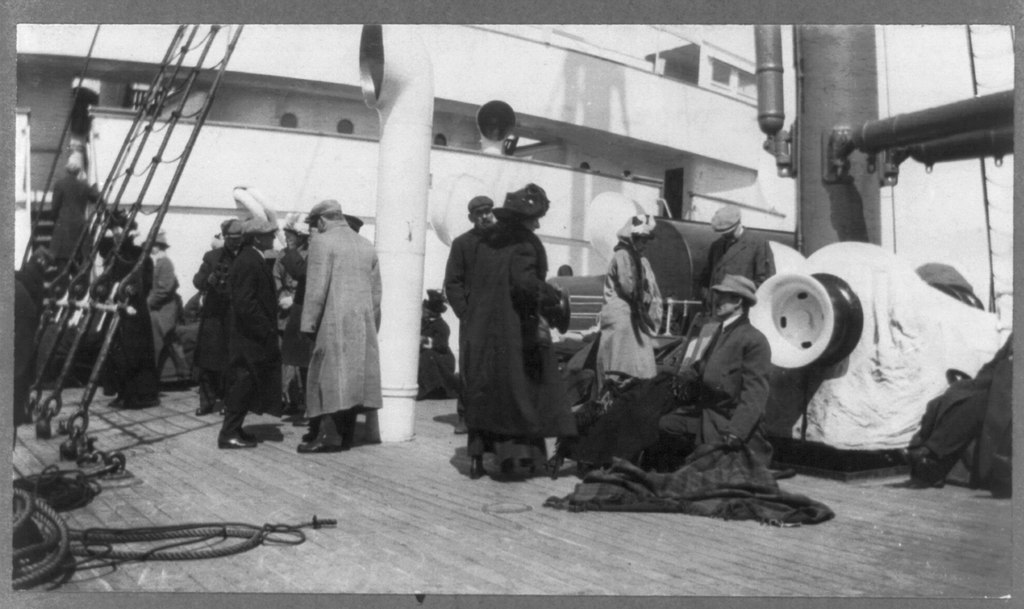
Titanic survivors aboard Carpathia.
U.S. Library of Congress, digital id: cph 3b04287
Public Domain

Since the sinking, the Carpathia has maintained a radio silence refusing to acknowledge except the most required about its upcoming arrival in New York. Names of those who were rescued were transmitted via the RMS Olympic to Cape Race and onto New York where the White Star Line made the names known to the public. Many had gathered outside their offices in New York City to learn the fate of those aboard Titanic. Messages from survivors were transmitted from Carpathia to their relatives.

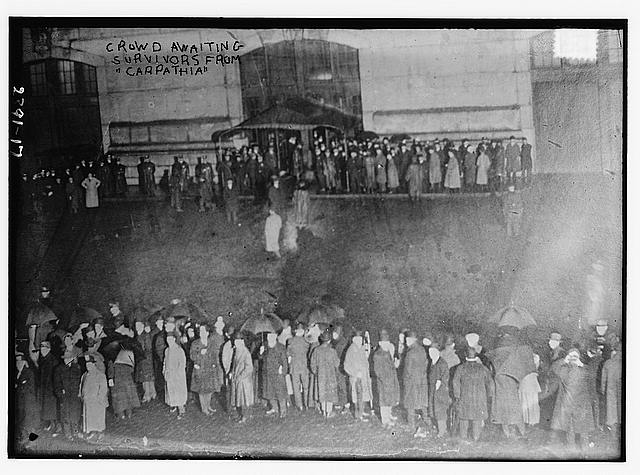
Boats of news reporters went out to meet Carpathia as it entered. Using megaphones, they yelled to people on deck hoping to get something. One reporter did manage to get aboard and get some interviews before tossing a cigar box filled with his notes that was lined with champagne corks to his editor waiting in a tugboat. It would swiftly be taken to the New York Herald and published. A large crowd, estimated at around 10,000 to see Carpathia come down the battery and about 1,000 where the ship was to dock. J.P. Morgan along with families of the famous people aboard such as the Astor, Thayer, and Widener families were there. Many had been on the special train that was mistakenly sent to Halifax believing Titanic was headed there to dock.

Bain News Service, Publisher. Crowd awaiting survivors from CARPATHIA. , 1912. [April date created or published later by Bain] Photograph. https://www.loc.gov/item/2014690330/.
Public Domain

It was raining that evening as Carpathia made its way to its dock but stopped first at the White Star Line dock to drop off the Titanic lifeboats. These lifeboats, except for the flotsam and jetsam on the ocean, were all that was left of the once great ship RMS Titanic. This delayed Carpathia’s arrival as it had been scheduled to arrive at 8:30 pm and was not until after 9 pm at Pier 54 it finally docked with the gangway coming down at 9:25 pm. News reports indicate some were crying in the crowd. The crowd had been silent up to its arrival, but now that had changed. A detachment of doctors, nurses, nuns, and priests went aboard. Three women, not wanting to wait for the gangway to come down, used the ship ladders to get down. The Salvation Army also was there to help as well.

Most came off Carpathia wearing a hodgepodge of clothes they were able to get aboard ship. Men standing in the crowd took off their hats as a show of respect. Those who had relatives were greeted by them. Those who had no one were assisted by a variety of groups: Women’s Relief Committee, Travelers Aid Society of New York, the Council of Jewish Women and many more. Transportation to shelters was provided for. Those with relatives in New York left soon afterwards while those who were elsewhere in the US had to make travel arrangements. The Pennsylvania Railroad provided a special free train to take survivors to Philadelphia. Surviving Titanic crew members were taken to the Red Star Line steamer SS Lapland to be housed temporarily.

Among the people that boarded Carpathia that night were two U.S. Senators: William Alden Smith and Francis G. Newlands. They had subpoenas served on J. Bruce Ismay, the surviving Titanic officers and crew, and Captain Rostron. A formal inquiry was about to take place in the United States, and they were not going to wait for an official British inquiry down the road. Smith argued that since White Star Line was ultimately owned by an American company–International Mercantile Marine–the United States had every right to conduct an inquiry of its own. This would cause considerable anger in Britain over it and unfavorable depictions of Smith in its press. However, both  inquiries would explore exactly how this tragedy occurred and how something so simple, having lifeboats for all, was not required by the British Board of Trade.

Sources

Disclosure: As an Amazon Associate, I earn from qualifying purchases. This post may contain affiliate links, which means I may receive a small commission at no extra cost to you.

Archbold, Rick, and Dana McCauley. Last Dinner on the Titanic Menus and Recipes From the Great Liner. Hachette Books, 1997.

Behe, George TITANIC: SAFETY, SPEED AND SACRIFICE, Transportation Trails, Polo, IL 1997

Behe, G. (2012). On board RMS Titanic: Memories of the Maiden Voyage. The History Press.

Behe, George. Voices From the Carpathia: Rescuing RMS Titanic, 2015.

Brewster, H. (2013). Gilded Lives, Fatal Voyage: The Titanic’s First-Class Passengers and Their World. National Geographic Books.

Cameron, Stephen. Titanic: Belfast’s Own. Colourpoint, 2011.

Eaton John P. & Haas Charles, TITANIC TRIUMPH AND TRAGEDY, SECOND EDITION, W.W. Norton & Company, New York, New York, 1995 First American Edition

Fitch, Tad, J. Kent Layton, and Bill Wormstedt. On a Sea of Glass: The Life & Loss of the RMS Titanic. Reprint. Amberley Publishing, 2015.

Lord, Walter, A NIGHT TO REMEMBER, Holt Rinehart and Winston, New York, New York, 1955. Multiple revisions and reprints, notably Illustrated editions (1976,1977,1978 etc.)

Lord, Walter, THE NIGHT LIVES ON, Willian Morrow and Company, New York, New York, 1986 (First Edition)

Lynch, Don & Marshall Ken, TITANIC AN ILLUSTRATED HISTORY, Madison Press Books, Toronto, Ontario Canada, 1992

Marshall, L. (2019). Sinking of the Titanic: The Greatest Disaster At Sea – Special Edition with Additional Photographs. Independently Published.

Rossignol, K. (2012). Titanic 1912: The Original News Reporting of the Sinking of the Titanic. Createspace Independent Publishing Platform.

Wade, Wyn Craig. The Titanic, End of a Dream, 1979.

Wilson, A. (2012). Shadow of the Titanic: The Extraordinary Stories of Those Who Survived. Simon and Schuster.

Internet

“The Titanic: Sinking & Facts | HISTORY.” HISTORY. Last modified March 26, 2026. https://www.history.com/articles/titanic.

“Encylopedia Titanica.” https://www.encyclopedia-titanica.org/.

“RMS Titanic – the Radio Officers Association.” https://radioofficers.com/archives/rms-titanic/.

“Titanic Facts • 1,000+ Fascinating Facts and Figures,” Titanic Facts, last modified October 7, 2023, https://titanicfacts.net/.

Documentary & Videos

Titanic. DVD. A+E Networks, Greystone Communications, 1994. Also known as Titanic: Death of a Dream and Titanic: The Complete Story

Oceanliner Designs, “What Happened to Titanic’s Survivors After the Sinking?,” Video, YouTube, April 21, 2024, https://www.youtube.com/watch?v=dkDv7XKxQGA.

Remembering Britannic (21 Nov 1916)

HMHS Britannic seen during World War I.
Image:public domain

On 21 November 1916, HMHS Britannic was sunk by mine near the island of Kea in the Aegean Sea. The ship sank in 55 minutes and 1,035 people were rescued, only 30 perished. Britannic was the third and last ship of the Olympic class liners built by White Star Line. The other two were Olympic and Titanic. Britannic was launched in February 1914. Many design changes were made prior to launch due to lessons learned from Titanic. Those changes were:

  • Double hull along the engine and boiler rooms raising six of the watertight bulkheads up to B deck.
  • More powerful turbine installed due to increase in hull width.
  • Watertight compartments were enhanced so that the ship can stay afloat with six compartments flooded.
  • Motorized davits to launch six lifeboats (only five out of eight were installed before war service). Manual operated davits were used for the remaining lifeboats. The new design also allowed all lifeboats to be launched even if the ship was listing. There were 55 lifeboats with capacity for 75 each so that 3,600 people could be carried.

When World War I broke out, the ship had to be retrofitted as a hospital ship. Most of the furnishings were stored in a warehouse to be placed back aboard after the war. The Britannic began service as a hospital ship on 12 December 1915. She was sent to the Aegean Sea to bring back sick and wounded soldiers. Her first tour of service was ended on 6 June 1916 and she was sent back to Belfast to be refitted back as a passenger liner. As this was underway, the ship was again recalled to military service on 26 August 1916 and was sent back to the Mediterranean Sea.

On the morning of 21 November 1916, the Britannic under the command of Captain Alfred Barnett was steaming into the Kea Channel when at 8:12 am a loud explosion shook the ship. The explosion, unknown at the time whether it was a torpedo or mine, damaged the first four watertight compartments and rapidly filled with water. Water was also flowing into the boiler room. Captain Bartlett ordered the watertight doors closed, sent a distress call, and ordered the lifeboats be prepared. Unfortunately, while they could send messages, damage to the antenna wires meant they could not hear the responses back from ships responding to their SOS.  Britannic was reaching her flooding limit and open portholes (opened by nurses to ventilate wards) were bringing more water in as well.

As the ship was still moving, Bartlett did not order lifeboats be lowered but two lifeboats were lowered anyway. They were sucked into the ships propellor and torn to bits killing everyone in those two lifeboats. Bartlett ordered the ship stopped to assess the damage. The ship was listing so badly that the gantry davits were inoperable. Thinking the sinking had slowed, he ordered the engines back on to try and beach the ship. The flooding increased as more water was coming in aided by the open portholes the nurses had opened to air out their wards early in the morning. Bartlett ordered the engines stopped and to abandon ship. She would sink at 9:07 am, 55 minutes after the explosion. Thankfully the water temperature was high (70 F), they had more lifeboats than Titanic, and rescue came less than two hours. Nearby fisherman were able to help and at 10:00 am, the HMS Scourge arrived and later the HMS Heroic and later the HMS Foxhound.

1,035 survived. Of the 30 lost, only five were buried as their bodies were not recovered. Memorials in Thessaloniki and London honor those lives lost. Survivors were housed on the warships and the nurses and officers were put into hotels. Most survivors were sent home, and some arrived in time for Christmas. Speculation about whether it was a torpedo or a mine was resolved when it was learned that a German submarine (SM U-73) had planted mines in the Kea Channel in October 1916. The loss of two Olympic class ships was a major blow to White Star Line. They would get, as a result of the Treaty of Versailles, the German ocean liner Bismarck (renamed Majestic), which replaced Britannic. They also got Columbus which was named Homeric.

Britannic has been largely forgotten except when news of expeditions were made to the wreck site over the years. The wreck itself was bought by noted author Simon Mills, who has written two books on the ship. An expedition in September 2003 located by sonar mine anchors confirming German records of U-73 that Britannic was sunk by a single mine. The expedition found several watertight doors open making it likely the mine strike was during a watch change on the ship. One notable survivor was Violet Jessop. She had been on Olympic as stewardess when it collided with the HMS Hawke, aboard Titanic in the same capacity when it sank, and then aboard Britannic as a stewardess with the Red Cross.

Sources

“Britannic,” Encyclopedia Britannica, last modified November 17, 2025, accessed November 20, 2025, https://www.britannica.com/topic/Britannic.

“HMHS Britannic | Atlantic Liners,” accessed November 20, 2025, https://atlanticliners.com/white_star_home/britannic_home/.

Milligan, Mark. “The Loss of the Britannic – Titanic’s Sister Ship.” HeritageDaily – Archaeology News. Last modified August 9, 2024. Accessed November 20, 2025. https://www.heritagedaily.com/2023/06/the-loss-of-the-britannic-titanics-sister-ship/147882.

Hickman, Kennedy. “World War I: HMHS Britannic.” ThoughtCo. Last modified May 29, 2019. Accessed November 20, 2025. https://www.thoughtco.com/world-war-i-hmhs-britannic-2361216.

Suggested Reading

Chirnside, Mark. Olympic, Titanic, Britannic: An Illustrated History of the Olympic Class Ships. Hardcover. The History Press, 2012.

Lord, Walter, A NIGHT TO REMEMBER, Holt Rinehart and Winston, New York, New York, 1955. Multiple revisions and reprints, notably Illustrated editions (1976,1977,1978 etc.)

Lord, Walter, THE NIGHT LIVES ON, Willian Morrow and Company, New York, New York, 1986 (First Edition)

Mills, Simon. Exploring the Britannic: The Life, Last Voyage and Wreck of Titanic’s Tragic Twin. Adlard Coles, 2019.

Titanic News Channel is a participant in the Amazon Services LLC Associates Program, an affiliate advertising program designed to provide a means for sites to earn advertising fees by advertising and linking to Amazon.com.

The Tragedy of SS Noronic (17 September 1949)

On September 177, 1949, the SS Noronic while docked in Toronto, Canada suffered a catastrophic fire that killed at least 119 people that ended the golden era of Great Lakes passenger cruise ships.

The SS Noronic was launched in 1913 for the Canadian Steamship Company. It was built for passenger and freight service on the Great Lakes. With five decks and the capacity to hold 800 passengers and 200 crew, and 360 feet (110 meters) long, she was the largest and fastest ship on the Great Lakes when launched. And she had many luxuries that other ships did not have. She had her own ice plant, wireless telegraph, bandstands, restaurants, bars, decks lined with mahogany and lounge chairs upholstered with Spanish leather earning her the nickname Queen of the Great Lakes. With fourteen lifeboats in case of emergency, she was considered quite safe as well after the Titanic sinking. However the only entrances and exits to the ship were on the bottom E deck, a fact that would play a major role in the disaster of 1949

She began a seven-day pleasure cruise of Lake Ontario on September 14, 1949. She was carrying 524 passengers and 171 crew. Most of the passengers were American and only twenty Canadians. This voyage would be the last voyage of the season as the ship would be laid up for winter. The captain for this voyage was Wiliam Taylor. Pulling into Toronto Harbor on September 16, she docked at Pier 9 at 7 pm and was scheduled to depart the following day. Many passengers and crew, including the captain, spent the evening in Toronto. Most passengers had returned to the ship before the fire broke out. Only fifteen crew members were aboard the ship that night as many had gone ashore to be with family or friends.

Around 2:30 am (some sources say 1:30 am) passenger Don Church saw smoke on C deck and followed the smell to a locked linen closet. After finding smoke coming from it, he informed bellboy Earnest O’Neill. O’Neil did not raise alarm and instead went to the steward’s office on D deck to get the keys. Upon opening the closet, fire exploded into the hallway spreading quickly. Church ran to get his family. Meanwhile O’Neill and another bellboy along with another passenger attempted to put out the fire. Unfortunately, the fire equipment did not work. He notified Captain Taylor of the fire, and the ship’s whistle was ordered to be blown. Unfortunately, either because of the fire or some other reason, the whistle only gave one blast. By 2:38 a.m., half of the ship’s decks were ablaze and noticed by people ashore alerting the fire department. However, no ship officer or crew member called them. Additionally there was no attempt by the crew to awaken the sleeping passengers.

Donald Williamson, aged twenty-seven, was the first rescuer. He had just come off a late shift and, as a former freighter deckhand, wanted to see the Noronic. He arrived just as the whistle sounded and could see the fire was spreading. He could also see people were frantically trying to get off the ship and jumping into the water. Acting quickly, he moved a large painters’ raft to the port bow and was able to pull people from the water onto the raft. Two police constables who arrived on the scene saw the ship ablaze and encountered survivors in shock and suffering from injuries and burns. Constable Ronald Anderson stripped off his uniform and assisted Williamson on the raft. Fireboats soon arrived to help rescue people in the water. Firefighting equipment arrived at the dock along with ambulances and other police to assist survivors and put out the raging fire.

Noronic Burns
Photo by Norman James, September 17, 1949
Public Domain in US/Canada via Wikimedia Commons

Aboard ship, people were desperate to get out. Portholes were broken by either crew members or passengers to get off the ship. Since the crew had failed to awaken the passengers, most only found out something was wrong when they heard screaming and running in the corridors. With most of the stairwells on fire, few could reach E-deck to escape using the gangplanks. Panic ensued and many were trampled to death. Many used ropes to climb down or to jump into the water. Those trapped on the upper decks–some on fire–jumped to the pier below and died. Others were unable to escape their cabins as the fire consumed the ship rapidly.

Noronic fire September 17, 1949
Unknown Author
City of Toronto Archives via Wikimedia Commons
Public Domain US/Canada

Attempts to get people off by rescue ladders were not always successful. One ladder was extended to the B deck and was swamped with passengers causing it to snap in two resulting in them being rescued by a lifeboat. Other ladders to C deck were successful and held up as people were able to get off. Despite a tremendous amount of water used to fight the fire, it was quickly realized that the fire would not extinguish. The high amounts of water used though, temporarily caused the ship to list to the pier resulting in firefighters having to retreat until it corrected itself.

By 5 am, the fire had gone out and an astonishing 1.7 million gallons of water had been used by 37 hoses. The ship was cool enough by 8 am to be boarded. Firefighters and others accompanying them found gruesome scenes. The fire burned so hot that instead of corpses they found mostly skeletons with little, or no flesh left. Some were found embracing each other while others were found in their beds. Identification of the remains proved difficult and a new technique, dental forensics was used. Additionally, all the glass fittings were melted, steel fittings warped, and only the bow stairwell survived. Due to a lack records, the exact death toll is unknown, it is estimated between 119-139 may have died, Suffocation was the main cause of death for most, followed by severe burns, being trampled to death in the corridors, jumping to the pier, and one drowning. Initially it was 118 dead by one crewmember would die later from burns suffered on her body bringing the estimated death toll to 119.

Evening Star (Washington, D.C.), September 17, 1949, Library of Congress
Public Domain

The disaster was well covered in the Toronto newspapers and on the American side as well since most of the passengers were American. The question everyone wanted answered was simple: how did this happen? The answers came from the official inquiry that took place later. Investigation showed that the fire had started on the linen closet on C deck and spread rapidly when it was opened by the bellboy. What started the fire is uncertain. A report that some laundry staff were seen smoking near the linen closet led some to believe that a carelessly dropped cigarette was the cause. Interviews of the crew members did not confirm this. Canadian Steamship believed it was arson. Another one of their ships a year later would have a similar fire in a linen closet but it was contained, and no loss of life occurred. The inquiry found that several major issues contributed to how the fire spread so quickly and was so hot. The mahogany wood deck linings had been coated with lemon-oil which the flames fed upon. Additionally, the structure of the ship-as the ship decks were placed close together-spread the fire fast. Improperly maintained fire equipment and extinguishers meant little water could be used on the ship to put it out.

The crew failed to alert the passengers as most were asleep. The one blast of the ship’s whistle before it died was not enough. Many did not know how serious the situation was until they were awakened by noise in the corridors. Some of the crew just fled rather than assist. The lack of clear exit signage and what to do was another factor. Passengers had to make their way down, if they could, to E deck where two planks were available to exit the ship. The rapid movement of the fire made that difficult and later impossible leading to mass panic. Without other exits, many were simply trapped forcing them to find whatever means they could. The fact that the crew mostly abandoned the ship and never had any emergency drills brought condemnation down on both the line owner, Canadian Steamship Lines, and Captain Taylor. Taylor had his master’s license revoked for a year; he would resign before it was made active. The company was sued in court and ended up paying out over two million Canadian dollars.

New regulations were enacted by both Canada and the United States to ensure this would never happen again. Ship design was altered, and new safety regulations were put in place regarding the use of flammable materials aboard passenger ships. Many ships were taken out of service as the cost of retrofitting was too high. The days of the Great Lakes luxury cruises came to an end as a result. With fewer passengers, there was not much profit anymore. Knowing that Canadian Steamship had allowed ships to sail without properly maintained fire equipment and a crew that did nothing to help the passengers, all contributed to the demise. By late 1960’s the last of these old passenger cruise ships were retired from service never to return.

As for the Noronic, it was partially disassembled at the pier and the rest of it towed away to be scrapped. A memorial was erected in the cemetery were many were interred and a memorial plaque put up near where the disaster had occurred. It remains to this day one of the deadliest fires in Toronto history.

SS Noronic Memorial at Mount Pleasant Cemetery, Toronto
Photo: Nick Number, 9 September 2024
Wikimedia Commons


Sources

Bipin Dimri, “The SS Noronic: Death in Toronto Harbor,” Historic Mysteries, last modified December 29, 2023, accessed September 15, 2025, https://www.historicmysteries.com/history/noronic/30544/.

By CraigBaird, “The SS Noronic Fire,” Canadian History Ehx, May 27, 2025, https://canadaehx.com/2025/05/27/the-ss-noronic-fire/.

Mike Filey, “THE WAY WE WERE: 119 Tragically Killed in SS Noronic Inferno 70 Years Ago,” Toronto Sun, last modified September 21, 2019, accessed September 15, 2025, https://torontosun.com/opinion/columnists/the-way-we-were-119-tragically-killed-in-ss-noronic-inferno-70-years-ago.

Brennan Doherty Staff Reporter, “September 17, 1949: S.S. Noronic Burns,” Toronto Star, September 17, 2016, https://www.thestar.com/news/gta/september-17-1949-s-s-noronic-burns/article_46ba351c-ad2f-5f3b-954e-74a54589c89f.html.

Chris Bateman, “The History of the S.S. Noronic Disaster in Toronto,” blogTO, August 8, 2020, https://www.blogto.com/city/2012/09/a_brief_history_of_the_ss_noronic_disaster/.

Ontario Heritage Trust, “Noronic Disaster, The,” Ontario Heritage Trust, last modified February 10, 2023, accessed September 15, 2025, https://www.heritagetrust.on.ca/plaques/noronic-disaster.

“Noronic Disaster Historical Plaque,” accessed September 15, 2025, https://torontoplaques.ca/Pages/Noronic_Disaster.

“Steamship Noronic Memorial (Unknown-1949) – Find A…,” accessed September 15, 2025, https://www.findagrave.com/memorial/10440/steamship_noronic_memorial.

Wikipedia contributors, “SS Naronic,” Wikipedia, last modified August 21, 2025, accessed September 15, 2025, https://en.wikipedia.org/wiki/SS_Naronic.

Remembering The Sultana Tragedy (27 April 1865)

On 27 April 1865 the steamboat Sultana, carrying recently released Union prisoners of war, exploded on the Mississippi River, killing 1,450 to 1,900 people. This disaster remains the deadliest maritime loss in U.S. history.

Sultana 26 April 1865 at Helena, Arkansas and obviously overcrowded. So many crowded on the port side to be in the photograph that it caused issues for the ship.
Original source: United States Library of Congress
Public Domain
Photo: Public Domain (U.S. Library of Congress, digital id#cph.3a48909)

The Sultana was built as a side-wheel steamboat in Cincinnati in 1863. The 260-foot-long wood steamboat transported passengers and freight between St. Louis and New Orleans on the Mississippi River. She was powered by four fire-tube boilers which could generate twice the amount of steam as conventional boilers. The one major drawback is that each boiler required water levels to be always maintained. Since it used river water, this had to be carefully monitored as sediment would block flues. And if the water level got too low hot spots would develop and an explosion would occur. With steamboats of this period using light weight wood that was covered with oil-based paint, fires were a major concern.

J. Cass Mason was the Sultana’s captain and was part owner. He was an experienced captain but had gotten into trouble trying to ship contraband. The Sultana departed St. Louis on 13 April 1865 for New Orleans. When he arrived at Cairo, Illinois on 15 April, he learned the shocking news of the assassination of President Abraham Lincoln. Grabbing a stack of newspapers, he immediately departed south as many places had no telegraph and would not learn the news of this event. Arriving in Vicksburg, he was approached by Captain Reuben Hatch, the chief quartermaster. He had a problem. The recently released Union Army prisoners of war needed to get home. And the government was willing to pay $2.75 for each enlisted man and $8.00 for each officer. Hatch knew that Mason needed the money and offered a 1,0000 Army soldiers. To secure this “guarantee” though, Hatch would get a kickback. Mason agreed and the Sultana continued its journey to New Orleans. Sultana departed New Orleans on 21 April 1865 with approximately 70 passengers, some livestock, and a crew of 85. On the way to Vicksburg, one of the boilers leaked and the steamboat limped into Vicksburg to pick up the Union prisoners heading home.

The boiler needed immediate repair but that would take several days. Mason was concerned that this delay would cost him money and other steamboats would take the released Union prisoners. The mechanic was ordered to make temporary repairs which only took a day hoping to make the full repair when he arrived back in St. Louis. Meanwhile the Sultanabegan taken on the prisoners. The ship had an official capacity of 376 people but would take on 1,950 of the prisoners along with 22 guards and 70 passengers. Every available space was used, and the overflow was so severe that at some places there was noticeable creaking and sagging requiring wooden beams for support. As Sultana departed on 24 April, it was carrying 2,127 people. Making matters worse, a massive Spring flood had occurred making it difficult traveling upriver. When she arrived in Helena, Arkansas on 26 April, a photo was taken showing how overcrowded the vessel was. Arriving at Memphis that night, she unloaded 200 men and sugar before departing around midnight to pick up coal upriver. Around 1 am, the ship continued its journey.

At 2:00 am on 27 April 1865 when Sultana was about seven miles north of Memphis, a massive explosion occurred with one boiler and then the three others exploded. The effect was catastrophic with it tearing through the crowded decks killing many and destroying the pilothouse. The ship was a burning hulk without anyone to steer it. The smokestacks collapsed causing further damage and death. Many became trapped inside as the forward part of the upper deck collapsed onto the middle deck. The twin openings of the main stairway survived allowing many to run down them. However, broken wood on the ship caught fire with the now exposed furnace boxes turning the ship into a raging inferno. Many jumped into the water, some in whole groups. Many were still recovering from their imprisonment and lacked the strength to survive. Whole groups of men clung together in desperation and perished together. Some grabbed ahold of debris to stay afloat.

The steamer Bostona was already heading downriver and came upon the scene at 2:30 am. She rescued scores of survivors in the water. Meanwhile many who had survived were being carried downriver by the current towards Memphis. There were cries of help heard and this caused the docked ships, several steamers and naval ships, to come to their aid. The water was icy cold from the spring runoff and many perished from hypothermia or drowned. A few survivors were even found on trees near the swollen riverbanks. Bodies of victims would be found downriver for months. Nearly all the Sultana’s officers perished including Captain James Cass Mason.

The news was greeted with shock when it was reported. Then it disappeared from the news. The assassination of President Lincoln and hunting down the assassin and those who aided him filled the news. It was not forgotten by the survivors nor by the people of Memphis, who went out of their way to assist those who had survived the disaster. The official investigation concluded that improper water levels along with overcrowding and being top heavy all contributed to the disaster. Another investigation in 2015 suggests that the quality of the metal in the boilers, the use of river water often filled with sediment, and the design of the boilers all contributed to the explosion. Some have speculated that sabotage was involved and while intriguing, no proof has been found to substantiate it. The PBS show History Detectives (2 July 2014) debunks those claims and focuses on the overcrowding and corruption as the major issues.

Despite the catastrophe, no one was held accountable. The military commission that investigated the tragedy determined the boiler explosion was the cause and discounted entirely the fact the ship was overloaded. J. J. Witzig, the supervising inspector of steamboats, found that the patch used for the emergency repair was too thin for the pressure of the return trip. There were other inquiries that pointed fingers at various officers that resulted in the overcrowding of the Sultana. Ultimately a court martial was ordered and both Captain Hatch and Captain Frederic Speed, who had overseen the troops being sent to the ship, were ordered to appear.  Hatch, who had allegations of corruption in the past and had been promoted to Lieutenant Colonel, never appeared. Speed was found guilty of all charges and to be dismissed from the service. This was overturned by the Army Judge Advocate General who determined Speed was not responsible for the actual loading, but Captain George Augustus Williams was.

It was Williams inaccurate numbers to Speed that caused problems with the exact numbers aboard Sultana. Williams was not prosecuted by the Army. Hatch, on the other hand, was relieved of his duties as chief quartermaster on 3 June 1865. Sometime later he was aboard the steamer Atlanticcarrying $14,490 in government money. A thief broke into the safe stealing the money but was captured before docking in St. Louis. However, there was $8,500 missing from the government money that Hatch claimed was in the safe. He was found in violation of government regulations in transporting the money and held liable for its loss.

In the wake of the disaster, safety laws for steamships were changed. The boilers responsible for the explosion were banned. The Act of 1871 established and revised the older Steamboat Act by creating a Steamboat Inspection Service giving it power to regulate all commercial steam-powered vessels, implement measures to protect passengers and crews, requiring licensing of ship masters and chief mates (and the authority to revoke them), and issue nautical rules for steamboat operations. This would shift to the Bureau of Marine Inspection and Navigation (BMIN) in 1936 which was part of the Commerce Department. It would shift to the Coast Guard starting in World War II and has stayed there ever since.

The remains of the Sultana were found 1982 but not in the Mississippi River but under a soybean field on the Arkansas side of the river. The Mississippi River has changed course over the years and so now the remains are on dry land and 2 miles east of where it was in 1865. Various memorials exist to the victims. The Sultana Disaster Museum has opened in Marion, Arkansas. The disaster remains as one of the worst maritime disasters in the United States and yet few know of it.

[This was modified from the 2022 posting. New source material was added along with expanded information regarding the disaster and Sultana]

Sources

Erin Blakemore, “Why Nobody Remembers America’s Worst Maritime Disaster,” History.Com, last modified August 13, 2025, accessed August 20, 2025, https://www.history.com/articles/why-nobody-remembers-americas-worst-maritime-disaster

Allen Coggins and Tennessee Historical Society, “Sultana Disaster of 1865,” Tennessee Encyclopedia, last modified October 17, 2017, accessed August 20, 2025, https://tennesseeencyclopedia.net/entries/sultana-disaster-of-1865/.

Kat Eschner, “This Civil War Boat Explosion Killed More People Than the ‘Titanic’,” Smithsonian Magazine, April 20, 2023, https://www.smithsonianmag.com/smart-news/civil-war-boat-explosion-killed-more-people-titanic-180963008/.

Barbara Voulgaris, “Sultana Fire – a Maritime Disaster That Helped Shape the Coast Guard’s Marine Safety Mission,” United States Coast Guard, last modified April 25, 2025, accessed August 20, 2025, https://www.mycg.uscg.mil/News/Article/4166478/sultana-fire-a-maritime-disaster-that-helped-shape-the-coast-guards-marine-safe/.

“Sultana: A Tragic Postscript to the Civil War,” HistoryNet, last modified April 19, 2020, accessed August 20, 2025, https://www.historynet.com/sultana-a-tragic-postscript-to-the-civil-war/.
“STORIES | Sultana Museum,” Sultana Museum, accessed August 20, 2025, https://www.sultanadisastermuseum.com/stories-from-the-sultana.

“Sultana: Titanic of the Mississippi,” last modified April 27, 2001, accessed August 20, 2025, https://www.unexplainedcases.com/2009/10/sultana-titanic-of-mississippi.html.

“The Disaster | Sultana Association,” Sultanaassociation, accessed August 20, 2025, https://www.thesultanaassociation.com/the-disaster.

“The Sultana Disaster,” American Battlefield Trust, accessed August 20, 2025, https://www.battlefields.org/learn/articles/sultana-disaster.

Remembering the Tragic Sinking of the General Slocum (15 June 1904)

On 15 June 1904 the General Slocum was taking members of St. Mark’s Evangelical Church to its annual picnic. Sadly, most would perish when the ship caught fire making it the worst maritime disaster in New York City and for a time the United States until Titanic sank in 1912.
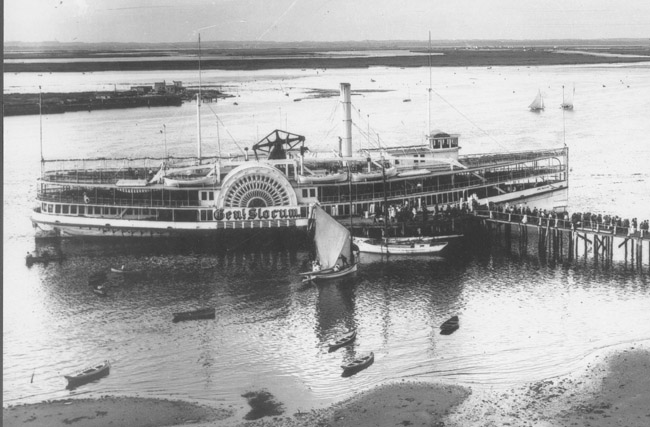
General Slocum, date and author unknown.
Image:Public Domain (National Archives)

The PS General Slocum was built in Brooklyn, New York in 1891. She was designed as a sidewheel passenger steamboat to ferry passengers to locations on the East River. Named for the famous Civil War general (and New York Congressman), Henry Warner Slocum, the ship conveyed the image of reliability. With three decks-main, promenade and hurricane-and with the capacity to hold up to 2,500 passengers, the ship was very popular especially with groups that were holding major events and needed a ship to convey them.

The Slocum was owned by the Knickerbocker Steamship Company and had been captained for many years by William H. Van Schaick with a total crew of 22 aboard. It had several mishaps before the 1904 disaster. After launching in 1891, she ran aground in Rockaway and tugboats had to pull her free. 1894 saw a number of accidents from running into a sandbar, running aground, and colliding with a tugboat that had caused serious damage. In 1902, the ship ran aground and was stuck there overnight forcing the passengers to camp out on the ship for the night.

By 1904, the Slocum had been superseded by other more modern ships but was still popular for excursion travel around New York City. St. Mark’s Evangelical Church in Little Germany district (Kleindeutschland) of New York had used the Slocum for its annual picnic for the past 17 years. The annual picnic was to celebrate the end of the Sunday School year. Teachers, mothers, and children attended this event. Since it was held during the weekday, most fathers were at work. Pastor George Haas had chartered the ship for $350. On 15 June 1904, the group of 1,358 of mostly women and children boarded the ship at the Third Street Pier. The Slocum would take them up the East River and then through Long Island Sound to its destination of Locust Grove, in Eaton’s Neck, Long Island where the picnic would be held.

The ship departed at 9:30 am and everything seemed to be going well. Nearly all the passengers, mostly women and children, were dressed up for the event. There was a band playing music and food for the trip was served by those attending the picnic. By 10 am the Slocum had made her way up to the passage of Hell Gate, between Ward’s Island and Queens. It was around this time a fire broke out in the Lamp Room. The Lamp Room (the third compartment from the bow under the main deck) as the name indicates, was used to store lamps and its oil. Rags with oil on them were around and packing straw was also in the room as well from the boxes of glasses the group had brought with them for the trip. No one can say for certain how the fire was started, but most likely caused by a discarded cigarette or match. The fire was soon noticed by crew who attempted to put it out using the emergency water hoses. Unfortunately, they were old and leaked so little water could be applied. It would be learned later that the company that sold them to Knickerbocker had used materials that were quite thin and cheap.

The captain was first notified by a child but dismissed it. He was officially told 10 minutes later but by now the fire was ablaze and passengers were now getting frightened. The ship was equipped with lifeboats, but they could not be released. They were held in place by wire and in many cases were covered with paint making it impossible to release them. People were getting frantic now. Life preservers were available but were so old that the cork inside had disintegrated into dust. And the dust absorbed water. In some of them were bits of metal put in by the manufacturer to make them weigh the same as ones with cork. Mothers watched in agony as the children they had put life preservers on sink and drown in the water. Also, few knew how to swim at the time as well so could not swim to safety. Adding more to this situation were that at the time people wore wool clothing even in summertime. So even if they could swim, it was very difficult with the heaviness of the wool weighing you down.

Captain Van Schaick initially ordered the ship full ahead as the nearest area of land had oil storage. He would change his mind a few minutes later and order the ship beached on North Brother Island. He would remain on the Hurricane deck until the last moments of the ship forced him to jump overboard into shallow water. The ship had been completely engulfed by the time she was beached-a mere 20 minutes after the fire had been discovered, Fortunately North Brother Island was a quarantine island and there were both doctors and nurses to assist those that had gotten ashore. Several vessels nearby had come to assist those they found in the water and responsible for saving 300 lives.

Victims of the General Slocum washed ashore at North Brother Island
15 June 1904
Possible source: Gustav Scholer (1851 – 1928)
Public Domain via Wikimedia Commons

Most however did not make it off the Slocum. An estimated 1021 would die according to a government report and of that only 2 were crew (though some sources put the figure lower). Sadly, many who died were children though sometimes parents or members of the extended family also perished. Some victims were never identified because there was no one living to do so. The funeral procession of the dead was witnessed by many, and the small coffins caused many to cry. One notable incident was a man accompanied by his wife carrying a small coffin under his arms. He could not afford a funeral wagon and so was walking to the cemetery. Fortunately, a man delivering flowers offered him a ride. Captain Van Schaick was injured in an eye and lost its use as result of the tragedy.

The city was aghast at what had happened. In supposedly one of the great cities of the world, a ship burned within its sight. A floating horror of fire and people frantically trying to escape facing either the flames or drowning. Newspapers carried headlines of the many funeral processions that occurred. Everyone wanted answers and President Roosevelt ordered a commission to investigate what had happened on the Slocum. And what the commission found was startling. Nothing had been done to maintain and replace as needed the safety equipment. The report found the fire hoses were made of cheap linen and full of kinks (and of course leaked). And of course, how the life preservers had failed as well along with the lifeboats that could not be accessed. Also, they found no safety drill had been done in over a year. Captain Van Schaick was found responsible as master of the Slocum and sentenced to 10 years in jail for failing to maintain the safety equipment. Since the captain bore the brunt of the blame, the Knickerbocker Steamship Company paid only a small fine though it was learned they had falsified safety records.
Later Van Schaick would be paroled and pardoned by President Taft in 1912 since many believed the company was at fault.

Aftermath

As a result of the tragedy, a reorganization of who was responsible for inspecting ships and tighter safety regulations would result. Today that is handled by the U.S. Coast Guard. The community of Little Germany in Manhattan was severely affected with the loss of so many in the tragedy. It brought the community together and St. Mark’s would continue to serve its community. Little Germany had grown and flourished from the 1840’s but by the end of the 19th century had already started to contract. The once solidly German area began to diminish and in many ways the tragedy of the General Slocum hastened it. Many began to resettle in Brooklyn. A new wave of immigrants was coming in from Italy and Eastern Europe. It would become eventually the Lower East Side forever changing the character with areas where Italian, Russian, and Yiddish would now be heard.

St. Mark’s Evangelical Church would never recover from the 1904 loss as most of its congregation were dead. While the parish would continue elsewhere, the church would become a synagogue (and still is to this day) in 1940. The building itself is listed on the U.S. National Register of Historic Places. In 1946 the parish of St. Mark’s merged with the Zion Church in Yorkville in 1946 to become Zion St. Mark’s Evangelical Lutheran Church.

General Slocum Memorial Tompkins Square Park, Manhattan, New York City
Image:Public Domain (Wikipedia)

In 1906 a marble memorial fountain, which stands to this day, was erected in Tompkins Square Park in Manhattan by the Sympathy Society of German Ladies. There is also another memorial in the Lutheran All Faiths Cemetery in Middle Village, Queens where many graves of the victims are to be found. The last survivor died in 2004.

The General Slocum was salvaged and turned into a barge renamed Maryland. Continuing its history of mishaps as before, it sank in the South River in 1909 and in 1911 while in the Atlantic off the coast of New Jersey. No one died in the 1911 sinking.

The movie Manhattan Melodrama (1934), which stars a young Clark Gable, has as its opening moments the events of the General Slocum which sets in motion the lives of the two characters the movie depicts. Not a bad movie for its time and worth looking at if you have the opportunity.

A memorial plaque placed near the former church of St. Mark’s on the centennial of disaster states:

This is the site of the former St. Mark’s Evangelical Lutheran Church (1857–1940) a mostly German immigrant parish. On Wednesday, June 15, 1904, the church chartered the excursion steamer, GENERAL SLOCUM, to take the members on the 17th annual Sunday school picnic. The steamer sailed up the East River, with some 1400 passengers aboard, when it entered the infamous Hell Gate passage, caught fire and was beached and sank on North Brother Island. It is estimated 1200 people lost their lives, mostly woman and children, dying within yards of the Bronx shore.

The GENERAL SLOCUM had been certified by the U.S. Steam boat Inspection Service to safely carry 2500 passengers five weeks before the disaster. An investigation after the fire and sinking found the lifeboats were wired and glued with paint to the deck, life jackets fell apart with age, fire hoses burst under water pressure, and the crew never had a fire drill. Until the terrorist attack on the World Trade Center on September 11, 2001, the Slocum disaster had been the largest fire fatality in New York City’s history.

Dedicated Sunday, June 13, 2004, by the Steam Centennial Committee.
The Maritime Industry Museum
SUNY-Maritime College, Fort Schulyer, The Bronx, NY

Sources

HISTORY.com Editors, “Riverboat Fire Leaves More Than 1,000 Dead | June 15, 1904 | HISTORY,” HISTORY, last modified May 27, 2025, https://www.history.com/this-day-in-history/june-15/river-excursion-ends-in-tragedy.

“The General Slocum Disaster of June 15, 1904 | the New York Public Library,” The New York Public Library, last modified June 13, 2011, https://www.nypl.org/blog/2011/06/13/great-slocum-disaster-june-15-1904.

“General Slocum | National Underwater and Marine Agency,” https://numa.net/expeditions/general-slocum/.

Wikipedia contributors, “PS General Slocum,” Wikipedia, last modified May 18, 2025, accessed June 18, 2025, https://en.wikipedia.org/wiki/PS_General_Slocum.

Wikipedia contributors, “Little Germany, Manhattan,” Wikipedia, last modified February 21, 2025, accessed June 18, 2025, http://en.wikipedia.org/wiki/Little_Germany,_Manhattan.

Zion-St. Mark’s Evangelical Lutheran Church. (n.d.). http://www.zionstmarks.org/ourhistory.htm

Videos

Fascinating Horror. (2023, August 8). The General Slocum | a short documentary | Fascinating horror [Video]. YouTube. https://www.youtube.com/watch?v=38NfsPVC6m8. Also available on Rumble: https://rumble.com/v3kq60p-the-general-slocum-fascinating-horror.html

Hank Linhart. (2017, June 13). Fearful visitation, The Steamship Fire of the General Slocum,1904 [Video]. YouTube. https://www.youtube.com/watch?v=ZU1QzU8tCnk

The History Guy: History Deserves to Be Remembered. (2017, June 15). New York’s worst maritime disaster, the General Slocum [Video]. YouTube. https://www.youtube.com/watch?v=tGlLwtqhUKE. Also available on Rumble: https://rumble.com/v2nsnrq-new-yorks-worst-maritime-disaster-the-general-slocum.html

Suggested Reading

Editors, C. R. C. R. (2015). The sinking of the General Slocum: The History of New York City’s Deadliest Maritime Disaster. CreateSpace.

Eggleston, M. A. (2021). Fire on the water: the General Slocum disaster. Independently Published.

O’Donnell, E. (2004). Ship ablaze: The Tragedy of the Steamboat General Slocum. Crown.

Titanic News Channel is a participant in the Amazon Services LLC Associates Program, an affiliate advertising program designed to provide a means for sites to earn advertising fees by advertising and linking to Amazon.com.

Remembering the Empress of Ireland (29 May 1914)

RMS Empress of Ireland 1908
Photo:Public Domain (Library and Archives Canada / PA-116389)

The Titanic disaster of 1912 was still making waves when on 29 May 1914, the RMS Empress of Ireland collided with the Norwegian coal freighter Storstad in the Saint Lawrence River at  Pointe-au-Père, Quebec. It occurred around 0200 in the morning. Storstad hit the starboard side, causing severe damage. Empress began to list and quickly filled with water. Portholes had not been secured before leaving port so many were open (many passengers complained of poor ventilation) so that allowed a lot of water to enter. Many in the lower decks drowned from water coming in from the open portholes.

Damage sustained by the SS Storstad after its collision with the RMS Empress of Ireland
Public Domain via Wikimedia Commons

Also, failure to close the watertight doors led to the quick sinking. Three lifeboats were launched quickly with passengers and crew that were in the upper deck cabins able to get away but as the ship listed further starboard, the other lifeboats could not be used. Ten minutes after the collision, Empress lurched violently on the starboard side allowing 700 passengers and crew to crawl out of portholes and decks on her side. Then 15 minutes later, after it briefly looked like she might have run aground, the hull sank dumping all the people left on her into the icy water. When the final tally was done, 1,012 people lost there lives. 465 survived. Many on the starboard side were asleep and likely drowned in their cabins.

The New York Times reporting on testimony of Captain Kendall of Empress of Ireland at inquest 31 May 1914
Public Domain via Wikimedia Commons

The official enquiry, which began on 16 June 1914, was headed by Lord Mersey who had previously headed the British Titanic enquiry (he would also lead up the enquiry into Lusitania later). Two very different accounts emerged of the collision from the Storstad and Empress. At the end of the day, the commission determined that when Storstad changed course, it caused the collision. The Norwegians did not accept the verdict and held their own enquiry which exonerated the captain and crew of the Storstad. Canadian Pacific, which owned the now sunk Empress of Ireland, pursued a legal claim and won. The Norwegian owners countersued but in the end the liabilities forced them to sell Storstad to put money in the trust funds.

What happened to Empress, though not receiving the same attention as Titanic, was to change ship design. The reverse slanting bow was dangerous in ship-to-ship collisions resulting in below the waterline damage. Bows were redesigned so the energy of the collision would be minimized below the surface. Longitudinal bulkheads were discontinued as they trapped water beneath them causing the ship to list and capsize. Needless to say portholes were to be secured from that point on (in fact nearly all cruise ships use decoratives that can never be opened). The wreck today has been salvaged many times and is now the only underwater historic site in Canada. The wreck is in shallow water (130 feet) but is notably dangerous dive due to the cold waters, currents, and often impaired visibility.

Sources

Dorothy Turcotte, “The Empress of Ireland Was Canada’s Titanic,” NiagaraThisWeek.Com, July 13, 2023, https://www.niagarathisweek.com/opinion/columnists/the-empress-of-ireland-was-canada-s-titanic/article_2b417429-aa48-5dd5-a61c-a2f6f208b0fb.html.

“ARCHIVED – Investigating the Empress of Ireland – Inland Waters – Shipwreck Investigations – Library and Archives Canada,” accessed May 29, 2025, https://www.collectionscanada.ca/sos/shipwrecks/002031-4100-e.html.

“‘Report and Evidence of the Commission of Enquiry Into the Loss of the British Steamship “Empress of Ireland” of Liverpool (0. No. 123972) Through Collision With the Norwegian Steamship “Storstad.” Quebec, June, 1914’.,” Internet Archive, last modified 1915, accessed May 29, 2025, https://archive.org/details/n16sessionalpaper50canauoft/page/n417/mode/2up?view=theater.

“The Empress of Ireland Disaster,” National Museums Liverpool, https://www.liverpoolmuseums.org.uk/maritime-museum/empress-of-ireland-disaster.

Wikipedia contributors, “RMS Empress of Ireland,” Wikipedia, last modified April 27, 2025, https://en.wikipedia.org/wiki/RMS_Empress_of_Ireland.

(This was updated from 2024 with newer sources and minor corrections)

Remembering History: Sinking of Lusitania (7 May 1915)

RMS Lusitania Coming Into Port (circa 1907-1913)
George Grantham Bain Collection, US Library of Congress, Digital Id cph.3g13287.
Public Domain

On 7 May 1915, the Cunard liner RMS Lusitania sailing from New York to Liverpool was torpedoed off Ireland and sank within 18 minutes. Of the 1,959 passengers and crew aboard, only 761 would survive. 128 of the passengers were American.

World War II had begun in 1914 between Britain, France, and Russia (including Belgium, Italy, Portugal, and Serbia) and Germany, Austria Hungary, and Turkey (then called Ottoman Empire). The United States, under President Woodrow Wilson, declared neutrality. Since the U.S. was a major trading partner with Britain, problems arose when Germany tried to quarantine the British Isles using mines.  Several American ships ended up being damaged or sunk as a result. In February 1915, Germany declared unrestricted submarine warfare around British waters. This meant any ship entering these waters were subject to being attacked and sunk by German forces.

To make this very clear, the German embassy in Washington had advertisements run in New York newspapers in early May 1915 that Americans traveling on British or Allied ships in war zones did so at their own risk. In one case, the announcement was on the same page as advertisement of the Lusitania sailing from New York to Liverpool.

Warning issued by Imperial German Embassy in Washington about travelling on RMS Lusitania.
Author Unknown
Public Domain/Wikimedia Commons

The British Admiralty issued warnings, due to merchant ships being sunk off the south coast of Ireland, to ships to avoid the area or take evasive action (zigzagging was advised). The British objected by pointing out that threatening to torpedo all ships was wrong, whether announced in advance or not. During her construction, subsidized by the British government, it was done with the proviso she could be converted to an armed merchant cruiser.

A compartment was also installed to for the purposes of carrying arms and ammunition if it were needed. Gun mounts were installed for deck cannons, but they were not installed. At the time of her sinking, she was not operating in any official capacity as an armed merchant cruiser. The Germans suspected the ship was being used to transport munitions and her repainting to a grey color was an attempt to disguise her (it was, but to make it harder to spot from a periscope).

The Lusitania was one of the fastest liners on the Atlantic capable of 25 knots (29 mph) with many refinements. With lifts, the wireless telegraph, electric lights, and more passenger space (and more sumptuous accomodations), traveling on the Lusitania or her sister ships Aquitania and Maurentania was considered a good experience by seasoned travelers. The fact that she traveled so fast makes it likely it was simply being in the right place and the right time for the German U-boat. She could not possibly have caught the speedy vessel otherwise (there are arguments about what speed Lusitania was doing at this time off Ireland).

Engraving of Lusitania Sinking by Norman Wilkinson, The Illustrated London News, May 15, 1915
Public Domain(Wikimedia)

Captain William Turner did not use zigzagging while in the area (many argue that it does not really work). The commanding officer of the U-boat,  Walther Schwieger, ordered one torpedo fired around 14:10 (2:10 pm). It struck the Lusitania on the starboard bow. A second explosion within the ship occurred and the ship began to founder starboard quickly. While the crew tried to launch the lifeboats, the severe list made it difficult and impossible in many cases. Only six of the forty-eight lifeboats would be launched. The ship sank in 18 minutes taking with her 1, 198 souls. Of the 764 that did survive (and that is a heroic tale of itself), three would die later from wounds sustained from the sinking. Though close to the coast, it would be some time before assistance arrived. Local fishing ships were the first to provide assistance, and later the naval patrol boat Heron. Other small ships provided assistance as well.

Aftermath

The sinking provoked international fury at Germany. Germany defended its actions saying the ship had been carrying contraband and was an armed auxiliary military cruiser. The reaction within Germany, Austria-Hungary and Turkey was criticism of the sinking. The German government tried to defend the sinking, even though she was not armed, by saying she was carrying contraband and they had warned this would happen. The official statements did not go over well in the United States or in Britain. Editorials in newspapers denounced what Germany had done calling for more to bring them to heel. It was hotly debated within the Wilson administration what to do. Wilson condemned what Germany had done but internally but William Jennings Bryan, the Secretary of State, argued for trying to convince both Britain and Germany to ratchet down some of the actions that had led to Lusitania sinking. Bryan was antiwar and like many did not want the U.S. getting involved in the European war.

Dead Wake: The Last Crossing of the Lusitania by Erik Larson

President Wilson would send three notes to Germany that made his position clear on the issue. First he said that Americans had the right to travel on merchant ships and for Germany to abandon submarine warfare on such vessels. Second, he rejected German arguments about Lusitania. This note caused Bryan to resign and was replaced by Robert Lansing. The third note was a warning that any subsequent sinkings would be “deliberately unfriendly.” That last one made it clear America’s position on the matter. While many wanted to stay out of the war, if the Germans did do it again they likely would find themselves at war with them.

The British government and press were not happy with Wilson over these notes. He was widely castigated and sneered. The reality was that American public opinion was not in favor of war. Wilson knew this and hoped Germany would stop attacking merchant vessels. There was some attempt within the German government to forbid action against neutral ships, which did curtail unrestricted submarine warfare for a while. British merchant ships were targeted, neutral ships treated differently (boarded and searched for war materials), and passenger ships left alone. But in 1917, Germany announced it would resume unrestricted submarine warfare. Wilson was furious and began preparations for war with Germany.

Shop For Lusitania books on Amazon

Sources:

———. “German Submarine Sinks Lusitania | May 7, 1915 | HISTORY.” HISTORY. Last modified February 18, 2025. https://www.history.com/this-day-in-history/german-submarine-sinks-lusitania.

The Lusitania Resource. “The Lusitania Resource: Passengers & Crew, Facts & History.” The Lusitania Resource. Last modified May 3, 2025. https://www.rmslusitania.info/.

———. “Lusitania | History, Sinking, Facts, & Significance.” Encyclopedia Britannica. Last modified April 15, 2025. https://www.britannica.com/topic/Lusitania-British-ship.

“Finding and Diving the Lusitania | Friends of the Lusitania,” https://lusitania.org/finding-and-diving-the-lusitania/.

“The Lusitania Disaster | Articles & Essays | Newspaper Pictorials: World War I Rotogravures, 1914-1919 | Digital Collections | Library of Congress,” The Library of Congress, https://www.loc.gov/collections/world-war-i-rotogravures/articles-and-essays/the-lusitania-disaster/

Titanic History: Carpathia Arrives In New York (18 April 1912)

Titanic survivors aboard Carpathia.
U.S. Library of Congress, digital id: cph 3b04287
Public Domain

Since the sinking of the Titanic, lingering questions as to who survived and who died were the subject of much speculation. Captain Arthur Rostron of the Carpathia had kept a media blackout refusing to answer any messages. J. Bruce Ismay was sequestered in a cabin and stayed there for the entire voyage back to New York. He sent a message to the New York office of the White Star Line informing of the sinking. Except for survivors sending their own messages out, no one really knew who had lived or died when Carpathia finally arrived on a rainy Thursday evening on 18 April 1912.

News reporters had gathered in boats with megaphones yelling to people aboard they would pay for their survivor accounts. One enterprising reporter did manage to get aboard and get some quick interviews. He tossed the notes inside a cigar box lined with champagne corks to a Hearst editor in a tugboat. It would be rushed back to the New York World for a special evening edition. Meanwhile in the pier sheds there were some 1,000 people-mainly friends and relatives-gathered there. J.P. Morgan Jr. was there along with members of the Widener and Thayer families who had been on the special trains that had been heading north to Halifax to greet the survivors there. There was some crying heard. As Carpathia slowly made her way down the battery, it was estimated close to 10,000 people were watching, mostly in silence, as she passed. Some numbers are higher at 40,000.

Crowd Awaiting Survivors of Titanic, 18 April 1912
U.S. Library of Congress,Bain Collection, Control #ggb2004010347
Public Domain

Carpathia would make a slight detour to the White Star dock to drop off her lifeboats. It was a stunning moment when you realize that those lifeboats, along with the flotsam and jetsam, were all that remained of the once proud RMS Titanic. Although arriving in New York at 8:30 pm, the delay to unload the lifeboats along with the rain and darkness meant Carpathia did not dock at Pier 54 until after 9 pm. The gangway went down at 9:25 pm. There were a large detachment of doctors, nurses, nuns, and priests ready to board along with stretchers. According to one report, three women did not want to wait for the gangway to come down and climbed down ladders from the ship. The Salvation Army was also there to render assistance as well.

Many men removed their hats in respect when the gangway went down. Many survivors had little clothing, just what they had on when they left Titanic, and wore a hodge-podge of whatever they could get on Carpathia. Two women were apparently hysterical (one report said violent and deranged). Those who had relatives waiting were greeted by them. Relief for those who had no one was done by the Women’s Relief Committee, the Travelers Aid Society of New York, the Council of Jewish women and many more. Transportation was provided to shelters provided by these groups. Those who had relatives in New York quickly left while those who had relatives within the U.S. stayed for a few days to arrange transportation. The Pennsylvania Railroad provided a special free train to take survivors to Philadelphia. The surviving crew members would be taken to the Red Star Line steamer SS Lapland and housed there temporarily in passenger cabins.

Meanwhile other interesting parties boarded the Carpathia that night. They were U.S. Senators William Alden Smith, Francis G. Newlands, and others armed with subpoenas to serve on J. Bruce Ismay, as well as the surviving officers and crew of Titanic. An inquiry was about to begin, and they wanted to make sure they would be all be there for it the following day at the Waldorf Astoria in New York.

Sources

Books

Behe, George TITANIC: SAFETY, SPEED AND SACRIFICE, Transportation Trails, Polo, IL 1997

Behe, George (2012). On board RMS Titanic: Memories of the Maiden Voyage. The History Press.

Eaton John P. & Haas Charles, TITANIC TRIUMPH AND TRAGEDY, SECOND EDITION, W.W. Norton & Company, New York, New York, 1995 First American Edition

Lord, Walter, A NIGHT TO REMEMBER, Holt Rinehart and Winston, New York, New York, 1955. Multiple revisions and reprints, notably Illustrated editions (1976,1977,1978 etc.)

Lord, Walter, THE NIGHT LIVES ON, Willian Morrow and Company, New York, New York, 1986 (First Edition)

Lynch, Don & Marshall Ken, TITANIC AN ILLUSTRATED HISTORY, Madison Press Books, Toronto, Ontario Canada, 1992

Internet

Tikkanen and Amy, “Titanic | History, Sinking, Rescue, Survivors, Movies, & Facts,” Encyclopedia Britannica, last modified April 7, 2025, https://www.britannica.com/topic/Titanic.

Encyclopedia Titanica, last modified April 9, 2025, https://www.encyclopedia-titanica.org/.

History.com Editors, “The Titanic: Sinking & Facts | HISTORY,” HISTORY, last modified February 27, 2025, https://www.history.com/articles/titanic.

Titanic Historical Society, Inc., “Titanic Museum | Titanic Historical Society Collection,” Titanic Historical Society, Inc., last modified January 19, 2023, https://titanichistoricalsociety.org/titanic-museum/.

British Pathé, “Titanic: The Facts Told by Real Survivors | British Pathé,” Video, YouTube, August 1, 2011, https://www.youtube.com/watch?v=_xKDRmhp6lQ.

Wikipedia contributors, “Titanic,” Wikipedia, last modified April 6, 2025, https://en.wikipedia.org/wiki/Titanic#Collecting_passengers.

Titanic News Channel is a participant in the Amazon Services LLC Associates Program, an affiliate advertising program designed to provide a means for sites to earn advertising fees by advertising and linking to Amazon.com.


Titanic History: White Star Line Hires Ships To Retrieve Bodies (16-17 April 1912)

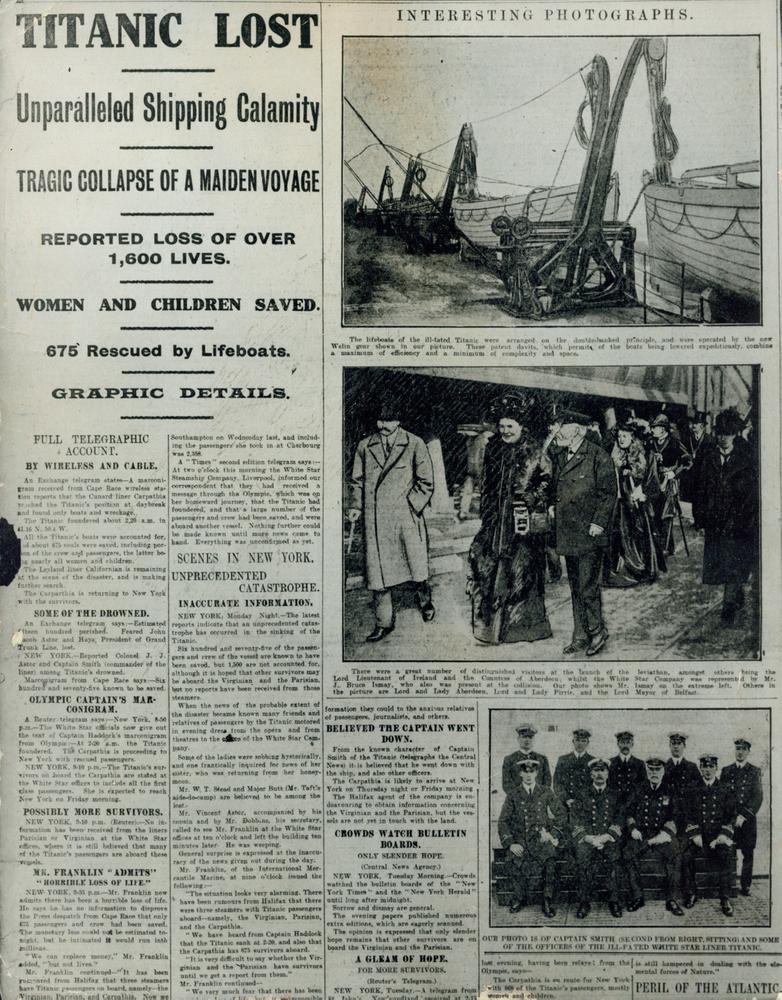
Titanic lost: Belfast Telegraph front page on 16 April 1912
Source: Belfast Telegraph

As the world awaits news of who survived Titanic, the White Star Line decides to hire ships to go out and retrieve bodies. Reports of bodies floating in the Atlantic had been reported and White Star wanted to retrieve them as quickly as possible for a number of practical reasons. Ocean currents would eventually move them out of the area, so getting them retrieved as soon as possible would allow families to lay them to rest. Another reason for speed was that sea creatures and birds would start consuming the bodies making identification difficult as well. The cable ship Mackay Bennett was the first ship hired by White Star. Three other ships would be hired as well: Minia (a cable ship), Montmagny (lighthouse supply ship), and the sealing vessel Algerine.

CS Mackay Bennett (circa 1884)
Artist Unknown
Public Domain/Wikimedia Commons

Each ship would carry the necessary supplies to retrieve and embalm the bodies. The Mackay Bennett emptied itself of its normal stores in Halifax, Nova Scotia and brought aboard supplies for its new mission:

  • Embalming supplies and coffins (100)
  • Chief embalmer of John Snow & Co., John R. Snow Jr.
  • 100 tons of ice to store the bodies
  • Canon Kenneth Hind of All Saints Cathedral, Halifax

Mackay Bennett left Halifax at 12:28 pm on 17 April 1912. Due to heavy fog and rough seas, it would take four days to reach where Titanic sank. They began recovery at 0600 on 20 April. Bodies were manually recovered by skiffs and brought back to the ship. They recovered 51 bodies but realized they did not have enough embalming supplies on hand. Since the laws at the time required bodies to be embalmed before unloading from ships docking in a Canadian port, they followed a general procedure:

  • First class passengers were embalmed and placed in coffins.
  • Second class passengers embalmed but wrapped in canvas.
  • Third class, crew, and bodies that were too decomposed or disfigured were buried at sea.
  • Bodies that were brought back were either transported by relatives to their final resting place or interred in Halifax, Nova Scotia.

Back in Halifax John Henry Barnstead, the Registrar of Vital Statistics, developed a system of identifying the bodies and protect personal possessions of the deceased. Since Halifax had direct rail and steamship connections, this made it easier for families of victims to travel to Halifax and identify the bodies. A large temporary morgue was set up using a local curling rink and undertakers from all over the area were asked to assist. Many families did decide to transport the bodies back to their hometowns in the United States or in Europe. Unclaimed or unidentified bodies would be interred in Halifax. 150 bodies would eventually be interred in Halifax cemeteries. The largest number are in the Fairview Lawn Cemetery followed by the nearby Mount Olivet and Baron de Hirsch cemeteries.

Titanic Grave markers at Fairview Cemetery Halifax N.S
William B. Grice (Wikimedia)

Bodies were still being reported in May. The Oceanic found three bodies in Titanic’s Collapsible A over two hundred miles from the sinking. When Carpathia had arrived, Fifth Officer Harold Lowe and other crewmembers removed the survivors but left three dead bodies aboard. Oceanic retrieved their bodies and then buried them at sea. On 22 May the Algerine found the body of steward James McGrady. His body was brought back to Halifax and buried in June at the Fairview Lawn Cemetery.

In the end only 333 bodies were recovered, a small number compared to the over 1,500 victims. Currents quickly moved bodies hundreds of miles making their recovery difficult. Life jackets will eventually disintegrate allowing bodies to sink or drift further away. Most who lost family, friends, and relatives had no body to bury since it was never recovered.

Sources

Books

Behe, George TITANIC: SAFETY, SPEED AND SACRIFICE, Transportation Trails, Polo, IL 1997

Behe, George (2012). On board RMS Titanic: Memories of the Maiden Voyage. The History Press.

Eaton John P. & Haas Charles, TITANIC TRIUMPH AND TRAGEDY, SECOND EDITION, W.W. Norton & Company, New York, New York, 1995 First American Edition

Lord, Walter, A NIGHT TO REMEMBER, Holt Rinehart and Winston, New York, New York, 1955. Multiple revisions and reprints, notably Illustrated editions (1976,1977,1978 etc.)

Lord, Walter, THE NIGHT LIVES ON, Willian Morrow and Company, New York, New York, 1986 (First Edition)

Lynch, Don & Marshall Ken, TITANIC AN ILLUSTRATED HISTORY, Madison Press Books, Toronto, Ontario Canada, 1992

Internet

Tikkanen and Amy, “Titanic | History, Sinking, Rescue, Survivors, Movies, & Facts,” Encyclopedia Britannica, last modified April 7, 2025, https://www.britannica.com/topic/Titanic.

Encyclopedia Titanica, last modified April 9, 2025, https://www.encyclopedia-titanica.org/.

History.com Editors, “The Titanic: Sinking & Facts | HISTORY,” HISTORY, last modified February 27, 2025, https://www.history.com/articles/titanic.

Titanic Historical Society, Inc., “Titanic Museum | Titanic Historical Society Collection,” Titanic Historical Society, Inc., last modified January 19, 2023, https://titanichistoricalsociety.org/titanic-museum/.

British Pathé, “Titanic: The Facts Told by Real Survivors | British Pathé,” Video, YouTube, August 1, 2011, https://www.youtube.com/watch?v=_xKDRmhp6lQ.

Wikipedia contributors, “Titanic,” Wikipedia, last modified April 6, 2025, https://en.wikipedia.org/wiki/Titanic#Collecting_passengers.

Titanic News Channel is a participant in the Amazon Services LLC Associates Program, an affiliate advertising program designed to provide a means for sites to earn advertising fees by advertising and linking to Amazon.com.