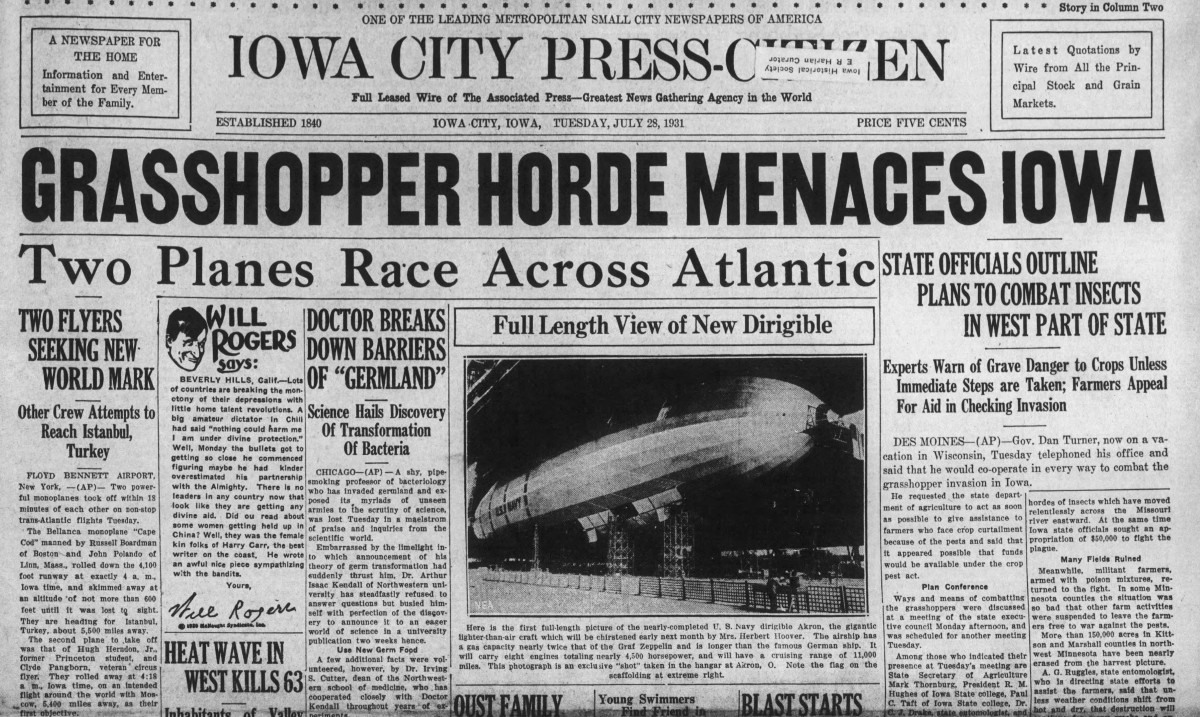
Headline from Iowa City Press-Citizen, 27 Jul 1931 Source: NotesonIowa.com
On 26 July 1931 swarms of grasshoppers would descend on the American Midwest resulting in millions of acres of farmland to be destroyed.
In 1931 the United States was in the throes of the Great Depression with many out of work, rural banks closing, capital to invest in industries limited, and the cost of living hard for most Americans. The American Midwest, which supplied much of the nation’s needed grain and other foods, was hit hard not only by the bad economic times but a drought as well. Agriculture faces many threats but one of the most serious are voracious insects such as grasshoppers and locusts. There had been such pestilence before in America. There had been one in July 1874 when Rocky Mountain Locusts swarmed through North Dakota to Texas destroying crops. There too the Midwest was beset by drought, which is considered to be a cause of large swarms being formed to find food.
Locusts and grasshoppers are similar to each other, can look the same in many cases, but have differences as well. Both belong to the same family- Acrididae- and can look the same but have differences as well. Grasshoppers are found worldwide while locusts are generally found in Africa and Asia. Both are solitary meaning after they are born, except for mating, they do not have much contact with others of their kind. Both eat plants and will devour the entire plant. Grasshoppers tend to eat a more varied diet than locusts. Both however can swarm when foods become scarce. Locusts though actually change color, unlike grasshoppers, when they swarm. Both though are a pestilence to farmers.
By July 1931, severe drought had devastated Iowa, Nebraska, and South Dakota. On July 26, swarms of grasshoppers descended and began eating all the cornstalks right down to the ground. The swarms were so massive that they actually blotted out the sun in some areas. They covered everything and seemed everywhere. You could not walk without stepping through them as they ate their way across the land. Anything that stored grains, unless well sealed, would be targeted as well if they could find a way in.
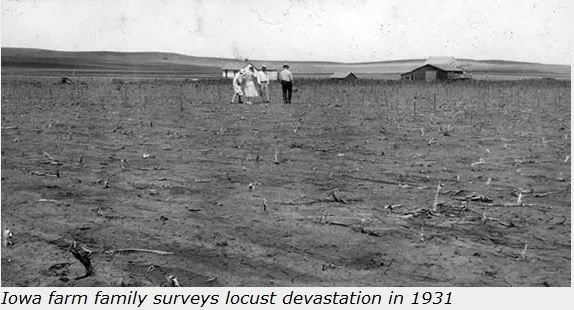
Photo of grasshopper devastation on Iowa farm July 1931 Source: NotesonIowa.com
The result were farms completely devastated once the grasshoppers were finished. The grasshoppers consumed every part of the cornstalk leaving nothing behind before they moved on. President Hoover allocated federal aid to help farmers after the crisis. However, the combined problems of the drought, the Great Depression, and the grasshoppers caused many to close up and move elsewhere to start over. Grasshoppers are still a threat today, somewhat minimized with pesticides, but can still swarm when drought limits their food supply.
Footnote
There was a major grasshopper swarm near Albuquerque, New Mexico in 2014. Due to drought and limited vegetation, the swarm headed to both urban and suburban centers. The swarm was so thick that it was picked up on radar. The grasshoppers destroyed or damaged home lawns, outdoor gardens, and just like in 1931 were everywhere.
The History Guy: History Deserves to Be Remembered. (2020, August 17). The Great Kansas Grasshopper Plague of 1874 [Video]. YouTube. https://www.youtube.com/watch?v=FxqgBWxLZa0
Titanic News Channel is a participant in the Amazon Services LLC Associates Program, an affiliate advertising program designed to provide a means for sites to earn advertising fees by advertising and linking to Amazon.com.
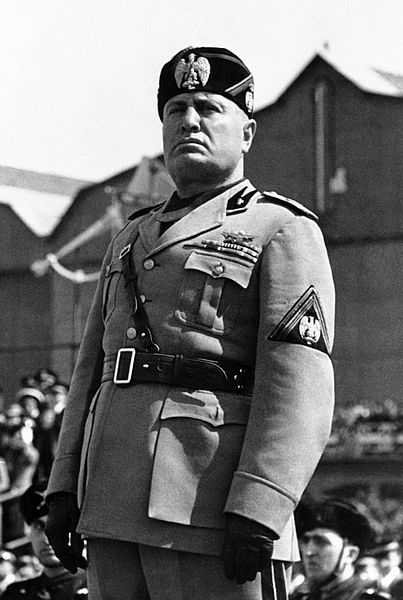
On 25 Jul 1943 the Fascist Grand Council formally voted Mussolini from power and was arrested later after meeting with King Victor Emmanuel III. So, what happened to the once all-powerful Duce? Let’s find out.
Italy had entered into the Pact of Steel with Germany in 1939 which committed Italy to fighting along with Germany if it declared war or was attacked. Mussolini entered the agreement knowing full well Italy did not have the resources or industrial capability for a sustained military conflict. Mussolini had grand ambitions about expanding the Italian sphere of influence in the region and even into central Europe. Mussolini believed that Fascism was on the march and aligning with Hitler seemed a good choice at the time. Italy had successfully invaded Ethiopia (1935-1937) though not without them putting up a strong fight. Using mustard gas against troops and civilians had gotten Mussolini severely criticized and international sanctions.
The war in Ethiopia and his intervention on the side of Franco in the Spanish Civil War had brought Italy closer to Germany with a treaty of mutual interest in 1936. And he needed coal from Germany since international sanctions over Ethiopia had made acquiring it more difficult. Mussolini believed a German-Rome Axis would be how Europe would turn but relying on Germany to supply items like coal meant Italy was more dependent on Germany rather than a true partnership. Mussolini tried to get all kinds of concessions from the British and French after the Munich Agreement in 1938; none were given. He made it clear in speeches (and those by others) that they wanted territory in France, Tunisia, a small part of Switzerland, and Albania. He upped his demands to demand free access to the world’s oceans by breaking British control of key places such as Gibraltar.
From the viewpoint in London, Paris, and elsewhere, his bellicose talk signaled major territorial ambitions. The Fascists mostly supported this though some, like his foreign minister Count Galeazzo Ciano, were concerned about aligning with Germany. Taking on both Britain and France became accepted since they were the major colonial powers that Italy saw as blocking them from achieving their rightful position in the world. On 7 April 1938, Italy invaded Albania and took control in three days. The formal military alliance with Germany (the Pact of Steel) was signed on 2 May 1939 cementing further the military ambitions of both countries together. The Italians thought war with Britain and France would not occur for years but dreadfully miscalculated Hitler’s ambitions.
Italy was not ready for major war operations until 1942 according to his own advisors. The Pact of Steel had said neither side was to enter war until 1943. Italy desperately needed this time in order to get its industry running and lacked critical military industrial production. Both Britain and France had highly developed military industrial production, but Italy was woefully behind in key areas such as automobile production (key to making tanks and other mobile artillery). Additionally, Italy needed to acquire all the needed raw resources needed for war production. Italy was primarily an agriculturally based economy with small pockets of industrial sectors. They needed to setup a supply chain to bring in all the raw materials like coal and import steel. Italy’s merchant marine was not managed in preparation for war and would lose those ships as they were in foreign ports when war was declared by Italy in 1940.
Prior to that, raw materials being sent from European ports to Italy were subject to seizure. Coal, for instance, was shipped out of Rotterdam. The British declared it contraband and seized it, infuriating Mussolini. The Germans offered to ship by train over the Alps while the British countered saying they would supply all of his country’s needs if Italy supplied them armaments. The British hoped to lure Italy away from its alliance with Germany. And it appeared to work as Mussolini had approved a draft contract to provide military equipment. It was suddenly scrapped under intense pressure from Germany caused Mussolini to fold. This decision would come back to haunt him much later down the road.
Italian debt, already large when Mussolini, came to power, had increased thanks to his generous support of General Franco in Spain that increased it. The blockade of coal was strengthened and deeper reliance on German imports of raw materials occurred. The economy was bolstered by the important of goods from Germany, but inflation was occurring causing basic goods and service to become more expensive. When Italy entered the war in 1940, its merchant marine in foreign ports were seized leaving the country without hardly any means of getting needed supplies by cargo vessels.
Adding more to the woes, the warnings of his advisors were accurate. Italy’s army was huge making it a major land force on paper but in reality, lacked modern transport and weapons. The army, because of the weak economy, did not have the needed armaments or supplies for war, and was the major reason it failed. Lightly armored infantry is no match for a fully equipped company of troops with full battle-ready equipment like the British had. Along with both a navy and air force that did not work together well, Italy was ill-prepared for general warfare except for a country that had a worse military than it had. There was poor leadership as well at the top that never had clearly defined military objectives and seemed to go at the whim of whatever Duce wanted them to do. They easily took the lower portions of Vichy France and Corsica. About the only good thing they did in taking that was providing a refuge for fleeing Jews. The Italians did not follow the German lead much regarding the Jews, which caused the Germans frustration over the Italian non-compliance in this area.
The succeeding campaigns in North Africa and Greece ended badly. In North Africa the British put up a good fight and had routed the Italians. Then the Germans arrived with Rommel in charge making it a much tougher campaign for the British and later the Americans; Greece was a total debacle. They invaded from Albania, but the Greeks pushed them back into Albania ending up in a stalemate that cost both sides. Once again, the Germans invaded (the British were using Greece to fly bombing raids into Romania) and successfully took Greece and Crete. Only Yugoslavia was a success but that was because the Germans were part of the campaign and once the country was divided up, Italy got the coastal area.
By 1943 though, things had gotten worse for most Italians. Food and other items were rationed, wartime inflation made everything more expensive, and the war itself was unpopular with most Italians. Mussolini was no longer seen as the great leader and the recent bombing of Rome showed how his boasts were hollow. The invasion of Sicily and later the south by Allied forces showed the proverbial “writing was on the wall.” Mussolini knew that his military could not successfully fight the Allies but stuck to the war because he saw no other option but to fight it out. The Fascist Grand Council knew the war was lost and that Mussolini had lost his stature with the people.
On the night of 24 July and in the early morning of 25 July, the Grand Council met with Mussolini. Accounts of the meeting indicate he was sick, tired, and felt the burden of the military reverses suffered by the Italian military. To some, it seemed he was looking for a way out and it was given to him. The Grand Council voted to remove him from power and transfer some of his duties to the King. While some opposed it, the vote was carried by the majority. Even his son-in-law Count Galeazzo Ciano voted for his ouster. Mussolini seemed dazed by the vote and while his supporters tried to get him to act, he seemed unable to do anything. He would go to his meeting with the King (unshaven and groggy) where he would be arrested. The King told him that General Pietro Badoglio would be taking over as Prime Minister and that the war was lost. He and his family were assured of their safety, and he was whisked away. Mussolini accepted his fall as it absolved him of any more responsibility for the war.
When it was declared Mussolini was out, the general response was one of relief. His fellow Fascists did not stage marches or protests over his dismissal and did nothing to release him from his incarceration on La Maddalena (he would be moved elsewhere). Hitler was furious and knew that the Italians would seek an armistice with the Allies (which was true but in public said otherwise to keep the Germans at bay). For the Allies his dismissal was good news as they hoped it might bring an end to the Italian campaign. And many Italians thought it would as well, Unfortunately the Germans had other plans and that would drag out the war in Italy until June 1944, but that is a story for another time.
Titanic News Channel is a participant in the Amazon Services LLC Associates Program, an affiliate advertising program designed to provide a means for sites to earn advertising fees by advertising and linking to Amazon.com.
Enormous gantry cranes in the yards of Harland & Wolff, Belfast 2018. Image Credit: August Schwerdfeger via Wikimedia Commons
Harland & Wolff has been denied support from the British government. John Wood, who was the Chief Executive Officer, has left the company. Harland & Wolff has hired Rothchild’s to look at its strategic options. Riverstone Capital, which owns much of the debt of the company, is seeking to place Russell Downs as the interim executive. Downs is apparently a turnaround artist so his skills will no doubt be put to the test here. The major question is whether or not Harland & Wolff will be able to fulfill a £1.6bn Royal Navy contract to build three support ships.
The Telegraph reports that government ministers advised the new government to withhold the loan guarantee as it would possibly violate EU rules. However, there is pressure from unions and other groups to support Harland & Wolff so that jobs are not lost.
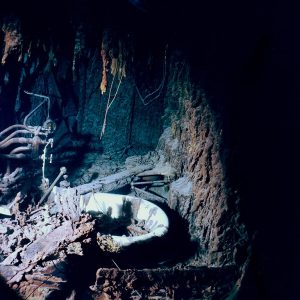
Bathtub in Capt. Smith’s bathroom. Rusticles are observed growing over most of the pipes and fixtures in the room. June 2004 Lori Johnston, RMS Titanic Expedition 2003, NOAA-OE. Public Domain via Wikimedia Commons
The reason for the lack of bones and skeletons is down to the depth at which the Titanic came to rest. It sits on the ocean seabed at around 3,800 metres (12,467 feet) and the chemical composition of the water at that depth changes the effect it has on bone. Professor Ballard, who also discovered the wreck of the Bismarck explained how it works to NPR: “The issue you have to deal with is, at depth below about 3,000 feet (914 meters), you pass below what’s called the calcium carbonate compensation depth. And the water in the deep sea is under saturated in calcium carbonate, which is mostly, you know, what bones are made of.
George Glaister, 67, wants to save a 100ft model of the iconic ship which is rotting and tangled in weeds since its creator Stan Fraser died six years ago. George said: “It’s such a shame. It was a labour of love for Stan and was really spectacular when it was built. “It’s like the real Titanic in that it was in prime condition for a short while and is now in decay.” Lighting engineer Stan started working on his version of the historic liner in 2000 after he was forced to quit work because he suffered from ME.
On 15th April 1912, the most infamous shipwreck in world history took place, an event which, in the years since it happened, hundreds of conspiracy theories have been conjectured. And while some of them are quite crazy, I think even some of the scientists’ wild theories on how to resurface the doomed vessel could be more so.
For a life without boundaries,’ promise the makers of the superyacht ‘Ulyssia’, a planned 1,050ft (320m) vessel bigger than The Titanic that its owners say with ‘transform our concept of discovery and home’. The Ulyssia is still some four years away from its expected date of completion, but new images provide unprecedented insight into the life of luxury on board, including 132 lavish apartments said to ‘meet the standards of a five-star hotel’, a theatre, a library, various pools and great underwater panoramic windows. Although it is not yet known exactly how much residency on board will cost, details have begun to emerge around the kind of lifestyle guests can expect to enjoy. Beyond the essential amenities – restaurants, a medical centre, an XXL wine cellar – residents will also be able to bring home comfort on board, customising their rooms to their liking.
=
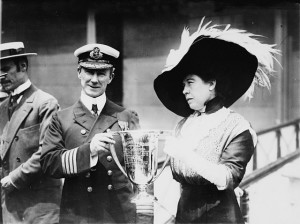
Mrs. J.J. “Molly” Brown presenting trophy cup award to Capt. Arthur Henry Rostron, for his service in the rescue of the Titanic. Photo:Public Domain (US Library of Congress, digital id# cph 3c21013)
A new Titanic exhibit is now on display at the Molly Brown House Museum through December, the historical landmark and tourist attraction announced Tuesday. “American Dreams” will showcase coal from the Titanic wreckage, a Titanic souvenir booklet, as well as other White Star Line collections — the company that created the Titanic. For those who don’t know, Margaret “Molly” Brown gained notoriety because she was one of the passengers on the Titanic. She was put on a lifeboat and ended up being saved, becoming the “Unsinkable Molly Brown.”
Lord, Walter, A NIGHT TO REMEMBER, Holt Rinehart and Winston, New York, New York, 1955. Multiple revisions and reprints, notably Illustrated editions (1976,1977,1978 etc.)
Titanic News Channel is a participant in the Amazon Services LLC Associates Program, an affiliate advertising program designed to provide a means for sites to earn advertising fees by advertising and linking to Amazon.com.
Martin Bormann, Hermann Göring, and Bruno Loerzer surveying the damaged conference room 20 Jul 1944 Source: German Federal Archives via Wikimedia Commons
On 20 July 1944 a bomb placed in the briefing room of Wolf’s Lair would explode in an attempt to kill Hitler. It failed and many of the conspirators, including Field Marshal Erwin Rommel, would either be executed or commit suicide. So, who were the conspirators and why did it fail? Let’s find out.
The conspirators were a combination of both civilians and military and had varying reasons for coming together. Some opposed the anti-Jewish policies and were shocked by Kristallnacht; others were upset with how Hitler had mismanaged the war. Many wanted to save Germany from a catastrophic defeat they saw coming. Some of them no doubt would have faced a military tribunal had they survived for war crimes for working or assisting with the elimination of Jews. An earlier plot to kill Hitler on his airplane had failed, so the plan was changed. Called Operation Valkyrie, the plan was to take control of cities, disarming the SS, and arresting Nazi leaders.
Colonel Claus von Stauffenberg was to place a bomb under a table at the East Prussian headquarters called Wolf’s Lair. Then once Hitler was confirmed dead, a radio announcement would go out saying that the Nazi Party had murdered Hitler and ordering the Reserve Army to take control of key installations in Berlin, arresting Nazi leaders. Carl Friedrich Goerdeler, former mayor of Leipzig would become chancellor with former army chief of staff Ludwig Beck becoming president. Then the new government would begin negotiating for an armistice.
Stauffenberg arrived with two bombs on 20 Jul 1944 but was unable to arm one of them. In the briefing room where military aides were briefing Hitler, he placed the briefcase with the bomb under the table and near Hitler. He excused himself and left the room. Unfortunately, the briefcase was moved to under a thick leg of the table. When it detonated at 12:42 PM, Stauffenberg believed Hitler had been killed and put Operation Valkyrie into action. Hitler was wounded but not killed but the stenographer and three officers died. However instead of acting right away, many of the conspirators waited until Stauffenberg arrived in Berlin three hours later. By that time rumors of Hitler’s survival sapped the courage of many to go through with their plans. Precious time was lost, and it was too late now.
General Friedrich Fromm, who knew of the plot and condoned it, quickly saved himself by arresting the key conspirators and executing them. Hitler would go on the radio on 21 July 1944 to announce his survival to the nation and that those who had done this would be taken care of. The Gestapo swung into action arresting and torturing the remaining conspirators. Some were hauled before the infamous Volksgericht (People’s Court). There the infamous Nazi judge Roland Freisler handed out death sentences. Some were hung or shot, and a few were strangled with piano wire. Fromm did not escape eventually being arrested, tried, and executed. General Beck was allowed to commit suicide but only wounded himself and had to be shot. The surprising revelation that Field Marshal Erwin Rommel was involved (he knew of the plot but took no active role in its planning or execution) shocked Hitler. Due to his popularity-and to avoid a trial-he was told if he committed suicide his family would be spared. Upon his death from an “illness”, he was given a full military funeral.
The assassination attempt did not weaken Hitler but strengthened it. His grip was tightened, and they went after not just those involved but other enemies, they could get rid of at the same time by claiming they were part of the plot as well. Over 7,000 were arrested and 4,980 were executed. The barbaric deaths of some by piano wire was specifically ordered by Hitler.
Sources
The Editors of Encyclopaedia Britannica. (2024e, July 13). July Plot | History, leaders, executions, & Facts. Encyclopedia Britannica. https://www.britannica.com/event/July-Plot
Titanic News Channel is a participant in the Amazon Services LLC Associates Program, an affiliate advertising program designed to provide a means for sites to earn advertising fees by advertising and linking to Amazon.com.
[Editors note: This has been updated from 2023 with updated source information.]
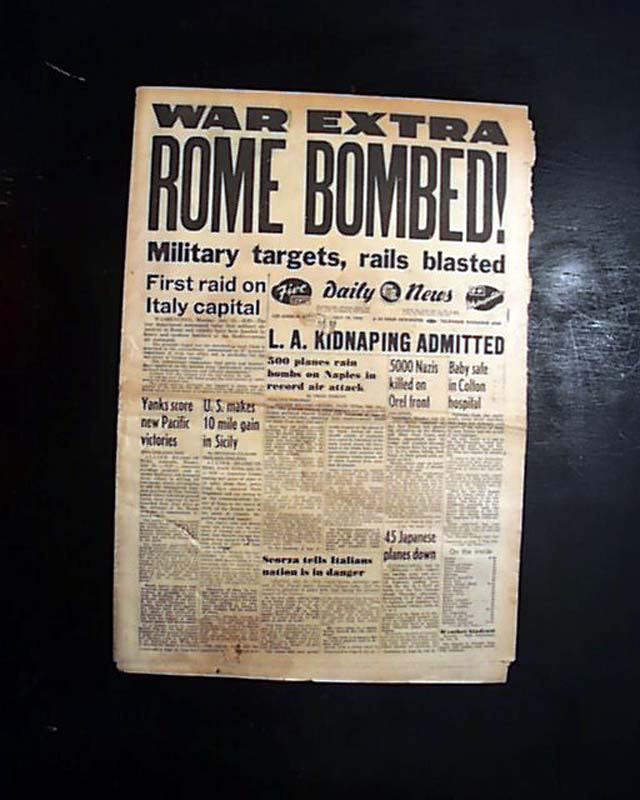
Daily News, Los Angeles- Headline on Bombing of Rome Source: RareEarlyNewspapers.com All Rights Reserved
By 1943, Italians had seen shortages in basic goods and supplies requiring rationing as their merchant marine had been decimated by the war. This led to a lot of grumbling about the war and its effects on Italy. Mussolini’s popularity had begun to wane. He had convinced Italians that the Allies would never bomb the eternal city of Rome. Then on 19 July 1943, the U.S. bombed the Rome railway yards.
Both President Franklin Roosevelt and British Prime Minister Winston Churchill had made a public appeal for Italians to reject Mussolini and save their country. The Allies by this time had invaded Sicily, and thanks to a clever deception, Hitler thought it initially a diversion. The Axis had been furthered weakened by its defeat in North Africa which had seen losses by both German and Italian forces. The advance of the Allied troops shook the Italian government. The bombing of Rome really caused panic in Rome as people went out into the streets.
It was much worse though as panic gave way to anger at Mussolini. People started destroying effigies of the dictator. And oddly, there was actually celebration of the attack as it was seen as leading to Mussolini’s demise. Hitler met with Mussolini to shore up his confidence after the attack. The attack had shaken him as well. Mussolini appeared unusually quiet in the meeting (he spoke poor German) and relied on the transcript later. Hitler tried to restore his confidence worried he might cave in and seek an armistice with the Allies. In the end, Mussolini agreed to continue the war though by this time he knew the truth. The Italian army was beaten and there was no way they could win the war. He could not tell that to Hitler fearing what he might do in response.
Hitler for his part was concerned that either Mussolini would surrender, or his own people might remove him. He quietly ordered Rommel to take control of the Greek islands in case something went wrong in Rome. The Germans would be ready to pounce when it did. And events happened faster than expected. Within a week the Fascist Grand Council would relieve Mussolini and he was put under arrest by the King.
Harland & Wolff, the owner of the Belfast shipyard that built the Titanic, has insisted that it is still awaiting a government decision on a £200m intervention despite signs that Labour is due to reject the financial lifeline. Harland & Wolff (H&W) was forced to suspend its London-listed shares a fortnight ago, and it has missed two deadlines to file audited accounts, raising questions over its finances and its ability to fulfil a £1.6bn contract to build the three fleet solid support ships that will carry supplies such as ammunition and food to the navy’s aircraft carriers.
Over 1,500 people died at sea that night. Horrible deaths, too. Among them, believe it or not, was a South Jersey native. His name was Frederick Sutton. Sutton was born in England but came to the US in the late 1800s. He ultimately ended up settling in present-day Haddonfield in Camden County. According to Encyclopedia Titanica, Sutton did pretty well for himself in life, making his fortune in multiple business ventures from coffee importing to holding leadership positions in multiple banks. The venture that led him to the southeastern most points of NJ, however, was his interest in real estate. Real estate + the beach… makes sense, right? Reportedly, Frederick Sutton was one of the founding fathers of a little fishing town on one specific South Jersey beach. Today, we call it Wildwood.
Titanic News Channel is a participant in the Amazon Services LLC Associates Program, an affiliate advertising program designed to provide a means for sites to earn advertising fees by advertising and linking to Amazon.com.
The Storming of the Bastille by Jean-Pierre Houël (1735–1813) National Library of France Public Domain via Wikimedia Commons
On 14 July 1789, the storming of the Bastille, a formidable stone prison originally built to protect the eastern entrance to Paris, is considered the launch of the French Revolution and celebrated as a holiday in France. The prison often held political prisoners and was seen as a sign of tyranny. By this time in 1789, the prison only held seven prisoners none of whom were of a political nature. Four were charged with forgery and two were considered mad or lunatics. The Bastille was actually being scheduled for demolition to make way for public square.
France was facing economic and social problems. Louis XVI had inherited considerable debt from his predecessor but continued to spend (along with his wife Marie Antoinette) considerable sums of money further deepening government debt. Crop failures in 1788 led to a national famine and the cost bread prices to soar. Unemployment was a factor as well and many thought they had lost jobs due to lessening of customs duties with England (resulting in more jobs there than in France). With violent food riots breaking out, King Louis XVI tried to resolve it through the Estates-General (a national assembly of clergy, nobility and the common person).
While in theory all three were equal, two of the other parts could outvote the third. This left many deputies upset demanding a greater voice and proclaiming their own National Assembly. This would lead to the famous Tennis Court Oath of 20 June 1789 not to separate until they had a constitution. Many nobles and clergy crossed over to this National Assembly which Louis XVI gave consent to. His ordering of army regiments into Paris though made many fear he was going to break up the assembly by force. The dismissal of Jacques Necker, a non-noble minister for the government on 11 July, triggered massive protests and destruction of custom posts. Custom posts were hated as they imposed taxes on goods.
On 14 July a mob seized muskets and cannons from a military hospital and then decided to get more at the Bastille. The governor of the Bastille saw the mob and invited them in to discuss terms of surrender. Outside the crowd grew restless awaiting word and it is possible some thought the delegates had been arrested. A group climbed over the outer wall and climbed in to open the drawbridge to the courtyard. The governor broke his pledge not to fire and bullets rang out killing 100 outright leaving others wounded. The royals only lost one soldier. The arrival of the French Guards, sympathetic to the mob, would force the governor to surrender after having cannons blasting away at the Bastille. Without adequate provisions, he surrendered the Bastille. Some of the royalist troops would be butchered after the surrender. The governor was taken prisoner and beheaded by the mob.
Aftermath
The Bastille was dismantled, and its only prisoner later would be Louis XVI. He would be executed on 21 January 1793 along with his wife. The French Revolution, once thought a means to reform France into a constitutional monarchy, slid into a revolutionary government that completely overturned the ancien regime. During its tenure, it became increasingly bloody killing off enemies of the new order. Anyone who was thought to disagree with them could be denounced and executed. Instead of creating a better stable system, it became one long food riot as one professor said to me once. And the revolutionaries fought amongst themselves as to who was the better one to lead. That led to more bloody executions and the guillotine became the image of the French Revolution. Ultimately the people tired of this turmoil and wanted order. And it would come from Napoleon Bonaparte, but that is another story.
Sources
The Editors of Encyclopaedia Britannica. (2024c, July 11). Bastille Day | Definition, history, traditions, celebrations, & facts. Encyclopedia Britannica. https://www.britannica.com/topic/Bastille-Day
Titanic News Channel is a participant in the Amazon Services LLC Associates Program, an affiliate advertising program designed to provide a means for sites to earn advertising fees by advertising and linking to Amazon.com.
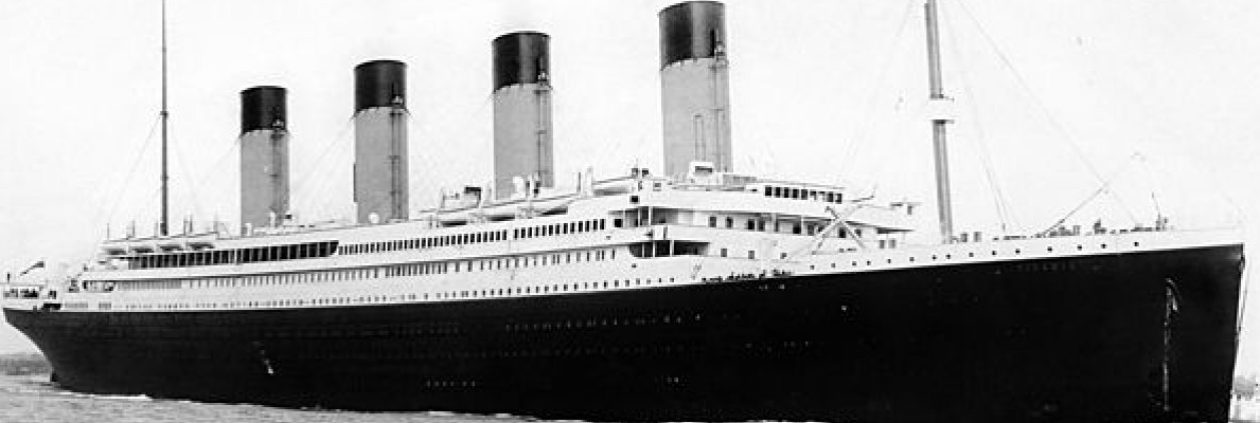
RMS Titanic pictured in Queenstown, Ireland 11 April 1912 Source:Cobh Heritage Centre, Cobh Ireland/Wikimedia Commons
The BBC is reporting that the upcoming dive by RMS Titanic Inc. will be gathering the most detailed photographic record of the wreck. They will be using state of the art technology and remotely operated vessels to go over every part of the ship they can.
NTSB drone image of Francis Scott Key Bridge and Cargo Ship Dali (26 Mar 2024) NTSB Public Domain via Wikimedia Commons
When the freighter Dali struck the Francis Scott Key Bridge in Baltimore, it sought protection from liability using an 1851 law called Shipowners’ Limitation of Liability Act of 1851. This act was famously used by the owners of Titanic to limit liability claims and became known as the Titanic Act since then. This act limits the liability by setting the value to just the value of the ship and its contents. It is from this pool that all liability payments will be drawn from. This forces all claims to go to this one court and limits the damages the company pays. The act was done to prevent American ship owners from having to pay out huge liability awards that could result in the company shuttering.
Now this limitation is quite striking when you consider air or rail disasters that result in significant legal damages often having to be paid either by court judgment or settlements. So for a ship owner, this can really keep you from being sued for astronomical sums of money. The downside, of course, is that for those who lost cargo or relatives, the money to be paid out will be quite small. Now the law does have some qualifications. If it can be proven the ship owner was negligent, then they cannot get coverage under this law. In the case of the Dali, they are using the act to limit the damages they will pay out. Not only did a bridge come down but several people died. So the City of Baltimore is challenging their claim arguing they were negligent and thus cannot be afforded protection under this act. The city is only going to get $300 million from Chubb, and the cost of building a new bridge will be a lot higher than that. A good review of the law and how it will be used in this particular case was done by two New York attorneys who wrote for their state bar association. It is worth a read to understand how this law works.
Titanic: The Artifact Exposition is coming to Boston on 17 October 2024. It will be at the Saunders Castle at Park Plaza. For information and details, go to https://titanicboston.us/ for information on dates, times, and how to purchase tickets.
Lord, Walter, A NIGHT TO REMEMBER, Holt Rinehart and Winston, New York, New York, 1955. Multiple revisions and reprints, notably Illustrated editions (1976,1977,1978 etc.)
Titanic News Channel is a participant in the Amazon Services LLC Associates Program, an affiliate advertising program designed to provide a means for sites to earn advertising fees by advertising and linking to Amazon.com.
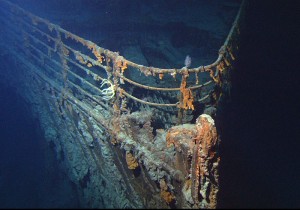
Titanic Wreck Bow Image: Public Domain (NOAA-http://www.gc.noaa.gov/images/gcil/ATT00561.jpg)
RMS Titanic Inc. is set to dive to Titanic later this month. Originally, they wanted to retrieve the Marconi wireless before further decay of the ship made it impossible. However, the U.S. government objected to the dive as it would be a violation of the Titanic Treaty now in place and thus the wreck a protected gravesite. RMS Titanic countered it had already sought and obtained permission from the court overseeing the salvage. The company has scaled back its plans and will no longer seek to remove anything from inside the hull. Also, they will not be using manned submersibles but remotely operated vehicles for the actual dive.
Lord, Walter, A NIGHT TO REMEMBER, Holt Rinehart and Winston, New York, New York, 1955. Multiple revisions and reprints, notably Illustrated editions (1976,1977,1978 etc.)
Titanic News Channel is a participant in the Amazon Services LLC Associates Program, an affiliate advertising program designed to provide a means for sites to earn advertising fees by advertising and linking to Amazon.com.
Heinrich Himmler, 1942 German Federal Archives (via Wikimedia Commons)
On 7 July 1942, Heinrich Himmler orders that experimentation on women at the Auschwitz concentration camp begin and also to investigate extending this to males. How and why did this happen? Let’s find out.
Himmler, as head of the Schutzstaffel (SS), believed in exterminating all European Jews. As head of the SS and the assistant chief of the Gestapo, he controlled all the police forces in Germany. This allowed him the power to carry out Hitler’s Final Solution and why he was the one who called for a conference that would devise how these experiments would be conducted. The conference attendees included SS General Richard Glueks (hospital chief), SS Major-General Karl Gebhardt, and Professor Karl Clauberg (a leading German gynecologist) and members of the Concentration Camp Protectorate.
Gate to Auschwitz I with its Arbeit macht frei sign (“work sets you free”), 2010 Image credit: xiquinhosilva Flickr via Wikimedia Commons
The conference decided that medical experimentations would take place but also done in a way that the women would not know what was being done to them. The experiments would be to devise methods of sterilizing Jewish women using massive doses of radiation and uterine injections. It was also decided to examine if X rays could be used to castrate men and use it on male Jewish prisoners. Adolf Hitler agreed to this, but it was kept top secret as they were concerned many would object (it had happened before when they tried exterminating disabled and those in hospitals with severe mental conditions). This program would further the Nazi’s aims to rid the world of Jews outside of their extermination camps. They knew that in time they would get control of countries where setting up extermination camps would not be practical, so developing means to sterilize Jewish men and women (and others they didn’t like as well) would allow them to continue eliminating Jews but under the guise of using medicine to eliminate them.




.jpg)

.jpg)