Tag Archives: SS Carpathia

Titanic Chronology-Titanic Final Day and Sinking (14-15 1912)

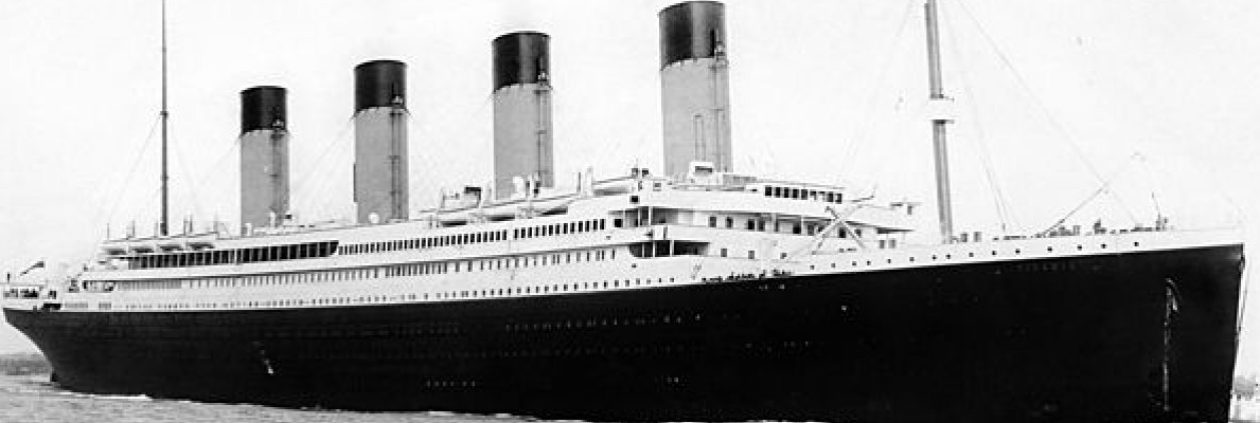
RMS Titanic pictured in Queenstown, Ireland 11 April 1912
Source:Cobh Heritage Centre, Cobh Ireland/Wikimedia Commons


Helen Candee awoke early on Sunday and went out on the deck to view the sunrise. She was not disappointed. This was to be the final day of the maiden voyage for tomorrow the ship would dock in New York. Little did anyone know that it would be the last sunrise Titanic would ever see.

At 10:30 am, a religious service was held in the First-Class dining room with a nice meal that followed for both First and Second class. On the bridge, ice warnings from other ships had been received but since such sightings were common, they were not of serious concern. No one had thought it serious enough to plot them. At noon the ship’s officers got together on the wing bridge to calculate Titanic’s position.

White Star liner Baltic reported at 1:42 pm of large quantities of ice providing coordinates. The message was delivered to Captain Smith who also showed the message to J. Bruce Ismay, chairman of the White Star Line. The SS Amerika spotted an iceberg at 1:45 and provided its coordinates. By afternoon, the temperature was falling fast and by 7:30 pm was 33F (1 C). Captain Smith ordered a course change to south and west around 5:50 pm possibly due to ice warnings.

RMS Olympic’s A la Carte Restaurant, located in B-Deck level. Circa May 1911
Robert John Welch (1859-1936), official photographer for Harland & Wolff
Public Domain/Wikimedia Commons

Meanwhile passengers enjoyed their last night on Titanic. Many survivors believe this was the best night of the trip. The food was exemplary and everyone was dressed in their finest clothes.  There was joyful celebration of their last night together on Titanic. On the bridge, Second Officer Charles Lightoller was going over a report from the California that reported three large icebergs that came in at 7:30 pm. Noting the drop in temperature to near freezing, he ordered the crew to watch the fresh water. Captain Smith returned to the bridge after dinner around 8:55 pm and conferred with Lightoller about the weather and icebergs. He then retired for the night advising Lightoller to awaken him “if becomes at all doubtful’. Lightoller at 9:30 pm advised the lookouts to watch for icebergs.

The only picture of the Marconi radio room onboard the Titanic. Harold Bride is seated at his station. Photo was taken by Father Francis Browne, SJ, while aboard Titanic.
Public Domain/Wikimedia Commons

Down in the Marconi telegraph office, Jack Phillips was busy handling heavy passenger traffic when a message for Mesaba came in warning about heavy pack ice and icebergs at 9:40 pm. The message never made it to the bridge, so they were unaware of it. First Officer William Murdoch relieved Lightoller at 10 pm. New lookouts took over as well, Frederick Fleet and Reginald Lee, who were advised to watch for icebergs. It was a moonless night with unusually calm seas, so they had to be especially alert for ice fields and icebergs. Unfortunately, the binoculars they should have had had been misplaced. By this time, the temperature had dropped to 31 F.

Public Domain

The captain of the SS Californian, Stanley Lord, decides to stop his ship for the night due to a large ice field in the way. The telegraph operator, Cyril Evans, sent out warnings to all ships in the area but Jack Phillips on Titanic sent back a blunt response: shut up. He was busy sending messages through Cape Race. Evans shut off his equipment and went to bed leaving the Californian with no wireless communications till morning. On Titanic, most were either asleep or heading to their cabins at 11 pm. Only a few were lingering over drinks, a card game, or reading. By 11:30 pm, around the time Cyril Evans went to bed, Titanic had settled in for the night.

Photograph of iceberg taken by chief steward of Prinz Adalbert on morning of 15 April 1912 near where Titanic sank. At the time he had not learned of the Titanic disaster. Smears of red paint along the base caught his attention. The photo and accompanying statement were sent to Titanic’s lawyers, which hung in their boardroom until the firm dissolved in 2002. Public Domain

Then just before 11:40 pm, the lookouts spotted an iceberg 500 feet away. Frederic Fleet rang the bell three times and calls the bridge telling Murdoch ‘Iceberg, right ahead.’ Titanic was going 21 knots (or slightly less) at the time. Murdoch ordered hard a starboard,” orders the engines stopped then full astern, and seals the watertight doors. Due to its size, Titanic had a larger turning radius, and this made it look like it would hit the iceberg dead on. Then it slowly veered to port making it appear the ship would pass the iceberg on the starboard side. Some speculate that it may have been a rare blue berg meaning it flipped over and was much larger underwater. The iceberg impacted on the starboard ship resulting in large and small punctures as it scraped the ship. Captain Smith came to the bridge to determine what happened learning they had struck an icebox. At first the damage reports seemed okay then it turned ominous with reports of water in the mailroom and other areas of the ship. Thomas Andrews assesses the damage himself and reports to Captain Smith that the ship is doomed. He tells Smith that the forward five compartments had been compromised and water is coming in. With water pulling the ship down at the bow, there was no way to prevent sinking. Titanic could stay afloat with one or two taking water but not all five at the same time.

Titanic Captain Edward J Smith, 1911
Author unknown. Published after sinking in 1912
Public Domain/Wikipedia Commons

For Captain Edward J. Smith, who had an illustrious career and set to retire after this voyage, this was a major shock. Unlike what has been dramatized, he had to be prodded by his officers to order lifeboats be lowered, muster the crew, and evacuate the passengers. Worse, despite having more than the required lifeboats per British Board of Trade regulations, it was still woefully short since the regulations were based on tonnage and not capacity. Of the 2,227 passengers and crew, only 1,178 would fit into them providing that they were filled completely to capacity. Wireless operators Jack Phillips and Harold Bride were ordered by Smith to send a distress call at 12:15 am. They first used the older one, CQD, and later switched to the newer one SOS. While many ships received the distress message, most were too far away to help. The SS Carpathia, about 58 miles away, received the distress call at 12:20 am. Harold Cottam quickly responded back to confirm the distress call and got the reply:

“Come at once. We have struck a berg. It’s a CQD, old man.”


Capt. Arthur H. Rostron, R.D., R.N.R, while serving as master of the Cunard liner RMS Carpathia in 1912
Public Domain via Wikimedia Commons

Cottam awakened Captain Arthur Rostron to inform him of the news. Rostron immediately gave out numerous orders to prepare the ship to take on survivors. And Carpathia quickly moved at high speed through the dangerous ice field in the hopes of getting there fast; they would arrive in three hours. However back on Titanic Andrews had told Smith that Titanic that the ship would sink in about 1 ½ hours to 2 hours making getting there before the ship sank impossible. Aboard Titanic, there was no central way to notify passengers, so stewards and others knocked on doors to rouse and inform them they had to put on life jackets and go topside. Many doubted they were in serious trouble and many of the staff did not know how dire the situation was. Up on deck, the crew had not any training–nor any drills–on how to operate the lifeboats. They required manual operation to be lowered into the water, and some were not sure if the davits were strong enough. And no one had told them that the lifeboats could carry 65 people, which is why some lifeboats that left could have taken on a lot more. Lightoller was strict in implementing the “women and children first “rule but seemed to interpret it meant no men could go aboard lifeboats (except for crew to steer it). However, on the other side of the ship, that rule was not carried out and many men boarded lifeboats there.

To try and get other ships in the area to respond, Titanic fired rockets. The crew on the Californian saw them but did not know its source nor did they investigate or awaken the wireless operator. They did think there was a ship that was ten miles away that appeared to be moving away, so it obviously was not in distress. Titanic tried using its Morse lamp as well but to no avail. Some believe it was a mirage while others wonder if it was an illegal Norwegian sealer, but that has never been confirmed. By 12:55 am lifeboats 5 and 6 were being lowered. Molly Brown was aboard Lifeboat 6 along with lookout Frederic Fleet and Quartermaster Robert Hitchens. Hitchens had been at the helm when Titanic hit the iceberg, and his testimony would prove valuable at the inquiries. However, his refusal to look for survivors would bring harsh criticism later.

Lifeboats 1 and 3 would be lowered around 1:00 am. Lifeboat 1, Emergency Cutter 1 has only 12 people (and can carry 40 people) while Lifeboat 3 has 39. Aboard Lifeboat 1 is Sir Cosmo Edmund-Duff Gordon and his wife, Lucy Duff-Gordon. She was a well-known British fashion designer known for innovative designs. Sir Cosmo handed out £5 notes to each of the crew aboard the lifeboat. Some argued later it was to keep others off the lifeboat. He strenuously denied the allegation and pointed out it was to help them replace lost clothing and gear. At 1:10 am Lifeboat 8 was lowered containing only 28 people that had aboard Noel, the Countess of Rothes. Both Isidor and Ida Straus were offered seats on the lifeboat but declined. Isidor, who had helped found Macy’s department store, believed only women and children should go first but Id did not want to leave her husband. She said famously: “Where you go, I go.” They would both perish when Titanic sank.

Lifeboat 9 launched at 1:20 am only had 30 people on it and was loaded by Purser Hugh McElroy and First Officer William Murdoch.  It had 30 people on it with 17 crew members, possibly stewards and cooks according to one survivor. Another account puts it between 35-40 with 12 ladies, 6-7 men passengers, and 18 male crew members. The mistress to Benjamin Guggenheim, Léontine Aubart, was on this lifeboat. He and his valet choose to dress properly and go down with the ship as gentleman. Lifeboat 10 is launched at 1:47 am had 57 people when it was launched but some transfers to other lifeboats brought it down to 50. Nine-week-old Milvina Deam was on this lifeboat. She along with her mother and brother would survive while her father died on Titanic. She became known later to many in the Titanic community living a long life dying at the age of 97 in 2009.

RMS Olympic Arrives In New York on Maiden Voyage, 21 June 1911
Source: U.S. Library of Commerce/Wikimedia Commons
Public Domain

Olympic received Titanic’s distress call but there was confusion because of many mixed signals and messages bouncing around; they did not know the severity of the disaster. They thought at one point Titanic was sailing towards them but got a quick message back they were putting women off in the lifeboats. They would learn of Titanic’s sinking later from Carpathia. Meanwhile on Titanic panic was setting in as it was obvious Titanic was sinking. Near Lifeboat 14 Fourth Officer Joseph Boxhall was forced to discharge his gun to calm things down, He would take command of Lifeboat 14 later transferring people to other boats so they could look for survivors. Lifeboats 13 and 15 are lowered but 15 starts drifting underneath the other lowering lifeboat. Quick action in 13 by crew averts disaster.

Sometime between 1:35 -1:40 am Lifeboat 16 and Collapsible C is lowered. White Star chairman J. Bruce Ismay is aboard C. Criticism that he boarded before women and children would haunt him after the sinking. He claimed that neither were around when he boarded C, so he boarded. Emergency Cutter 2 is lowered and not long afterwards Lifeboats 11 and 4. A pregnant Madeline Astor is aboard Lifeboat 4. John Jacob Astor did ask if he could join her, but Lightoller denied the request. By 2 am only the collapsible boats remain but Titanic was slowly rising in the stern with its propellers visible. Collapsible D was the only one successfully launched and would carry 20 in it. A is washed off the deck and fills partly with water while B falls and is swept off before it is righted. Before this Captain Smith has released the crew saying it is now “every man for himself.” Wireless operator Phillips sends the final distress signal at 2:17 am. He would get to Collapsible B but would die later from exposure and his body would never be recovered.

By 2 am only the collapsible boats remain. Titanic had sunk low enough that the stern propellers were visible. Collapsible lifeboat D is launched from the roof of the officer’s quarters and would have 20 people in it. Collapsible A is washed off the deck and partly filled with water. Fifth Officer Harold Lowe in lifeboat 14 finds only 12 of the 20 that got into it are alive. Collapsible B falls and is swept off before it can be righted. The now overturned lifeboats are used by 30 people including Lightoller and wireless operator Bride. At this point, Captain Smith releases the crew saying, “it’s every man for himself.” Smith was last seen on the bridge and his body was never recovered. Wireless operator Phillips sends the final distress signal at 2:17 am. He made it to collapsible lifeboat B but died from exposure. His body would not be recovered.

Meanwhile the ship was plunged into darkness as the power went off. People frantically ran to the stern. Some would jump into the water while others hoped that by some miracle they would be spared. It is around 2:18 am when Titanic, suffering tremendous strain midsection would break in two between the third and fourth funnels. The bow sank into the water and for a time the stern seemed to float on its own but slowly sank. Those remaining on the stern would just swim away since there was no suction. Then it too slowly began to rise becoming vertical and sink beneath the waves. By 2:20 am, Titanic was gone. J. Bruce Ismay turned away before this; he did not want to see Titanic sink. The cries of those in the water was a sound no one in the boats would ever forget. And would haunt many for the rest of their lives.

RMS Carpathia (date unknown)
Image: public domain

Carpathia would arrive in the area firing rockets to get attention at around 3:30 am. Lifeboat 2 was the first to reach the rescue ship. It would take several hours to pick up all the survivors. Ismay would send a message to the White Star Line office informing Titanic sank. He then would isolate himself in a cabin for the remainder of the voyage to New York. The Californian arrived on scene at around 8 am. Carpathia asked her to look for any bodies, but they would find none and depart. Meanwhile aboard Carpathia, they held a service for the four bodies they had recovered. They would see one more as they steamed around the area but did not pick it up. Before 9 am, Carpathia sounded its whistle and began steaming towards New York

Meanwhile the Carpathia’s purser compiled a list of the Titanic survivors, which Rostron ordered Cottam to transmit the list to Cape Race but due to the limited range of their transmitter, this could not be achieved. They could get signals from Cape Race but not send them back. Cottam was besieged with messages wanting information and Titanic survivors wanting to send messages as well. Harold Bride, the surviving Titanic wireless operator, assisted him so he could get sleep. Rostron allowed no communications with the press. Eventually they were able to use Olympic, which had a more powerful transmitter, to transmit the names of those who were aboard Carpathia.

Outside the White Star Line Office after Titanic Disaster, New York, April 1912.
Bain News Service, U.S. Library of Congress, digital id#ggbain 10352

In New York, bedlam had reigned. Due to mixed up messages, there were many false reports about Titanic. Some reports indicated all was well and people picked up by Olympic. People gathered outside the White Star Line offices in New York for information. Initially White Star was hopeful and believed Titanic was safe. But the New York Times realized communication from Titanic had stopped after 2:20 am and ran the story she had sunk. The message from Ismay from Carpathia ended all doubt; people wept. Titanic, the pride of the White Star Line, had sunk taking with her over 1,500 plus lives and only 705 survivors. Now they awaited the arrival of Carpathia.

Sources

Behe, George TITANIC: SAFETY, SPEED AND SACRIFICE, Transportation Trails, Polo, IL 1997

Behe, G. (2012). On board RMS Titanic: Memories of the Maiden Voyage. The History Press.

Ballard, Robert D. Exploring the Titanic. Reprint. Madison Press Books, 2014.

Ballard, Robert D., and Rick Archbold. The Discovery of the Titanic. New York, N.Y.?: Warner Books, 1987.

Ballard, Robert D., Lost Liners: From the Titanic to the Andrea Doria the Ocean Floor Reveals Its Greatest Lost Ships(Hyperion, 1998).

Brewster, H. (2013). Gilded Lives, Fatal Voyage: The Titanic’s First-Class Passengers and Their World. National Geographic Books.

Cameron, Stephen. Titanic: Belfast’s Own. Colourpoint, 2011.

Eaton John P. & Haas Charles, TITANIC TRIUMPH AND TRAGEDY, SECOND EDITION, W.W. Norton & Company, New York, New York, 1995 First American Edition

Fitch, Tad, J. Kent Layton, and Bill Wormstedt. On a Sea of Glass: The Life & Loss of the RMS Titanic. Reprint. Amberley Publishing, 2015.

Lord, Walter

A NIGHT TO REMEMBER, Holt Rinehart and Winston, New York, New York, 1955. Multiple revisions and reprints, notably Illustrated editions (1976,1977,1978 etc.)

THE NIGHT LIVES ON, Willian Morrow and Company, New York, New York, 1986 (First Edition)

Lynch, Don & Marshall Ken, TITANIC AN ILLUSTRATED HISTORY, Madison Press Books, Toronto, Ontario Canada, 1992

Titanic News Channel is a participant in the Amazon Services LLC Associates Program, an affiliate advertising program designed to provide a means for sites to earn advertising fees by advertising and linking to Amazon.com.

Titanic History: Titanic Strikes Iceberg And Sinks (14-15 April 1912)

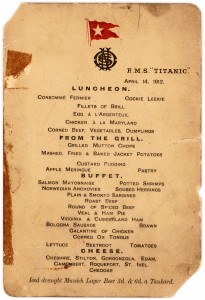
Titanic Lunch Menu 14 April 1912
Photo: AP

Sunday, 14 April 1912 was what many survivors’ thought was the best day of the journey so far. Religious service was held in the First-Class dining room at 10:30 am. Many in first and second class had a very nice meal afterwards, followed by a stroll around the deck. Ice warnings had been received from other ships in the past two days, but no one had plotted them or gave them deep thought. Icebergs were common and no one thought they were that serious of an issue at the time. At noon the ship’s officers got together on the wing bridge to calculate the Titanic’s position.

About 1:42 pm, White Star Liner Baltic reported large quantities of field ice along with the coordinates. The message was delivered to Captain Edward J. Smith who passed it on to Joseph Bruce Ismay, chairman of White Star Line. The Amerika sighted a large iceberg at 1:45 pm and transmitted notice and its coordinates as well. As the afternoon progressed, air temperature began to drop and by 7:30 pm was at 33F. At 5:50 pm, Captain Smith orders the course to south and west of the usual course taken, possibly, due to the ice warnings.

The only picture of the Marconi radio room onboard the Titanic. Harold Bride is seated at his station. Photo was taken by Father Francis Browne, SJ, while aboard Titanic.
Public Domain/Wikimedia Commons

At 7:30 pm, the Californian reported three large icebergs, which were reported to the bridge while Second Officer Charles Lightoller is on duty. Captain Smith was attending a dinner in the First-Class Dining Room. Contrary to what is shown in A Night to Remember, messages were not delivered by the wireless operators but by the Titanic crew. Lightoller would order the crew to watch the fresh water supply as the temperature was dropping to freezing. Smith would return to the bridge at 8:55 pm and discuss with Lightoller the weather and icebergs. Captain Smith would retire for the night at 9:20 pm telling Lightoller to wake him “if becomes at all doubtful.”At 9:30 pm, Lightoller would advise the lookouts to watch for icebergs.

The Mesaba sent a warning of heavy pack ice and icebergs at 9:40 pm. However, due to heavy wireless passenger traffic, Jack Phillips was too busy to have it sent to the bridge. At 10:00 pm, First Officer William Murdoch would relieve Second Officer Lightoller. Lightoller would tell Murdoch of current conditions. The lookouts were also relieved by the new watch. Lookouts Frederick Fleet and Reginald Lee are advised to watch for icebergs. Since it is a moonless night and the sea calm, they will need to be extra alert in looking for any ice fields or icebergs that might appear. Also, they have no binoculars as they have been misplaced. The temperature continues to drop and is recorded at 31F.

The Californian decides to stop at 10:55 pm due to large field ice in its way. Warnings were sent out to all shipping in the area. The wireless operator contacts Titanic with additional ice warning. Jack Phillips sends back a blunt response telling him to shut up as he was sending messages through Cape Race. At around 11:00 pm, most people are either in bed or heading back to their cabins. A few might still be enjoying a drink, a card game, or reading. By 11:30 pm, the Californian wireless operator, after listening to Titanic’s message traffic, shuts down and goes to bed.

Photograph of iceberg taken by chief steward of Prinz Adalbert on morning of 15 April 1912 near where Titanic sank. At the time he had not learned of the Titanic disaster. Smears of red paint along the base caught his attention. The photo and accompanying statement were sent to Titanic’s lawyers, which hung in their boardroom until the firm dissolved in 2002. Public Domain

Just before 11:40 pm, lookouts spot an iceberg 500 feet away. Lookout Frederick Fleet rings the bell three times and calls the bridge telling Murdoch ‘Iceberg, right ahead.’ Titanic was doing around 21 knots (or slightly less) at the time. Murdoch gives the order “hard a starboard,” orders the engines stopped then full astern, and seals the watertight doors. Due to the size, ships of this size have a larger turning radius then most. At first it looked like Titanic would hit the iceberg dead on but then slowly veered to port to pass by on the starboard. Some speculate the iceberg may have been inverted making it larger underwater than on top. The iceberg makes contact with the ship causing large and small punctures in the process as it scraped the ship.

Thomas Andrews, 1911
Public Domain/Wikimedia Commons

Captain Smith would come to the bridge to determine what happened and was informed they struck an iceberg. Reports started coming in of water in the mail room and other areas of the ship. Titanic designer Thomas Andrews assesses the damage along with Captain Smith. With water coming in the mail room and in the first five compartments of the ship, Andrews informs Smith that Titanic will stay afloat for 1 ½ to 2 hours. The ship could survive one compartment being damaged but all not all five with water coming pulling it down at the bow. Captain Smith was in a state of shock at this news and had to be prodded to order lifeboats be lowered, muster the crew, and evacuate the passengers. Since lifeboats were based on tonnage (per British Board of Trade regulations) and not capacity, 1,178 of 2,227 passengers could be put into them if filled to capacity.

RMS Carpathia (date unknown)
Image: public domain

At 12:15 am, Captain Smith orders wireless operators Jack Phillips and Harold Bride to send out distress messages. While SOS is the new distress signal, they also send out the older one CQD (come quick distress). Many ships will hear the distress but many like the Frankfurt are too far away to respond. On Carpathia, approximately 58 miles away, its wireless operator heard the message at 12.20 am, “Come at once. We have struck a berg. It’s a CQD, old man.” Once informed of this, Captain Arthur Rostron immediately orders his ship make to the coordinates provided by Titanic. As the ship speeds to the scene at top speed, he issues a flurry of orders to make ready the ship for receiving survivors. It would take three hours for Carpathia to arrive.

Since Titanic lacked a central alarm system to notify passengers to evacuate the ship, it fell to stewards and others to knock on passenger’s doors to rouse them. At first many did not believe the ship was in any danger but that would become apparent as time went on. Since the crew had not had any training or drills in lowering the lifeboats, they were unsure if the davits were strong enough or the capacity of the lifeboats. And the system of who could board lifeboats varied from port or starboard side. Lightoller was strict about women and children first. At 12:45 am, lifeboat number 7 on the starboard side was lowered but only had 27 people instead of full capacity of 65.

Titanic fired distress rockets as well to get the attention of any nearby ships. They were seen by the Californian, but they did not know the source and did not investigate. A ship appeared to be ten miles away but did not respond to rockets or the Morse lamp. Later some thought this was a Norwegian fishing vessel illegally hunting seals, but evidence did not confirm it. Whether this ship was a mirage caused by conditions on the sea or atmospherics, or the real thing, has never been confirmed. By 12:55 am, lifeboats 5 and 6 are lowered. Number 6 had passenger Molly Brown and lookout Frederick Fleet. Quartermaster Robert Hitchens, who was at the helm when Titanic struck the iceberg, would be criticized later for refusing to look for survivors.

By 1:00 am, lifeboat 3 is lowered and only carries 39 people, 12 from the crew. Lifeboat 1 is lowered with only 12 people. It is one of the emergency cutters designed for quick lowering and raising in cases of a person overboard. It can hold up to 40. Both Sir Cosmo Edmund-Duff Gordon and his wife, Lucy Duff-Gordon, are aboard this lifeboat. They would be accused, but denied it, of bribing the crew by giving them £5 each to keep others from using the boat. Sir Cosmo would say the money was offered to them for them to replace lost clothing and gear.

At 1:10 am, the first lifeboat on the port side is lowered. Number 8 only had 28 people on it and included the Countess of Rothes, Lucy Noel Martha. Ida and Isidor Strauss were offered seats on this lifeboat but declined. Isidor believed women and children should go first and Ida did not want to leave her husband. “Where you go, I go,” she said. Both would remain aboard Titanic and perish when it sank. Lifeboat 10 is launched at 1:20 am and had the nine-week-old Milvina Dean on it. She would become later one of the survivors often interviewed about Titanic and lived a long life till dying in 2009 at the age of 97. Lifeboat 9 is launched and is near capacity at 56 people aboard. Benjamin Guggenheim’s mistress was aboard, but he remained with his valet aboard the ship dressed in formal attire.

On Olympic, there was some confusion about the distress call they received. It is possible that with all the signals going out that night, that some got jumbled up (this proved true later when apparently confusing messages were received in New York). About 1:25 am, they radioed Titanic asking if they were steaming to meet them. The response was simple: that they were putting women off in the boats. Later Olympic would be informed by Carpathia of the sinking. Panic was starting to set in aboard the ship as it became very obvious by this time she was sinking and filling up with water. A panic near lifeboat 14 caused Fifth Officer Boxhall to discharge his weapon. He took command of the lifeboat and would later transfer people into other lifeboats so they could look for survivors. The lowering of lifeboat 13 is quickly followed by 15. However, it drifts underneath the lowering lifeboat but quick action by crewman in 13 saves it by cutting the ropes and rowing away.

Between 1:35-1:40 am lifeboat 16 and collapsible C is lowered. On C is White Star chairman J. Bruce Ismay. Later he would be criticized for boarding before women and children. He would claim that neither were around when he boarded the lifeboat. True or not, it would stick with him for the rest of his life with some calling him a coward. By 1:45 am, Emergency Cutter 2 is launched with Boxhall with 20 people. Lifeboats 11 and 4 would be launched as well. Madeline Astor, five months pregnant, is aboard number 4. Her husband, John Jacob Astor, would ask to join her but Lightoller, who followed the order of women and children first, declined. Astor’s body would later be recovered.

Titanic Captain Edward J Smith, 1911
Author unknown. Published after sinking in 1912
Public Domain/Wikipedia Commons

By 2 am only the collapsible boats remain. Titanic had sunk low enough that the stern propellers were now visible. Collapsible lifeboat D is launched from the roof of the officer’s quarters and would have 20 people in it. Collapsible A is washed off the deck and partly filled with water. Fifth Officer Harold Lowe in lifeboat 14 finds only 12 of the 20 that got into it are alive. Collapsible B falls and is swept off before it can be righted. The now overturned lifeboats are used by 30 people including Lightoller and wireless operator Bride. At this point, Captain Smith releases the crew saying, “it’s every man for himself.” Smith was last seen on the bridge and his body was never recovered. Wireless operator Phillips sends the final distress signal at 2:17 am. He made it to collapsible lifeboat B but died from exposure. His body would not be recovered.

Titanic is plunged into darkness as its power generators fail. The bow continues its inexorable pull downward as the stern rises higher out of the water. Around 2:18 am, the tremendous strain on the midsection of the ship causes it to break in two between the third and fourth funnels. The bow would disappear beneath the waves while the stern settled back in the water. At this moment, those on the stern can literally swim away before it starts rising. Water would fill into the stern causing it to rise and becoming vertical. At 2:20 am, it would begin the final plunge and disappear. The Titanic was gone.

Collapsible lifeboat D photographed by passenger on Carpathia on the morning of 15 April 1912.
Public Domain(Wikipedia)

Carpathia would arrive in the area firing rockets to get attention at around 3:30 am. Lifeboat 2 was the first to reach the rescue ship. It would take several hours to pick up all the survivors. Ismay would send a message to the White Star Line office informing Titanic sank. He then would isolate himself in a cabin for the remainder of the voyage to New York. The Californian arrived on scene at 8:30 am. They learned of the sinking around 5:30 am. They find no survivors.

At 8:50 am, Carpathia sounded her whistle and began heading to New York with the 705 survivors aboard. Due to garbled and mixed-up messages, the American press believed at first disaster had been averted and she was in tow. People were gathering outside of the White Star Liner offices in New York, London, and other offices for information. The White Star Line office in New York believed Titanic was okay and conveyed that to the public that morning. However, that changed by the afternoon when Ismay’s message from Californian was received, and other information also confirmed it as well. Titanic, the pride of the White Star Line, had sunk on her maiden voyage taking 1,500 lives with only 705 survivors.

Sources

Books

Behe, George TITANIC: SAFETY, SPEED AND SACRIFICE, Transportation Trails, Polo, IL 1997

Behe, George (2012). On board RMS Titanic: Memories of the Maiden Voyage. The History Press.

Eaton John P. & Haas Charles, TITANIC TRIUMPH AND TRAGEDY, SECOND EDITION, W.W. Norton & Company, New York, New York, 1995 First American Edition

Lord, Walter, A NIGHT TO REMEMBER, Holt Rinehart and Winston, New York, New York, 1955. Multiple revisions and reprints, notably Illustrated editions (1976,1977,1978 etc.)

Lord, Walter, THE NIGHT LIVES ON, Willian Morrow and Company, New York, New York, 1986 (First Edition)

Lynch, Don & Marshall Ken, TITANIC AN ILLUSTRATED HISTORY, Madison Press Books, Toronto, Ontario Canada, 1992

Internet

Tikkanen and Amy, “Titanic | History, Sinking, Rescue, Survivors, Movies, & Facts,” Encyclopedia Britannica, last modified April 7, 2025, https://www.britannica.com/topic/Titanic.

Encyclopedia Titanica, last modified April 9, 2025, https://www.encyclopedia-titanica.org/.

History.com Editors, “The Titanic: Sinking & Facts | HISTORY,” HISTORY, last modified February 27, 2025, https://www.history.com/articles/titanic.

Titanic Historical Society, Inc., “Titanic Museum | Titanic Historical Society Collection,” Titanic Historical Society, Inc., last modified January 19, 2023, https://titanichistoricalsociety.org/titanic-museum/.

British Pathé, “Titanic: The Facts Told by Real Survivors | British Pathé,” Video, YouTube, August 1, 2011, https://www.youtube.com/watch?v=_xKDRmhp6lQ.

Wikipedia contributors, “Titanic,” Wikipedia, last modified April 6, 2025, https://en.wikipedia.org/wiki/Titanic#Collecting_passengers.

Titanic News Channel is a participant in the Amazon Services LLC Associates Program, an affiliate advertising program designed to provide a means for sites to earn advertising fees by advertising and linking to Amazon.com.

Titanic Strikes Iceberg And Sinks (14-15 April 1912)

Titanic Lunch Menu 14 April 1912
Photo: AP

Sunday, 14 April 1912 was what many survivors’ thought was the best day of the journey so far. Religious service was held in the First-Class dining room at 10:30 am. Many in first and second class had a very nice meal afterwards, followed by a stroll around the deck. Ice warnings had been received from other ships in the past two days, but no one had plotted them or gave them deep thought. Icebergs were common and no one thought they were that serious of an issue at the time. At noon the ship’s officers got together on the wing bridge to calculate the Titanic’s position.

About 1:42 pm, White Star Liner Baltic reported large quantities of field ice along with the coordinates. The message was delivered to Captain Edward J. Smith who passed it on to Joseph Bruce Ismay, chairman of White Star Line. The Amerika sighted a large iceberg at 1:45 pm and transmitted notice and its coordinates as well. As the afternoon progressed, air temperature began to drop and by 7:30 pm was at 33F. At 5:50 pm, Captain Smith orders the course to south and west of the usual course taken, possibly, due to the ice warnings.

The only picture of the Marconi radio room onboard the Titanic. Harold Bride is seated at his station. Photo was taken by Father Francis Browne, SJ, while aboard Titanic.
Public Domain/Wikimedia Commons

At 7:30 pm, the Californian reported three large icebergs, which were reported to the bridge while Second Officer Charles Lightoller is on duty. Captain Smith was attending a dinner in the First-Class Dining Room. Contrary to what is shown in A Night to Remember, messages were not delivered by the wireless operators but by the Titanic crew. Lightoller would order the crew to watch the fresh water supply as the temperature was dropping to freezing. Smith would return to the bridge at 8:55 pm and discuss with Lightoller the weather and icebergs. Captain Smith would retire for the night at 9:20 pm telling Lightoller to wake him “if becomes at all doubtful’. At 9:30 pm, Lightoller would advise the lookouts to watch for icebergs.

The Mesaba sent a warning of heavy pack ice and icebergs at 9:40 pm. However, due to heavy wireless passenger traffic, Jack Phillips was too busy to have it sent to the bridge. At 10:00 pm, First Officer William Murdoch would relieve Second Officer Lightoller. Lightoller would tell Murdoch of current conditions. The lookouts were also relieved by the new watch. Lookouts Frederick Fleet and Reginald Lee are advised to watch for icebergs. Since it is a moonless night and the sea calm, they will need to be extra alert in looking for any ice fields or icebergs that might appear. Also, they have no binoculars as they have been misplaced. The temperature continues to drop and is recorded at 31F.

The Californian decides to stop at 10:55 pm due to large field ice in its way. Warnings were sent out to all shipping in the area. The wireless operator contacts Titanic with additional ice warning. Jack Phillips sends back a blunt response telling him to shut up as he was sending messages through Cape Race. At around 11:00 pm, most people are either in bed or heading back to their cabins. A few might still be enjoying a drink, a card game, or reading. By 11:30 pm, the Californian wireless operator, after listening to Titanic’s message traffic, shuts down and goes to bed.

Photograph of iceberg taken by chief steward of Prinz Adalbert on morning of 15 April 1912 near where Titanic sank. At the time he had not learned of the Titanic disaster. Smears of red paint along the base caught his attention. The photo and accompanying statement were sent to Titanic’s lawyers, which hung in their boardroom until the firm dissolved in 2002. Public Domain

Just before 11:40 pm, lookouts spot an iceberg 500 feet away. Lookout Frederick Fleet rings the bell three times and calls the bridge telling Murdoch ‘Iceberg, right ahead.’ Titanic was doing around 21 knots (or slightly less) at the time. Murdoch gives the order “hard a starboard,” orders the engines stopped then full astern, and seals the watertight doors. Due to the size, ships of this size have a larger turning radius then most. At first it looked like Titanic would hit the iceberg dead on but then slowly veered to port to pass by on the starboard. Some speculate the iceberg may have been inverted making it larger underwater than on top. The iceberg makes contact with the ship causing large and small punctures in the process as it scraped the ship.

Thomas Andrews, 1911
Public Domain/Wikimedia Commons

Captain Smith would come to the bridge to determine what happened and was informed they struck an iceberg. Reports started coming in of water in the mail room and other areas of the ship. Titanic designer Thomas Andrews assesses the damage along with Captain Smith. With water coming in the mail room and in the first five compartments of the ship, Andrews informs Smith that Titanic will stay afloat for 1 ½ to 2 hours. The ship could survive one compartment being damaged but all not all five with water coming pulling it down at the bow. Captain Smith was in a state of shock at this news and had to be prodded to order lifeboats be lowered, muster the crew, and evacuate the passengers. Since lifeboats were based on tonnage (per British Board of Trade regulations) and not capacity, 1,178 of 2,227 passengers could be put into them if filled to capacity.

RMS Carpathia (date unknown)
Image: public domain

At 12:15 am, Captain Smith orders wireless operators Jack Phillips and Harold Bride to send out distress messages. While SOS is the new distress signal, they also send out the older one CQD (come quick distress). Many ships will hear the distress but many like the Frankfurt are too far away to respond. On Carpathia, approximately 58 miles away, its wireless operator heard the message at 12.20 am, “Come at once. We have struck a berg. It’s a CQD, old man.” Once informed of this, Captain Arthur Rostron immediately orders his ship make to the coordinates provided by Titanic. As the ship speeds to the scene at top speed, he issues a flurry of orders to make ready the ship for receiving survivors. It would take three hours for Carpathia to arrive.

Since Titanic lacked a central alarm system to notify passengers to evacuate the ship, it fell to stewards and others to knock on passenger’s doors to rouse them. At first many did not believe the ship was in any danger but that would become apparent as time went on. Since the crew had not had any training or drills in lowering the lifeboats, they were unsure if the davits were strong enough or the capacity of the lifeboats. And the system of who could board lifeboats varied from port or starboard side. Lightoller was strict about women and children first. At 12:45 am, lifeboat number 7 on the starboard side was lowered but only had 27 people instead of full capacity of 65.

Titanic fired distress rockets as well to get the attention of any nearby ships. They were seen by the Californian, but they did not know the source and did not investigate. A ship appeared to be ten miles away but did not respond to rockets or the Morse lamp. Later some thought this was a Norwegian fishing vessel illegally hunting seals, but evidence did not confirm it. Whether this ship was a mirage caused by conditions on the sea or atmospherics, or the real thing, has never been confirmed. By 12:55 am, lifeboats 5 and 6 are lowered. Number 6 had passenger Molly Brown and lookout Frederick Fleet. Quartermaster Robert Hitchens, who was at the helm when Titanic struck the iceberg, would be criticized later for refusing to look for survivors.

By 1:00 am, lifeboat 3 is lowered and only carries 39 people, 12 from the crew. Lifeboat 1 is lowered with only 12 people. It is one of the emergency cutters designed for quick lowering and raising in cases of a person overboard. It can hold up to 40. Both Sir Cosmo Edmund-Duff Gordon and his wife, Lucy Duff-Gordon, are aboard this lifeboat. They would be accused, but denied it, of bribing the crew by giving them £5 each to keep others from using the boat. Sir Cosmo would say the money was offered to them for them to replace lost clothing and gear.

At 1:10 am, the first lifeboat on the port side is lowered. Number 8 only had 28 people on it and included the Countess of Rothes, Lucy Noel Martha. Ida and Isidor Strauss were offered seats on this lifeboat but declined. Isidor believed women and children should go first and Ida did not want to leave her husband. “Where you go, I go,” she said. Both would remain aboard Titanic and perish when it sank. Lifeboat 10 is launched at 1:20 am and had the nine-week-old Milvina Dean on it. She would become later one of the survivors often interviewed about Titanic and lived a long life till dying in 2009 at the age of 97. Lifeboat 9 is launched and is near capacity at 56 people aboard. Benjamin Guggenheim’s mistress was aboard, but he remained with his valet aboard the ship dressed in formal attire.

On Olympic, there was some confusion about the distress call they received. It is possible that with all the signals going out that night, that some got jumbled up (this proved true later when apparently confusing messages were received in New York). About 1:25 am, they radioed Titanic asking if they were steaming to meet them. The response was simple: that they were putting women off in the boats. Later Olympic would be informed by Carpathia of the sinking. Panic was starting to set in aboard the ship as it became very obvious by this time she was sinking and filling up with water. A panic near lifeboat 14 caused Fifth Officer Boxhall to discharge his weapon. He took command of the lifeboat and would later transfer people into other lifeboats so they could look for survivors. The lowering of lifeboat 13 is quickly followed by 15. However, it drifts underneath the lowering lifeboat but quick action by crewman in 13 saves it by cutting the ropes and rowing away.

Between 1:35-1:40 am lifeboat 16 and collapsible C is lowered. On C is White Star chairman J. Bruce Ismay. Later he would be criticized for boarding before women and children. He would claim that neither were around when he boarded the lifeboat. True or not, it would stick with him for the rest of his life with some calling him a coward. By 1:45 am, Emergency Cutter 2 is launched with Boxhall with 20 people. Lifeboats 11 and 4 would be launched as well. Madeline Astor, five months pregnant, is aboard number 4. Her husband, John Jacob Astor, would ask to join her but Lightoller, who followed the order of women and children first, declined. Astor’s body would later be recovered.

Titanic Captain Edward J Smith, 1911
Author unknown. Published after sinking in 1912
Public Domain/Wikipedia Commons

By 2 am only the collapsible boats remain. Titanic had sunk low enough that the stern propellers were now visible. Collapsible lifeboat D is launched from the roof of the officer’s quarters and would have 20 people in it. Collapsible A is washed off the deck and partly filled with water. Fifth Officer Harold Lowe in lifeboat 14 finds only 12 of the 20 that got into it are alive. Collapsible B falls and is swept off before it can be righted. The now overturned lifeboats are used by 30 people including Lightoller and wireless operator Bride. At this point, Captain Smith releases the crew saying, “it’s every man for himself.” Smith was last seen on the bridge and his body was never recovered. Wireless operator Phillips sends the final distress signal at 2:17 am. He made it to collapsible lifeboat B but died from exposure. His body would not be recovered.

Titanic is plunged into darkness as its power generators fail. The bow continues its inexorable pull downward as the stern rises higher out of the water. Around 2:18 am, the tremendous strain on the midsection of the ship causes it to break in two between the third and fourth funnels. The bow would disappear beneath the waves while the stern settled back in the water. At this moment, those on the stern can literally swim away before it starts rising. Water would fill into the stern causing it to rise and becoming vertical. At 2:20 am, it would begin the final plunge and disappear. The Titanic was gone.

Collapsible lifeboat D photographed by passenger on Carpathia on the morning of 15 April 1912.
Public Domain(Wikipedia)

Carpathia would arrive in the area firing rockets to get attention at around 3:30 am. Lifeboat 2 was the first to reach the rescue ship. It would take several hours to pick up all the survivors. Ismay would send a message to the White Star Line office informing Titanic sank. He then would isolate himself in a cabin for the remainder of the voyage to New York. The Californian arrived on scene at 8:30 am. They learned of the sinking around 5:30 am. They find no survivors.

At 8:50 am, Carpathia sounded her whistle and began heading to New York with the 705 survivors aboard. Due to garbled and mixed-up messages, the American press believed at first disaster had been averted and she was in tow. People were gathering outside of the White Star Liner offices in New York, London, and other offices for information. The White Star Line office in New York believed Titanic was okay and conveyed that to the public that morning. However, that changed by the afternoon when Ismay’s message from Californian was received, and other information also confirmed it as well. Titanic, the pride of the White Star Line, had sunk on her maiden voyage taking 1,500 lives with only 705 survivors.

Sources:

Books

Behe, George TITANIC: SAFETY, SPEED AND SACRIFICE, Transportation Trails, Polo, IL 1997

Eaton John P. & Haas Charles, TITANIC TRIUMPH AND TRAGEDY, SECOND EDITION, W.W. Norton & Company, New York, New York, 1995 First American Edition

Lord, Walter, A NIGHT TO REMEMBER, Holt Rinehart and Winston, New York, New York, 1955. Multiple revisions and reprints, notably Illustrated editions (1976,1977,1978 etc)

Titanic Chronology:Titanic Strikes Iceberg And Sinks (14-15 April 1912)

Poster Advertising Vinolia Otto Soap for Titanic
Image: Public Domain via Wikimedia Commons

Sunday, 14 April 1912 was what many survivors thought was the best day of the journey so far. Religious service was held in the First-Class dining room at 10:30 am.  Many in first and second class had a very nice meal afterwards, followed by a stroll around the deck. Ice warnings had been received from other ships in the past two days, but no one had plotted them or gave them deep thought. Icebergs were common and no one thought they were that serious of an issue at the time. At noon the ship’s officers got together on wing bridge to calculate the Titanic’s position.

About 1:42 pm, White Star Liner Baltic reported large quantities of field ice along with the coordinates. The message was delivered to Captain Edward J. Smith who passed it on to Joseph Bruce Ismay, chairman of White Star Line.  The Amerika sighted a large iceberg at 1:45 pm and transmitted notice and its coordinates as well. As the afternoon progressed, air temperature began to drop and by 7:30 pm was at 33F.  At 5:50 pm, Captain Smith orders the course to south and west of the usual course taken possibly due to the ice warnings.

Titanic Lunch Menu 14 April 1912
Photo: AP

At 7:30 pm, the Californian reported three large icebergs, which was reported to the bridge while Second Officer Charles Lightoller is on duty. Captain Smith was attending a dinner in the First-Class Dining Room. Contrary to what is shown in A Night To Remember, messages were not delivered by the wireless operators but by Titanic crew. Lightoller would order the crew to watch the fresh water supply as the temperature was dropping to freezing. Smith would return to the bridge at 8:55 pm and discuss with Lightoller to the weather and icebergs. Captain Smith would retire for the night at 9:20 pm telling Lightoller to wake him “if becomes at all doubtful’. At 9:30 pm, Lightoller would advise the lookouts to watch for icebergs.

The Mesaba sent a warning of heavy pack ice and icebergs at 9:40 pm. However due to heavy wireless passenger traffic, Jack Phillips was too busy to have it sent to the bridge. At 10:00 pm, First Officer William Murdoch would relieve Second Officer Lightoller. Lightoller would tell Murdoch of current conditions. The lookouts were also relieved by the new watch. Lookouts Frederick Fleet and Reginald Lee are advised to watch for icebergs. Since it is a moonless night and the sea calm, they will need to be extra alert in looking for any ice fields or icebergs that might appear. Also, they have no binoculars as they have been misplaced. The temperature continues to drop and is recorded at 31F.

The Californian decides to stop at 10:55 pm due to large field ice in its way. Warnings were sent out to all shipping in the area. The wireless operator contacts Titanic with additional ice warning. Jack Phillips sends back a blunt response telling him to shut up as he was sending messages through Cape Race. At around 11:00 pm, most people are either in bed or heading back to their cabins. A few might still be enjoying a drink, a card game, or reading. By 11:30 pm, the Californian wireless operator, after listening to Titanic’s message traffic, shuts down and goes to bed.

Photograph of iceberg taken by chief steward of Prinz Adalbert on morning of 15 April 1912 near where Titanic sank. At the time he had not learned of the Titanic disaster. Smears of red paint along the base caught his attention. The photo and accompanying statement were sent to Titanic’s lawyers, which hung in their boardroom until the firm dissolved in 2002. Public Domain


Just before 11:40 pm, lookouts spot an iceberg 500 feet away. Lookout Frederick Fleet rings the bell three times and calls the bridge telling Murdoch ‘Iceberg, right ahead.’ Titanic was doing around 21 knots (or slightly less) at the time. Murdoch gives the order “hard a starboard,” orders the engines stopped then full astern, and seals the watertight doors. Due to the size, ships of this size have a larger turning radius then most. At first it looked like Titanic would hit the iceberg dead on but then slowly veers to port to pass by on the starboard. Some speculate the iceberg may have been inverted making it larger underwater than on top. The iceberg makes contact with the ship causing large and small punctures in the process as it scraped the ship.

Thomas Andrews, 1911
Public Domain/Wikimedia Commons

Captain Smith would come to the bridge to determine what happened and informed they struck an iceberg. Reports started coming in of water in the mail room and other areas of the ship. Titanic designer Thomas Andrews assesses the damage along with Captain Smith. With water coming in the mail room and in the first five compartments of the ship, Andrews informs Smith that Titanic will stay afloat for 1 ½ to 2 hours. The ship could survive one compartment being damaged but all not all five with water coming pulling it down at the bow. Captain Smith was in a state of shock at this news and had to be prodded to order lifeboats be lowered, muster the crew, and evacuate the passengers. Since lifeboats were based on tonnage (per British Board of Trade regulations) and not capacity, 1,178 of 2,227 passengers could be put into them if filled to capacity.

At 12:15 am, Captain Smith orders wireless operators Jack Phillips and Harold Bride to send out distress messages. While SOS is the new distress signal, they also send out the older one CQD (come quick distress). Many ships will hear the distress but many like the Frankfurt are too far away to respond. On Carpathia, approximately 58 miles away, its wireless operator heard the message at 12.20 am, “Come at once. We have struck a berg. It’s a CQD, old man.” Once informed of this, Captain Arthur Rostron immediately orders his ship make to the coordinates provided by Titanic. As the ship speeds to the scene at top speed, he issues a flurry of orders to make ready the ship for receiving survivors. It would take three hours for Carpathia to arrive.

Since Titanic lacked a central alarm system to notify passengers to evacuate the ship, it fell to stewards and others to knock on passenger’s doors to rouse them. At first many did not believe the ship was in any danger but that would become apparent as time went on. Since the crew had not had any training or drills in lowering the lifeboats, they were unsure the davits were strong enough or the capacity of the lifeboats. And the system of who could board lifeboats varied from port or starboard side. Lightoller was strict about women and children first. At 12:45 am, lifeboat number 7 on the starboard side was lowered but only had 27 people instead of full capacity of 65.

Titanic fired distress rockets as well to get the attention of any nearby ships. They were seen by the Californian, but they did not know the source and did not investigate. A ship appeared to be ten miles away but did not respond to rockets or the Morse lamp. Later some thought this was a Norwegian fishing vessel illegally hunting seals, but evidence did not confirm it. Whether this ship was a mirage caused by conditions on the sea or atmospherics, or the real thing, has never been confirmed. By 12:55 am, lifeboats 5 and 6 are lowered. Number 6 had passenger Molly Brown and lookout Frederick Fleet. Quartermaster Robert Hitchens, who was at the helm when Titanic struck the iceberg, would be criticized later for refusing to look for survivors

By 1:00 am, lifeboat 3 is lowered and only carries 39 people, 12 from the crew. Lifeboat 1 is lowered with only 12 people. It is one of the emergency cutters designed for quick lowering and raising in cases of a person overboard. It can hold up to 40. Both Sir Cosmo Edmund-Duff Gordon are aboard this lifeboat. They would be accused, but denied it, of bribing the crew by giving them £5 each to keep others from using the boat. Sir Cosmo would say the money was offered to them for them to replace lost clothing and gear.

At 1:10 am, the first lifeboat on the port side is lowered. Number 8 only had 28 people on it and included the Countess of Rothes, Lucy Noel Martha. Ida and Isidor Strauss were offered seats on this lifeboat but decline. Isidor believed women and children should go first and Ida did not want to leave her husband. “Where you go, I go,” she said. Both would remain aboard Titanic and perish when it sank. Lifeboat 10 is launched at 1:20 am and had the nine-week-old Milvina Dean on it. She would become later one of the survivors often interviewed about Titanic and lived a long life till dying in 2009 at the age of 97. Lifeboat 9 is launched and is near capacity at 56 people aboard. Benjamin Guggenheim’s mistress was aboard, but he remained with his valet aboard the ship dressed in formal attire.

On Olympic, there was some confusion about the distress call they received. It is possible that with all the signals going out that night, that some got jumbled up (this proved true later when apparently confusing messages were received in New York). About 1:25 am, they radioed Titanic asking if they steaming to meet them. The response was simple that they were putting women off in the boats. Later Olympic would be informed by Carpathia of the sinking. Panic was starting to set in aboard the ship as it became very obvious by this time she was sinking and filling up with water. A panic near lifeboat 14 caused Fifth Officer Boxhall to discharge his weapon. He took command of the lifeboat and would later transfer people into other lifeboats so they could look for survivors. The lowering of lifeboat 13 is quickly followed by 15. However, it drifts underneath the lowering lifeboat but quick action by crewman in 13 save it by cutting the ropes and rowing away.

Between 1:35-1:40 am lifeboat 16 and collapsible C is lowered. On C is White Star chairman J. Bruce Ismay. Later he would be criticized that he boarded before women and children. He would claim that neither were around when he boarded the lifeboat. True or not, it would stick with him for the rest of his life with some calling him a coward. By 1:45 am, Emergency Cutter 2 is launched with Boxhall with 20 people. Lifeboats 11 and 4 would be launched as well. Madeline Astor, five months pregnant, is aboard number 4.  Her husband, John Jacob Astor, would ask to join her but Lightoller, who followed the order of woman and children first, declined. Astor’s body would later be recovered.

Titanic Captain Edward J Smith, 1911
Author unknown. Published after sinking in 1912
Public Domain/Wikipedia Commons

By 2 am only the collapsible boats remain. Titanic had sunk low enough that the stern propellors were now visible. Collapsible lifeboat D is launched from the roof of the officer’s quarters and would have 20 people in it. Collapsible A is washed off the deck and partly filled with water. Fifth Officer Harold Lowe in lifeboat 14 finds only 12 of the 20 that got into it are alive. Collapsible B falls and swept off before it can be righted. The now overturned lifeboats is used by 30 people including Lightoller and wireless operator Bride. At this point, Captain Smith releases the crew saying, “it’s every man for himself.” Smith was last seen on the bridge and his body was never recovered. Wireless operator Phillips sends the final distress signal at 2:17 am. He made it to collapsible lifeboat B but died from exposure. His body would not be recovered.

Titanic is plunged into darkness as its power generators fail. The bow continues its inexorable pull downward as the stern rises higher out of the water. Around 2:18 am, the tremendous strain on the midsection of the ship causes it to break in two between the third and fourth funnels. The bow would disappear beneath the waves while the stern settles back in the water. At this moment, those on the stern can literally swim away before it starts rising. Water would fill into the stern causing it to rise and becoming vertical. At 2:20 am, it would begin the final plunge and disappear. Titanicwas gone.

RMS Carpathia (date unknown)
Image: public domain

Carpathia would arrive in the area firing rockets to get attention at around 3:30 am. Lifeboat 2 was the first to reach the rescue ship. It would take several hours to pick up all the survivors. Ismay would send a message to the White Star Line office informing them Titanic sank. He then would isolate himself in a cabin for the remainder of the voyage to New York. The Californian arrived on scene at 8:30 am. They learned of the sinking around 5:30 am. They find no survivors.

Collapsible lifeboat D photographed by passenger on Carpathia on the morning of 15 April 1912.
Public Domain(Wikipedia)

At 8:50 am, Carpathia sounded her whistle and began heading to New York with the 705 survivors aboard. Due to garbled and mixed-up messages, the American press believed at first disaster had been averted and she was in tow.  People were gathering outside of the White Star Liner offices in New York, London and other offices for information. The White Star Line office in New York believed Titanic was okay and conveyed that to the public that morning. However, that changed by the afternoon when Ismay’s message from Californian was received and other information also confirmed it as well. Titanic, the pride of the White Star Line, had sunk on her maiden voyage taking 1,500 lives with only 705 survivors.

Sources:

Books

Behe, George TITANIC: SAFETY, SPEED AND SACRIFICE, Transportation Trails, Polo, IL 1997

Eaton John P. & Haas Charles, TITANIC TRIUMPH AND TRAGEDY, SECOND EDITION, W.W. Norton & Company, New York, New York, 1995 First American Edition

Lord, Walter, A NIGHT TO REMEMBER, Holt Rinehart and Winston, New York, New York, 1955. Multiple revisions and reprints, notably Illustrated editions (1976,1977,1978 etc)

Lord, Walter, THE NIGHT LIVES ON, Willian Morrow and Company, New York, New York, 1986 (First Edition)

Lynch, Don & Marshall Ken, TITANIC AN ILLUSTRATED HISTORY, Madison Press Books, Toronto, Ontario Canada, 1992

Internet

 Encyclopedia Britannica, www.britannica.com/search?query=Titanic.

“Encyclopedia Titanica.” www.encyclopedia-titanica.org.

“The Titanic: Sinking and Facts | HISTORY.” HISTORY, 12 Mar. 2024, www.history.com/topics/early-20th-century-us/titanic.

Titanic Chronology:Titanic Strikes Iceberg And Sinks (14-15 April 1912)

Poster Advertising Vinolia Otto Soap for Titanic
Image:Public Domain

Sunday, 14 April 1912 was what many survivors thought was the best day of the journey so far. Religious service was held in the First-Class dining room at 10:30 am.  Many in first and second class had a very nice meal afterwards, followed by a stroll around the deck. Ice warnings had been received from other ships in the past two days, but no one had plotted them or gave them deep thought. Icebergs were common and no one thought they were that serious of an issue at the time. At noon the ship’s officers got together on wing bridge to calculate the Titanic’s position.

About 1:42 pm, White Star Liner Baltic reported large quantities of field ice along with the coordinates. The message was delivered to Captain Edward J. Smith who passed it on to Joseph Bruce Ismay, chairman of White Star Line.  The Amerika sighted a large iceberg at 1:45 pm and transmitted notice and its coordinates as well. As the afternoon progressed, air temperature began to drop and by 7:30 pm was at 33?F.  At 5:50 pm, Captain Smith orders the course to south and west of the usual course taken possibly due to the ice warnings.

Titanic Lunch Menu 14 April 1912
Photo: AP

At 7:30 pm, the Californian reported three large icebergs, which was reported to the bridge while Second Officer Charles Lightoller is on duty. Captain Smith was attending a dinner in the First-Class Dining Room. Contrary to what is shown in A Night To Remember, messages were not delivered by the wireless operators but by Titanic crew. Lightoller would order the crew to watch the fresh water supply as the temperature was dropping to freezing. Smith would return to the bridge at 8:55 pm and discuss with Lightoller to the weather and icebergs. Captain Smith would retire for the night at 9:20 pm telling Lightoller to wake him “if becomes at all doubtful’. At 9:30 pm, Lightoller would advise the lookouts to watch for icebergs.

The Mesaba sent a warning of heavy pack ice and icebergs at 9:40 pm. However due to heavy wireless passenger traffic, Jack Phillips was too busy to have it sent to the bridge. At 10:00 pm, First Officer William Murdoch would relieve Second Officer Lightoller. Lightoller would tell Murdoch of current conditions. The lookouts were also relieved by the new watch. Lookouts Frederick Fleet and Reginald Lee are advised to watch for icebergs. Since it is a moonless night and the sea calm, they will need to be extra alert in looking for any ice fields or icebergs that might appear. Also, they have no binoculars as they have been misplaced. The temperature continues to drop and is recorded at 31?F.

The Californian decides to stop at 10:55 pm due to large field ice in its way. Warnings were sent out to all shipping in the area. The wireless operator contacts Titanic with additional ice warning. Jack Phillips sends back a blunt response telling him to shut up as he was sending messages through Cape Race. At around 11:00 pm, most people are either in bed or heading back to their cabins. A few might still be enjoying a drink, a card game, or reading. By 11:30 pm, the Californian wireless operator, after listening to Titanic’s message traffic, shuts down and goes to bed.

Photograph of iceberg taken by chief steward of Prinz Adalbert on morning of 15 April 1912 near where Titanic sank. At the time he had not learned of the Titanic disaster. Smears of red paint along the base caught his attention. The photo and accompanying statement were sent to Titanic’s lawyers, which hung in their boardroom until the firm dissolved in 2002. Public Domain

Just before 11:40 pm, lookouts spot an iceberg 500 feet away. Lookout Frederick Fleet rings the bell three times and calls the bridge telling Murdoch ‘Iceberg, right ahead.’ Titanic was doing around 21 knots (or slightly less) at the time. Murdoch gives the order “hard a starboard,” orders the engines stopped then full astern, and seals the watertight doors. Due to the size, ships of this size have a larger turning radius then most. At first it looked like Titanic would hit the iceberg dead on but then slowly veers to port to pass by on the starboard. Some speculate the iceberg may have been inverted making it larger underwater than on top. The iceberg makes contact with the ship causing large and small punctures in the process as it scraped the ship.

Thomas Andrews, 1911
Public Domain/Wikimedia Commons

Captain Smith would come to the bridge to determine what happened and informed they struck an iceberg. Reports started coming in of water in the mail room and other areas of the ship. Titanic designer Thomas Andrews assesses the damage along with Captain Smith. With water coming in the mail room and in the first five compartments of the ship, Andrews informs Smith that Titanic will stay afloat for 1 ½ to 2 hours. The ship could survive one compartment being damaged but all not all five with water coming pulling it down at the bow. Captain Smith was in a state of shock at this news and had to be prodded to order lifeboats be lowered, muster the crew, and evacuate the passengers. Since lifeboats were based on tonnage (per British Board of Trade regulations) and not capacity, 1,178 of 2,227 passengers could be put into them if filled to capacity.

At 12:15 am, Captain Smith orders wireless operators Jack Phillips and Harold Bride to send out distress messages. While SOS is the new distress signal, they also send out the older one CQD (come quick distress). Many ships will hear the distress but many like the Frankfurt are too far away to respond. On Carpathia, approximately 58 miles away, its wireless operator heard the message at 12.20 am, “Come at once. We have struck a berg. It’s a CQD, old man.” Once informed of this, Captain Arthur Rostron immediately orders his ship make to the coordinates provided by Titanic. As the ship speeds to the scene at top speed, he issues a flurry of orders to make ready the ship for receiving survivors. It would take three hours for Carpathia to arrive.

Since Titanic lacked a central alarm system to notify passengers to evacuate the ship, it fell to stewards and others to knock on passenger’s doors to rouse them. At first many did not believe the ship was in any danger but that would become apparent as time went on. Since the crew had not had any training or drills in lowering the lifeboats, they were unsure the davits were strong enough or the capacity of the lifeboats. And the system of who could board lifeboats varied from port or starboard side. Lightoller was strict about women and children first. At 12:45 am, lifeboat number 7 on the starboard side was lowered but only had 27 people instead of full capacity of 65.

Titanic fired distress rockets as well to get the attention of any nearby ships. They were seen by the Californian, but they did not know the source and did not investigate. A ship appeared to be ten miles away but did not respond to rockets or the Morse lamp. Later some thought this was a Norwegian fishing vessel illegally hunting seals, but evidence did not confirm it. Whether this ship was a mirage caused by conditions on the sea or atmospherics, or the real thing, has never been confirmed. By 12:55 am, lifeboats 5 and 6 are lowered. Number 6 had passenger Molly Brown and lookout Frederick Fleet. Quartermaster Robert Hitchens, who was at the helm when Titanic struck the iceberg, would be criticized later for refusing to look for survivors

By 1:00 am, lifeboat 3 is lowered and only carries 39 people, 12 from the crew. Lifeboat 1 is lowered with only 12 people. It is one of the emergency cutters designed for quick lowering and raising in cases of a person overboard. It can hold up to 40. Both Sir Cosmo Edmund-Duff Gordon are aboard this lifeboat. They would be accused, but denied it, of bribing the crew by giving them £5 each to keep others from using the boat. Sir Cosmo would say the money was offered to them for them to replace lost clothing and gear.

At 1:10 am, the first lifeboat on the port side is lowered. Number 8 only had 28 people on it and included the Countess of Rothes, Lucy Noel Martha. Ida and Isidor Strauss were offered seats on this lifeboat but decline. Isidor believed women and children should go first and Ida did not want to leave her husband. “Where you go, I go,” she said. Both would remain aboard Titanic and perish when it sank. Lifeboat 10 is launched at 1:20 am and had the nine-week-old Milvina Dean on it. She would become later one of the survivors often interviewed about Titanic and lived a long life till dying in 2009 at the age of 97. Lifeboat 9 is launched and is near capacity at 56 people aboard. Benjamin Guggenheim’s mistress was aboard, but he remained with his valet aboard the ship dressed in formal attire.

On Olympic, there was some confusion about the distress call they received. It is possible that with all the signals going out that night, that some got jumbled up (this proved true later when apparently confusing messages were received in New York). About 1:25 am, they radioed Titanic asking if they steaming to meet them. The response was simple that they were putting women off in the boats. Later Olympic would be informed by Carpathia of the sinking. Panic was starting to set in aboard the ship as it became very obvious by this time she was sinking and filling up with water. A panic near lifeboat 14 caused Fifth Officer Boxhall to discharge his weapon. He took command of the lifeboat and would later transfer people into other lifeboats so they could look for survivors. The lowering of lifeboat 13 is quickly followed by 15. However, it drifts underneath the lowering lifeboat but quick action by crewman in 13 save it by cutting the ropes and rowing away.

Between 1:35-1:40 am lifeboat 16 and collapsible C is lowered. On C is White Star chairman J. Bruce Ismay. Later he would be criticized that he boarded before women and children. He would claim that neither were around when he boarded the lifeboat. True or not, it would stick with him for the rest of his life with some calling him a coward. By 1:45 am, Emergency Cutter 2 is launched with Boxhall with 20 people. Lifeboats 11 and 4 would be launched as well. Madeline Astor, five months pregnant, is aboard number 4.  Her husband, John Jacob Astor, would ask to join her but Lightoller, who followed the order of woman and children first, declined. Astor’s body would later be recovered.

Titanic Captain Edward J Smith, 1911
Author unknown. Published after sinking in 1912
Public Domain/Wikipedia Commons

By 2 am only the collapsible boats remain. Titanic had sunk low enough that the stern propellors were now visible. Collapsible lifeboat D is launched from the roof of the officer’s quarters and would have 20 people in it. Collapsible A is washed off the deck and partly filled with water. Fifth Officer Harold Lowe in lifeboat 14 finds only 12 of the 20 that got into it are alive. Collapsible B falls and swept off before it can be righted. The now overturned lifeboats is used by 30 people including Lightoller and wireless operator Bride. At this point, Captain Smith releases the crew saying, “it’s every man for himself.” Smith was last seen on the bridge and his body was never recovered. Wireless operator Phillips sends the final distress signal at 2:17 am. He made it to collapsible lifeboat B but died from exposure. His body would not be recovered.

Titanic is plunged into darkness as its power generators fail. The bow continues its inexorable pull downward as the stern rises higher out of the water. Around 2:18 am, the tremendous strain on the midsection of the ship causes it to break in two between the third and fourth funnels. The bow would disappear beneath the waves while the stern settles back in the water. At this moment, those on the stern can literally swim away before it starts rising. Water would fill into the stern causing it to rise and becoming vertical. At 2:20 am, it would begin the final plunge and disappear. Titanicwas gone.

RMS Carpathia (date unknown)
Image: public domain

Carpathia would arrive in the area firing rockets to get attention at around 3:30 am. Lifeboat 2 was the first to reach the rescue ship. It would take several hours to pick up all the survivors. Ismay would send a message to the White Star Line office informing them Titanic sank. He then would isolate himself in a cabin for the remainder of the voyage to New York. The Californian arrived on scene at 8:30 am. They learned of the sinking around 5:30 am. They find no survivors.

Collapsible lifeboat D photographed by passenger on Carpathia on the morning of 15 April 1912.
Public Domain(Wikipedia)

At 8:50 am, Carpathia sounded her whistle and began heading to New York with the 705 survivors aboard. Due to garbled and mixed-up messages, the American press believed at first disaster had been averted and she was in tow.  People were gathering outside of the White Star Liner offices in New York, London and other offices for information. The White Star Line office in New York believed Titanic was okay and conveyed that to the public that morning. However, that changed by the afternoon when Ismay’s message from Californian was received and other information also confirmed it as well. Titanic, the pride of the White Star Line, had sunk on her maiden voyage taking 1,500 lives with only 705 survivors.

Sources:

Books

Behe, George TITANIC: SAFETY, SPEED AND SACRIFICE, Transportation Trails, Polo, IL 1997

Eaton John P. & Haas Charles, TITANIC TRIUMPH AND TRAGEDY, SECOND EDITION, W.W. Norton & Company, New York, New York, 1995 First American Edition

Lord, Walter, A NIGHT TO REMEMBER, Holt Rinehart and Winston, New York, New York, 1955. Multiple revisions and reprints, notably Illustrated editions (1976,1977,1978 etc)

Lord, Walter, THE NIGHT LIVES ON, Willian Morrow and Company, New York, New York, 1986 (First Edition)

Lynch, Don & Marshall Ken, TITANIC AN ILLUSTRATED HISTORY, Madison Press Books, Toronto, Ontario Canada, 1992

Internet

Britannica.com
Cobh Heritage Center
Encyclopedia Titanica
History.com

,,,


Daily Mirror:Titanic Expert Claims He’s Solved 110-Year-Old Mystery from Night Of Sinking


New York Times Front Page 16 April 1912
Public Domain (Wikimedia Commons)

Titanic Expert Claims He’s Solved 110-Year-Old Mystery from Night Of Sinking (Daily Mirror, 24 Jan 2022)

Parks continued: “If Evans had remained at his station and received Titanic’s distress call, could the Californian – arguably the closest ship – have come to the rescue before Carpathia? “Could Californian have averted the heavy loss of life? I would say no. “In daylight, it took her over two hours to work her way slowly out of the ice into clear water and reach the scene of the disaster. At night, it would have taken much longer.“In short, had Evans received Titanic’s distress call, it would have already foundered and most of the people in the water would have died from cold shock and exposure before Californian arrived.


Titanic Chronology:Titanic Strikes Iceberg And Sinks (14-15 April 1912)

The Grand Staircase of the RMS Olympic
Photo:Public Domain (Wikipedia)

Sunday, 14 April 1912 was what many survivors thought was the best day of the journey so far. Religious service was held in the First-Class dining room at 10:30 am.  Many in first and second class had a very nice meal afterwards, followed by a stroll around the deck. Ice warnings had been received from other ships in the past two days, but no one had plotted them or gave them deep thought. Icebergs were common and no one thought they were that serious of an issue at the time. At noon the ship’s officers got together on wing bridge to calculate the Titanic’s position.

About 1:42 pm, White Star Liner Baltic reported large quantities of field ice along with the coordinates. The message was delivered to Captain Edward J. Smith who passed it on to Joseph Bruce Ismay, chairman of White Star Line.  The Amerika sighted a large iceberg at 1:45 pm and transmitted notice and its coordinates as well. As the afternoon progressed, air temperature began to drop and by 7:30 pm was at 33?F.  At 5:50 pm, Captain Smith orders the course to south and west of the usual course taken possibly due to the ice warnings.

RMS Olympic First Class Lounge (1912)
Photo: Robert John Welch (1859-1936), official photographer for Harland & Wolff
Public Domain/Wikimedia Commons

At 7:30 pm, the Californian reported three large icebergs, which was reported to the bridge while Second Officer Charles Lightoller is on duty. Captain Smith was attending a dinner in the First-Class Dining Room. Contrary to what is shown in A Night To Remember, messages were not delivered by the wireless operators but by Titanic crew. Lightoller would order the crew to watch the fresh water supply as the temperature was dropping to freezing. Smith would return to the bridge at 8:55 pm and discuss with Lightoller to the weather and icebergs. Captain Smith would retire for the night at 9:20 pm telling Lightoller to wake him “if becomes at all doubtful’. At 9:30 pm, Lightoller would advise the lookouts to watch for icebergs.

The Mesaba sent a warning of heavy pack ice and icebergs at 9:40 pm. However due to heavy wireless passenger traffic, Jack Phillips was too busy to have it sent to the bridge. At 10:00 pm, First Officer William Murdoch would relieve Second Officer Lightoller. Lightoller would tell Murdoch of current conditions. The lookouts were also relieved by the new watch. Lookouts Frederick Fleet and Reginald Lee are advised to watch for icebergs. Since it is a moonless night and the sea calm, they will need to be extra alert in looking for any ice fields or icebergs that might appear. Also, they have no binoculars as they have been misplaced. The temperature continues to drop and is recorded at 31?F.

The Californian decides to stop at 10:55 pm due to large field ice in its way. Warnings were sent out to all shipping in the area. The wireless operator contacts Titanic with additional ice warning. Jack Phillips sends back a blunt response telling him to shut up as he was sending messages through Cape Race. At around 11:00 pm, most people are either in bed or heading back to their cabins. A few might still be enjoying a drink, a card game, or reading. By 11:30 pm, the Californian wireless operator, after listening to Titanic’s message traffic, shuts down and goes to bed.

Photograph of iceberg taken by chief steward of Prinz Adalbert on morning of 15 April 1912 near where Titanic sank. At the time he had not learned of the Titanic disaster. Smears of red paint along the base caught his attention. The photo and accompanying statement were sent to Titanic’s lawyers, which hung in their boardroom until the firm dissolved in 2002. Public Domain

Just before 11:40 pm, lookouts spot an iceberg 500 feet away. Lookout Frederick Fleet rings the bell three times and calls the bridge telling Murdoch ‘Iceberg, right ahead.’ Titanic was doing around 21 knots (or slightly less) at the time. Murdoch gives the order “hard a starboard,” orders the engines stopped then full astern, and seals the watertight doors. Due to the size, ships of this size have a larger turning radius then most. At first it looked like Titanic would hit the iceberg dead on but then slowly veers to port to pass by on the starboard. Some speculate the iceberg may have been inverted making it larger underwater than on top. The iceberg makes contact with the ship causing large and small punctures in the process as it scraped the ship.

Thomas Andrews, 1911
Public Domain/Wikimedia Commons

Captain Smith would come to the bridge to determine what happened and informed they struck an iceberg. Reports started coming in of water in the mail room and other areas of the ship. Titanic designer Thomas Andrews assesses the damage along with Captain Smith. With water coming in the mail room and in the first five compartments of the ship, Andrews informs Smith that Titanic will stay afloat for 1 ½ to 2 hours. The ship could survive one compartment being damaged but all not all five with water coming pulling it down at the bow. Captain Smith was in a state of shock at this news and had to be prodded to order lifeboats be lowered, muster the crew, and evacuate the passengers. Since lifeboats were based on tonnage (per British Board of Trade regulations) and not capacity, 1,178 of 2,227 passengers could be put into them if filled to capacity.

At 12:15 am, Captain Smith orders wireless operators Jack Phillips and Harold Bride to send out distress messages. While SOS is the new distress signal, they also send out the older one CQD (come quick distress). Many ships will hear the distress but many like the Frankfurt are too far away to respond. On Carpathia, approximately 58 miles away, its wireless operator heard the message at 12.20 am, “Come at once. We have struck a berg. It’s a CQD, old man.” Once informed of this, Captain Arthur Rostron immediately orders his ship make to the coordinates provided by Titanic. As the ship speeds to the scene at top speed, he issues a flurry of orders to make ready the ship for receiving survivors. It would take three hours for Carpathia to arrive.

Since Titanic lacked a central alarm system to notify passengers to evacuate the ship, it fell to stewards and others to knock on passenger’s doors to rouse them. At first many did not believe the ship was in any danger but that would become apparent as time went on. Since the crew had not had any training or drills in lowering the lifeboats, they were unsure the davits were strong enough or the capacity of the lifeboats. And the system of who could board lifeboats varied from port or starboard side. Lightoller was strict about women and children first. At 12:45 am, lifeboat number 7 on the starboard side was lowered but only had 27 people instead of full capacity of 65.

Titanic fired distress rockets as well to get the attention of any nearby ships. They were seen by the Californian, but they did not know the source and did not investigate. A ship appeared to be ten miles away but did not respond to rockets or the Morse lamp. Later some thought this was a Norwegian fishing vessel illegally hunting seals, but evidence did not confirm it. Whether this ship was a mirage caused by conditions on the sea or atmospherics, or the real thing, has never been confirmed. By 12:55 am, lifeboats 5 and 6 are lowered. Number 6 had passenger Molly Brown and lookout Frederick Fleet. Quartermaster Robert Hitchens, who was at the helm when Titanic struck the iceberg, would be criticized later for refusing to look for survivors

By 1:00 am, lifeboat 3 is lowered and only carries 39 people, 12 from the crew. Lifeboat 1 is lowered with only 12 people. It is one of the emergency cutters designed for quick lowering and raising in cases of a person overboard. It can hold up to 40. Both Sir Cosmo Edmund-Duff Gordon are aboard this lifeboat. They would be accused, but denied it, of bribing the crew by giving them £5 each to keep others from using the boat. Sir Cosmo would say the money was offered to them for them to replace lost clothing and gear.

At 1:10 am, the first lifeboat on the port side is lowered. Number 8 only had 28 people on it and included the Countess of Rothes, Lucy Noel Martha. Ida and Isidor Strauss were offered seats on this lifeboat but decline. Isidor believed women and children should go first and Ida did not want to leave her husband. “Where you go, I go,” she said. Both would remain aboard Titanic and perish when it sank. Lifeboat 10 is launched at 1:20 am and had the nine-week-old Milvina Dean on it. She would become later one of the survivors often interviewed about Titanic and lived a long life till dying in 2009 at the age of 97. Lifeboat 9 is launched and is near capacity at 56 people aboard. Benjamin Guggenheim’s mistress was aboard, but he remained with his valet aboard the ship dressed in formal attire.

On Olympic, there was some confusion about the distress call they received. It is possible that with all the signals going out that night, that some got jumbled up (this proved true later when apparently confusing messages were received in New York). About 1:25 am, they radioed Titanic asking if they steaming to meet them. The response was simple that they were putting women off in the boats. Later Olympic would be informed by Carpathia of the sinking. Panic was starting to set in aboard the ship as it became very obvious by this time she was sinking and filling up with water. A panic near lifeboat 14 caused Fifth Officer Boxhall to discharge his weapon. He took command of the lifeboat and would later transfer people into other lifeboats so they could look for survivors. The lowering of lifeboat 13 is quickly followed by 15. However, it drifts underneath the lowering lifeboat but quick action by crewman in 13 save it by cutting the ropes and rowing away.

Between 1:35-1:40 am lifeboat 16 and collapsible C is lowered. On C is White Star chairman J. Bruce Ismay. Later he would be criticized that he boarded before women and children. He would claim that neither were around when he boarded the lifeboat. True or not, it would stick with him for the rest of his life with some calling him a coward. By 1:45 am, Emergency Cutter 2 is launched with Boxhall with 20 people. Lifeboats 11 and 4 would be launched as well. Madeline Astor, five months pregnant, is aboard number 4.  Her husband, John Jacob Astor, would ask to join her but Lightoller, who followed the order of woman and children first, declined. Astor’s body would later be recovered.

Titanic Captain Edward J Smith, 1911
Author unknown. Published after sinking in 1912
Public Domain/Wikipedia Commons

By 2 am only the collapsible boats remain. Titanic had sunk low enough that the stern propellors were now visible. Collapsible lifeboat D is launched from the roof of the officer’s quarters and would have 20 people in it. Collapsible A is washed off the deck and partly filled with water. Fifth Officer Harold Lowe in lifeboat 14 finds only 12 of the 20 that got into it are alive. Collapsible B falls and swept off before it can be righted. The now overturned lifeboats is used by 30 people including Lightoller and wireless operator Bride. At this point, Captain Smith releases the crew saying, “it’s every man for himself.” Smith was last seen on the bridge and his body was never recovered. Wireless operator Phillips sends the final distress signal at 2:17 am. He made it to collapsible lifeboat B but died from exposure. His body would not be recovered.

Titanic is plunged into darkness as its power generators fail. The bow continues its inexorable pull downward as the stern rises higher out of the water. Around 2:18 am, the tremendous strain on the midsection of the ship causes it to break in two between the third and fourth funnels. The bow would disappear beneath the waves while the stern settles back in the water. At this moment, those on the stern can literally swim away before it starts rising. Water would fill into the stern causing it to rise and becoming vertical. At 2:20 am, it would begin the final plunge and disappear. Titanicwas gone.

RMS Carpathia (date unknown)
Image: public domain

Carpathia would arrive in the area firing rockets to get attention at around 3:30 am. Lifeboat 2 was the first to reach the rescue ship. It would take several hours to pick up all the survivors. Ismay would send a message to the White Star Line office informing them Titanic sank. He then would isolate himself in a cabin for the remainder of the voyage to New York. The Californian arrived on scene at 8:30 am. They learned of the sinking around 5:30 am. They find no survivors.

Collapsible lifeboat D photographed by passenger on Carpathia on the morning of 15 April 1912.
Public Domain(Wikipedia)

At 8:50 am, Carpathia sounded her whistle and began heading to New York with the 705 survivors aboard. Due to garbled and mixed-up messages, the American press believed at first disaster had been averted and she was in tow.  People were gathering outside of the White Star Liner offices in New York, London and other offices for information. The White Star Line office in New York believed Titanic was okay and conveyed that to the public that morning. However, that changed by the afternoon when Ismay’s message from Californian was received and other information also confirmed it as well. Titanic, the pride of the White Star Line, had sunk on her maiden voyage taking 1,500 lives with only 705 survivors.

Sources:

Books

Behe, George TITANIC: SAFETY, SPEED AND SACRIFICE, Transportation Trails, Polo, IL 1997

Eaton John P. & Haas Charles, TITANIC TRIUMPH AND TRAGEDY, SECOND EDITION, W.W. Norton & Company, New York, New York, 1995 First American Edition

Lord, Walter, A NIGHT TO REMEMBER, Holt Rinehart and Winston, New York, New York, 1955. Multiple revisions and reprints, notably Illustrated editions (1976,1977,1978 etc)

Lord, Walter, THE NIGHT LIVES ON, Willian Morrow and Company, New York, New York, 1986 (First Edition)

Lynch, Don & Marshall Ken, TITANIC AN ILLUSTRATED HISTORY, Madison Press Books, Toronto, Ontario Canada, 1992

Internet

Britannica.com
Cobh Heritage Center
Encyclopedia Titanica
History.com

,,,


Items from Titanic Rescue Ship Auctioned Off

RMS Carpathia (date unknown)
Image: public domain

The Independent is reporting that items from Titanic rescue ship Carpathia have been auctioned off by a U.S. auction house. Single lumps of coal were purchased for $600, binoculars went for $1,600, and a intact Pepsi bottle sold for $2,000 were among the items auctioned off. The online auction was done by Ahlers & Ogletree of Atlanta, Georgia.

Source:

Items From Titanic Rescue Ship Sunk Off Ireland Fetch Huge Sums At US Auction (Independent.ie, 15 Jan 2021)


Friday Titanic News

Mrs. J.J. “Molly” Brown presenting trophy cup award to Capt. Arthur Henry Rostron, for his service in the rescue of the Titanic.
Photo:Public Domain (US Library of Congress, digital id# cph 3c21013)

Titanic’: Who Was the Real “Molly Brown”? (MSN, 7 Jan 2021

James Cameron’s Oscar-winning film Titanic was noted at the time for its historical accuracy. The filmmaker for example included many of the real-life passengers in the telling of his story. Probably the most famous first-class passenger of the real Titanic that was featured in the movie was Margaret “Molly” Brown.

Items from the estate of Jack Warner and the passenger ship Carpathia will be in Ahlers & Ogletree’s Jan. 15-17 auction -Press Release-(WICZ, 7 Jan 2021)


The objects from the RMS Carpathia are historically significant and Ahlers & Ogletree is honored to be selling them. All items come with a conservation/condition report and a certificate of authenticity. Collectors of ocean liner memorabilia will be drawn to these:

  • Pair of binoculars with glass lenses, unmarked, 3 ¾ inches wide (est. $500-$700).
  • Brass ship’s bridge engine order telegraph on a base, likely made by A. Robinson & Co., Ltd. (Liverpool England, founded 1760), 48 inches tall (est. $500-$700).
  • First class Mintons ‘Ormond’ pattern blue and white floral partial pottery saucer with Cunard Line logo, stamped to bottom, 6 ½ inches diameter (est. $300-$500).
  • Pepsi-Cola bottle, molded colorless glass with swirled body, the front having raised letters reading “Pepsi-Cola”, a little over 6 ½ inches tall (est. $200-$400).

Does Google Earth Reveal a Sunken Ship in a Japanese Port? (Snopes.com, 28 Dec 2020)

Contrary to TikTok shenanigans, the boat is neither the RMS Titanic nor the Ottoman frigate Ertu?rul that is sometimes referred to as “the Titanic of Turkey.”

And here is some music for your Friday.  Dean Martin sings Luna Mezzo Mare. If you watched The Godfather, this was sung in the wedding scene.  It is a fun song to listen to (there are many places on the Internet to get the lyrics).  When I first heard, I had no idea why everyone around me was laughing. Then I was told the lyrics and laughed as well.


The Titanic Mystery Ship

Titanic Leaving Queenstown 11 April 1912. Believed to be the last photograph of ship before it sank.
Public Domain

A recent television documentary show is once again raising the issue of a mystery ship that was near to Titanic during the time it was sinking. The SS Californian was thought to be that ship by many though it was hotly denied by its captain Stanley Lord. He would be forever tarnished by the accusation, right or wrong, that he failed to act in assisting Titanic when it sent out its distress calls. With the discovery of the wreck in 1985, it became easier to pinpoint, from the location of the wreck and reported locations during that period of time, the relative positions of ships in the area.

According to Senan Moloney, Californian was at least 40 nautical miles away from Titanic. They likely saw the rockets but were not close enough to see the ship itself. Now there were other ships in that area that night that were seen by the captain of the Mount Temple but could not be identified. Captain Roston of the Californian saw two ships in the morning when he arrived near where Titanic sank. One was the Californian, the other he could not identify. Despite some intriguing possibilities, to date no one has been able to positively identify the other ships seen in the area.

We may never know for certain the mystery ship(s) that were in the area. We can certainly make some educated guesses but for everyone put forth, their seems to be contrary evidence against it. So, it remains one of those mysteries that will not be solved. Nor harm in going over the many fine points though, if for nothing else better understanding what went on that fateful night in 1912.

For further information:

,,
