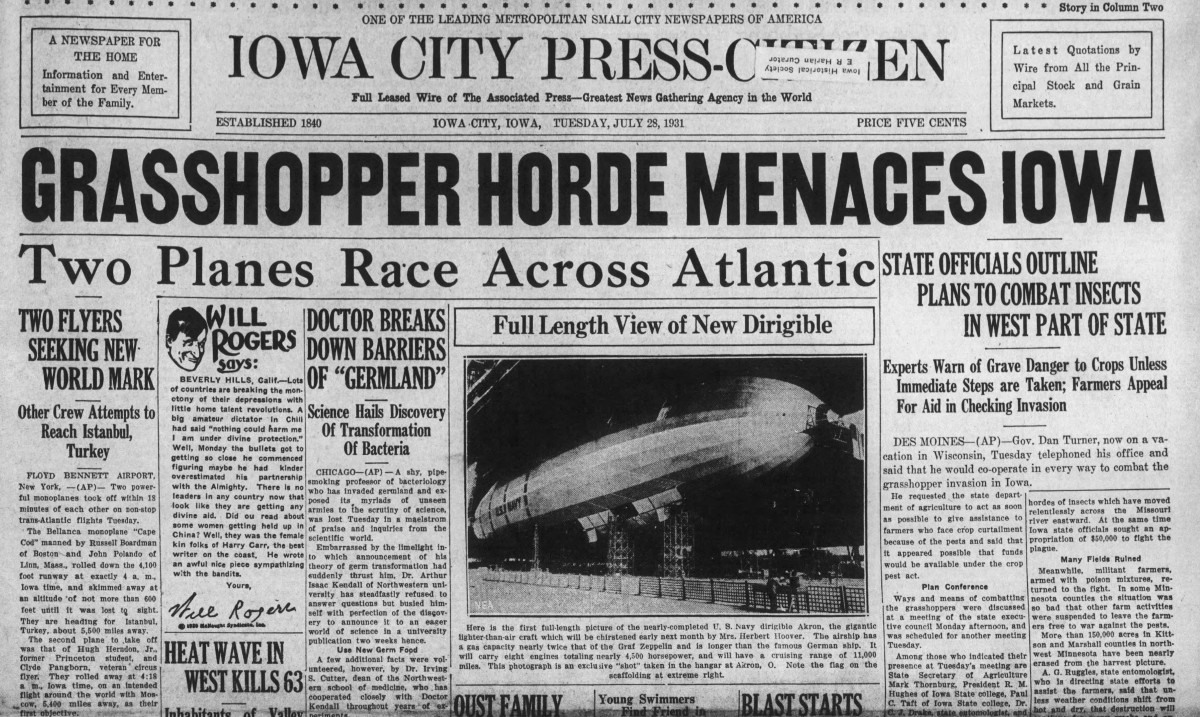
Headline from Iowa City Press-Citizen, 27 Jul 1931 Source: NotesonIowa.com
On 26 July 1931 swarms of grasshoppers would descend on the American Midwest resulting in millions of acres of farmland to be destroyed.
In 1931 the United States was in the throes of the Great Depression with many out of work, rural banks closing, capital to invest in industries limited, and the cost of living hard for most Americans. The American Midwest, which supplied much of the nation’s needed grain and other foods, was hit hard not only by the bad economic times but a drought as well. Agriculture faces many threats but one of the most serious are voracious insects such as grasshoppers and locusts. There had been such pestilence before in America. There had been one in July 1874 when Rocky Mountain Locusts swarmed through North Dakota to Texas destroying crops. There too the Midwest was beset by drought, which is considered to be a cause of large swarms being formed to find food.
Locusts and grasshoppers are similar to each other, can look the same in many cases, but have differences as well. Both belong to the same family- Acrididae- and can look the same but have differences as well. Grasshoppers are found worldwide while locusts are generally found in Africa and Asia. Both are solitary meaning after they are born, except for mating, they do not have much contact with others of their kind. Both eat plants and will devour the entire plant. Grasshoppers tend to eat a more varied diet than locusts. Both however can swarm when foods become scarce. Locusts though actually change color, unlike grasshoppers, when they swarm. Both though are a pestilence to farmers.
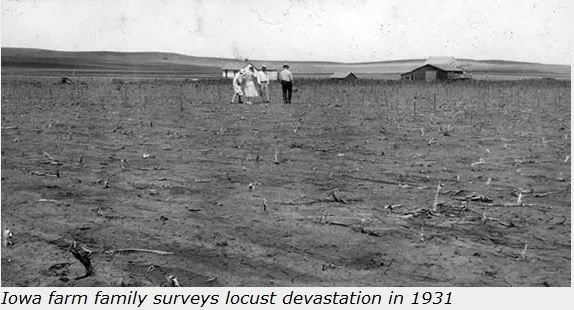
By July 1931, severe drought had devastated Iowa, Nebraska, and South Dakota. On July 26, swarms of grasshoppers descended and began eating all the cornstalks right down to the ground. The swarms were so massive that they actually blotted out the sun in some areas. They covered everything and seemed everywhere. You could not walk without stepping through them as they ate their way across the land. Anything that stored grains, unless well sealed, would be targeted as well if they could find a way in.
Photo of grasshopper devastation on Iowa farm July 1931 Source: NotesonIowa.com
The result were farms completely devastated once the grasshoppers were finished. The grasshoppers consumed every part of the cornstalk leaving nothing behind before they moved on. President Hoover allocated federal aid to help farmers after the crisis. However, the combined problems of the drought, the Great Depression, and the grasshoppers caused many to close up and move elsewhere to start over. Grasshoppers are still a threat today, somewhat minimized with pesticides, but can still swarm when drought limits their food supply.
Footnote
There was a major grasshopper swarm near Albuquerque, New Mexico in 2014. Due to drought and limited vegetation, the swarm headed to both urban and suburban centers. The swarm was so thick that it was picked up on radar. The grasshoppers destroyed or damaged home lawns, outdoor gardens, and just like in 1931 were everywhere.
The History Guy: History Deserves to Be Remembered. (2020, August 17). The Great Kansas Grasshopper Plague of 1874 [Video]. YouTube. https://www.youtube.com/watch?v=FxqgBWxLZa0
Titanic News Channel is a participant in the Amazon Services LLC Associates Program, an affiliate advertising program designed to provide a means for sites to earn advertising fees by advertising and linking to Amazon.com.
On 25 Jul 1943 the Fascist Grand Council formally voted Mussolini from power and was arrested later after meeting with King Victor Emmanuel III. So, what happened to the once all-powerful Duce? Let’s find out.
Italy had entered into the Pact of Steel with Germany in 1939 which committed Italy to fighting along with Germany if it declared war or was attacked. Mussolini entered the agreement knowing full well Italy did not have the resources or industrial capability for a sustained military conflict. Mussolini had grand ambitions about expanding the Italian sphere of influence in the region and even into central Europe. Mussolini believed that Fascism was on the march and aligning with Hitler seemed a good choice at the time. Italy had successfully invaded Ethiopia (1935-1937) though not without them putting up a strong fight. Using mustard gas against troops and civilians had gotten Mussolini severely criticized and international sanctions.
The war in Ethiopia and his intervention on the side of Franco in the Spanish Civil War had brought Italy closer to Germany with a treaty of mutual interest in 1936. And he needed coal from Germany since international sanctions over Ethiopia had made acquiring it more difficult. Mussolini believed a German-Rome Axis would be how Europe would turn but relying on Germany to supply items like coal meant Italy was more dependent on Germany rather than a true partnership. Mussolini tried to get all kinds of concessions from the British and French after the Munich Agreement in 1938; none were given. He made it clear in speeches (and those by others) that they wanted territory in France, Tunisia, a small part of Switzerland, and Albania. He upped his demands to demand free access to the world’s oceans by breaking British control of key places such as Gibraltar.
From the viewpoint in London, Paris, and elsewhere, his bellicose talk signaled major territorial ambitions. The Fascists mostly supported this though some, like his foreign minister Count Galeazzo Ciano, were concerned about aligning with Germany. Taking on both Britain and France became accepted since they were the major colonial powers that Italy saw as blocking them from achieving their rightful position in the world. On 7 April 1938, Italy invaded Albania and took control in three days. The formal military alliance with Germany (the Pact of Steel) was signed on 2 May 1939 cementing further the military ambitions of both countries together. The Italians thought war with Britain and France would not occur for years but dreadfully miscalculated Hitler’s ambitions.
Italy was not ready for major war operations until 1942 according to his own advisors. The Pact of Steel had said neither side was to enter war until 1943. Italy desperately needed this time in order to get its industry running and lacked critical military industrial production. Both Britain and France had highly developed military industrial production, but Italy was woefully behind in key areas such as automobile production (key to making tanks and other mobile artillery). Additionally, Italy needed to acquire all the needed raw resources needed for war production. Italy was primarily an agriculturally based economy with small pockets of industrial sectors. They needed to setup a supply chain to bring in all the raw materials like coal and import steel. Italy’s merchant marine was not managed in preparation for war and would lose those ships as they were in foreign ports when war was declared by Italy in 1940.
Prior to that, raw materials being sent from European ports to Italy were subject to seizure. Coal, for instance, was shipped out of Rotterdam. The British declared it contraband and seized it, infuriating Mussolini. The Germans offered to ship by train over the Alps while the British countered saying they would supply all of his country’s needs if Italy supplied them armaments. The British hoped to lure Italy away from its alliance with Germany. And it appeared to work as Mussolini had approved a draft contract to provide military equipment. It was suddenly scrapped under intense pressure from Germany caused Mussolini to fold. This decision would come back to haunt him much later down the road.
Italian debt, already large when Mussolini, came to power, had increased thanks to his generous support of General Franco in Spain that increased it. The blockade of coal was strengthened and deeper reliance on German imports of raw materials occurred. The economy was bolstered by the important of goods from Germany, but inflation was occurring causing basic goods and service to become more expensive. When Italy entered the war in 1940, its merchant marine in foreign ports were seized leaving the country without hardly any means of getting needed supplies by cargo vessels.
Adding more to the woes, the warnings of his advisors were accurate. Italy’s army was huge making it a major land force on paper but in reality, lacked modern transport and weapons. The army, because of the weak economy, did not have the needed armaments or supplies for war, and was the major reason it failed. Lightly armored infantry is no match for a fully equipped company of troops with full battle-ready equipment like the British had. Along with both a navy and air force that did not work together well, Italy was ill-prepared for general warfare except for a country that had a worse military than it had. There was poor leadership as well at the top that never had clearly defined military objectives and seemed to go at the whim of whatever Duce wanted them to do. They easily took the lower portions of Vichy France and Corsica. About the only good thing they did in taking that was providing a refuge for fleeing Jews. The Italians did not follow the German lead much regarding the Jews, which caused the Germans frustration over the Italian non-compliance in this area.
The succeeding campaigns in North Africa and Greece ended badly. In North Africa the British put up a good fight and had routed the Italians. Then the Germans arrived with Rommel in charge making it a much tougher campaign for the British and later the Americans; Greece was a total debacle. They invaded from Albania, but the Greeks pushed them back into Albania ending up in a stalemate that cost both sides. Once again, the Germans invaded (the British were using Greece to fly bombing raids into Romania) and successfully took Greece and Crete. Only Yugoslavia was a success but that was because the Germans were part of the campaign and once the country was divided up, Italy got the coastal area.
By 1943 though, things had gotten worse for most Italians. Food and other items were rationed, wartime inflation made everything more expensive, and the war itself was unpopular with most Italians. Mussolini was no longer seen as the great leader and the recent bombing of Rome showed how his boasts were hollow. The invasion of Sicily and later the south by Allied forces showed the proverbial “writing was on the wall.” Mussolini knew that his military could not successfully fight the Allies but stuck to the war because he saw no other option but to fight it out. The Fascist Grand Council knew the war was lost and that Mussolini had lost his stature with the people.
On the night of 24 July and in the early morning of 25 July, the Grand Council met with Mussolini. Accounts of the meeting indicate he was sick, tired, and felt the burden of the military reverses suffered by the Italian military. To some, it seemed he was looking for a way out and it was given to him. The Grand Council voted to remove him from power and transfer some of his duties to the King. While some opposed it, the vote was carried by the majority. Even his son-in-law Count Galeazzo Ciano voted for his ouster. Mussolini seemed dazed by the vote and while his supporters tried to get him to act, he seemed unable to do anything. He would go to his meeting with the King (unshaven and groggy) where he would be arrested. The King told him that General Pietro Badoglio would be taking over as Prime Minister and that the war was lost. He and his family were assured of their safety, and he was whisked away. Mussolini accepted his fall as it absolved him of any more responsibility for the war.
When it was declared Mussolini was out, the general response was one of relief. His fellow Fascists did not stage marches or protests over his dismissal and did nothing to release him from his incarceration on La Maddalena (he would be moved elsewhere). Hitler was furious and knew that the Italians would seek an armistice with the Allies (which was true but in public said otherwise to keep the Germans at bay). For the Allies his dismissal was good news as they hoped it might bring an end to the Italian campaign. And many Italians thought it would as well, Unfortunately the Germans had other plans and that would drag out the war in Italy until June 1944, but that is a story for another time.
Titanic News Channel is a participant in the Amazon Services LLC Associates Program, an affiliate advertising program designed to provide a means for sites to earn advertising fees by advertising and linking to Amazon.com.
Martin Bormann, Hermann Göring, and Bruno Loerzer surveying the damaged conference room 20 Jul 1944 Source: German Federal Archives via Wikimedia Commons
On 20 July 1944 a bomb placed in the briefing room of Wolf’s Lair would explode in an attempt to kill Hitler. It failed and many of the conspirators, including Field Marshal Erwin Rommel, would either be executed or commit suicide. So, who were the conspirators and why did it fail? Let’s find out.
The conspirators were a combination of both civilians and military and had varying reasons for coming together. Some opposed the anti-Jewish policies and were shocked by Kristallnacht; others were upset with how Hitler had mismanaged the war. Many wanted to save Germany from a catastrophic defeat they saw coming. Some of them no doubt would have faced a military tribunal had they survived for war crimes for working or assisting with the elimination of Jews. An earlier plot to kill Hitler on his airplane had failed, so the plan was changed. Called Operation Valkyrie, the plan was to take control of cities, disarming the SS, and arresting Nazi leaders.
Colonel Claus von Stauffenberg was to place a bomb under a table at the East Prussian headquarters called Wolf’s Lair. Then once Hitler was confirmed dead, a radio announcement would go out saying that the Nazi Party had murdered Hitler and ordering the Reserve Army to take control of key installations in Berlin, arresting Nazi leaders. Carl Friedrich Goerdeler, former mayor of Leipzig would become chancellor with former army chief of staff Ludwig Beck becoming president. Then the new government would begin negotiating for an armistice.
Stauffenberg arrived with two bombs on 20 Jul 1944 but was unable to arm one of them. In the briefing room where military aides were briefing Hitler, he placed the briefcase with the bomb under the table and near Hitler. He excused himself and left the room. Unfortunately, the briefcase was moved to under a thick leg of the table. When it detonated at 12:42 PM, Stauffenberg believed Hitler had been killed and put Operation Valkyrie into action. Hitler was wounded but not killed but the stenographer and three officers died. However instead of acting right away, many of the conspirators waited until Stauffenberg arrived in Berlin three hours later. By that time rumors of Hitler’s survival sapped the courage of many to go through with their plans. Precious time was lost, and it was too late now.
General Friedrich Fromm, who knew of the plot and condoned it, quickly saved himself by arresting the key conspirators and executing them. Hitler would go on the radio on 21 July 1944 to announce his survival to the nation and that those who had done this would be taken care of. The Gestapo swung into action arresting and torturing the remaining conspirators. Some were hauled before the infamous Volksgericht (People’s Court). There the infamous Nazi judge Roland Freisler handed out death sentences. Some were hung or shot, and a few were strangled with piano wire. Fromm did not escape eventually being arrested, tried, and executed. General Beck was allowed to commit suicide but only wounded himself and had to be shot. The surprising revelation that Field Marshal Erwin Rommel was involved (he knew of the plot but took no active role in its planning or execution) shocked Hitler. Due to his popularity-and to avoid a trial-he was told if he committed suicide his family would be spared. Upon his death from an “illness”, he was given a full military funeral.
The assassination attempt did not weaken Hitler but strengthened it. His grip was tightened, and they went after not just those involved but other enemies, they could get rid of at the same time by claiming they were part of the plot as well. Over 7,000 were arrested and 4,980 were executed. The barbaric deaths of some by piano wire was specifically ordered by Hitler.
Sources
The Editors of Encyclopaedia Britannica. (2024e, July 13). July Plot | History, leaders, executions, & Facts. Encyclopedia Britannica. https://www.britannica.com/event/July-Plot
Titanic News Channel is a participant in the Amazon Services LLC Associates Program, an affiliate advertising program designed to provide a means for sites to earn advertising fees by advertising and linking to Amazon.com.
[Editors note: This has been updated from 2023 with updated source information.]
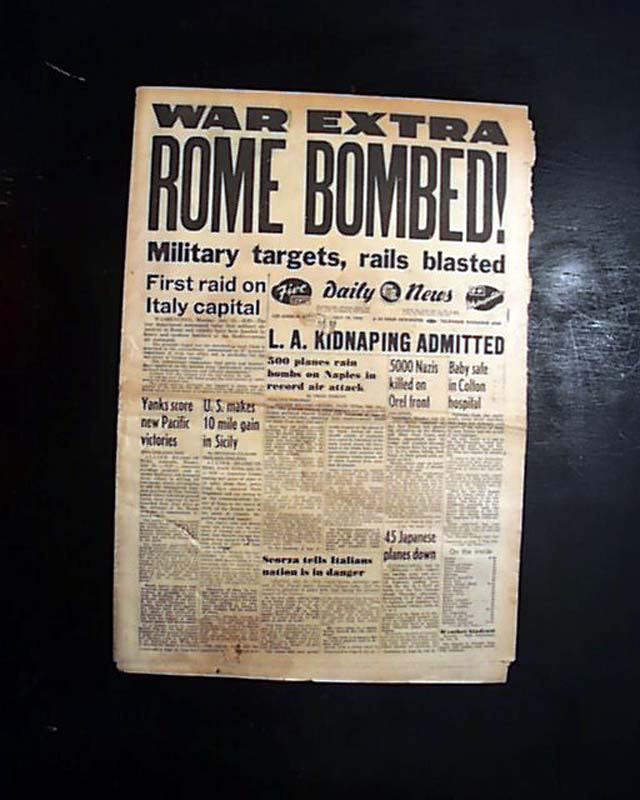
Daily News, Los Angeles- Headline on Bombing of Rome Source: RareEarlyNewspapers.com All Rights Reserved
By 1943, Italians had seen shortages in basic goods and supplies requiring rationing as their merchant marine had been decimated by the war. This led to a lot of grumbling about the war and its effects on Italy. Mussolini’s popularity had begun to wane. He had convinced Italians that the Allies would never bomb the eternal city of Rome. Then on 19 July 1943, the U.S. bombed the Rome railway yards.
Both President Franklin Roosevelt and British Prime Minister Winston Churchill had made a public appeal for Italians to reject Mussolini and save their country. The Allies by this time had invaded Sicily, and thanks to a clever deception, Hitler thought it initially a diversion. The Axis had been furthered weakened by its defeat in North Africa which had seen losses by both German and Italian forces. The advance of the Allied troops shook the Italian government. The bombing of Rome really caused panic in Rome as people went out into the streets.
It was much worse though as panic gave way to anger at Mussolini. People started destroying effigies of the dictator. And oddly, there was actually celebration of the attack as it was seen as leading to Mussolini’s demise. Hitler met with Mussolini to shore up his confidence after the attack. The attack had shaken him as well. Mussolini appeared unusually quiet in the meeting (he spoke poor German) and relied on the transcript later. Hitler tried to restore his confidence worried he might cave in and seek an armistice with the Allies. In the end, Mussolini agreed to continue the war though by this time he knew the truth. The Italian army was beaten and there was no way they could win the war. He could not tell that to Hitler fearing what he might do in response.
Hitler for his part was concerned that either Mussolini would surrender, or his own people might remove him. He quietly ordered Rommel to take control of the Greek islands in case something went wrong in Rome. The Germans would be ready to pounce when it did. And events happened faster than expected. Within a week the Fascist Grand Council would relieve Mussolini and he was put under arrest by the King.
The Storming of the Bastille by Jean-Pierre Houël (1735–1813) National Library of France Public Domain via Wikimedia Commons
On 14 July 1789, the storming of the Bastille, a formidable stone prison originally built to protect the eastern entrance to Paris, is considered the launch of the French Revolution and celebrated as a holiday in France. The prison often held political prisoners and was seen as a sign of tyranny. By this time in 1789, the prison only held seven prisoners none of whom were of a political nature. Four were charged with forgery and two were considered mad or lunatics. The Bastille was actually being scheduled for demolition to make way for public square.
France was facing economic and social problems. Louis XVI had inherited considerable debt from his predecessor but continued to spend (along with his wife Marie Antoinette) considerable sums of money further deepening government debt. Crop failures in 1788 led to a national famine and the cost bread prices to soar. Unemployment was a factor as well and many thought they had lost jobs due to lessening of customs duties with England (resulting in more jobs there than in France). With violent food riots breaking out, King Louis XVI tried to resolve it through the Estates-General (a national assembly of clergy, nobility and the common person).
While in theory all three were equal, two of the other parts could outvote the third. This left many deputies upset demanding a greater voice and proclaiming their own National Assembly. This would lead to the famous Tennis Court Oath of 20 June 1789 not to separate until they had a constitution. Many nobles and clergy crossed over to this National Assembly which Louis XVI gave consent to. His ordering of army regiments into Paris though made many fear he was going to break up the assembly by force. The dismissal of Jacques Necker, a non-noble minister for the government on 11 July, triggered massive protests and destruction of custom posts. Custom posts were hated as they imposed taxes on goods.
On 14 July a mob seized muskets and cannons from a military hospital and then decided to get more at the Bastille. The governor of the Bastille saw the mob and invited them in to discuss terms of surrender. Outside the crowd grew restless awaiting word and it is possible some thought the delegates had been arrested. A group climbed over the outer wall and climbed in to open the drawbridge to the courtyard. The governor broke his pledge not to fire and bullets rang out killing 100 outright leaving others wounded. The royals only lost one soldier. The arrival of the French Guards, sympathetic to the mob, would force the governor to surrender after having cannons blasting away at the Bastille. Without adequate provisions, he surrendered the Bastille. Some of the royalist troops would be butchered after the surrender. The governor was taken prisoner and beheaded by the mob.
Aftermath
The Bastille was dismantled, and its only prisoner later would be Louis XVI. He would be executed on 21 January 1793 along with his wife. The French Revolution, once thought a means to reform France into a constitutional monarchy, slid into a revolutionary government that completely overturned the ancien regime. During its tenure, it became increasingly bloody killing off enemies of the new order. Anyone who was thought to disagree with them could be denounced and executed. Instead of creating a better stable system, it became one long food riot as one professor said to me once. And the revolutionaries fought amongst themselves as to who was the better one to lead. That led to more bloody executions and the guillotine became the image of the French Revolution. Ultimately the people tired of this turmoil and wanted order. And it would come from Napoleon Bonaparte, but that is another story.
Sources
The Editors of Encyclopaedia Britannica. (2024c, July 11). Bastille Day | Definition, history, traditions, celebrations, & facts. Encyclopedia Britannica. https://www.britannica.com/topic/Bastille-Day
Titanic News Channel is a participant in the Amazon Services LLC Associates Program, an affiliate advertising program designed to provide a means for sites to earn advertising fees by advertising and linking to Amazon.com.
May 1942 photo for passport Anne Frank House, Amsterdam. Public Domain via Wikipedia Commons
After receiving word that they would be deported to a Nazi work camp, Ann Frank and her family take refuge in a secret annex of an Amsterdam warehouse. Her family was from Germany and fled in 1933 to Holland to escape Nazi persecution. The Netherlands declared its neutrality but that did not stop the Germans from invading on 10 May 1940. After the bombing of Rotterdam, its military forces surrendered, and its government and royal family fled to London. Germany would occupy the country until the German surrender in May 1945.
The initial phase of the occupation was mild and often called the “velvet glove” where Germans under Arthur Seyss-Inquart did not impose the harsher rules of occupation found in other countries. The economy was doing well, and repression of the Jewish population was light. Starting in June 1941, that changed as Germany started demanding more from the occupied territories which lowered the standard of living. Repression of Jews began now in earnest as many were now deported to extermination camps.
Otto Frank had come to Amsterdam from Germany in 1933 with his wife Edith and their two daughters Margot and Anne. He worked for Opetka, which sold pectin and spices for jam production. A second company he started, Pectacon, sold wholesale spices, pickling salts, and herbs for sausage production. As things got more tense with Germany, he tried, unsuccessfully to move his business to Britain. When the occupation came and German laws about making businesses Aryan, he transferred ownership to his employees to keep it out of German hands. He unsuccessfully sought to emigrate to the United States.
Otto approached his bookkeeper, Miep Gies, to see if she could help hide his family. He also asked other employees to assist as well in bringing food to them in the secret annex hidden behind on a movable bookshelf. Another family, Van Pels would join them later as would Fritz Pfeffer making 8 people in total hiding in the Secret Annex.
For the next two years Ann would record in her diary her thoughts, humor, insight, and what was going on inside the annex. There were a lot of disagreements between the various people living together and Anne records how her father acted as a peacemaker. For two years they kept quiet during the day as people worked below and Nazi patrols were out on the streets. It all came to an end on 4 August 1944 when Dutch police officers with a member of the SS in charge raided the Secret Annex and arrested them all. Two employees were also arrested. They were all sent to Auschwitz, including the two men who had helped them. When Otto got off the train in Auschwitz, it was the last time he saw his wife and children. He would learn after the war his wife died in Auschwitz. Both Margo and Ann were moved to the Bergen-Belson concentration camp in Germany, where they both perished of typhus.
Otto would be the only one to survive and returning to Amsterdam he was given Anne’s diary by Miep Gies. After reading it, he was advised by others who had read it to have it published. It took a while, but it was first published in 1947 and into English in 1952. It has since then been translated into 70 languages and became a best seller and acclaimed movie. The diary stands as a testament to the six million Jews whose lives were taken by the Holocaust.
Titanic News Channel is a participant in the Amazon Services LLC Associates Program, an affiliate advertising program designed to provide a means for sites to earn advertising fees by advertising and linking to Amazon.com.
“Fix these faces in your memory” cartoon that ran in newspapers in 1920 after the scandal broker in 1920. Source: Anderson, Wayne (2004) “The Fix” in The Chicago Black Sox Trial: A Primary Source Account, Great Trials of the Twentieth Century, New York, United States: The Rosen Publishing Group Public Domain via Wikimedia Commons
The 1919 World Series between the Chicago White Sox and the Cincinnati Reds has been forever tainted by allegations that the game was thrown by some White Sox team members being paid by a gambling syndicate being run by Arthur Rothstein. The scandal changed baseball forever resulting in imposition of new rules of player conduct and putting into power a baseball commissioner who would preside like a dictator over baseball for decades. So, what happened? Let’s find out.
The White Sox were heavily favored to win the game in 1919 but many players were upset with being underpaid by team owner Charles Comiskey. It is believed that first baseman Chick Gindil may have initiated contact and through intermediaries New York gambler Arnold Rothstein offered money for the players to lose some of the games intentionally. Rumors of game fixing began on the first day of the game (1 Oct 1919). A lot of money was being placed against the Reds, which raised suspicions. The rumors reached the press box which started getting sports writers interested. As the games went on, plays were being watched more carefully and what the players were doing (or rather, not doing right). By Game 5 though, those involved were upset that they had not be paid and won Games 6 and 7. The gamblers struck back, and threats were made against the players and the families. Game 8 was lost by the Sox ending the series. The main conspirators received $5,000 each with Chick Gandil, who was the one who initiated the scheme, receiving $35,000.
Rumors swirled into the 1920 season and newspaper stories of corruption in other ball clubs emerged as well. Finally what appeared to be a rigged regular season game between the Cubs and the Phillies in August 1920 led to a grand jury being convened in September to investigate the 1919 World Series. Pitcher Eddie Cicotte confessed to his role and signed a waiver of immunity. Shoeless Joe Jackson soon testified to receiving $5,000 from his teammates. Lefty Williams and Oscar Felsch also confessed as well. In October indictments for conspiracy were handed down for seven members of the White Sox, forever dubbed the Black Sox:
Arnold “Chick” Gandil (1st Base)
Eddie Cicotte (Pitcher)
Claude “Lefty” Williams (Pitcher)
Charles “Swede” Risberg (Shortstop)
Oscar “Happy” Felsch (Outfielder)
“Shoeless” Joe Jackson (Outfielder)
Fred McMullin (Infielder)
Buck Weaver ( 3rd Base)
The media and the public were unforgiving. Numerous stories appeared on how they sold out baseball and baseball fans over what happened. It was a major public relations nightmare for both the American and National leagues (back then they were separate unlike today). The trial took a mysterious turn when signed confessions and other documents mysteriously disappeared from the Cook County Courthouse. Both Cicotte and Jackson retracted their confessions, and without direct evidence what the jury heard were second hand or hearsay accounts. White Sox player “Sleepy Bill” Burns gave the most damning testimony when he said that Rothstein was involved and Cicotte had said he would fix the game. White Sox owner Charles Comiskey, who many felt had mistreated his players by not paying his player enough and not paying promised bonuses, was grilled on the stand so hard by the defense counsel that he became enraged. The jury got the case on 28 Jul and returned with a not guilty verdict three hours later.
Baseball Owners Respond
Prior to the jury verdict and even before the scandal broke out, the baseball team owners wanted to change how things were run. A National Commission governed the sport, but they realized things had to change. One suggestion was to get a recognized federal judge to sit on this commission and help direct baseball in a better direction. They looked at noted baseball fan and federal judge Kenesaw Mountain Landis, but he demanded that he be made sole commissioner with nearly unchecked powers as commissioner. Although there were misgivings, the baseball owners agreed to his demands and made him the sole commissioner. This was unheard of back then as usually you wanted power vested in a group rather than one person. Landis would rule baseball from 1920-1944 and he would rule it with an iron fist. He would be the first and the last commissioner to have unchecked powers as he did.
Commissioner Landis Sets a New Tone for Baseball
Landis speaking at a church in 1921 is reported as saying he would tolerate any crooks in baseball.
Now that I am in baseball, just watch the game I play. If I catch any crook in baseball, the rest of his life is going to be a pretty hot one. I’ll go to any means and to anything possible to see that he gets a real penalty for his offense.
Like everyone else, he watched how the federal trial was going on against the White Sox players. When evidence disappeared requiring some charges to be dropped and new ones added (McMullin was dropped in the new charges), Landis responded by putting all eight on the ineligible list, banning them from major and minor league baseball. Comiskey released the seven who still were under contract, so they were effectively barred from professional baseball. However, Jackson, Williams, Felsch, and Weaver were able to play in a semi-pro game though sports writers heavily criticized it and the public for attending.
The acquittal seemed to end it and everyone in a celebratory mood afterwards. Both players and the jury went to an Italian restaurant and celebrated, it is said, long into the night. Their joy was short lived though. The following day (3 Aug 1921) Commissioner Landis issued the following statement:
Regardless of the verdict of juries, no player that throws a ball game; no player that undertakes or promises to throw a ball game; no player that sits in a conference with a bunch of crooked players and gamblers where the ways and means of throwing ball games are planned and discussed and does not promptly tell his club about it, will ever play professional baseball. Of course, I don’t know that any of these men will apply for reinstatement, but if they do, the above are at least a few of the rules that will be enforced. Just keep in mind that, regardless of the verdict of juries, baseball is competent to protect itself against crooks, both inside and outside the game.
With that statement, Landis set a standard that still applies to this day. No ball player who colludes with gamblers or promises to throw a ball game is going to find a home in baseball. And even if a jury acquits them, baseball is the final arbiter of who can and cannot play. Now one can argue that if a person is legally acquitted of a crime of conspiracy to throwing a game, he should be welcomed back. Except that Landis knew, as did others, that there were signed confessions out there that mysteriously disappeared, and they recanted confessions after they vanished. The jury never got to see those confessions, which likely would have made a difference in the outcome. Unlike someone who steadfastly says he is innocent and is proven at trial that someone else was, the evidence here was certainly conclusive that they had conspired to through the game for gamblers.
Landis refused to reinstate any of the eight even with a lot of support and statements that perhaps they had been misled, their baseball stats from the games showed they had not thrown the games, or other reasons. To this day their expulsions stand despite sympathy for Jackson and Weaver. Landis moved to crack down on any association with gambling. Two team owners who had purchased a racing horse track had to sell it. Other baseball players who associated themselves in any way with gamblers or gambled on the game were struck off and out of the game. Also playing baseball outside of the season for pay was discouraged without permission from Landis.
Babe Ruth got into hot water with Landis for not getting his permission and for a while made him ineligible to play again for the Yankees until Landis met with him. Landis was also strict with the team owners making them disclose holdings they had in minor leagues and to honor their contracts with players. He was not a fan of the farm system, but it has become the way most teams develop promising players for the major leagues. While apparently a liberal on racial matters, he upheld the unofficial ban on black ballplayers playing in professional baseball and forbade teams from playing black baseball teams (though it was done unofficially). While it is debatable how racist Landis was, there were indications many players were and would not tolerate nor accept a black ballplayer. Perhaps, and this is not an excuse for his actions, Landis feared ugly incidents in the club house that would do more damage to the sport than gambling did.
The Spirit of 76 (Yankee Doodle) by Archibald Willard (1836–1918) 1912 Public Domain va Wikimedia Commons
On 2 July 1776, the Continental Congress adopted a resolution that formally declared that American colonies independent of Britain. A final document had to be created explaining the reasons. A committee of five composed of John Adams, Roger Sherman, Robert Morris, Benjamin Franklin, and Thomas Jefferson worked on a draft form for the Congress to approve. On 4 July 1776 the Declaration of Independence was published. Although John Adams believed 2 July would be remembered for generations, it would be the day the Declaration was published that would be remembered.
Declaration of Independence (1819) by John Trumbull (1756-1843). Public Domain
It would be spread in July and August in a variety of ways. It was published in newspapers throughout the American colonies. It was spread via word of mouth by horseback and by ships. Newspapers published the Declaration and was read aloud for people and troops serving the Continental Congress. It was also sent to Europe as well. The Declaration clearly spelled out the reasons for the split and roused support for the American Revolution. It was a shocking document read in London and in other capitals. For it laid out clearly and precisely the reasons why a people could, and under the proper circumstances, rise up and replace their government with something better.
Thomas Jefferson, one of the principal writers of the Declaration, wanted to convey in a commonsense manner the reasons for the split. He wanted everyone who read or heard it read aloud to know exactly why this had to occur. He drew upon well-known political works in the language he used. His most important goal was to express the American mind against the tyranny of Britain.
We hold these truths to be self-evident, that all men are created equal, that they are endowed by their Creator with certain unalienable rights, that among these are life, liberty and the pursuit of happiness. That to secure these rights, governments are instituted among men, deriving their just powers from the consent of the governed. That whenever any form of government becomes destructive to these ends, it is the right of the people to alter or to abolish it, and to institute new government, laying its foundation on such principles and organizing its powers in such form, as to them shall seem most likely to effect their safety and happiness.
“4th-of-July-1819-Philadelphia-John-Lewis-Krimmel” by John Lewis Krimmel – Unknown. Licensed under Public Domain via Wikimedia Commons –
The Declaration announced to the world the uniqueness of the American Revolution. This was not like simply toppling a monarch and replacing him with a Cromwell or another king. It was about creating a government that believed and supported civil liberties along with the idea of self-government. A government that ruled with the consent of the governed, and not the other way around which was common in most of the world. The Declaration would become the cornerstone of what the United States would stand for and inspire others around the world to believe in it as well.
Today many are not sure of what happened in 1776 because they were not taught or learned why this occurred. There are those who try to rewrite history to fit their own narrative, often for political or social reasons or causes. The American Revolution occurred because people had become tired and frustrated by a government that was remote to their needs. They were British citizens, and many had families that came from Britain and settled in the colonies. They assumed they had the same basic rights of all English citizens, but the government saw the colonies as a means of revenue to refill their treasury. And they had little representation back in London, unlike there where you had a House of Commons that represented each borough.
When the British imposed taxes and restrictions on the American Colonies, many were disturbed by these actions and began protesting them. Attempts in some small ways of self-governance were met with indifference or hostility. The infamous tax on tea that led to the famous Boston Tea Party (1773). While this act was not celebrated by everyone (John Adams and George Washington, both thought it was wrong), it became a defining act of defiance, and the British took note since 45 tons of tea (worth a lot of money) was destroyed. The British closed down the port, demanded compensation, ended the Massachusetts Constitution, ended elections of public officials, instituted martial law as all courts were moved to Britain, required housing of British troops on private property. And to further snub the local Protestants, French-Canadian Catholics were allowed to worship openly.
These rules, called the Coercive Acts, led to the First Continental Congress of 1774. Many thought what happened was wrong but this was too far. The British hoped the acts would stop further acts of rebellion but ended up doing the opposite. It brought together people of all levels against the British and further convinced many that they now lived under a tyranny. The First Continental Congress, while disagreeing about the Boston Tea Party, was strongly united against Britain because of the Coercive Acts. In their declaration they formally censured Britain for these acts, imposed a boycott of British goods, declared they had a right to govern themselves, and called on colonists to form militias. For most it came down to a simple word: sovereignty. And so, the Declaration of Independence on 4 July 1776, they declared to the world the reasons why they had to formally break with Britain and declare their independence. Those that signed the declaration knew they would become targets, and many did. Some were arrested, imprisoned, or executed. Families were destroyed. Many leaders would lose all their wealth during the war to follow. And it was no sure thing they would win.
Britain was one of the premier powers of Europe at the time, with France being the other. They had a highly trained army and navy against a ragtag group of colonials though some had military experience (like George Washington). And the British showed, along with German mercenary troops, they were indeed not to be doubted. Yet something remarkable did happen. Despite all the odds against them, battles lost, cities taken, and at times appearing hopeless, the Americans did turn it around and show the British that they were determined and resolved in their desire to win. And they did to the surprise and shock of the world. They had defeated Britain and achieved their independence. What came of it was an American republic, distinctly different from anywhere else, where government was set to serve the people and constrained by a constitution, to prevent a tyrant from ruling outright. And the first amendments to this constitution would enshrine and limit those powers they so detested the British had done to them.
Titanic News Channel is a participant in the Amazon Services LLC Associates Program, an affiliate advertising program designed to provide a means for sites to earn advertising fees by advertising and linking to Amazon.com.
July, from the Très Riches Heures du Duc de Berry Limbourg brothers (fl. 1402–1416) Public Domain via Wikimedia Commons
Welcome to July everyone! July is the seventh month in the Gregorian calendar and is named for Julius Caesar. On the old Roman calendar, it was called Quintillis meaning fifth as July was the fifth month on that calendar. It is generally the hottest month in the Northern Hemisphere and the coldest month in the Southern Hemisphere, which is in winter. The old phrase “Dog days of summer” has nothing to do with canines, but an event in the night sky. During the early parts of July–often the most hot and humid–the star Sirius can be seen in the night sky and is part of the constellation Canis Major (the largest dog). The hot days of July then became described as the dog days in reference to the astronomical event.
July has another astronomical event of note, a Supermoon. There are different names for it (Buck Moon, Thunder Moon, Hay Moon etc) This occurs when the Moon is the closest to the Earth making it appear larger than it normally would appear. It can be either a new moon or a full moon. The July Supermoon is often called a Buck Moon since it in this month new antlers appear on the deer buck’s forehead. It turns out that male deer shed their antlers every year and grow new ones.
There are many observances and events, but two biggest national holidays are Independence Day (U.S., 4 July) and Bastille Day (France, 14 July). Independence Day celebrates the Declaration of Independence from Great Britain on 4 July 1776 while Bastille Day in France commemorates the storming of the Bastille in Paris on 14 July 1789. It is considered the start of the French Revolution.
Titanic News Channel is a participant in the Amazon Services LLC Associates Program, an affiliate advertising program designed to provide a means for sites to earn advertising fees by advertising and linking to Amazon.com.
On 30 June 1934 Hitler purged his own party of members he feared would become his enemies. Why did this happen? Let’s dive in and find out.
The National Socialist German Workers Party (Nationalsozialistische deutsche Arbeiterpartei Or NSDAP) was formed in the early 1920’s by Adolf Hitler hoping to draw people away from Marxist groups that were attracting many followers. The NSDAP (later to be called simply Nazi) fused elements of Socialism with nationalism creating something similar to what Benito Mussolini did in Italy with Fascism. Both Fascists and Nazis believed in a strong central state, a single party and a strong leader, and that citizens serve the national will in all that they do. They both reject democracy as weak, disdain for civil liberties, and capitalism that seeks profit over that of the state. The agree with Communists and Socialists about the political structure of the state but disagree over nationalism, worker’s rights, and its private ownership. Fascists and Nazis both believe in nationalism as a cornerstone of their ideology, unlike Communists and Socialists who believe they have to be torn down.
Hitler’s party targeted those who felt betrayed by the stinging defeat of World War I. It meant the end of both the German Empire and Austria-Hungary. Austria would be reduced down to its present size of what Austria is today and no longer a major power in the world. On top of that, the hated Versailles Treaty of 1919 levied huge reparations on Germany and stripped her of land and its overseas territories. His party absorbed other parties, some more extreme, as well. Antisemitism would also be a major draw for this party. Many in Germany believed, or were convinced, that Jews had conspired to bring down what happened. Jews owned banks, newspaper and other key businesses were profiteers and grifters who betrayed the German people. It would become a major feature of the party in the years to come.
Inspired by Mussolini’s Black Shirts, Hitler created his own paramilitary called Sturmabteilung (Storm Troops) or SA or simply called Brown Shirts to be used to threaten and intimidate enemies of the party and Germany. It was composed in the early days with war veterans and those that had been members of the Free Corps (Freikorps) which had been formed to counter left wing groups. In 1923 under the leadership of General Erich Ludendorff there was the famous Beer Hall Putsch to seize control of the Bavarian State. It failed and Hitler was imprisoned. While in jail, he composed his seminal book that told the world what his beliefs were and what the Nazi Party would do. Mein Kampf would, when published, become popular reading. It still is today in many parts of the world influenced by elements of fascism and antisemitism.
1932 Berlin SA-Propagandamarsch in Spandau Bundesarchiv, B 145 Bild-P049500 / CC-BY-SA 3.0 German Federal Archives via Wikimedia Commons
The Nazi Party would continue to grow through the 1920’s and as economic conditions got worse, found many willing to hear about rebuilding Germany and tossing out the current ruling elites that had made a mess of things. Mussolini made the same type of appeal much earlier and was swept into power after his march on Rome where the king appointed him prime minister even though there had not been a vote to put his party into full power. The Nazi Party, though it used the SA to bully and intimidate, used the ballot box to gain seats in the Reichstag. By 1928, it had gained lots of members but only held 12 seats. Its support came primarily from those who had served in the war, the disillusioned, and many who felt Germany was on the wrong path. Despite its name of being a worker’s party, most industrial workers were not drawn to Nazis. Hitler was not worried about this as he was building a national movement that would draw people into counter those who feared Communism and Socialism. Nazis used posters, slogans, parades, and other things to convey their message to the masses, which was we are to hear to fix Germany and toss out the weak Weimar government.
By the late 1920’s and early 1930’s, both the Nazis and Communists were popular. Both sought to fix the problems but in strikingly different ways. The SA got more active and soon fights were breaking out in the streets, assassinations were occurring. All of this convinced many that a strong central figure was needed to end the chaos, which was what Hitler sought to achieve. The antisemitic leanings were downplayed in general elections but anyone who attended their meetings knew that hatred of Jews was deeply ingrained in its leadership. In the July 1932 elections they got 37% of the vote and 230 seats in the Reichstag. It was a great victory for Hitler, but the November elections saw their fortunes had dissipated. The Nazi Party lost seats (down to 196) while the Communists gained. The other conservative and moderate political parties did well but no one had a clear majority to govern leaving it without a government for a time. President Hindenburg had defeated Hitler who had run for the same position.
The reasons that the Nazis lost votes has been debated, but by this time the Germany economy seemed better, and the Weimar government looked better as a result. This stung the Nazi leadership because the last thing they wanted was Weimar to stay in power. Hitler and those that supported him worked hard to negotiate with the other conservative parties to gain their support. They appealed to the old military aristocracy, the industrialists, and other leaders they needed to get support from. They played up the fear that the Communists would gain power. Most of the other conservative parties were wary of Hitler and his Nazis but ultimately decided to join with him to create a majority so that government could be formed.
And on 30 January 1933, President Hindenburg appointed Hitler as chancellor. Hindenburg and the others who had allied with him though they could control him. That would prove to be a disastrous miscalculation on their part. Hitler moved quickly to solidify the power of the Nazi party. While technically a coalition government, they quickly began suppressing and abridging press freedoms and individual liberties. All those who opposed the Nazis now had the SA, now part of the government, being given police powers. Jews would be dismissed from government posts. Hitler convinced Hindenburg to dissolve the Reichstag, a clever move so that when elections would be held only his party would be seated. They quickly worked to suppress all other parties except the ones that had supported them.
By 1934 the Nazi’s had swept away the old order and through elections (which in many cases were fraudulent) got all the seats they needed to fill the Reichstag. Things looked good but there were some problems. Internal corruption was an issue but so was the issue of continued violence the SA was doing. The SA, like the Black Shirts, served a vital role but also tended to be more purist about their doctrines than most in the party were. The SA had swelled in size to 4.5 million making it a very large paramilitary organization. As revolutionaries know, the greatest threat is not from outsiders but from those inside who build powerful groups internally that might topple ?you. Stalin had purged most of the early revolutionaries because they wanted more radical ideas and threatened his power. Mussolini had issues. Now Hitler was facing it as well.
The German army also was worried. There was a fully armed paramilitary organization that ran parallel to it. That would inevitably cause friction, especially in times of war when you needed clear operational structures. The SS, by contrast, was both a bodyguard for Hitler and oversaw the administration of specific areas designated to them by Hitler. They did not act as a paramilitary organization. Also, the public began to complain as well. That seems odd in a dictatorship they would care about public opinion, but the Nazis knew if they lost support of the populace, it would be an even bigger issue to contend with. The violence of the SA was getting loud feedback from the local Nazi leaders. In short, it had to be curtailed. Some saw its leader Ernst Rohm as the German equivalent of the Roman Sejanus who had become very powerful under Emperor Tiberius and threatened his reign. Both Himmler and Goering played on this fear when trying to convince Hitler that its leader, Ernst Röhm, was planning a coup.
Photo of Ernst Roehm, probably taken in Munich (München), Germany (Weimar Republic) on 1 April, 1924 National Archives and Records Administration (NAID) 162122137 Public Domain
And so, on the night of 30 June 1934, called the Night of the Long Knives came about. Rohm and all the leaders of the SA were arrested and ultimately executed (often brutally). Nazis took advantage of this event to also to eliminate other political opponents including former chancellor Kurt von Schleicher.
Aftermath
The SA was downsized and a new leader, Viktor Lutze, was appointed as Stabschef (the equivalent of chief of staff) to the SA. The SA would continue to be used to go after those opposing Hitler and later the Jews. The SA was used in Kristallnacht in November 1938 to destroy over 7,500 glass storefronts on Jewish shops and businesses along with ransacking Jewish homes. The also helped destroy nearly all the Jewish synagogues (the only ones that were spared were ones next to important buildings-they could be ransacked but not burned). The SA also carried out mass beatings of Jews and arrested many who were taken to concentration camps. They became overshadowed by the SS that now handled policing and security. By
1939 it had lost significance in the Nazi Party. It was converted into a training school for the armed forces. Once war began, it lost its members to the Wehrmacht (German armed forces). It continued to exist though and when the SS and the Foreign Office had major issues, he appointed SA members to diplomatic posts to counter the SS. When Lutze died in a car accident in 1943, the new leader tried to smooth out the tensions between the SS and the SA. The SA would formally cease to exist when the war ended in 1945.
Titanic News Channel is a participant in the Amazon Services LLC Associates Program, an affiliate advertising program designed to provide a means for sites to earn advertising fees by advertising and linking to Amazon.com.



,_by_John_Trumbull.jpg)