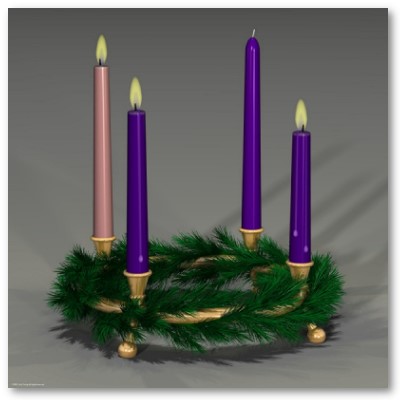
The first two Sundays of Advent are times of penance and reflection. On the third Sunday, it is time to remember both the joy to come with the birth of Jesus and his return. The third Sunday of Advent is called Gaudete Sunday or Rejoice Sunday. Gaudete is the Latin word for Rejoice so is commonly called that on traditional Christian liturgical calendars. The third Sunday is the joyful midpoint on our way towards Christmas, so we spend time reflecting on joy and hope.
Back in the Middle Ages, church leaders realized that if you have an entire season of repentance, you need to also celebrate joy and hope. Without that, its whole purpose would be lost. So, on Gaudete Sunday we take time to step back from the somber nature of the season and celebrate the joy and hope that is to come. Rather than the somber purple of penance, the liturgical color is rose or pink (priests or ministers can wear either one). And the advent candle for this day is one of those colors as well. Since we are lighting this candle on Gaudete Sunday, it is the candle of joy.
The scripture readings will also reflect this as well. Often St. Paul’s Letter to the Philippians is read in particular verses 4:4-7:
“Brothers and sisters: Rejoice in the Lord always. I shall say it again: rejoice! Your kindness should be known to all. The Lord is near. Have no anxiety at all, but in everything, by prayer and petition, with thanksgiving, make your requests known to God. Then the peace of God that surpasses all understanding will guard your hearts and minds in Christ Jesus.”
On this particular Sunday, you will see more joyful decorations in church with emphasis on joy. Colorful flowers, decorations, and banners may be displayed. Music will be joyful as well along with special prayers offered during the service. Families are encouraged to get together for a special meal on this Gaudete Sunday (often a brunch).
Titanic News Channel is a participant in the Amazon Services LLC Associates Program, an affiliate advertising program designed to provide a means for sites to earn advertising fees by advertising and linking to Amazon.com.
Saint Lucy by Domenico Beccafumi, 1521 AD. Public domain via Wikimedia Commons
Saint Lucy of Syracuse (Santa Lucia) is observed as the bringer of light in the darkest times. Born in Syracuse possibly in 283 into a noble family, she devoted herself to God after her father’s death. Her mother suffering from an illness, set up an arranged marriage for her so her future would be secure. She prayed at the shrine of Saint Agatha and received a vision that her mother would be healed. When she was, she encouraged her and the family to give their wealth to the poor. However, the man she was betrothed to was angry and informed the authorities that she was a Christian.
Emperor Diocletian was intolerant of Christianity and led one the most severe persecutions against them. Lucy was asked to renounce her faith and refused. She was tortured and lost her eyes (though some sources say she did that herself) since the Roman governor did not want her seeing any more visions. Refusing to surrender her faith, she initially was to burn to death. However, the fire would not light, and she was killed by the sword steadfast in her faith till the end. She died in 303 AD.
Her devotion and martyrdom became well known. While many legends abound, it is clear she was a martyr for the faith and never wavered. Her feast day was set on December 13. On the old Julian calendar, that was the shortest day of the year when light was needed. Her day became symbol to mean return of the light. Although that day shifted when a new calendar was adopted, her feast day remains the same. Her feast day is celebrated in Scandinavian countries as a festival of light during the long winter night. A young girl in a white dress and red sash carries palms and wears a wreath of candles on head. Special rolls or cookies are made for the day and often handed out to the elderly. It is also celebrated in parts of Italy particularly in Sicily and in many places of the world today. There are many churches dedicated to her and the island of Santa Lucia in the Caribbean is named for her.
Saint Lucy is the patron saint of the blind, visually impaired, eye health, spiritual vision and discernment, protection during periods of hopelessness, and for those seeking clarity or guidance.
“O St. Lucy, Virgin and Martyr, you who sacrificed your life for Christ, intercede for us who seek your guidance. May your example of faith inspire us to walk in the light of Christ, and may your patronage bring healing to those who suffer from blindness, both physical and spiritual. Amen.” (Prayer of Saint Lucy)
Titanic at the docks of Southampton, 10 April 1912 Unknown Author Public Domain via Wikimedia Commons
Before and after the wreck was found in 1985, various people proposed interesting and sometimes bizarre ways to bring it to the surface. Before its discovery, it was assumed to be in one piece; although 1912 testimony claimed it had split in two, this was not believed at the time. Here are some notable ideas, most from Slashgear:
1) Vaseline
After discovery but before realizing the bow was embedded in the seabed, one plan was to place 180,000 tons of Vaseline in polyester bags around the wreck. The cold-hardened Vaseline would lift it to about 200 feet below the surface.
2) Liquid Nitrogen
Wire mesh would enclose the wreck, then liquid nitrogen pumped in to freeze the water inside, turning the ship into a giant iceberg that would float up—ironically fitting, given the original iceberg collision.
3) Ping-Pong Balls
One idea was to inject millions of ping-pong balls for buoyancy. Cool in theory, but hard science shows they would crush under the immense pressure at Titanic’s depth.
4) Glass Spheres
A variation used hollow glass spheres instead. The concept looked impressive in art, but the estimated cost was around $240 million.
5) Balloons (1960s, not from Slashgear)
Douglas Woolley proposed attaching gas-filled balloons to float the ship. He founded the Titanic Salvage Company, raised funding, and planned to tow it to Liverpool as a museum. The main problem was filling the balloons with gas at depth—impossible with 1960s diving technology. The idea likely inspired Clive Cussler’s novel Raise the Titanic!, an excellent book (though the movie is forgettable except for the raising scene), where compressed air and other buoyancy aids are used.
2nd Advent Sunday Photo: Clemens PFEIFFER, Vienna (Wikimedia Commons)
O come, O come, Emmanuel, And ransom captive Israel, That mourns in lonely exile here Until the Son of God appears. Rejoice! Rejoice! Emmanuel shall come to thee, O Israel
Advent History
Advent finds its roots not in Christmas but in the observance of the Epiphany where Jesus is baptized. In France during the early centuries there was a time of preparation for this feast, which included fasting and prayer. Initially this was for three weeks and extended to forty to imitate the Lent season. Since this started on November 11 and on the feast of St. Martin, it became known as St. Martin’s Lent. This became codified by the Council of Saragossa in 330 AD requiring a time of fasting and prayer before the Epiphany, Then, in 581 the Council of Macon extended this to all the dioceses in France. This would spread to England where this custom was observed as well.
Back in Rome though the feast of the Epiphany was not celebrated but Christmas was. There was no special preparatory period for it either but there was concern there should be one for Christmas. Pope Gregory 1 (590-604) created the Advent Season by composing prayers, antiphons, and psalms to be used. This became known as the Roman Rite of Advent that lasted four weeks. When France adopted this, it added an emphasis be made to the second coming of Jesus. This eventually got back to Rome, which added it to the Advent themes. This became the Advent Liturgical season that we know today.
This is why the first two weeks have scripture readings focusing on the return of Jesus, while the last two weeks are concerned with the birth. Both themes are connected, and the emphasis is on people to “be prepared.” It is this dynamic that makes Advent an important part of the Christian calendar and why it is the beginning of the liturgical year. Advent is the starting point which flows to all the feasts and important holy days to come and ends on the very last Sunday before Advent celebrating Christ the King. Advent is a spiritual journey that prepares both for the birth of the savior but also his return. That is why the readings of the prophet Isaiah are featured during Advent as he speaks often of Israel’s salvation. Music played for Advent such as “Come, O Come, Emmanuel (based on the 9th century Veni, Veni Emmanuel) match this preparation period.
Titanic News Channel is a participant in the Amazon Services LLC Associates Program, an affiliate advertising program designed to provide a means for sites to earn advertising fees by advertising and linking to Amazon.com.
“We here highly resolve that these dead shall not have died in vain… remember Dec. 7th!” Creator/Contributor: Russell Allen Sauberg, Office of War Information Publisher: U.S. Government Printing Office 1942 Public Domain via Wikimedia Commons
On this date in 1941, Japan launched a carrier-based strike on U.S. military forces based in Pearl Harbor, Hawaii. Their strategy was to convince the country and its leaders that war with Japan would be futile. They achieved tactical surprise as no warning of an attack had yet been received. While decryption of their codes had revealed their intent, the warning did not reach Pearl Harbor until after the attack had begun. The Japanese legation in Washington did not deliver their government’s official response declaring war until after the attack due to problems in transcribing the message. The attack began at 07:55 local time (12:55 p.m. in Washington D.C.). It was early afternoon when President Roosevelt was notified by Secretary of War Henry Stimson of the attack. There was some doubt among some staff as to the validity of the report, but President Roosevelt believed it. And subsequent reports would show it was true. Radio was soon reporting on it as well and the entire nation soon learned of the shocking event that had taken place in the faraway location.
The purpose of the attack was to seriously cripple the U.S. Naval and Army Air Corp operations. The surprise was effective in sinking or crippling numerous ships and destroying most of the planes on the ground. However, the primary target of the Japanese, the aircraft carriers, were not there and they had no idea where they were. After conducting two strikes and contemplating a third, Admiral Nagumo decided to retire due to deteriorating weather, that they were at the far end of logistical support, and they had no idea where the three carriers were. Captain Minoru Genda argued for a third strike and invasion to taking out the storage, maintenance, and docking facilities in Pearl Harbor. Nagumo realized also in the time it would take to make a third strike that American forces might counterattack. Additionally, the attack group was low on fuel requiring them to conserve fuel. Later Admiral Yamamoto would say that it was a mistake as it allowed the U.S. to come back quickly.
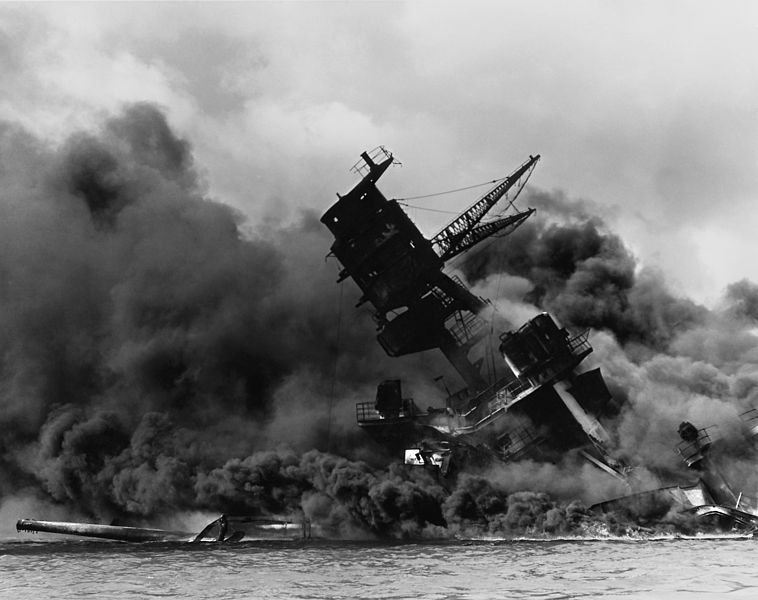
The USS Arizona burning after the Japanese attack on Pearl Harbor, December 7, 1941. National Archives Identifier: 520601/Local Identifier: 80-G-32420. Public Domain
Most of those who died at Pearl were sailors aboard the ships that were damaged or sunk. Of the 2,008 sailors killed, 1,177 were killed when the forward magazine on the USS Arizona exploded. Eighteen ships were sunk, beached, or run aground. 188 aircraft (mostly Army Air Corps) destroyed, 159 damaged. Most of the planes were destroyed on the ground. Only eight pilots got airborne and did attack Japanese aircraft but only one was shot down. Some pilots were killed or shot down later by friendly fire. Five inbound planes from USS Enterprise were shot down. The Navy lost 24 of its PBY planes. Additional casualties came from when Japanese attacked barracks. 2,403 Americans killed and 1,178 others were wounded. Since the U.S. was not at war, they are all classified as non-combatants. The Japanese lost 55 airmen, nine submariners and one captured. They lost 29 planes in battle and 74 were damaged by antiaircraft fire.
“The Japanese Government regrets to have to notify hereby the American Government that in view of the attitude of the American Government it cannot but consider that it is impossible to reach an agreement through further negotiations.”
As news broke across the country of the attack, the Japanese ambassador met with Secretary of State Cordell Hull at 2:30 pm to deliver the Japanese response. The long message listed the Japanese concerns and accusations about seeking peace ended with it saying they could no longer accept the current proposal and no further negotiations. Cordell Hull, after reading the full document, could not believe what he just read. According to Time magazine, he was visibly angry and responded: “In all my 50 years of public service I have never seen a document that was more crowded with infamous falsehoods and distortions — infamous falsehoods and distortions on a scale so huge that I never imagined until today that any government on this planet was capable of uttering them.” Japanese ambassador Admiral Kichisaburo Nomura (retired) remained silent along with an accompanying official. Hull would note in his diary later that he knew that Nomura was sincerely working for peace and totally unaware of the planned attack. In fact, the Japanese foreign office was never told about the planned attack. Nomura and the rest of his staff were interned and in 1942 sent to Portuguese East Africa where they were exchanged for Americans interned in Japan.
People enjoying a pleasant Sunday afternoon now were listening to news reports and early editions of newspapers screamed the headlines of the Japanese attack on Pearl Harbor. Military recruitment centers found lines of young men wanting to join up to fight the Japanese. The isolationist sentiment that once screamed for peace was ushered to the rear while most of the nation united against Japan. Old political foes in Congress now joined together supporting war. And on 8 November 1941, President Roosevelt addressed a joint session of Congress–carried live on radio–and asked for a declaration of war.
Mr. Vice President, Mr. Speaker, members of the Senate and the House of Representatives:
Yesterday, December 7th, 1941 – a date which will live in infamy – the United States of America was suddenly and deliberately attacked by naval and air forces of the Empire of Japan.
The United States was at peace with that nation, and, at the solicitation of Japan, was still in conversation with its government and its Emperor looking toward the maintenance of peace in the Pacific.
Indeed, one hour after Japanese air squadrons had commenced bombing in the American island of Oahu, the Japanese Ambassador to the United States and his colleague delivered to our Secretary of State a formal reply to a recent American message. And, while this reply stated that it seemed useless to continue the existing diplomatic negotiations, it contained no threat or hint of war or of armed attack.
It will be recorded that the distance of Hawaii from Japan makes it obvious that the attack was deliberately planned many days or even weeks ago. During the intervening time the Japanese Government has deliberately sought to deceive the United States by false statements and expressions of hope for continued peace.
The attack yesterday on the Hawaiian Islands has caused severe damage to American naval and military forces. I regret to tell you that very many American lives have been lost. In addition, American ships have been reported torpedoed on the high seas between San Francisco and Honolulu.
Yesterday the Japanese Government also launched an attack against Malaya. Last night Japanese forces attacked Hong Kong. Last night Japanese forces attacked Guam. Last night Japanese forces attacked the Philippine Islands. Last night the Japanese attacked Wake Island. And this morning the Japanese attacked Midway Island.
Japan has therefore undertaken a surprise offensive extending throughout the Pacific area. The facts of yesterday and today speak for themselves. The people of the United States have already formed their opinions and well understand the implications to the very life and safety of our nation.
As Commander-in-Chief of the Army and Navy I have directed that all measures be taken for our defense, that always will our whole nation remember the character of the onslaught against us.
No matter how long it may take us to overcome this premeditated invasion, the American people, in their righteous might, will win through to absolute victory.
I believe that I interpret the will of the Congress and of the people when I assert that we will not only defend ourselves to the uttermost but will make it very certain that this form of treachery shall never again endanger us.
Hostilities exist. There is no blinking at the fact that our people, our territory and our interests are in grave danger.
With confidence in our armed forces, with the unbounding determination of our people, we will gain the inevitable triumph. So help us God.
I ask that the Congress declare that since the unprovoked and dastardly attack by Japan on Sunday, December 7th, 1941, a state of war has existed between the United States and the Japanese Empire.
Congress declared war an hour later. The attack did not result in America cowering but uniting it. Both Italy and Germany, as members of the Pact of Steel, declared war on the United States. Roosevelt was surprised at both doing so. The German High Command was unprepared for war with America (they had planned it would happen some years later) and now faced a two-front war, something they had hoped to avoid. Italians were puzzled that Mussolini declared war on America and side with Germany. It was a foolish decision by Mussolini that would ultimately lead to his ouster in 1943.
Aftermath
Japan had control of the Pacific until June 1942. That is when the U.S. Navy engaged the Japanese at the Battle of Midway. At the end of the battle, four Japanese aircraft carriers were sunk to our one (the Yorktown). It was a shocking loss to the Japanese (and one they kept secret for as long as possible). The Doolittle Raid earlier that year had convinced them to take on the American Navy directly. They did and lost spectacularly. And it shifted the balance of power in the Pacific. Admiral Yamamoto, who supported the attack on Pearl Harbor, had expressed concerns about a long-term conflict with America. “I shall run wild considerably for the first six months or a year, but I have utterly no confidence for the second and third years,” he noted in memos before the war began. The famous Sleeping Giant quote though is purely fictional coming primarily from the movie Tora! Tora! Tora!.
Yamamoto would not survive the war. President Roosevelt ordered that he be taken care of for his part in planning the Pearl Harbor attack. Thanks to the work of U.S. Naval Intelligence that had broken Japanese codes (code named Magic), his travel plans to the South Pacific in April 1943 were learned. Orders were given and select pilots were used to target a very important high officer but were not told who it was. On 18 April 1943, a squadron of Lockheed P-38’s was assigned to intercept and bring down his transport being escorted by Japanese zeroes. There were two Japanese transports. After a dogfight with the Zeroes and transports, the transport with Yamamoto’s plane crashed into the jungle north of Buin, Papua New Guinea. Japanese search parties found his body, thrown from the aircraft and under a tree. He had two .50 caliber bullet wounds, one in his left shoulder and the other that had exited through his right eye. The true manner of his death was hidden from the Japanese public and not revealed until long after the war had ended. He was cremated, given a state funeral, and given posthumous titles and awards. Today the place where his plane crashed is a tourist attraction.
“USS Arizona BB-39 – USSARIZONA.ORG – Official Homepage of Battleship USS Arizona (BB-39) & Pearl Harbor Memorial Website Since 1999,” https://www.ussarizona.org/.
Dec. 7th, 1941: Pearl Harbor Old Historic Films USS Arizona Before and After. DVD. Campbell Films, 1941. This has 5 separate films in the collection. One is from Japan telling its citizens of the great victory. Another is a War Department film about the attack. There is an episode from Victory At Sea included, newsreels, and a film about USS Arizona. A must have for the serious enthusiast!
Tora! Tora! Tora! DVD. Williams-Fleischer Productions, Toei Company, 2006. This 1970 movie covers it from both the Japanese and American perspectives and is historically accurate. This provides an even handed look at both sides without a lot of drama (which was criticized) but the recreation of the attack is considered on the best done. Later movies rely on many of the action scenes from this movie. It takes the documentaries and brings them alive with a real cast and sees how this attack was planned, staged, and executed.
Titanic News Channel is a participant in the Amazon Services LLC Associates Program, an affiliate advertising program designed to provide a means for sites to earn advertising fees by advertising and linking to Amazon.com.
St. Nicholas Vintage Christmas Card (unknown date, possibly later 19th or early 20th century). Vintage Aloha/Pinterest
Today is the feast of St. Nicholas, the basis for what has become known as Santa Claus. He was born in the third century to a wealthy family in the village of Patara (now located on the southern coast of Turkey). At the time the area was mostly Greek. While he was young, his parents died during an epidemic. Raised as a Christian, he believed in obeying Jesus in giving his inheritance to those in need. He dedicated his life to serving God and was made Bishop of Myra while still quite young. He earned a reputation for being generous to those in need, his love for children, and concern for sailors and ships.
During the rule of the Roman Emperor Diocletian, Christians were ruthlessly persecuted, and Nicholas suffered for his faith by being exiled and imprisoned. Despite all the hardship he endured, he never wavered in his faith. He was released and attended the Council of Nicaea in 325 AD. He died on 6 December 343 AD in Myra and was buried. The anniversary of his death would become a celebration and still celebrated to this day (it is 19 December on the Julian calendar used by Eastern Orthodox churches).
His generous deeds and miracles attributed to him spread during the Middle Ages. Many sailors claimed him as a patron and told of him when they traveled. Churches dedicated to Nicholas appeared in many seaport cities. His name spread both east and west making him a very popular saint with many churches named after him in Austria, Belgium, England, Italy, Russia and Switzerland to name a few. His tomb became popular to visit but concerns over wars in the area cutting off access worried many. In 1087 sailors from Bari were able to retrieve his relics and bring them back. A church was built over his crypt so that pilgrims could visit. The shrine to St. Nicholas in Bari became a major pilgrimage center during medieval Europe. People still visit the shrine today at the Basilica di San Nicola in Bari.
The Roman Catholic Church, Eastern Orthodox, Greek Orthodox, Anglican, and Lutheran churches all have his feast day on their calendars. His generosity and compassion are seen as a model of Christian life. There is some confusion generated about how saint feasts days are celebrated in the Catholic church. Since there quite a fewsaints with feasts, it was decided that some saint feast days would be optional for a diocese to celebrate. Saint Nicholas became one of them. He was not stripped of his sainthood. In a diocese where he is popular, has churches or schools named after him, or perhaps the bishop believes he is model to be held up for veneration, his feast day will be celebrated. His feast day is celebrated throughout Europe and in Russia and children receive gifts on the day. Saint Nicholas’ feast day is usually the start of the Christmas season in Europe and elsewhere.
Saint Nicholas and Santa Claus
Saint Nicholas did not fare well during the Protestant Reformation. Saints, even revered ones, were removed to focus on Jesus. Some went so far as to nearly ban any public display of traditional religious customs related to saints or even Christmas (it was not a holiday for that reason in areas that groups like the Puritans dominated). Martin Luther wanted to shift the focus of Christmas to Jesus. The problem was that you cannot have a baby delivering gifts to children as Saint Nicholas did. He came up with the Christkind (Christkindl), a children’s gift giver. This angel, depicted as young girl, brings the gifts when the children are not present. In Nuremberg, the Christkind is selected every two years by vote and between the ages of 16-19. The Christkind opens the Christmas market. She also has her picture taken with kids, listens to what they want, visits kids in hospitals and the elderly as well amongst many other duties. The Christkind was also adopted by many German Catholics as well and spread into Latin America as well. In some cases, both the Christkind and Saint Nicholas deliver presents together.
Despite attempts to diminish Saint Nicholas using the Christkind, he remained popular except in England where many Christmas folk traditions were altered (especially under the rule of the Puritans and Oliver Cromwell). Puritans in America (and some others as well) forbade celebrating Christmas. German immigrants brought celebrating Christmas with them along with Saint Nicholas as well. It was believed the Dutch had brought Saint Nicholas to America, but recent scholarship indicates that was not likely (it is not mentioned in letters or records from the Dutch who lived in New Amsterdam at the time). It appears a series of fictional stories about Saint Nicholas (described as a jolly man with a clay piper) being celebrated by the early Dutch may have been the source.
The 19th century was one of change in America regarding Christmas-and elsewhere as well. Since it was not a sacred or public holiday in many places, it was not the time of carols and goodwill we think about today. Instead, it was a was a rowdy holiday where many got wildly drunk, gambled, and got riotous in some cases threatening people. In England, the Father Christmas figure was about adult merriment and feasting and had nothing to do with children. The actual celebration of Christmas seemed to be fading until books were published depicting Christmas as a time for family, children and faith were published in the 19th century. Washington Irving’s The Sketchbook of Geoffrey Crayon (1819) depicted the celebration of Christmas in England as a warm holiday where peasants were invited into the home to celebrate the holiday. And stories about a magical gift giver called Sante Claus began to appear. Books such as The Children’s Friend (1821) had a character delivering gifts to children on Christmas Eve. Flying a sleigh and living up north, this Sante Claus would form the basis of what is known today as Santa Claus.
The famous Clement Clark Moore poem A Visit from St. Nicholas would further cement the image of this Sante Claus. Books depicting Christmas began to appear and of course the most famous being A Christmas Carol by Charles Dickens in 1843. This came at a time in Britain when they were re-examining Christmas. This book and others would further help to make Christmas as a time for families, children, and caring about the less fortunate as well. Thomas Nast, the famous political cartoonist, illustrated him as a rotund figure with a beard, fur clothing, and with a clay pipe in 1863. He also changed the name to Santa Claus. His image, with some embellishments and refinements, has remained intact to our time. Christmas was becoming widely celebrated and by 1860 had already been adopted as a state holiday in fourteen states. In 1870, President Grant proclaimed Christmas Day as a federal holiday in the District of Columbia. Congress would pass legislation that made Christmas, New Years, Independence Day, and Thanksgiving as federal holidays (remember back then nearly all federal workers were in the District of Columbia). States would also make it a holiday as well.
Merry Old Santa Claus Thomas Nast, 1881 Public Domain
By the start of the 1930’s, the American Santa had come full form thanks to various illustrators such as Norman Rockwell. Coca-Cola would use Santa in its advertising further establishing his identity in the commercial world. The jolly man with the red suit would be seen in magazines, billboards, shop counters, and greeting cards. A benign source of happiness and seemingly endorsing all kinds of commercial products, he became as American as apple pie (to coin a phrase). His image would spread out to the world competing with local versions (Father Christmas, Pere Noel, Babbo Natale, Sinter Klass, Julenesse etc.) Saint Nicholas still retains his place in Europe despite this.
Many people, seeing Santa as a commercial and pagan creation, are now reclaiming the saint for use in the holiday. Saint Nicholas brings a spiritual emphasis to the holiday, which Santa does not. Some have tried to ban Santa Claus because of his supposed connection to Saint Nicholas, except there is none. One is a revered saint and bishop, the other a complete concoction of writers, illustrators, and marketing departments. There is nothing Christian about Santa Claus. Movies like The Santa Clause, while entertaining, put him into a world of fantasy beings like Mother Nature, Cupid, and the Tooth Fairy. By returning focus to Saint Nicholas, we get closer to what the celebration is about which is the birth of Jesus.
Straus, Jacob R. “Federal Holidays: Evolution and Current Practices.” Congress.Gov. Last modified July 1, 2021. Accessed December 2, 2025. https://www.congress.gov/crs-product/R41990.
———. “History of Christmas – Origins, Traditions & Facts | HISTORY.” HISTORY. Last modified November 19, 2025. Accessed December 2, 2025. https://www.history.com/articles/history-of-christmas.
Titanic News Channel is a participant in the Amazon Services LLC Associates Program, an affiliate advertising program designed to provide a means for sites to earn advertising fees by advertising and linking to Amazon.com.
Très Riches Heures du duc de Berry Folio 12, December circa 1440 Public Domain via Wikimedia Commons
December is the 12th month on the Gregorian calendar. The name derives from the Latin word decem, which means ten. It originally was the tenth and final month of the year on the old Roman calendar which began in March. With the adoption of the Julian calendar, January and February were added but the name remained. Anglo-Saxons used the word Yule for December-January but that now has been changed to mean December and Christmas season.
The December solstice is known as the Winter Solstice in the Northern Hemisphere, but it is the Summer Solstice in the southern. The solstice generally takes place around 21 -22 December and is the shortest day of the year in the north (the reverse in the south). Depending on how far north you are, sunlight may only be a few hours a day. And in some places, it is either dark or twilight for winter. Many old festivals took place to commemorate this event (and some still do to this day). For Christians, the first four weeks before Christmas is Advent in which they prepare for the birth of Jesus on 25 December. Jews celebrate Chanukah/Hanukkah, the 8-day Festival of Lights in December as well.
The first full moon of December is often called the Cold Moon in some places but has many other names as well depending on the culture and people that observed and followed the lunar schedule. The Geminid Meteor Shower takes place on 13-14 December. The Ursid Meteor Shower is on 22-23 December.
 The first two Sundays of Advent are times of penance and reflection. On the third Sunday, it is time to remember both the joy to come with the birth of Jesus and his return. The third Sunday of Advent is called Gaudete Sunday or Rejoice Sunday. Gaudete is the Latin word for Rejoice so is commonly called that on traditional Christian liturgical calendars. The third Sunday is the joyful midpoint on our way towards Christmas, so we spend time reflecting on joy and hope.