Today is Christmas Day in the Eastern Orthodox Church. Most Eastern Orthodox follow the Julian calendar for the liturgical year, which means Christmas is celebrated 13 days after it is celebrated in the West. The Eastern Orthodox churches in Constantinople (Istanbul), Alexandria, Antioch, Bulgaria, Cyprus, Greece, Poland, Romania and most recently Ukraine celebrate Christmas on December 25. All the other Eastern Orthodox churches celebrate it on 7 January. Armenia has both Catholic and Eastern Orthodox churches, so both dates are observed. Many old order Amish celebrate a second Christmas, called Old Christmas, on January 7 as well.
So to my Eastern Orthodox friends, I will wish a blessed and joyful Christmas Day.
==
Titanic News Channel wishes everyone a blessed and joyous Christmas Day. Merry Christmas!
The Adoration of the Shepherds (Gerard van Honthorst 1590–1656) Image: Public Domain (Wikipedia)
….And it was always said of him, that he knew how to keep Christmas well, if any man alive possessed the knowledge. May that be truly said of us, and all of us! And so, as Tiny Tim observed, God Bless Us, Every One!” (Dickens, A Christmas Carol)
Wise Men Adoration Bartolomé Esteban Murillo ((1617–1682) Toledo Museum of Art Public Domain
Epiphany or Three Kings Day is celebrated on January 6 by most Western Christian denominations. It is the day set aside to celebrate the arrival of the Three Wise Men in Bethlehem and the presentation of their gifts to Jesus. The Catholic Church decided to move its observance to the Sunday after Christmas so people would not have to take off work to attend mass. In 2021, since Christmas fell on a Saturday, it was celebrated the next day. However the traditional Twelve Days of Christmas are still in play.
Twelfth Day observances vary by country and some celebrate it on the evening before. Usually there are special celebrations involving foods and special cakes. If a Christmas log was lit for the season, it is now extinguished. King cake (a traditional part of the feast) is almost always present. Children often get gifts of candy or other things from the Wise Men. In Italy, the Christmas Witch La Belfana delivers gifts on Epiphany Eve to stockings children put up before bed. They awake to the delight of treats in the stockings. In Spain, it is celebrated as Dia de los Reyes (Three Kings’ Day) where families gather to celebrate the day.
One good way to celebrate it with the family is to gather before the nativity to remember what the holiday is all about. Christmas music should be played and a nice midday meal served. Then taking down the Christmas tree can be done together. The nativity scene can remain up until the Baptism of the Lord (Jan 9 this year) which ends the Christmas season.
Saint Stephen by Carlo Crivelli (1476) Source: National Gallery, London via Wikimedia Commons. Public Domain in UK and US; may be restricted in other countries.
If you remember the Christmas carol Good King Wenceslas , you heard the name. Stephen was a deacon in the early Christian church who was accused of blasphemy and put on trial by Jewish authorities in Jerusalem. After a trial in which he denounced them, Stephen was stoned to death. One of the witnesses to the event was Saul of Tarsus, who later converted and is known today as the apostle Saint Paul. Stephen is considered the first martyr for the faith, the reason his feast day immediately follows the celebration of Jesus birth. All the major Christian congregations–Anglican, Catholic, Lutheran, Oriental Orthodox, and Eastern Orthodox–all venerate him as a Saint and celebrate the feast day (Western churches on 26 December, 27 Dec Orthodox, and 8 Jan Oriental Orthodox). In some countries (mainly Western Europe) it is a public holiday.
In the United Kingdom, Australia, Canada, and New Zealand it is celebrated as Boxing Day, a secular holiday that falls on the same day as Feast of Stephen. Traditionally it is the day in which servants and tradespeople receive the “Christmas box” from their employers. While that tradition may still hold true, it is either a second Christmas day for some or an extra shopping day (though in some countries it apparently is a day when a lot of returns to retailers takes place). It is also a major sports day as well.
Titanic News Channel wishes everyone a blessed and joyous Christmas Day. Merry Christmas!
The Adoration of the Shepherds (Gerard van Honthorst 1590–1656) Image: Public Domain (Wikipedia)
….And it was always said of him, that he knew how to keep Christmas well, if any man alive possessed the knowledge. May that be truly said of us, and all of us! And so, as Tiny Tim observed, God Bless Us, Every One!” (Dickens, A Christmas Carol)
‘Twas the night before Christmas, when all through the house
Not a creature was stirring, not even a mouse;
The stockings were hung by the chimney with care,
In hopes that St. Nicholas soon would be there;
The children were nestled all snug in their beds;
While visions of sugar-plums danced in their heads;
And mamma in her ‘kerchief, and I in my cap,
Had just settled our brains for a long winter’s nap,
When out on the lawn there arose such a clatter,
I sprang from my bed to see what was the matter.
Away to the window I flew like a flash,
Tore open the shutters and threw up the sash.
The moon on the breast of the new-fallen snow,
Gave a lustre of midday to objects below,
When what to my wondering eyes did appear,
But a miniature sleigh and eight tiny rein-deer,
With a little old driver so lively and quick,
I knew in a moment he must be St. Nick.
More rapid than eagles his coursers they came,
And he whistled, and shouted, and called them by name:
“Now, Dasher! now, Dancer! now Prancer and Vixen!
On, Comet! on, Cupid! on, Donner and Blitzen!
To the top of the porch! to the top of the wall!
Now dash away! dash away! dash away all!”
As leaves that before the wild hurricane fly,
When they meet with an obstacle, mount to the sky;
So up to the housetop the coursers they flew
With the sleigh full of toys, and St. Nicholas too—
And then, in a twinkling, I heard on the roof
The prancing and pawing of each little hoof.
As I drew in my head, and was turning around,
Down the chimney St. Nicholas came with a bound.
He was dressed all in fur, from his head to his foot,
And his clothes were all tarnished with ashes and soot;
A bundle of toys he had flung on his back,
And he looked like a pedler just opening his pack.
His eyes—how they twinkled! his dimples, how merry!
His cheeks were like roses, his nose like a cherry!
His droll little mouth was drawn up like a bow,
And the beard on his chin was as white as the snow;
The stump of a pipe he held tight in his teeth,
And the smoke, it encircled his head like a wreath;
He had a broad face and a little round belly
That shook when he laughed, like a bowl full of jelly.
He was chubby and plump, a right jolly old elf,
And I laughed when I saw him, in spite of myself;
A wink of his eye and a twist of his head
Soon gave me to know I had nothing to dread;
He spoke not a word, but went straight to his work,
And filled all the stockings; then turned with a jerk,
And laying his finger aside of his nose,
And giving a nod, up the chimney he rose;
He sprang to his sleigh, to his team gave a whistle,
And away they all flew like the down of a thistle.
But I heard him exclaim, ere he drove out of sight— “Happy Christmas to all, and to all a good night!”
Silent Night Chapel in Oberndorf bei Salzburg, Austria. Photo:Gakuro
Silent Night(Stille Nacht in German, Silens Nox in Latin) is perhaps the most beloved Christmas Carol. It was composed in 1818 by Franz Guber, an organist and schoolmaster, to lyrics by Father Joseph Mohr of the St. Nicholas parish in Oberndorf bei Salzburg, Austria. It was first performed on Christmas Eve in 1818 and since the organ was broken, the only musical accompaniment was the guitar. The popularity of the song spread and the version commonly used today comes from a translation in 1859. John Freeman Young, serving as an Episcopal priest at Trinity Church in New York City, translated and changed the tempo of the song. The original rendition by Gruber was more like a dance tune and sung faster. Young made into a slower lullaby style that is the most common version today. Because it has been so widely translated, it is the one Christmas carol that is known worldwide.
In Austria Silent Night is not heard until Christmas Eve, usually around 9 p.m. Then it is played on the radio once an hour and of course during church services.
Silent night, Holy Night All is calm, all is bright round yon Virgin Mother and Child, Holy infant so tender and mild, sleep in Heavenly peace! sleep in Heavenly peace!
Silent night! Holy night! Shepherds quake at the sight; glories stream from Heaven afar, Heavenly hosts sing Alleluia, Christ, the Saviour, is born! Christ, the Saviour, is born!
Silent night! Holy night! Son of God, Love’s pure light radiant, beams from Thy Holy face, with the dawn of redeeming grace, Jesus, Lord at Thy birth, Jesus, Lord at Thy birth.
(In German) Stille Nacht! Heilige Nacht! Alles schläft; einsam wacht Nur das traute hoch heilige Paar. Holder Knab’ im lockigen Haar, Schlafe in himmlischer Ruh! Schlafe in himmlischer Ruh!
Stille Nacht! Heilige Nacht! Gottes Sohn, o wie lacht Lieb’ aus deinem göttlichen Mund, Da uns schlägt die rettende Stund’. Jesus in deiner Geburt! Jesus in deiner Geburt!
Stille Nacht! Heilige Nacht! Die der Welt Heil gebracht, Aus des Himmels goldenen Höhn, Uns der Gnaden Fülle läßt sehn, Jesum in Menschengestalt! Jesum in Menschengestalt!
Today is the fourth Sunday of Advent and normally the last full week of Advent. However in 2023 this is both the first and last day of Advent as today is Christmas Eve. Advent begins on the Sunday closest to the Feast of St. Andrew (30 November) but this year that day fell on a Thursday, meaning that the first day of Advent fell on Sunday, December 3 making it a three week Advent season.
This does not mean one does not observe it. You should light the Advent candles at dinner after reciting the prayer. And of course read the scripture readings for this day as well, If you are participating in the Christmas Novena, this is the last day of the novena. Then at midnight Advent ends and it becomes Christmas Day!
For 2024, Advent will begin on December 1 as the previous day was the feast of St. Andrew. And unlike 2023, will go the full four weeks with the last Sunday on December 22.
Drop down dew from above, you heavens, and let the clouds rain down the Just One; let the earth be opened and bring forth a Saviour.
(Isaiah 45:8)
Marley’s Ghost. Image from 1843 edition of A Christmas Carol, illustrated by John Leech Source: British Library via Wikimedia Commons Public Domain
On 19 Dec 1843 noted writer Charles Dickens novella A Christmas Carol was published by Chapman & Hall. The book came at a time when Christmas was fading but at the same time people were rediscovering Christmas traditions and exploring new ones (such as Christmas cards and Christmas trees). The story relates how Ebenezer Scrooge, a miserly man, who receives the ghost of his dead partner along with Christmas Past, Present, and Yet to Come. The visitations changed Scrooge into a warmer, forgiving man and the book sold out all its initial copies on Christmas Eve.
The story has become a favorite at Christmas time owing to its theme of transformation. While some academics argue about whether his story was secular or a religious allegory, the story alludes to a higher power at work to help Scrooge reflect on his life and to make changes. Scrooge shows everything wrong about the age-of acquiring money for its own sake and nothing else. He showed no empathy nor compassion for the plights of his fellow men and women wanting only to increase his wealth at the expense of others. One can be lulled into thinking though that Scrooge is just a two-dimensional character at first. As the story progresses, we learn of his early years, his being at school alone, of his lovely sister who brings him home, and the joy of working with old Fezziwig. And then he changes, slowly but steadily into the man we see at the beginning and losing the woman who loved him in the process. And we see as he reflects back upon his past, he starts regretting ill-treating his nephew and his clerk Bob Cratchit.
The story is of redemption, but not done in the modern syrupy way you see now in terribly done holiday movies of today. There are hard truths that Scrooge has to face about himself, and his choice is simple: continue as he is now and face a terrible fate or change to becoming more caring and joyful in his life. We also get to see the joy of Christmas being celebrated both in the Cratchit house and later with his nephew Fred. Despite not having a lot of money, the Cratchit’s have a wonderful holiday together. Christmas is depicted as a time for families, children, and to care about our fellow brothers and sisters. Dickens wanted to relate in his book that poverty was no small thing and that we needed to help those in need rather than ignoring them (especially children).
Christmas, like much of the world in Dicken’s time, was undergoing a major change. The observance of the Nativity of Christ was important to the faithful. Yet while it was a time of celebration, it was a simpler celebration. The religious part took place in church while food and drink were at home. Some took the partying to excess causing social problems. General George Washington famously crossed the Delaware River on Christmas Day in 1776 knowing that after a day of partying the German soldiers would be unable to fight. The Reformation had wiped out Christmas traditions in many places, and the Puritans had banned its celebration in England and later in the areas they settled in North America. It was not a public holiday in the United States (except in states that made it a holiday) or much of Europe.
The social changes brought by the dramatic shift from agrarian to industrial society made people want to look for a deeper meaning to things. And Christmas was ripe to be revitalized after being so low-key or ignored for a long time, or a time for wild partying. Dicken’s depiction of the day was family, church, mistletoe and holly, charity, and food. After the book came out, more traditions would be created from Christmas carols, St. Nicholas, Christmas cards and trees. And as many people wanted to celebrate the day with family, it became eventually a national holiday in just about every country in Europe, North and South America, and parts of the far east (Russia mostly). And reading A Christmas Carol has become a Christmas tradition as well. Dicken’s was at the cusp of change when it came to Christmas. He wrote great books before and after this one, but many remember him chiefly for the story of redemption of Ebenezer Scrooge.
Adaptations
There are many adaptations that have been made from plays to movies. Here is a list of those you might want to watch. Almost all the movies change the story in varying ways but try to keep faithful to the overall story.
Scrooge (1913)
One of the early silent movies starring Seymour Hicks. It is one of the few that shows Bob Cratchit sitting by the body of Tiny Tim.
A Christmas Carol (1938)
This version stars Reginald Owen who plays Scrooge well. The story cuts out a lot of the sadder parts of the story and alters the story in other ways (Cratchit is fired early in the movie). Still a good movie to watch for the excellent acting.
Scrooge (1951), re-titled A Christmas Carol
This one starring Alistair Sim is considered by many to be the best. Sim really nails Scrooge, and it is closer to the original in some ways. Shows a bit of his life not covered in the book or other movies to show how became so mean and miserly.
A Christmas Carol (1984)
This version stars George C. Scott as Scrooge. This was a made for television unlike the others above. It was filmed on location in the historic town of Shrewsbury in Shropshire, England lending it an authentic look. Scott’s depiction is not as harsh in tone as Alistair Sim’s depiction, but just as ruthless and unbending in his ways. It has a good cast as well with David Warner playing Bob Cratchit. It has become a favorite and seen on Hallmark and AMC channels during Christmas. Scott’s portrayal got him a nomination for an Emmy for Outstanding Lead Actor in a Limited Series or a Special. The combination of a great supporting cast and Scott’s performance as Scrooge makes this adaptation better than Alistair Sim’s version.
A Christmas Carol (1999)
This version based on Patrick Stewart’s one man play, but with a full supporting cast, It was inspired by the Sim movie and shows a lot of the grimness of the story. Stewart’s depiction of Scrooge is even more harsh than what Sim or Scott did. Solidly acted but one may be put off by the harsh and grim version of this Scrooge.
The Muppet Christmas Carol (1992)
This musical starring Michael Caine and all the Muppet favorites is funny and amusing at times. It is heartwarming and enjoyable on its own terms. Michael Caine delivers a great performance as Scrooge. It is mainly directed at kids, so they will enjoy it best. Adults may find it tedious at times, but the payoffs are the wonderful musical numbers and how the Muppet characters interact during the story. Especially when the Ghost of Christmas yet to be appears. It sends our narrator running for cover until the scene is over. There are two songs that really make this worth watching. One is the song It Feels Like Christmas sung by the Ghost of Christmas Present which says why Christmas is important and how to keep it with us all year. The second is sung by Scrooge (Michael Caine) called Thankful Heart. This song really neatly ties together all the lessons Scrooge has learned and what we should learn as well.
Sliced English Fruitcake Image: TheMightyGrog, 18 June 2019 (via Wikimedia Commons)
As a kid, fruitcake was this strange cake that appeared around Christmas and never tasted like much. My mother was not a great baker, so she bought one at a store. Now I had an aunt who made her own fruitcake, and it tasted delicious. However, the prevailing view for most people is that fruitcake was either one of the few things that survived a nuclear holocaust or was regifted so often that only one really existed. And that is a shame since fruitcake, when done right, is actually worthy of a place at the Christmas table.
Fruitcake has a long history and there are many variations of it. Aside from the English version, the Italians have panforte, the Germans stollen, and there is one even in the Caribbean. Fruitcakes could be eaten anytime of the year provided you had the ingredients, but at some time they became more closely associated with Christmas. One reason, perhaps, is that the ingredients were not cheap, so you really had it on special events like Christmas or Easter. And in days before refrigeration, the fruitcake was a way to use nuts and fruits in something that could last a while. Fruitcakes were commonly soaked in alcohol to keep them moist so you could eat them throughout the winter season.
Panforte, traditional italian dessert from Siena. Public Domain via Wikimedia Commons
For a long time, fruitcake was really something the wealthy and nobility ate. However, once many of the ingredients became more readily available (thanks to the opening of trade routes around the world), the cost of many ingredients began to come down, making them more affordable for the middle and working class. Books and illustrations showed fruitcakes and other treats as part of the Christmas feast, so many naturally began to imitate it. Another thing that made it in reach, though not until much later, was the availability for ovens in the home. Many people did not have ovens and either cooked over a hearth fire or a stovetop. If you needed a goose or turkey cooked, you had the local baker cook it for you in their ovens. This is illustrated in Charles Dicken’s A Christmas Carol where Scrooge sees people taking their Christmas goose to the baker to be cooked. And in the book, the arrival of the cooked goose in the Cratchit home meant it was time for the Christmas dinner. Until then, you either just had the traditional Christmas pudding or bought a fruitcake from the local baker.
Fruitcake was very popular, but its downfall came about the same way as home baked bread. Home baked bread was replaced by the large scale producers who sold it grocery stores. Until the advent of sliced bread, you bought the loaf and sliced it at home. Once sliced bread came about, most people bought their bread at the grocery rather than make it at home. Fruitcake fell victim to that as well. The large baking companies started churning out mass produced fruitcakes. Unfortunately, they were dense without much moisture. While convenient, they lacked the deep flavor of homemade ones. Some argue the same occurred to panettone as well. A beautiful cake that is a joy to eat when made by a real bakery. But the boxed ones you see in many stores are dry and crumbly with almost no texture (comparable to sawdust).
Fruitcake though has started to become popular again as people rediscover it. Thanks to celebrity chefs like Alton Brown and specialty producers, the rich but dense and moist cake is popular. And the specialty bakers will surprise you. Years ago, Chuck Williams, who owned Williams-Sonoma, tasted a fruitcake from a monastery in Missouri. When they decided to do this, they got a recipe from world famous chef who once worked for the Duke and Duchess of Windsor. The recipe is the traditional dark and rich fruitcake that is known and loved in England. That recipe and his advice on producing it, made it possible for that monastery to produce it. Williams realized this could be part of his Christmas catalog and the monks agreed. Fruitcake sales from the Williams-Sonoma catalog skyrocketed as people ordered and tasted the fruitcake. The making of fruitcakes turned into a major source of revenue for the small band of monks and continues to this day. Other religious orders are now selling traditional fruitcakes and other food treats as well. Some make cookies and fudge as well.
So, if you have ever wondered why fruitcake was once so popular, seek out those bakers who make it like it used to be. These are not doorstops, but something you will enjoy eating. Alton Brown likes it for breakfast with mascarpone cheese, but you can put any topping you want (or not). I often use brandy butter I make for the holidays.
Here is the monastery referenced in the above article:
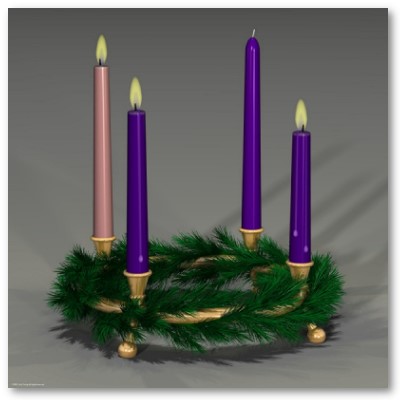
Gaudete Sunday, sometimes called Rejoice Sunday, is the mid-point during the Advent season. Advent is, like Lent, a penitential time but shortened considerably. During Advent priests wear purple and some aspects of the liturgy are, like Lent, not performed. Likewise, the altar is kept as simple as possible. On Gaudete Sunday, the priest will wear a rose or pink color vestment, flowers are allowed in the altar, and the use of an organ is allowed as well. The purpose of the day is to remind that during a time of penance (or any period of darkness) is that God’s joy is with us. That times of darkness are temporary, and we should rejoice. The Advent wreath candle for the day is also rose or pink as well. The word gaudete means rejoice in Latin.
The hymn Veni, veni, Emmanuel (or better known in English as (O come, O come, Emmanuel ) is sung in churches on this day.
Veni, Veni Emmanuel
Veni, veni Emmanuel!
Captivum solve Israel!
Qui gemit in exilio,
Privatus Dei Filio,
Gaude, gaude, Emmanuel
nascetur per te, Israel.
O come, O come, Emmanuel,
And ransom captive Israel,
That mourns in lonely exile here,
Until the Son of God appear.
Rejoice ! Rejoice ! Emmanuel
Shall come to thee, O Israel.





,_opposite_25_-_BL.jpg)
.jpg)