June calendar from the Très Riches Heures du Duc de Berry From Très Riches Heures du duc de Berry Folio 6, verso: June Between 1412 and 1416, circa 1440 or between 1485 and 1486 Public Domain via Wikimedia Commons
June is the sixth month on both the Gregorian and Julian calendars. June is one four months to be only 30 days long. June marks the beginning of summer in the Northern Hemisphere (and the reverse below the equator.) The Summer Solstice usually occurs between the 20-22 of the month and is the longest day of the year. June gets its name from the Latin Iunius, which was used on the old Roman calendar (which June was the fourth month since March used to be the first month) and believed to be named for the Roman god Juno. Juno was the wife and sister of Jupiter (the Roman version of Zeus, king of the gods). Juno was the protector of the nation and watched over women. She was also associated with youth.
Midsummer is celebrated in June on the summer solstice or St. John’s Day on 24 June. It is mainly celebrated in Denmark, Finland, Norway, and Sweden but the Baltic countries of Estonia, Latvia, and Lithuania celebrate it as well. Father’s Day is celebrated around the world in June but not on the same date. 19 June is Juneteenth, a federal holiday in the United States, which commemorates the Emancipation Proclamation read aloud in Galveston, Texas. This freed the enslaved people in the state that had been outside of Union Army control.
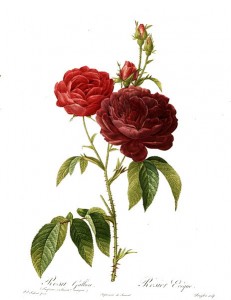
Rose is the June Flower. Les Roses by Pierre-Joseph Redouté (1759-1840) Photo:Public Domain (US Library of Congress: lccn.loc.gov/50049695)
It is a month of celebrations and weddings are very popular during this month. During Roman times getting married during the month of June was considered lucky and has become traditional since then as the month for preferred weddings. The June symbols are pearl, alexandrite and moonstone for the birthstones, with the rose and honeysuckle for the flowers. Although officially summer does not begin until the solstice, for commercial and agricultural purposes summer begins when the month begins.
May, from the Très Riches Heures du Duc de Berry (1412-1416) Limbourg brothers (fl. 1402–1416) Public Domain (Wikimedia Commons)
May is the fifth month on the current Gregorian and the old Julian calendar. It is named for the Greek goddess Maia. On the old Roman calendar, this was the third month. May has 31 days. The full moon in May is sometimes called the Flower Moon since many flowers bloom during this month.
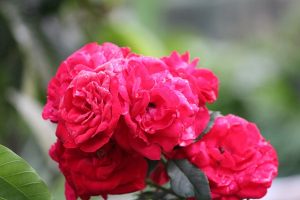
Bouquet of beautiful red roses Davidjose365, May 2015 Wikimedia Commons
May is commonly associated with spring in the Northern Hemisphere but autumn in the Southern Hemisphere. As the bridge month between spring and summer, the month has some days of hot and cold depending on location. There is an old expression that says “Warm January, cool May” that sometimes is accurate. In more olden times, when you sealed up the home for winter, it is now time to open the windows and let the warm spring air in! Spring cleaning was (and still is) a time to clean out the home after a long cold winter and freshen it up. If you ever saw the television show The Beverly Hillbillies, granny would have everything put outside so she could thoroughly and completely clean their mansion.
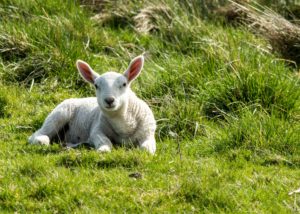
A sure sign spring is here is when lambs appear. Spring Lamb In The Sunshine Photo: Tanya Hall/publicdomainpictures.net
Spring is the time that plants begin to grow, and many festivals and celebrations have grown up around it. The ancient Romans had several of them during May and many Europeans today have events during the month. Late May is often considered the beginnings of the summer season in many places. The May symbols are the emerald (birthstone), along with Lilly of the Valley and Hawthorn as the birth flowers.
St. Patrick’s Day postcard, 1912 of “Old Weir Bridge” at Dinis Cottage, in Killarney National Park, Ireland. Public Domain/Wikipedia
March is the third month on both the old Julian and current Gregorian calendar. It is the month that begins spring in the Northern Hemisphere and autumn in the Southern Hemisphere. March is believed to be derived from the Roman god Mars (Greek equivalent Ares). Before the advent of the Julian calendar, Romans considered March the first month of the new year. With winter over, it was also the start of military campaigns to resume. Festivals were also held at this time in ancient Rome to honor Mars as well.
The March equinox is usually around March 21-22. Many spring festivals take place in March. Passover and Easter may take place in March, but not always as it is dependent upon very specific calculations and can change from year to year. St. Patrick’s Day is celebrated on March 17. If it falls on a Friday, Catholics are given dispensation to eat meat on that day (at least in Ireland and in areas where the feast is celebrated) If it falls on a Sunday, the diocese that observes the day will do so on Monday. For Ireland, since St. Patrick is its patron saint, it will be celebrated on Sunday replacing the normally observed day of Lent.
The famous Ides of March (March 15) was once a day to pay debts in Rome, but it became infamously associated with the assassination of Julius Caesar on that day in 44 BC. Daylight Saving Time begins in the U.S. and Canada on the second Sunday in March. For most of Europe, this will occur on March 31. The first full moon of March is often called the Worm Moon as many earthworms are being noticed in the Northern Hemisphere.
February by Leandro Bassano,1595/1600 Public Domain (via Wikimedia Commons)
February is the second month on the current Gregorian calendar (and the same on the old Julian). It is the shortest month of the year with 28 days except in leap years when it is 29. The name is derived from Februarius, a purification ritual that was held around 15 February on the old Roman lunar calendar. Until the calendar was reformed under the Julian, January and February were the last two months of the year (although originally there were no months after December as the Romans considered the time a month less period until spring). For the southern hemisphere, the seasons are switched so they are heading towards Autumn, so it is the equivalent of August for them.
With shorter number of days, it is the one month that can pass without a full moon (it happened in 2018). There are many fascinating names used during the month such as Snow Moon to indicate snow is on the ground. Some Native American tribes call it the Hunger Moon due to limited food sources during winter.
Why the leap year?
The old Roman calendar was ten months, which began in March and ended in December. When January and February were added it meant February became the last month of the year. That meant the month had to have 28 days to fit into the calendar. A leap month was introduced every few years after February to make room for the thirteenth month. This meant February had to be shortened. As you might guess, this made things a bit confusing. Julius Caesar introduced the new calendar in 46 BC (named for him of course). He abolished the 13th month and introduced the leap year so that every fourth year, February would have 29 instead of 28 days. Thus, the leap year was born and became part of the Gregorian calendar as well.
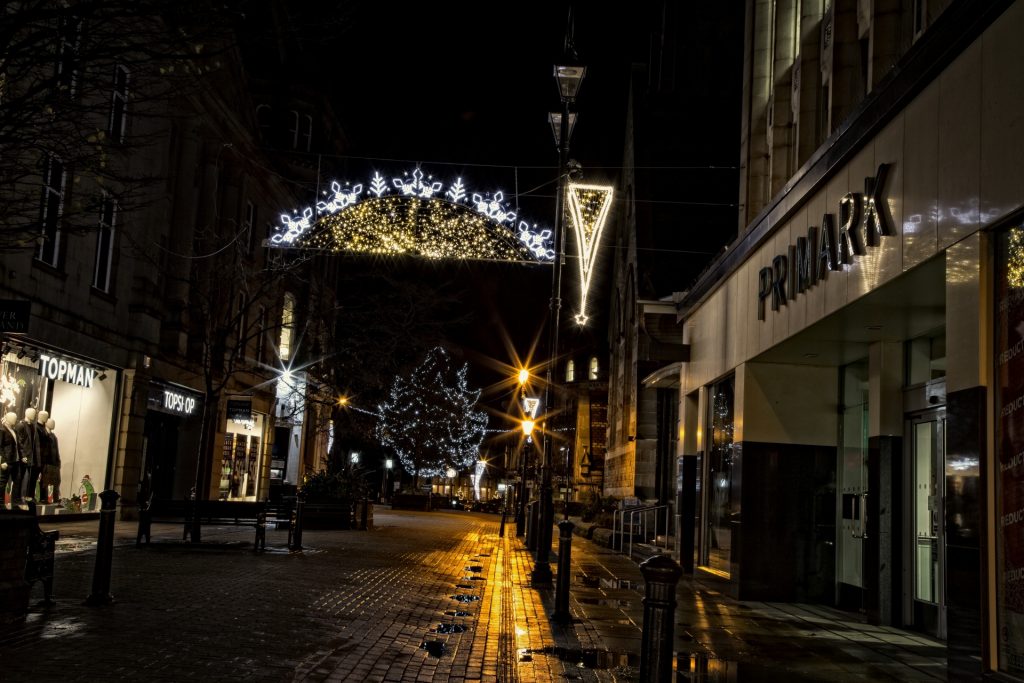
Night town with the Christmas lighting, Harrogate, North Yorkshire George Hodan, publicdomainpictures.net
December is the 12th month on the Gregorian calendar. The name derives from the Latin word decem, which means ten. Originally December was the tenth month in an older calendar as it started in March. Apparently the winter days that followed December were not included in a month until much later when January and February were added. December retained its name though. Anglo-Saxons used the term Yule for December-January, but that now that has largely come to mean December and the Christmas season.
December has the winter solstice in the Northern Hemisphere and the summer solstice in the Southern. Winter traditionally begins on the astronomical calendar around 21 December or the date of the actual solstice. The winter solstice is the shortest day of the year and depending on how far north you live, sunlight may only be for a few hours on that day. The symbols for December are the narcissus flower and turquoise, zircon and tanzanite as the birthstones.
Most Christians celebrate Advent in preparation for the celebration of Christmas on 25 December. Jews celebrate Chanukah/Hanukkah, the 8-day Festival of Lights in December as well. Kwanzaa is celebrated from December 26-January 1.
Le Très Riches Heures du duc de Berry-November Jean Colombe (1430–1493) Public Domain (Wikimedia)
November is the last month of Autumn in the Northern Hemisphere, and the last month of Spring in the Southern. The name November comes from the Latin novem, which means nine. This was its position on the old Roman calendar as that calendar only had ten months. The name remained despite it becoming the 11th month of the newer Julian and later Gregorian calendars. Daylight Savings Time, if it has not come to an end already, ends for everyone in the Northern in November. The annual Leonid Meteor Shower is usually around November 17-18. The first full moon of November is often called the Beaver Moon since many beavers build their dams around this time. In the United States, the major holiday is Thanksgiving celebrated on the last Thursday of the month.
The symbols for November are the topaz (birthstone that symbolizes friendship), and its flower is the chrysanthemum.
October is the 10th month on the Gregorian and Julian calendars. Under the old Roman calendar this was the eighth month and retained its name. October in the Northern Hemisphere begins the full transition to Autumn while in the Southern Hemisphere it is Spring.
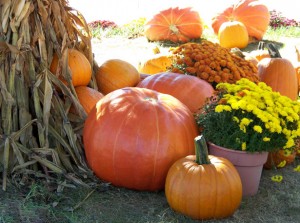
Autumn harvests are underway this month with apples, artichokes, cranberries, pears, and pumpkins becoming widely available in many areas. Pumpkins are important this time of year as decorations and the source for pumpkin pie and delicious roasted pumpkin seeds. Octoberfest is a major event in Munich, Germany but has spread into Europe, the United States and South America. It began in 1810 to honor a Bavarian royal wedding and now is in many places like a carnival with rides, lots of German themed food and of course beer. Beer of all kinds, especially craft beers find their ways to such events to be judged. Oktoberfest usually goes from mid-September to October (it used to end on the first Sunday in October) but it usually goes on later these days. One figure estimates the consumption of beer to be around 1.85 million gallons (7 million liters) of beer. Now that is a lot of beer!
Daylight Savings Time comes to an end in Australia and Europe this month. In the United States, that will on the first Sunday in November. Though legislation was passed in the U.S. Senate to change to Daylight Savings Time for the entire year, the House of Representatives did not pass it due to multiple objections. So the United States will remain on using both Standard and Daylight Savings Time.
Of course, the big event in October is Halloween or more properly All Hallows Eve on October 31. What used to be a day to prepare for the feast of All Saints Day now has morphed into an event primarily for children to put on masks and ask neighbors for a treat. Haunted House exhibits are open, hayrides through a haunted landscape, and of course scary movies to watch. We get the obligatory Halloween themed commercials and lots of scary themed promos. Many parents opt to have simpler old fashioned celebration with friends and children assembling for food, entertainment, and of course hearing very spooky stories.
A film about the Titan incident is already in the works. It is currently titled ‘Salvaged’ and is set to be produced by E. Brian Dobbins and MindRiot Entertainment – a company also making a docuseries about Kyle Bingham, the former mission director of OceanGate. MindRiot’s Justin MacGregor and Jonathan Keasey will co-write the film. “The Titan tragedy is reminiscent of the space shuttle Challenger disaster of 1986: it’s a tragedy I’ll never forget,” said MacGregor. According to Deadline, the film will cover periods before, during, and after the five-day tragedy.
Eerie pictures have been captured inside the abandoned TSS Duke of Lancaster described as a “ghost ship frozen in time.” Only echoes remain of the vessel’s past when the 1950s cruise ship treated passengers to silver service as they sailed from Ireland, Scotland and Europe. The first-class quarters were called “the best around” during its first decade on the sea.
Maritime search-and-rescue teams should receive more psychological support for stress and mental exhaustion after shortcomings were highlighted by the deaths of five people on a submersible diving down to the wreck of the Titanic, according to documents lodged at the International Maritime Organization. The international hunt for the Titan submersible exposed limitations in search-and-rescue planning, and have prompted efforts to improve the response to potential disasters beneath the sea, according to a paper submitted by Chile.
A remarkable, historic artifact with a strong Halifax connection sold at auction over the weekend for nearly $180,000. The final price on a special key(opens in a new tab) assigned to a first class steward on the Titanic was USD $151,250. Buried in Fairview Lawn Cemetery(opens in a new tab) in Halifax, Alfred Deeble was entrusted with the key to the saloon liquor cabinet — a “Pantryman” key as it was known then. Recovered with his body after the sinking, the key was carefully catalogued in Halifax with his other possessions, and sent to his grieving sister at her request.
A unique event is being held at one of Edinburgh’s city centre hotels, with an “immersive dining experience”. The evening, which will include a three course meal and performance, is all based on the final hours onboard the Titanic. Guests can expect an “elegant and opulent” evening, with a “heartfelt tribute” to the 1503 people who lost their lives. The event is being held on September 29 and 30, and again on October 1.
Carnegie Science Center will host Titanic: The Artifact Exhibition from Oct. 21 through April 15. Visitors will experience the grandeur of the RMS Titanic through full-scale room re-creations and 154 authentic artifacts on display within the Science Center’s PPG Science Pavilion. This must-see exhibition, viewed by more than 30 million people worldwide, takes visitors on a chronological journey through life on the Titanic, with a replica boarding pass featuring a real passenger’s name, from the ship’s construction to life on board, the fated sinking, and modern-day recovery efforts.
Emails obtained by The Canadian Press show officials with Memorial’s Fisheries and Marine Institute signed an agreement with OceanGate in December allowing the company to store equipment with the university and promising that students and faculty would have opportunities “to join OceanGate expeditions to support research endeavours.” The memorandum of understanding also says the marine institute would show off OceanGate’s submersible to visitors, in an effort to promote ocean literacy and the “blue economy.”
Medieval illustration of men harvesting wheat with reaping-hooks Circa 1310 Public Domain via Wikimedia Commons
August is the eight month on the Gregorian and Julian calendars. One the old Roman calendar this was the sixth month called Sextilis since that calendar start in March. It is named for the Roman emperor Augustus and this month was chosen as many important battles he won were done during this month. It is the last full month of summer in the Northern Hemisphere but in the southern the equivalent of February. In Europe, it is often the month where many workers take vacations.
August in the Northern Hemisphere is also when the first harvest and harvest festivals begin. The dog days of summer end officially on August 11. The Perseid Meteor shower which began in July continues to August 24. Usually the best viewing days are between August 9-13th. The August full moon is sometimes called Sturgeon Moon but since harvesting begins in the Northern Hemisphere it has also called Grain Moon, Fruit Moon, and Barley Moon.. For the people that live in the town of Ny-Ålesund in Norway, August is very important. As the northernmost town in the world, the summer has been one long day. The sun has been staying above the horizon since April and finally during August Polar Day occurs. That often occurs on August 24 though it can vary year to year. Tourists often visit between May-August. The sun does not rise between late October to mid-February.
June by Leandro Bassono (1557-1622) Public Domain/Wikimedia Commons
June is the sixth month on the Gregorian calendar. It is named for the Roman god Juno. Juno was the equivalent of the Greek god Hera, though with a few differences. Like Hera, Juno was the wife and sister of Jupiter (the Roman version of Zeus, king of the gods). Juno was the protector of the nation and watched over women. On the old Roman calendar, June was usually the fourth month as their new year started in March. June has 30 days.
June is also the month that has the most sunlight in the Northern Hemisphere. The summer solstice (winter solstice in the Southern Hemisphere) takes place during the month. It is a month of celebrations and weddings are very popular during this month. During Roman times getting married during the month of June was considered lucky and has become traditional since then as the month for preferred weddings.
The June symbols are pearl, alexandrite and moonstone for the birthstones, with the rose and honeysuckle for the flowers. Although officially summer does not begin until the solstice, for commercial and agricultural purposes summer begins when the month begins.
May, from the Très Riches Heures du Duc de Berry (1412-1416) Limbourg brothers (fl. 1402–1416) Public Domain (Wikimedia Commons)
May is the fifth month on the current Gregorian and the old Julian calendar. It is named for the Greek goddess Maia. On the old Roman calendar, this was the third month. May has 31 days. The full moon in May is sometimes called the Flower Moon since many flowers bloom during this month.
May is commonly associated with spring in the Northern Hemisphere but autumn in the Southern Hemisphere. Usually, it is also the time that plants begin to grow. It is a time for many festivals and celebrations as well. The ancient Romans had several of them during May and many Europeans today have events during the month. Late May is often considered the beginnings of the summer season in many places.
The May symbols are the emerald (birthstone), along with Lilly of the Valley and Hawthorn as the birth flowers.
Emerald from Muzo Mine, Mun. de Muzo, Vasquez-Yacopí Mining District, Boyacá Department, Colombia Public Domain via Wikimedia Commons







_2.jpg)