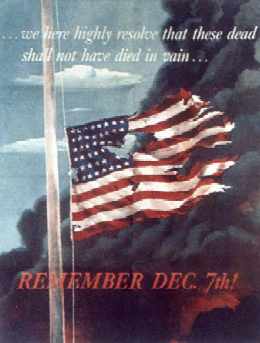
On this date in 1941, Japan launched a carrier based strike on U.S. military forces based in Pearl Harbor, Hawaii. Their strategy was to use this attack to convince the country and its leaders that war with Japan would be futile. They achieved tactical surprise as no warning of an attack had yet been received. While decryption of their codes had revealed their intent, the warning did not reach Pearl Harbor until after the attack had begun. The Japanese legation in Washington did not deliver their government’s official response to a recent diplomatic exchange until after the attack due to problems in transcribing the message. The attack began at 07:55 local time (12:55 p.m. eastern standard time). It was early afternoon when President Roosevelt was notified by Secretary of War Henry Stimson of the attack. There was some doubt among some staff as to the validity of the report but President Roosevelt believed it. And subsequent reports would show it was true. Radio was soon reporting on it as well and the entire nation soon learned of the shocking event that had taken place in the faraway location.
The purpose of the attack was to seriously cripple the U.S. naval and air operations (both the Navy and Army Air Corps). The surprise was effective and sank or crippled numerous American ships. However the jewels of the fleet were the aircraft carriers and they were not there. And the Japanese had no idea where they were. After conducting the first two strikes, a third strike was considered to more completely wipe out the storage, maintenance and dry dock facilities. Captain Minoru Genda, who helped in the planning, argued for invasion to maximize American losses. Admiral Nagumo decided to retire because of deteriorating weather, the unknown location of the American carriers, the long turnaround time required for a third strike that would allow American forces to gather and counterattack, and the fact the Nagumo’s strike force was at the extreme limit of logistical support. They were low on fuel and another strike would require them to travel at reduced speeds to conserve fuel. So he headed home. Much later Admiral Yamamoto, who supported the decision at the time, would in retrospect say it was a mistake since it allowed the U.S. to come back quickly.
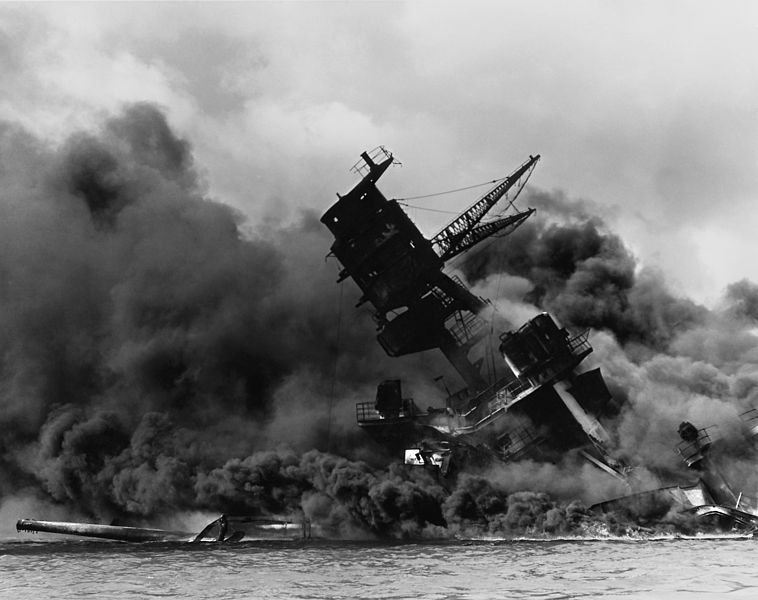
Image: Public Domain (National Archives and Records Administration,ARC Identifier#195617)
Most of those who died at Pearl were sailors aboard the ships that were damaged or sunk. Of the 2,008 sailors killed, 1,177 were killed when the forward magazine on the USS Arizona exploded. Eighteen ships were sunk, beached, or run aground. 188 aircraft (mostly Army Air Corps) destroyed, 159 damaged. Most of the planes were destroyed on the ground. Only eight pilots got airborne and did attack Japanese aircraft but only one was shot down. Some pilots were killed or shot down later by friendly fire. Five inbound planes from USS Enterprise were shot down. The Navy lost 24 of its PBY planes. Additional casualties came from when Japanese attacked barracks. 2,403 Americans killed and 1,178 others were wounded. Since the U.S. was not at war, they are all classified as non-combatants. The Japanese lost 55 airmen, nine submariners and one captured. They lost 29 planes in battle and 74 were damaged by antiaircraft fire.
Most Americans were enjoying a pleasant Sunday. Secretary of State Cordell Hull met with the Japanese ambassador around 2:30 p.m., just when the first reports were coming in about the attack. Popular Sunday afternoon radio shows were interrupted with the stunning news about the attack on Pearl Harbor. From coast to coast, Americans were riveted to their radios listening to the latest updates. Lines of volunteers began forming outside military recruitment centers. The isolationist sentiment was ushered to the rear while most of the nation united against the Japanese. On 8 November before a joint session of Congress, President Roosevelt asked for a declaration of war.
Mr. Vice President, Mr. Speaker, members of the Senate and the House of Representatives:
Yesterday, December 7th, 1941 – a date which will live in infamy – the United States of America was suddenly and deliberately attacked by naval and air forces of the Empire of Japan.
The United States was at peace with that nation, and, at the solicitation of Japan, was still in conversation with its government and its Emperor looking toward the maintenance of peace in the Pacific.
Indeed, one hour after Japanese air squadrons had commenced bombing in the American island of Oahu, the Japanese Ambassador to the United States and his colleague delivered to our Secretary of State a formal reply to a recent American message. And, while this reply stated that it seemed useless to continue the existing diplomatic negotiations, it contained no threat or hint of war or of armed attack.
It will be recorded that the distance of Hawaii from Japan makes it obvious that the attack was deliberately planned many days or even weeks ago. During the intervening time the Japanese Government has deliberately sought to deceive the United States by false statements and expressions of hope for continued peace.
The attack yesterday on the Hawaiian Islands has caused severe damage to American naval and military forces. I regret to tell you that very many American lives have been lost. In addition, American ships have been reported torpedoed on the high seas between San Francisco and Honolulu.
Yesterday the Japanese Government also launched an attack against Malaya.
Last night Japanese forces attacked Hong Kong.
Last night Japanese forces attacked Guam.
Last night Japanese forces attacked the Philippine Islands.
Last night the Japanese attacked Wake Island.
And this morning the Japanese attacked Midway Island.
Japan has therefore undertaken a surprise offensive extending throughout the Pacific area. The facts of yesterday and today speak for themselves. The people of the United States have already formed their opinions and well understand the implications to the very life and safety of our nation.
As Commander-in-Chief of the Army and Navy I have directed that all measures be taken for our defense, that always will our whole nation remember the character of the onslaught against us.
No matter how long it may take us to overcome this premeditated invasion, the American people, in their righteous might, will win through to absolute victory.
I believe that I interpret the will of the Congress and of the people when I assert that we will not only defend ourselves to the uttermost but will make it very certain that this form of treachery shall never again endanger us.
Hostilities exist. There is no blinking at the fact that our people, our territory and our interests are in grave danger.
With confidence in our armed forces, with the unbounding determination of our people, we will gain the inevitable triumph. So help us God.
I ask that the Congress declare that since the unprovoked and dastardly attack by Japan on Sunday, December 7th, 1941, a state of war has existed between the United States and the Japanese Empire.

President Franklin D. Roosevelt Signing Declaration of War Against Japan 8 Dec 1941
National Archives and Records Administration
And a hour later Congress officially declared war on Japan. Far from causing the U.S. to cower, it brought Americans together like never before. Hitler’s decision to join with Japan on 11 Dec was somewhat of a surprise-to his German High Command! They had not planned with war with the United States so soon and now they faced a two front war with an highly industrialized power against them. Mussolini foolishly committed Italy to the war with the U.S. as well.
For Japan they had control of the Pacific until June 1942. That is when the U.S. Navy engaged the Japanese at the Battle of Midway. At the end of the battle, four Japanese aircraft carriers were sunk to our one (the Yorktown). It was a shocking loss to the Japanese (and one they kept secret for as long as possible). The Doolittle Raid had convinced them to take on the American Navy directly. They did and lost spectacularly. And it shifted the balance of power in the Pacific. Admiral Yamamoto had been correct in his assessment of how the war with America would go:“I shall run wild considerably for the first six months or a year, but I have utterly no confidence for the second and third years.”
Yamamoto would not survive the war. President Roosevelt ordered that he be taken care of for his part in planning the Pearl Harbor attack. Thanks to the work of U.S. Naval Intelligence that had broken Japanese codes (code named Magic), his travel plans to the South Pacific in April, 1943 were learned. Orders were given and select pilots were used to target a very important high officer but were not told who it was. On 18 April 1943, a squadron of Lockheed P-38’s were assigned to intercept and bring down his transport being escorted by Japanese zeroes. There were two Japanese transports. After a dogfight with the Zeroes and transports, the transport with Yamamoto’s plane crashed into the jungle north of Buin, Papua New Guinea. Japanese search parties found his body, thrown from the aircraft and under a tree. He had two .50 caliber bullet wounds, one in his left shoulder and the other that had exited through his right eye. The true manner of his death was hidden from the Japanese public and not revealed until long after the war had ended. He was cremated, given a state funeral, and given posthumous titles and awards. Today the place where his plane crashed is a tourist attraction.
Sources:
“Pearl Harbor: Attack, Deaths and Facts.” HISTORY, 29 Oct. 2009, www.history.com/topics/world-war-ii/pearl-harbor.
“Pearl Harbor Attack | Date, History, Map, Casualties, Timeline, and Facts.” Encyclopedia Britannica, 1 Dec. 2023, www.britannica.com/event/Pearl-Harbor-attack.
“Pearl Harbor Attack, December 7, 1941 | the National WWII Museum | New Orleans.” The National WWII Museum | New Orleans, 7 Dec. 2001, www.nationalww2museum.org/war/topics/pearl-harbor-december-7-1941.
“Pearl Harbor Attack.” Naval History and Heritage Command, www.nationalww2museum.org/war/topics/pearl-harbor-december-7-1941.
Accessed 4 Dec. 2023.
For more information:
Home of Heroes
Pearl Harbor Remembered
The History Place
Pearl Harbor Attack(Naval Heritage & History Command)
Battleship USS Arizona History


