July 1947 photo of the rear entrance to the Führerbunker in the garden of the Reich Chancellery. German Federal Archives, Bundesarchiv, Bild 183-V04744 / CC-BY-SA 3.0
The defeat of German forces at the Battle of the Bulge in December 1945 ended any serious attempt by German forces to launch any further major military campaigns. In March 1945 American forces captured the Ludendorff Bridge intact allowing them to enter Germany over the Rhine. Meanwhile Soviet forces were pushing in from the East and closing in on Berlin. Due to Allied air attacks on Berlin, Hitler and his staff relocated from the Reich Chancellery to the Fuhrerbunker. This underground complex served as the command center for the Third Reich in the last months of its existence.
Hitler had remained inside this complex from the beginning of January 1945 only briefly coming up on April 20, his 56th birthday, to award the Iron Cross to Hitler Youth boys. On April 22, 1945, Soviet troops began entering Berlin suburbs meeting no resistance. When informed, Hitler was enraged and denounced the army for failing him and Germany. He stated that he knew the war was lost and despite being offered a way to flee south, decided to stay. Hermann Goering, his once designated successor, now would try to seize power under a 1941 decree giving him the power believing Hitler had incapacitated himself from power. It failed and he was forced to resign and put under house arrest. Hitler would later expel him from the Nazi Party. Heinrich Himmler was also trying to negotiate with the Allies via Sweden. When the BBC reported on April 28 that this was going on, Hitler was stunned as he considered Himmler one of his most loyal persons serving under him. He ordered Himmler’s aide in the bunker, who had been captured trying to desert, to be court-martialed and shot. He ordered Himmler’s arrest, expelled him from the Nazi party, and stripped him of all his titles. The once invincible Third Reich was in its last days.
[Disclosure: As an Amazon Associate, I earn from qualifying purchases. This post may contain affiliate links, which means I may receive a small commission at no extra cost to you.]
This photo from a captured Nazi shows German troops rushing across a Belgian road blocked with vehicles and armor during the enemy attack against the American Army which began Dec. 16th, 1944. Public Domain via U.S. National Archives
By December 1944 it had become clear to the German military and civilian leadership that that they would not be able to thwart a Soviet invasion without first ending the war in the West. Hitler, who had assumed direct control of the military in 1941, ordered a winter offensive that would deny the Allies the use of Antwerp’s port and to split the Allied lines. It was believed that if they achieved these aims it would force the British and Americans to seek a cease fire and a peace treaty. This then would free up the Wehrmacht to concentrate all its forces to defeat the expected Soviet invasion.
The Germans used 250,000 soldiers, 14 infantry divisions, and five panzer divisions in its initial assault on 16 December 1944. They attacked early in the morning on the weakest part of the Allied line, an 80 mile poorly defended stretch that was mainly hilly and a woody forest as well. The Allied leadership believed the Germans would not be able to traverse the Ardennes and therefore did not consider it a location for a German offensive. This was the same unfortunate thinking that doomed Singapore. The British concentrated all their forces to repel a frontal assault and left the rear-mainly jungle-lightly protected since they did not believe the Japanese would traverse that difficult terrain to attack. Unfortunately for the British, that is what the Japanese did and captured Singapore.
The Germans threw 250,000 soldiers into the initial assault, 14 German infantry divisions guarded by five panzer divisions-against a mere 80,000 Americans. Their assault came in early morning at the weakest part of the Allied line, an 80-mile poorly protected stretch of hilly, woody forest (the Allies simply believed the Ardennes too difficult to traverse, and therefore an unlikely location for a German offensive). Between the vulnerability of the thin, isolated American units and the thick fog that prevented Allied air cover from discovering German movement, the Germans were able to push the Americans into retreat. While some Allied troops were taken prisoner, some were not so fortunate. The following day in Malmedy, Belgium, a group of Americans from the 285th Field Artillery Observation Battalion were captured and rounded up in a field. They had been captured by the 1st SS Leibstandarte “Adolf Hitler” Division under SS Obersturmbahnführer (Lieutenant Colonel) Joachim “Jochen” Peiper.
The American troops were not front- line troops but were in a convoy when captured. They were taken to a field and with their arms raised, were fired on by German machine gunners. After that was over, SS soldiers shot the wounded and those groaning. Of the 113 Americans captured, 84 were dead. Those that survived feigned death. A Belgian widow, who witnessed the massacre, was also killed. Other Belgians in the area also saw it as well. Since the SS routinely did this, they had no reason to conceal it and moved on. News of the atrocity would spread fast from the survivors to the fighting troops in the area.
Six weeks of battle would result and the besieged troops in the surrounded town of Bastogne refused to give in. When asked to surrender, Brigadier General Anthony McAuliffe answered with famous “NUTS” reply. The U.S. 3rd Army drive to relieve Bastogne has become legend. Over 600,00o troops were involved making it the largest battle ever fought by the US Army in history.
Despite the intense cold, the Allied lines did not break and ultimately the Germans were forced back to Germany. Hitler’s gamble failed but it did upset the Allied war preparations causing a lot of damage. However tactically the German counteroffensive failed. Germany lost 120,000 men and material stores it could not replace easily. The Allies suffered 75,000 casualties but Germany no longer had the ability to put up a prolonged resistance to the renewed Allied offensive. German troops and their leaders knew that they lacked the ability to turn the tide and hopes for an end to the war were dashed for good. When the combat casualties of American troops was counted after the war, ten percent of the total casualties came to American troops at the Battle of the Bulge.
The-Battle-Of-The-Bulge. “Battle of the Bulge: The Largest WW2 Battle.” Last modified March 13, 2025. Accessed December 16, 2025. https://the-battle-of-the-bulge.com/.
“Battle of the Bulge | the United States Army.” Battle of the Bulge | the United States Army. Accessed December 16, 2025. https://www.army.mil/botb/.
Titanic News Channel is a participant in the Amazon Services LLC Associates Program, an affiliate advertising program designed to provide a means for sites to earn advertising fees by advertising and linking to Amazon.com.
“We here highly resolve that these dead shall not have died in vain… remember Dec. 7th!” Creator/Contributor: Russell Allen Sauberg, Office of War Information Publisher: U.S. Government Printing Office 1942 Public Domain via Wikimedia Commons
On this date in 1941, Japan launched a carrier-based strike on U.S. military forces based in Pearl Harbor, Hawaii. Their strategy was to convince the country and its leaders that war with Japan would be futile. They achieved tactical surprise as no warning of an attack had yet been received. While decryption of their codes had revealed their intent, the warning did not reach Pearl Harbor until after the attack had begun. The Japanese legation in Washington did not deliver their government’s official response declaring war until after the attack due to problems in transcribing the message. The attack began at 07:55 local time (12:55 p.m. in Washington D.C.). It was early afternoon when President Roosevelt was notified by Secretary of War Henry Stimson of the attack. There was some doubt among some staff as to the validity of the report, but President Roosevelt believed it. And subsequent reports would show it was true. Radio was soon reporting on it as well and the entire nation soon learned of the shocking event that had taken place in the faraway location.
The purpose of the attack was to seriously cripple the U.S. Naval and Army Air Corp operations. The surprise was effective in sinking or crippling numerous ships and destroying most of the planes on the ground. However, the primary target of the Japanese, the aircraft carriers, were not there and they had no idea where they were. After conducting two strikes and contemplating a third, Admiral Nagumo decided to retire due to deteriorating weather, that they were at the far end of logistical support, and they had no idea where the three carriers were. Captain Minoru Genda argued for a third strike and invasion to taking out the storage, maintenance, and docking facilities in Pearl Harbor. Nagumo realized also in the time it would take to make a third strike that American forces might counterattack. Additionally, the attack group was low on fuel requiring them to conserve fuel. Later Admiral Yamamoto would say that it was a mistake as it allowed the U.S. to come back quickly.
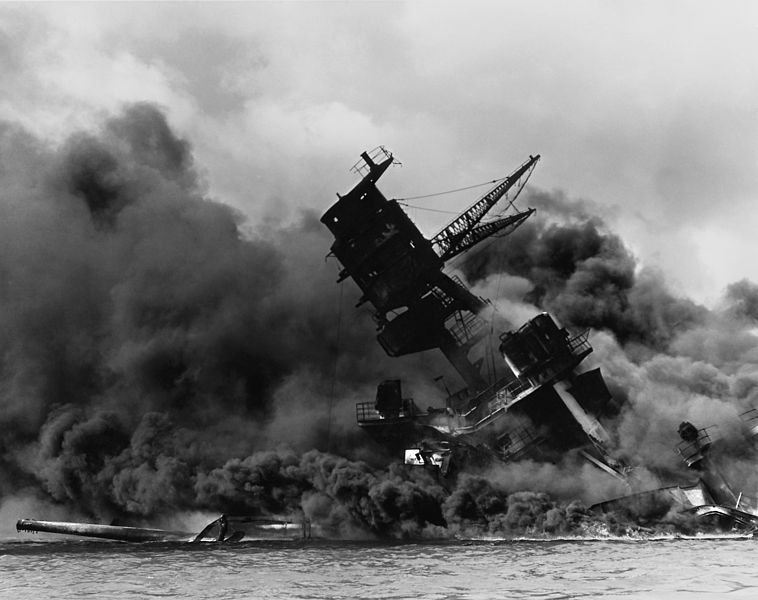
The USS Arizona burning after the Japanese attack on Pearl Harbor, December 7, 1941. National Archives Identifier: 520601/Local Identifier: 80-G-32420. Public Domain
Most of those who died at Pearl were sailors aboard the ships that were damaged or sunk. Of the 2,008 sailors killed, 1,177 were killed when the forward magazine on the USS Arizona exploded. Eighteen ships were sunk, beached, or run aground. 188 aircraft (mostly Army Air Corps) destroyed, 159 damaged. Most of the planes were destroyed on the ground. Only eight pilots got airborne and did attack Japanese aircraft but only one was shot down. Some pilots were killed or shot down later by friendly fire. Five inbound planes from USS Enterprise were shot down. The Navy lost 24 of its PBY planes. Additional casualties came from when Japanese attacked barracks. 2,403 Americans killed and 1,178 others were wounded. Since the U.S. was not at war, they are all classified as non-combatants. The Japanese lost 55 airmen, nine submariners and one captured. They lost 29 planes in battle and 74 were damaged by antiaircraft fire.
“The Japanese Government regrets to have to notify hereby the American Government that in view of the attitude of the American Government it cannot but consider that it is impossible to reach an agreement through further negotiations.”
As news broke across the country of the attack, the Japanese ambassador met with Secretary of State Cordell Hull at 2:30 pm to deliver the Japanese response. The long message listed the Japanese concerns and accusations about seeking peace ended with it saying they could no longer accept the current proposal and no further negotiations. Cordell Hull, after reading the full document, could not believe what he just read. According to Time magazine, he was visibly angry and responded: “In all my 50 years of public service I have never seen a document that was more crowded with infamous falsehoods and distortions — infamous falsehoods and distortions on a scale so huge that I never imagined until today that any government on this planet was capable of uttering them.” Japanese ambassador Admiral Kichisaburo Nomura (retired) remained silent along with an accompanying official. Hull would note in his diary later that he knew that Nomura was sincerely working for peace and totally unaware of the planned attack. In fact, the Japanese foreign office was never told about the planned attack. Nomura and the rest of his staff were interned and in 1942 sent to Portuguese East Africa where they were exchanged for Americans interned in Japan.
People enjoying a pleasant Sunday afternoon now were listening to news reports and early editions of newspapers screamed the headlines of the Japanese attack on Pearl Harbor. Military recruitment centers found lines of young men wanting to join up to fight the Japanese. The isolationist sentiment that once screamed for peace was ushered to the rear while most of the nation united against Japan. Old political foes in Congress now joined together supporting war. And on 8 November 1941, President Roosevelt addressed a joint session of Congress–carried live on radio–and asked for a declaration of war.
Mr. Vice President, Mr. Speaker, members of the Senate and the House of Representatives:
Yesterday, December 7th, 1941 – a date which will live in infamy – the United States of America was suddenly and deliberately attacked by naval and air forces of the Empire of Japan.
The United States was at peace with that nation, and, at the solicitation of Japan, was still in conversation with its government and its Emperor looking toward the maintenance of peace in the Pacific.
Indeed, one hour after Japanese air squadrons had commenced bombing in the American island of Oahu, the Japanese Ambassador to the United States and his colleague delivered to our Secretary of State a formal reply to a recent American message. And, while this reply stated that it seemed useless to continue the existing diplomatic negotiations, it contained no threat or hint of war or of armed attack.
It will be recorded that the distance of Hawaii from Japan makes it obvious that the attack was deliberately planned many days or even weeks ago. During the intervening time the Japanese Government has deliberately sought to deceive the United States by false statements and expressions of hope for continued peace.
The attack yesterday on the Hawaiian Islands has caused severe damage to American naval and military forces. I regret to tell you that very many American lives have been lost. In addition, American ships have been reported torpedoed on the high seas between San Francisco and Honolulu.
Yesterday the Japanese Government also launched an attack against Malaya. Last night Japanese forces attacked Hong Kong. Last night Japanese forces attacked Guam. Last night Japanese forces attacked the Philippine Islands. Last night the Japanese attacked Wake Island. And this morning the Japanese attacked Midway Island.
Japan has therefore undertaken a surprise offensive extending throughout the Pacific area. The facts of yesterday and today speak for themselves. The people of the United States have already formed their opinions and well understand the implications to the very life and safety of our nation.
As Commander-in-Chief of the Army and Navy I have directed that all measures be taken for our defense, that always will our whole nation remember the character of the onslaught against us.
No matter how long it may take us to overcome this premeditated invasion, the American people, in their righteous might, will win through to absolute victory.
I believe that I interpret the will of the Congress and of the people when I assert that we will not only defend ourselves to the uttermost but will make it very certain that this form of treachery shall never again endanger us.
Hostilities exist. There is no blinking at the fact that our people, our territory and our interests are in grave danger.
With confidence in our armed forces, with the unbounding determination of our people, we will gain the inevitable triumph. So help us God.
I ask that the Congress declare that since the unprovoked and dastardly attack by Japan on Sunday, December 7th, 1941, a state of war has existed between the United States and the Japanese Empire.
Congress declared war an hour later. The attack did not result in America cowering but uniting it. Both Italy and Germany, as members of the Pact of Steel, declared war on the United States. Roosevelt was surprised at both doing so. The German High Command was unprepared for war with America (they had planned it would happen some years later) and now faced a two-front war, something they had hoped to avoid. Italians were puzzled that Mussolini declared war on America and side with Germany. It was a foolish decision by Mussolini that would ultimately lead to his ouster in 1943.
Aftermath
Japan had control of the Pacific until June 1942. That is when the U.S. Navy engaged the Japanese at the Battle of Midway. At the end of the battle, four Japanese aircraft carriers were sunk to our one (the Yorktown). It was a shocking loss to the Japanese (and one they kept secret for as long as possible). The Doolittle Raid earlier that year had convinced them to take on the American Navy directly. They did and lost spectacularly. And it shifted the balance of power in the Pacific. Admiral Yamamoto, who supported the attack on Pearl Harbor, had expressed concerns about a long-term conflict with America. “I shall run wild considerably for the first six months or a year, but I have utterly no confidence for the second and third years,” he noted in memos before the war began. The famous Sleeping Giant quote though is purely fictional coming primarily from the movie Tora! Tora! Tora!.
Yamamoto would not survive the war. President Roosevelt ordered that he be taken care of for his part in planning the Pearl Harbor attack. Thanks to the work of U.S. Naval Intelligence that had broken Japanese codes (code named Magic), his travel plans to the South Pacific in April 1943 were learned. Orders were given and select pilots were used to target a very important high officer but were not told who it was. On 18 April 1943, a squadron of Lockheed P-38’s was assigned to intercept and bring down his transport being escorted by Japanese zeroes. There were two Japanese transports. After a dogfight with the Zeroes and transports, the transport with Yamamoto’s plane crashed into the jungle north of Buin, Papua New Guinea. Japanese search parties found his body, thrown from the aircraft and under a tree. He had two .50 caliber bullet wounds, one in his left shoulder and the other that had exited through his right eye. The true manner of his death was hidden from the Japanese public and not revealed until long after the war had ended. He was cremated, given a state funeral, and given posthumous titles and awards. Today the place where his plane crashed is a tourist attraction.
“USS Arizona BB-39 – USSARIZONA.ORG – Official Homepage of Battleship USS Arizona (BB-39) & Pearl Harbor Memorial Website Since 1999,” https://www.ussarizona.org/.
Dec. 7th, 1941: Pearl Harbor Old Historic Films USS Arizona Before and After. DVD. Campbell Films, 1941. This has 5 separate films in the collection. One is from Japan telling its citizens of the great victory. Another is a War Department film about the attack. There is an episode from Victory At Sea included, newsreels, and a film about USS Arizona. A must have for the serious enthusiast!
Tora! Tora! Tora! DVD. Williams-Fleischer Productions, Toei Company, 2006. This 1970 movie covers it from both the Japanese and American perspectives and is historically accurate. This provides an even handed look at both sides without a lot of drama (which was criticized) but the recreation of the attack is considered on the best done. Later movies rely on many of the action scenes from this movie. It takes the documentaries and brings them alive with a real cast and sees how this attack was planned, staged, and executed.
Titanic News Channel is a participant in the Amazon Services LLC Associates Program, an affiliate advertising program designed to provide a means for sites to earn advertising fees by advertising and linking to Amazon.com.
Nuremberg Trials. Defendants in their dock, circa 1945-1946. (in front row, from left to right): Hermann Göring, Rudolf Heß, Joachim von Ribbentrop, Wilhelm Keitel (in second row, from left to right): Karl Dönitz, Erich Raeder, Baldur von Schirach, Fritz Sauckel) Public Domain (Wikipedia)
In the aftermath of World War II, there was debate about how to hold accountable those responsible for war crimes and especially the Holocaust. Adolf Hitler, Heinrich Himmler and Joseph Goebbels were already dead by suicide. Churchill had the simplest approach of wanting to simply execute them, but it was decided that tribunal would be a better method. The tribunal would reveal to the world the extent of the crimes upon humanity the persons were responsible for.
The concept of an international tribunal was novel and had never been done before. Then again, no nation had before committed to full scale extermination of whole peoples as the Nazi’s had tried to do. An international tribunal composed of representatives from Great Britain, France, the Soviet Union, and the United States was formed. Defendants faced charges that varied from war crimes to crimes against humanity. Twenty- four were indicted along with six Nazi organizations such as the Gestapo that were also determined to be criminal. One was declared medically unfit to stand trial and another committed suicide before the trial began. Two top Hitler associates, Heinrich Himmler (1900-45) and Joseph Goebbels (1897-45), had each committed suicide in the spring of 1945 before they could be brought to trial.
Each defendant was allowed to choose their own lawyers. They all pled not guilty and either argued that the crimes they committed were declared crimes after the London Charter (meaning ex post facto) or that they were applying harsh standards as they were the victors. The trials would last 1 October 1946 when verdicts were handed down. Twelve were sentenced to death and others got prison terms. On 16 October 1946, 10 Nazi policy architects were hanged. Hermann Goering, who had been called the “leading war aggressor and creator of the oppressive program against the Jews,” committed suicide by poison the night before. Martin Bormann was tried in absentia and many thought he had escaped Germany. However, he never left Berlin, and his remains were eventually found (it appears he committed suicide), examined, and conclusively identified in 1988 using DNA. Other war criminals (German and Axis government leaders both civilian and military) would be tried into the 1950’s. 5,025 were convicted and 806 were executed. Those not sentenced to death, depending on what they did, served life sentences or were given shorter sentences.
Titanic News Channel is a participant in the Amazon Services LLC Associates Program, an affiliate advertising program designed to provide a means for sites to earn advertising fees by advertising and linking to Amazon.com.
Joseph Goebbels, Reich Minister of Propaganda Heinrich Hoffmann (1885-1957) German Federal Archives via Wikimedia
On 16 November 1941, Joseph Goebbels publishes in the German magazine Das Reich that the “Jews wanted the war, and now they have it.” This was part of the Nazi propaganda scheme to shift blame for the war to Jews and thus rationalizing the Final Solution–the elimination of Jews. German soldiers and the SS were infused with this propaganda and anti-Communist rhetoric to carry out their task of eliminating the Jews with enthusiasm.
[T]he prophecy which the Fuhrer made…that should international finance Jewry succeed in plunging the nations into a world war once again, the result would not be the Bolshevization of the world…but the annihilation of the Jewish race in Europe. We are in the midst of that process…Compassion or regret are entirely out of place here.
Joseph Goebbels (1897-1945)
Joseph Goebbels joined the Nazi Party in 1924. He had obtained a PhD in German literature from the University of Heidelberg in 1920. Prior to joining the party, he had worked as a writer, journalist, and clerk. The same year he joined the Nazi Party, he became editor of the Völkische Freiheit (Folkish Freedom) where he honed his propaganda skills for the party. Goebbels became an admirer of Hitler and became unfailingly loyal to him. He was also a rabid antisemite.
He came to Hitler’s attention in 1926 due to his organizational skills, devotion to the party, and his clever propaganda. He was made a regional Gauleiter (party chief) for Greater Berlin. He built up the Nazi Party organization and ran his own newspaper (Der Angriff or The Assault in English) until 1935 where he advanced the Nazi Party goals of anticommunism, antisemitism, and promoted Hitler becoming dictator of Germany. He would be elected to the Reichstag in 1928 representing the Nazi Party in Berlin.
Goebbels was a tireless agitator as the District Leader in Berlin. He railed against the Communist and Social Democratic party members, marched with the SA (Storm Troopers) into working class neighborhoods where support for those parties was strong. Bitter street fights would result, and Goebbels would call those who were injured or killed as suffering for the party. He made sure through his paper and other media of the heroism of those who suffered. Films were made to dramatize the events and led to the creation of the Horst Wessel Song, named for one of those who were killed in 1930. The song would become the party’s anthem.
The image he crafted was one of bloodied stormtrooper (and overly muscled as well) that would appear in Nazi propaganda for years to come. They died, the party said, fighting the Marxist enemy.
Hitler would appoint him as Reich leader of propaganda for the Nazi Party in 1929 and would hold that position until his death in 1945. Hitler relied on Goebbels in the critical elections of 1932. Goebbels was the first of that era to use radio and film for mass propaganda techniques. Films of Nazi rallies, speeches, and other important events were filmed and broadcast over the radio to inspire supporters and draw new ones in. Hitler was depicted by Goebbels as energetic and using all the modern modes of transport to get around Germany. Films showed him flying all over Germany on the same day holding events.
German students publicly burn collected, “un-German” writings and books on the central boulevard “Unter den Linden” in Berlin. 10 May 1933 Photo: Pahl, Georg German Federal Archives via Wikimedia Commons
After Hitler was appointed Chancellor in 1933, Goebbels would be instrumental in implementing the Nazi’s desire to control all aspects of German culture. Hitler established the Ministry of Public Enlightenment and Propaganda in March. At thirty-five years of age, he was the youngest member of the cabinet. Goebbels was tasked with decontamination of German culture, and nothing was considered outside of their control. Film, radio, and the press all fell under Goebbels control, and he used it to its fullest advantage. To make sure German’s accepted the anti-Jewish measures, Jews were cast into the worst possible light. Viewpoints unacceptable to the Nazi Party were silenced, books and publications were suppressed, and supported book burnings to cleanse the German spirit. Preaching national unity, Goebbels rallied people to support Hitler and the Nazi Party against those who had damaged Germany. And Jews were at the top of the list along with Communists, Socialists, certain religious groups, and others such as Roma. The doctrine of racial purity that party believed in excluded large swaths of people from German society.
Goebbels was the chief instigator for Kristallnacht in 1938. He convinced Hitler that the murder of the German diplomat in Paris was the perfect opportunity for a nationwide attack on Jews. And when Germany needed to invade other countries, he helped develop the Führer cult which glorified Hitler as both Germany’s war leader and savior. Mass propaganda was used to convince people that countries had to be invaded to save them from their mess created by Jews and Liberalism. Of course, during this whole time, the mass propaganda depicting the Jews and others negatively made it easier to target, imprison, and execute them. Right up until the end the near deification of Hitler and the rabid antisemitism would continue until the war ended in 1945. Goebbels was a complete supporter of the Final Solution-the Holocaust-the extermination of all Jews.
One of Goebbels last tasks in the final years was as Plenipotentiary for the War Economy which Hitler appointed him to in 1944. Goebbels had worked hard to keep morale up especially after the defeat at Stalingrad. In the new position, he was to help maximize manpower and arms production. He was not highly successful and ran into opposition with other ministers particularly Albert Speer who was in charge of armaments.
After Hitler committed suicide on 30 April 1945, Goebbels became the new Reich Chancellor. He refused the idea of surrender and knew full well he would be put on trial and executed. He and his wife Magda poisoned their six children and then both committed suicide on 1 May 1945. The corpses were partly burned but never buried. There were repeated burials and exhumations, and they were finally buried in Magdeburg at the SMERSH facility in 1946. The remains were exhumed again in 1970 under orders from KGB director Yuri Andropov and destroyed. They were then dumped into the Biederitz river.
Titanic News Channel is a participant in the Amazon Services LLC Associates Program, an affiliate advertising program designed to provide a means for sites to earn advertising fees by advertising and linking to Amazon.com.
FRANCE – JANUARY 02: Marshal Petain And Prime Minister Pierre Laval In The Park Of The Sevigne Pavillion In Vichy In 1942. Behind Them, On The Left, Dr. Bernard Menetrel Keeps Out Of Their Conversation. (Photo by Keystone-France/Gamma-Keystone via Getty Images) Public Doman via Wikimedia Commons
Following the French surrender to Germany in 1940, the Vichy state was created with Henri -Phillipe Pétain in charge and Pierre Laval as head of state. Laval began his political life as a pacifist but shifted to fascism in the 1930’s and anti-communist supporting France aligning with Italy rather than the Soviet Union. With war looming in 1939, he argued against war with Germany encouraging the antiwar faction to avoid sending troops into Germany when it invaded Poland in September 1939. His support of Germany got himself a high position in the new Vichy government.
Pétain disliked Laval and dismissed him after learning he was negotiating with Germany on his own. His friendship with Hitler though would bring him back into power becoming the real ruler of Vichy with Pétain as a figurehead. Under his rule, he carried out German directives rounding up and deporting Jews and imposing their draconian laws and policies. He fled to Germany after France was liberated in 1944. He had to flee again when Germany was defeated in 1945 to Spain. Franco deported him and hid out in Austria ultimately surrendering to American forces. Put on trial in France for his collaboration with Germany, he was found guilty of treason after a sensational trial that revealed how complicit he had been. Sentenced to death, he attempted suicide and failed. He was executed by firing squad on 15 October 1945.
Marshal Henri -Phillipe Pétain, revered for his service for France in World War I, was spared execution. Though convicted of treason and sentenced to death, the court asked that it not be carried out. President Charles de Gaulle commuted his sentence to life imprisonment. He was stripped of nearly all his military ranks and decorations but retained the rank of Marshal. He died in 1951.
Hermann Goering Commits Suicide (15 October 1946)
Herman Goering body, 15 Oct 1946 Public Domain
Hermann Goering was the highest member of Nazi Germany to be put on trial after World War II (except for Admiral Donitz who was appointed Reich President by Hitler in 1945). As Reichsmarschall, he held the highest military rank answerable only to Hitler and his designated successor. He commanded the Luftwaffe, was president of the Reichstag, prime minister of Prussia and many more titles too long to list here. Under his direction, concentration camps were created to imprison the regime’s enemies. Goering was greatly responsible for many of the anti-Jewish policies that were implemented particularly Kristallnacht where Jewish business were looted and nearly every synagogue was burned to the ground. He was known for his great art collection that was substantially increased as it was enlarged by art taken from captured countries.
Because of his high position and Hitler’s confidence in him, few dared to oppose him. Only SS head Heinrich Himmler was his only threat. Both ironically would try and fail to assume power in the last days before Germany fell in 1945. Goering’s stature had diminished over time with Hitler. He failed to deliver a fatal blow during the Battle of Britain (1940) and his Luftwaffe did not deter enemy bombings of Germany. His increased reliance on painkillers to overcome depression led to addiction causing problems for Hitler and others around him. After his dismissal (officially called a retirement for health reasons), he would later surrender himself to Allied forces rather than be taken by the Soviets. He would be tried in Nuremberg for various crimes against humanity.
As a result of his imprisonment, Goering’s addiction to painkillers ended allowing him to defend himself at the International Military Tribunal. He denied complicity in the more heinous acts done in concentration camps and the murdering of Jews, blaming them on Himmler. He tried to portray himself as a peacemaker and diplomat. Some testimony pointed out that opposing Hitler was impossible as it meant execution. However, when documents were introduced showing his complicity in Kristallnacht in 1938. Testimony also showed he knew about the execution of 50 airman who escaped but got recaptured as well as the extermination of Hungarian Jews.
He was found guilty of all charges on 30 September 1946 and sentenced to be hanged. He asked to be shot as a soldier but that was denied. Before he was to be executed on 16 October 1946, he committed suicide the night before taking a potassium cyanide capsule. Attempts to revive him failed but the mystery of how he obtained the poison would linger for years. A note written by him was found in 1967 stating he had hidden the capsule in a pomade container. In 2005 a former army private, Lee Stivers, who had served in the honor guard at the trial, came forward to say he had been given a pen by a German girl named Mona. According to his story, he had met her on the street one day and was impressed with him. Two male acquaintances of hers asked him to take secret messages to Goering using a fountain pen. He did this twice but on the third time he was told it contained a pill that was medication for Goering. He never saw the woman or the two men again and came forward to clear his conscience in the matter.
There are many that doubt Stivers story, but some believe it to be true. Aaron Breitbart of the Simon Wiesenthal Center in Los Angeles is quoted by the BBC as saying, “is crazy enough to be true.” In the end his body and the others executed were cremated and the ashes scattered over the Isar River.
Sources
Pierre Laval
“Pierre Laval | French Prime Minister, Collaborator & Statesman,” Encyclopedia Britannica, last modified October 11, 2025, accessed October 14, 2025, https://www.britannica.com/biography/Pierre-Laval.
Titanic News Channel is a participant in the Amazon Services LLC Associates Program, an affiliate advertising program designed to provide a means for sites to earn advertising fees by advertising and linking to Amazon.com.
On 8 Sep 1941, German forces began their siege of Leningrad that would last 872 days making it one of the most grueling sieges in modern warfare.
The fire of anti-aircraft guns deployed in the neighborhood of St. Isaac’s cathedral during the defense of Leningrad (now called St. Petersburg, its pre-Soviet name) in 1941. Public Domain via Wikimedia Commons
Leningrad, known previously as St. Petersburg and the Russian capital before the Communist Revolution of 1918, was a major industrial center. As the second largest Russian city, it was a strategic city for the Germans to conquer. When war started with Germany in 1941, most of the industrial plants and their workers were relocated to safer areas to prevent capture. However, this left approximately two million to face the rapidly moving German army. Everyone from old to young was conscripted to build anti-tank fortifications around the city. In July, the railway to Moscow was cut off by and German forces began besieging the outer fortifications. By September 8, they were outside the city but unable to enter due to both the fortifications and about 200,000 Red Army soldiers. German bombers destroyed warehouses and other infrastructure to making holding out more difficult. With all highways and rail lines cut off, the city was encircled with Finnish forces supporting the Germans.
Food had to be carefully rationed with most eating one slice of bread a day causing widespread starvation. And it was one of the coldest winters on record. Many still worked to build arms to defeat the Germans despite the intense deprivations of both warmth and food. Everything that could be eaten –cats and dogs, animals from the city zoo, wallpaper paste, leather boiled to make an edible jelly–was used. Various plants, grasses, and even weeds were consumed to add vitamins. And, taking a page from the unfortunate Donner Party, many started cannibalizing the dead as well. This was such a major issued that the police department had to create a special unit to handle this. Some supplies were able to be brought over Lake Ladoga, but the amounts were small and unable to alleviate the situation. Some evacuations of elderly and children were able to be done, but most starved or died. Thankfully by June 1943, Soviet forces were able to break the German blockade and establish a better supply line to Lake Ladoga.
This helped the inhabitants and with an oil pipeline and electricity being supplied as well during the siege, things were better than at the outset. Also, with spring there came the use of land to grow produce that would help many as well. Finally, by January 1944 the German Army was forced to retreat ending the siege. However, the death toll was staggering with at least one million dead. It would not be until the 1960’s when the population reached pre-siege levels of three million. Those who survived were all awarded the Order of Lenin. Today the city has fully recovered and there is no trace of this dark period in its history. It is a very popular tourist destination not only for Russians but others as well. The city is very spread out requiring the use of cars for even the shortest of destinations.
An old travel guide before 1918, advised people to pack warm clothing for the nights. While spring and summer days are often pleasant, cool nighttime temperatures required warm clothing. Raingear is recommended as well. As for the winter, bring lots of warm clothing Also, it advised people to make sure you knew there was a significant calendar change. Russia, until 1918, used the Julian calendar. And that meant you needed to subtract 13 days for the correct date in old Russia when you crossed the border. Christmas was not on December 25th, but on January 6. Today that is not a problem since Russia now uses the Gregorian, but the other advice is still sound. And to avoid getting into vodka challenges especially if it involves lots of caviar as well.
St. Petersburg, Russia. View from the visitor’s gallery at the Colonnade of the St. Isaac’s Cathedral. 2012 A.Savin via Wikimedia Commons
In history circles, there is a sort of a trivia game that is played over the city name. The city has had three names. It was St. Petersburg from 1703 to 1914. Because of its German sounding name, it was changed to Petrograd in 1914. Up until the Communist Revolution of 1918, the city was the cultural center as well as the capital of Russia. After that, the capital was moved to Moscow primarily to prevent any invasion that would take down the government. When Lenin died in 1924, the city was again renamed to Leningrad. After the fall of Communism, in 1991 the citizens decided in a referendum to restore the original name to St. Petersburg. So, the game is this: what is the real name of the old Russian capital? Is it St. Petersburg, Petrograd, or Leningrad? To make it tougher, sometimes a year is used: “What was the name of the former Russian capital in 1922 (or 1941)? The Jeopardy answer, if no year is specified, is all three.
On 23 August 1939 it was announced that Nazi Germany and the Soviet Union had signed a non-aggression treaty. The announcement was a complete surprise since Hitler had both in his writings and public speaking had denounced Communism and the Soviet Union. So why did this happen and what were its effects? Let’s find out.
Map of Europe and Western Asia in 1923 after World War I. Image via Wikimedia Commons
Both Germany and Russia had suffered in World War I. Germany was defeated by the Allies, lost its monarchy and colonial territories, and was ordered to pay huge reparations per the Versailles Treaty. Russia had gotten into the war to protect Serbia but was ill-equipped for a major war due to its limited resources and industrial capability. It suffered humiliating defeats during the war and its people suffered with reduced goods and services. This fed to unrest which led to Tsar Nicholas II to abdicate and allow a more democratic government to take over. Alas, that did not last as it continued in the war despite its unpopularity. This allowed the Communists, led by Lenin (who had been sent back to the country by Germany to foment chaos) to seize power and overturn the entire social and political structure of the country. In Germany, after a decade of vacillating leadership and discontent over inflation and Germany’s loss of status in the world, Adolf Hitler would lead the Nazi Party to victory after he was given the chancellorship in in 1933. Both Germany and Russia (now called the Union of Soviet Socialist Republics or just Soviet Union), were led by authoritarian governments that ruled with an iron fist.
The Soviet Union in its early days sought a promised world-wide revolution that never happened causing its leader Lenin and later Stalin to realize that building up the country first was needed before worldwide revolution. Hitler and the Nazi’s had a different view as they wanted to expand their country and restore pride in Germany. A new Germany was being formed with a clear ideology they were the people that would lead to change Europe and the world. By 1939, Germany was making its moves in Europe by invading Czechoslovakia. In 1938, they demanded and got a piece of Czechoslovakia when Britain and France, desperate to avoid war, forced Czechoslovakia to accept the deal breaking a treaty they had signed to defend it. Germany also annexed Austria that year as well uniting both countries. The invasion of Czechoslovakia told Britain and France that Hitler would not honor his agreements.
On the Russian side, Stalin had instituted programs to industrialize the country, but his brutal dictatorship had resulted in people being denounced, tried, and either imprisoned for years or executed. A climate of fear existed and not knowing whether someone had denounced you in secret made you wonder if you would come home that night. The Great Purge of 1936-1938 saw its officer corps depleted. The German Gestapo, feeding on Stalin’s paranoia, used the situation to use create documents that implicated many in the officer corps but also in government as well. The era became known for its show trials where the accused would be brought in, tried of a crime they didn’t commit, and faced imprisonment or death depending on the severity of the charge. Those who had become important members of government or close to Stalin that had been purged would be removed from the public record as well. Photos were retouched to show they were no longer walking, standing, or near Stalin or other people.
Stalin looked at expanding the Soviet Union by stealth or force into Europe. He hoped the war between the European nations would so weaken them so he could achieve his aims. Poland was, like Czechoslovakia a means to an end for both powers. Germany’s racial theory held the Polish people were, like the Jews, to be eliminated. For all the bad reasons, both Hitler and Stalin would come to terms and agree to a treaty that divided Poland into two spheres. Secret protocols to the pact indicated the demarcation lines and other things as well. The countries of Lithuania, Latvia, Estonia, Finland were secretly divided up as well giving both Germany and the Soviet Union access to raw materials. This allowed Hitler to invade Poland in September. Russia would move to claim its share of Poland, which the German military was not quite happy about since in some areas they had to withdraw back to the lines agreed to in the secret protocols.
“Nothing more unbelievable could be imagined. Astonishment and skepticism turned quickly to consternation and alarm”. (Gunther, John (1940). Inside Europe. New York: Harper & Brothers.)
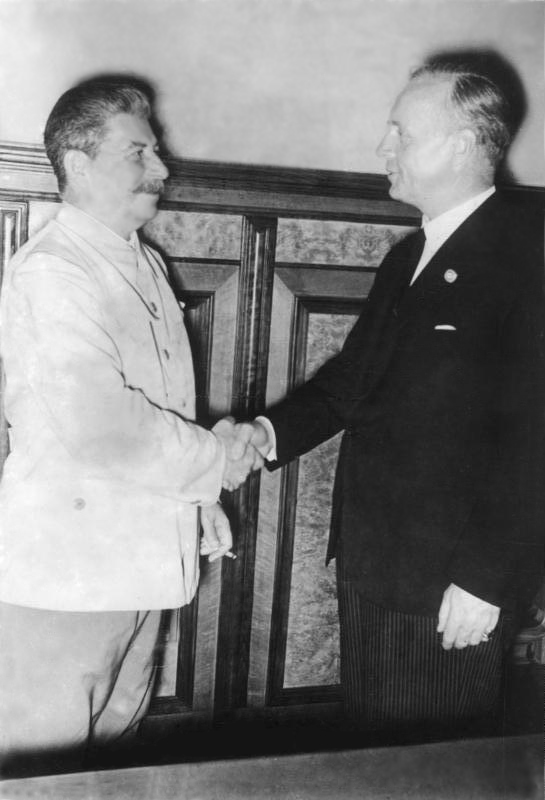
Stalin and Ribbentrop shaking hands over the newly signed pact between Germany and Soviet Union. August 23,1939 Source: German Federal Archive
The news of the agreement, popularly called the Molotov-Ribbentrop Pact, stunned the world. No one expected that Hitler would make a deal with Stalin. There had been some leaks suggesting of it, but no one thought it credible this would occur. The British and French had been in negotiations with the Soviets for months and were blindsided. Soviet propaganda heralded the agreement while others questioned secret protocols that were signed. Italy and the U.S. were given some limited information about them, but the full details were not disclosed. Soviet propaganda downplayed the previous attacks on Germany and Molotov himself made it clear they harbored no ill will. Nazi propaganda also had to do an about face as well. The Nazi’s had shut down the German Communist Party, imprisoned its leaders, and shut down its press. And they had nothing good to say about the Soviet Union either. Now they had to say everything was good with the hated Communist state.
Meanwhile the Baltic States began to worry how the rumored secret protocols would soon impact them. British and French attempts to meet with the Soviet negotiator over the agreement were rebuffed. Hitler said that with the treaty in place Britain should recognize Germany’s claims over Poland since it changed the situation from that of World War I. Instead, and to the German leader’s surprise, Britain announced a defense pact with Poland on 25 August 1939. Needless to say, Poland now realized it was being divided up by the two powers and war was coming.
How Central Europe would be divided up according the agreement. And what actually happened before Germany broke the treaty and attacked the Soviet Union. Author: Peter Hanula via Wikimedia Commons
The British and French governments had reached their end with Hitler; they no longer trusted him. In both countries the appeasement supporters diminished as reality set in that war was most certainly coming now with Germany. Neville Chamberlain, the chief supporter of the Munich Agreement a year before to avoid war, now realized his failure. He made it clear to Germany it would stand by Britain’s agreement to defend Poland. Hitler considered Chamberlain a fool and ordered the military to invade Poland as planned. The only question the Germans really had was whether those powers would do anything while they were attacking Poland. Both the British and French declared war on Germany when it invaded Poland on 1 September 1939 but took no immediate military action. It was a mistake that would prove costly for both countries later.
Aftermath
Stalin gambled that Hitler would focus on Europe and not on Russia. His goal was to build up the Soviet Union for war or to move in when his forces had subverted the country they wanted to take. Like many (including the German military high command) a two-front war was to be avoided. All of that went out of the window when Hitler decided he would invade Russia in 1941 under Operation Barbarossa. The goal of the operation was to remove and execute the leadership of Russia, take control of Russia, and make it a place for German resettlement. Stalin was not prepared for war and had discounted warnings Germany was about to invade as an attempt to get Russia to scuttle the treaty. Germany got the initial success and took territory easily defeating the military forces it encountered. However, they never took Moscow despite being twenty miles from it. And as time went on, faced more stiffer resistance and a military helped by American military equipment sent to help Russia defeat Hitler.
A vicious war broke out between the German and Russian forces creating now an Eastern Front that began to demand more resources than initially thought needed. The Soviet Union was getting supplies from the Allies using the dangerous North Atlantic to Murmansk route. And when the Allies landed in Europe in June 1944, this caused even more strain already on the limited resources Germany had. The Soviet troops started pushing back and ultimately forced Germany into retreat and ultimately to Berlin in 1945 where Hitler would commit suicide rather than be captured.
Stalin though did achieve his war aims in the end. Now with their troops in Poland and throughout Central Europe in countries they had liberated from Nazi rule, they would undermine the return of its former governments and subverted their political structure to ensure Communists would take charge. Albania, Bulgaria, Czechoslovakia, East Germany, Hungary, Poland, Romania and Yugoslavia all came to be controlled by the Soviet Union through governments that were installed and supported by them. It gave them access to sources of raw materials they had not had before and created a buffer around Russia. For people that had survived living under the yoke of Nazi controlled governments, it was simply swapping out one ideology for another with the same type of tyranny running things. Yugoslavia under Tito did break away from Moscow (he was fiercely independent but Communist) but that was about it.
The Iron Curtain, in black. Countries to the East of it are noted in Red and Warsaw Pact countries. NATO countries are blue, neutral states gray. Green depicts Yugoslavia which broke away from Moscow in 1948. Albania also had its own split starting in 1961 and in 1968 withdrew from the Pact but remained Communist. While a small part of Austria was occupied by the Soviet Union from 1945-1955, it did not join the Warsaw Pact and declared its neutrality. The small black dot in East Germany indicates West Berlin which was circled with the infamous Berlin Wall starting in 1961. Image: Sémhur via Wikimedia Commons
Until the fall of Communism began in 1991, these countries would remain either directly or indirectly controlled by Moscow through their governments. Some countries such as Czechoslovakia would break up (Czech Republic and Slovakia) after Communism ended. Yugoslavia would also break up as well into Bosnia, Croatia, Macedonia, Slovenia and the Federal Republic of Yugoslavia. Romania had the most violent uprising (Poland had strikes that forced out the Communists) that ended with its leader being executed in the end. East Germany would be unified with West Germany ending the separation that had begun in 1945.
Titanic News Channel is a participant in the Amazon Services LLC Associates Program, an affiliate advertising program designed to provide a means for sites to earn advertising fees by advertising and linking to Amazon.com.
Rare Agfacolor photo (invention from 1936) dated August 1944 taken in Warsaw, Poland in the Old Town Market Place during Warsaw Uprising in August 1944 Ewa Faryaszewska (1920-1944) Public Domain via Wikimedia Commons
On 1 Aug 1944 Poles in Warsaw launched a major uprising against the Nazi occupation. The Soviet Army had advanced to the Vistula River on the eastern suburb of Warsaw prompting the revolt. Polish General Tadeusz Bor-Komorowski, commander of the Home Army (an underground resistance group of around 40,000). The Home Army had ties to the government-in-exile in London, which was anti-communist. The hope was to gain at least partial control of Warsaw before the Soviets arrived.
By this time, the German Army had been pushed back considerably from its gains in Russia. And their taking Warsaw seemed likely. Despite this, Adolf Hitler ordered that the uprising be suppressed at all costs. The Nazi SS directed the defense force and engaged in brutal street fighting. The Polish Home Army fought back hard despite having limited supplies and no support from the Soviet Army (which cause friction between Poland and the Soviet Union for years).
The Red Army did capture several bridgeheads across the Vistula River in preparation to take Warsaw but held back doing anything more. Only under intense pressure from British Prime Minister Winston Churchill and American President Franklin Roosevelt did Stalin relent and allow Allies to drop supplies to the rebels. But it was too late as by that time, both the rebels and the citizens ran out of food, supplies, and medical supplies. The uprising came to an end on 2 October when the remaining forces surrendered. The revolt had lasted 63 days but the cost for both sides was high. An estimated three-fourths of the Home Army died along with 200,000 civilians. The Germans suffered 10,000 dead, 9,000 wounded, and 7,000 missing. In keeping with their dislike of the Polish people (they were seen as just a notch above the Jews but were slated for either slavery or death by the Nazis) the survivors were deported.
Deploying demolition squads, most of the remaining intact buildings in Warsaw would be destroyed over the next several months. All of Warsaw’s treasures were looted, burned, or destroyed. Meanwhile the Red Army sitting outside Warsaw did nothing to stop the Germans. They would not move until January 1945 when their final offensive was launched. On 17 January 1945, the ruins of Warsaw were liberated by the Soviets who faced little or no opposition. Thus, making it easy for them to establish a Communist state in Poland. After suffering from Nazi occupation, the Polish people would suffer a longer one under the Communists.
Sources
The Editors of Encyclopaedia Britannica, “Warsaw Uprising | Summary, Dates, & Monument,” Encyclopedia Britannica, last modified July 25, 2025, https://www.britannica.com/event/Warsaw-Uprising.
HISTORY.com Editors, “Warsaw Uprising Begins | August 1, 1944 | HISTORY,” HISTORY, last modified May 27, 2025, https://www.history.com/this-day-in-history/august-1/warsaw-revolt-begins.
On 25 Jul 1943 the Fascist Grand Council formerly voted Mussolini from power and was arrested later after meeting with King Victor Emmanuel III. So, what happened to the once all-powerful Duce? Let’s find out.
Benito Mussolini from the second edition of Adolf Dresler’s “Mussolini als Journalist” (1939) Public Domain via Wikimedia Commons
Italy Aligns with Germany
On 22 May 1939 Italy signed a treaty with Germany that allied both countries militarily and politically. Mussolini nicknamed this treaty, formally known as the Pact of Friendship and Alliance, as the Pact of Steel. The treaty committed Italy to support Germany if attacked or if it declared war. Mussolini believed the pact would provide defense from other Western nations and provide support for his ambitions in the Balkans and elsewhere. Italy was in desperate need of resources due to international sanctions in using mustard gas to conquer Ethiopia. It also lacked the industrial capability at that time for a sustained military conflict. Germany and Italy shared similar interests in believing Fascism was on the march. Italy, like Germany, sided with Francisco Franco during the Spanish Civil War (1936-1939). A treaty of mutual interest in 1936 brought them closer together and paved the way for the Pact of Steel. It was also Mussolini who coined the term Axis regarding the countries that signed the treaty.
Mussolini had hoped both the British and French would give him concessions after the Munich Agreement of 1938, where both powers forced Czechoslovakia to hand over territory to Germany. There was none and Mussolini gave speeches laying out Italy’s desire to take territory in North Africa, France, a part of Switzerland, and Albania. He also threatened British control of the seas and of taking Gibraltar. In both London and Paris, such talk was seen as signaling his territorial ambitions. In 1938, Italy invaded and conquered Albania convincing the other powers of his territorial ambitions. The Pact of Steel in 1939 cemented the partnership between the two countries that had been going on informally. Not all Fascists in Italy agreed with aligning with Germany. Foreign Minister Count Galeazzo Ciano, married to Mussolini’s daughter Edda, became skeptical later as Germany failed to disclose the planned to invade Poland as required by the treaty. While Ciano and other Fascists believed war with Britain and France was inevitable as both powers were blocking their ambitions, they did not see it occurring for a few more years. They dreadfully miscalculated Hitler’s aims and ambitions.
World War II
Mussolini knew that Italy was not ready for war until 1942 (and the Pact of Steel said neither side was to enter war till 1943). Lacking the raw resources and industrial capability, they needed to import both coal and steel. Countries like Britain banned those raw materials, making it difficult to acquire. Knowing this, Britain and France did try to lure Mussolini away from Germany by offering those resources. And it may have worked as Mussolini was preparing to sign documents to that effect. German pressure on Mussolini though scuttled it. They sent coal by train over the Alps to him to strengthen their friendship. The Italian Army was large on paper but lacked modern transport and weapons leaving them unable to hold their own against a fully trained and battle-ready army. Since supplies were critical to Italy, it failed to prepare its merchant fleet for war and lost many ships that were enemy ports when war was declared. Mussolini was warned by his military advisors to wait until war production would be able arm his military for war. While Italy easily took Albania, the British routed them in North Africa, and the Greeks were able to stop an Italian invasion of their country. In both cases, Germany sent troops to accomplish what the Italians failed to do. They were successful in Yugoslavia since German troops were with them. And the only declared war on France when Germany had defeated them so they could take territory in the south including Corsica. Thanks to Italian occupation in France though, Jews were safe as Italy refused German demands to turn them over.
Rationing of food and other supplies took its toll on the population. Due to a reduced merchant fleet, supplies became more difficult to acquire and had to rely on Germany for a lot of it. Inflation set in as well making it hard for many to buy the supplies. The poor military situation only made it worse and support for Mussolini began to slip. The army was lightly armored, the air force and navy were at odds with each other, poor leadership in the upper levels that were coupled with ill defined goals. Additionally, Mussolini might decide to do things on a whim making it a chaotic situation. With the Allies taking Sicily, landing in the south, and dropping bombs on Rome, most people had enough of the war. Both King Victor Emmanuel III and members of the Fascist Grand Council wanted Italy out of the war. Mussolini had to go.
Mussolini Sacked
The Fascist Grand Council met on 24 July 1943-a meeting that would last till the next morning-to discuss what to do. Mussolini, according to various accounts, looked sick, tired, and felt the burden of the military defeats suffered by the Italian military. For some, it appeared he wanted a way out and he got it. The Grand Council voted to remove him from power and transfer some of his powers to the king. There was opposition, but the majority voted for his removal. His son-in-law, Count Galeazzo Ciano, voted for his removal as well. Mussolini seemed stunned and dazed by it. His supporters tried to rally him, but he seemed deflated. He left for his meeting with King Emmanuel and arrived unshaven and groggy. He was informed by the king that he was under arrest and that General Pietro Badoglio would be taking over as Prime Minister. The war was seen as lost, the King Emmanuel reportedly said. Mussolini did not resist and seemed to accept it. He was told his family would remain safe. He was whisked away and imprisoned.
The announcement of Mussolini’s downfall was greeted with a general sense of relief. It was hoped this would mean the end of the war. The Fascists did not stage any protests or marches over his removal and imprisonment. He was being held at La Maddalena and later removed to a safer location to prevent his being rescued. The new Italian government negotiated behind the scenes seeking an armistice that would lead to a peace treaty. For a moment Italians breathed a sigh of relief hoping the war would soon be over.
Aftermath
Hitler was furious at his removal and knew the Italians would sign an armistice. Several German battalions were sent into Italy despite objections from the new government. When the armistice was announced on 3 September 1943, Operation Asche was implemented. German troops seized control of northern Italy and marched on Rome. They also seized all its territory in the Balkans and France. Italian forces were told to disarm or be fired upon. Some resistance was done in Rome as the royal family fled with the government. Corsica, Calabria, and Sardinia were successfully defended by Italian troops and repelled German troops until the Americans arrived. The Germans quickly implemented their anti-Jewish policies. Hitler ordered Mussolini found and was rescued from imprisonment at Hotel Campo Imperatore atop Gran Sasso d’Italia mountain range on 12 September 1943. Italians in the north would have to wait until June 1944 to be liberated.
[This was rewritten for 2025 correcting spelling, punctuation, and brevity]
The Editors of Encyclopaedia Britannica, “Pact of Steel | Italy–Germany [1939] | Britannica,” Encyclopedia Britannica, last modified March 18, 2009, https://www.britannica.com/event/Pact-of-Steel.
The Editors of Encyclopaedia Britannica, “Italian Campaign | Summary, Map, Significance, Date, & World War II,” Encyclopedia Britannica, last modified July 2, 2025, https://www.britannica.com/topic/Italian-Campaign.
Titanic News Channel is a participant in the Amazon Services LLC Associates Program, an affiliate advertising program designed to provide a means for sites to earn advertising fees by advertising and linking to Amazon.com.