Tag Archives: Mythbusters

Remembering History: The Hindenburg Disaster (6 May 1937)

[Note this has been rewritten from 2025 for conciseness and additional source information]

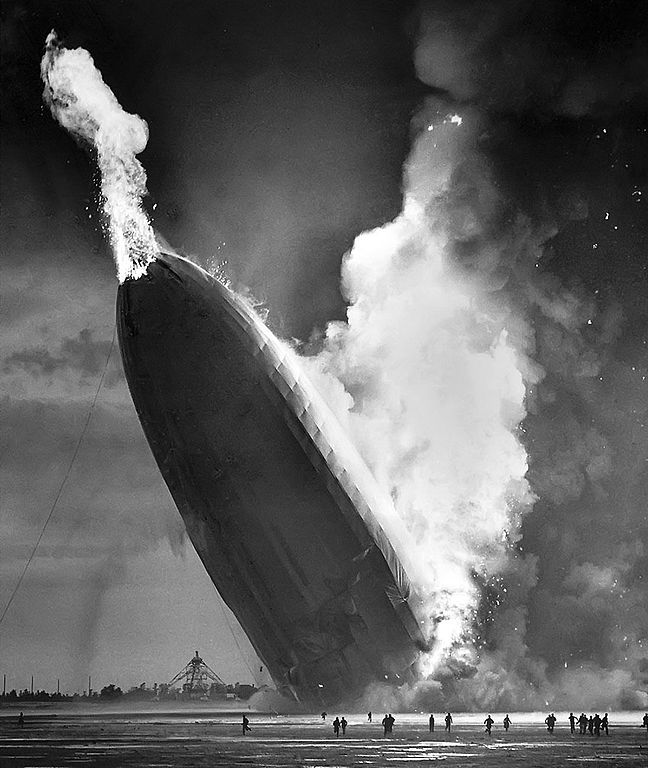
On 6 May 1937, the German airship Hindenburg caught fire and was destroyed while docking at Naval Air Station Lakehurst, New Jersey. Of the 97 passengers and crew, 35 died, and one ground worker was killed.

Airship Hindenburg crash in Lakehurst, New Jersey on May 6, 1937
Photo originally taken by Murray Becker, AP
Public Domain via Wikimedia Commons

The Silver Giant was the nickname of the German airship Hindenburg. At 804 feet long she was just 80 feet shorter than Titanic and was the largest aircraft ever built. She traveled at 80 miles an hour making a journey from Germany to the United States in 2 ½ days, faster than passenger liners of the day. It was a marvel of aviation to see these German airships move through the skies offering unparalleled views that modern day passenger jets rarely offer. Airships were essentially giant balloons, a technology that had been around since the 18th century and it was the German Ferdinand Graf von Zeppelin that developed them. His first creations were only a modest success but World War I saw them used for aerial bombings. Now called Zeppelins, they would drop bombs on unsuspecting people below in London or Paris causing panic. The damage they did was minimal and the British had a hard time shooting them down requiring newer ammunition be developed.

German engineers after the war designed airships as long range passenger ships to cross the Atlantic. While a test flight in 1919 showed it could be done, it would take until 1928 when the age of airship travel began. The Graf Zeppelin, launched in 1928, carried passengers in style that rivaled that of passenger lines. Commercial service between Germany, the United States, and South America commenced. Launched in 1936, Hindenburg made roundtrips to the United States and Brazil. It ?had 25 two person cabins, a bar, restaurant, and smoking lounge. Meals were served three times a day on fine china, with a grand piano as well. It was luxuriously decorated evoking a style only the most upscale hotels or passenger liners would do. One way cost $400 and most considered the experience worth the cost. All the German airships were originally designed to use helium, but the United States banned its export to Germany, so they used hydrogen instead.

Hydrogen being flammable required additional safety measures to ensure it would not contact anything that might ignite it. The smoking lounge was pressurized to keep the gas out. Smoking was forbidden outside of that area. The engines–4 Daimler Benz 16-cylinder engines that gave it were far away from the gas as well. A crew of forty was aboard the airship that day when it arrived in the United States. Despite this, many considered it safe and a better flying experience than taking an airplane. Its only rival was the Pan Am Clipper, which offered service to Asia, and many said was just as good. The future looked bright for airships, but what happened on May 6, 1937, would change that forever.

Scheduled to dock at the Lakehurst Naval Air Station in New Jersey, it first flew over Manhattan to give passengers a spectacular view of the city. The landing was delayed though due to winds of up to 25 knots. Being lighter than air, this would make landings difficult. Heading south until a storm had passed, then turned back at 6 pm and was scheduled to dock at 7 pm. As they approached, they dropped some ballast water splashing onlookers at the landing area. Hindenburg passengers could be seen looking out the windows by people on the ground around 7:21 pm. All looked normal to flight officers and crew were ready on the ground for the mooring line to drop from the tail and rear landing wheel.

Witnesses say they saw a mushroom size flame rise from the top of the tail section, just in front of the tail fin around 7:25 pm.  Crew in the tail heard a detonation that reminded them of a burner on a gas stove. Fire spread rapidly engulfing the midsection in flames before the tail hit the ground. Soon the entire airship was being consumed in flames in just 34 seconds leaving both passengers and crew little time to react. Many jumped when the ship was still high, perishing when they hit the ground. Many were trapped by both furniture and dead passengers. Some managed to walk out when it hit the ground or were rescued from its burning remains. An infirmary was used for survivors, and the press room was converted into a temporary morgue. Only 13 of the 35 passengers survived.

Due to the large number of reporters present, photographs and filming of the arrival was done. Reporters quickly called in their stories and photographs of the burning Hindenburg were quickly developed and published. Live reporting was rare, so most recorded their broadcast for later as was done by WLS (Chicago) reporter Herbert Morrison. His reporting of seeing the Hindenburg being destroyed was played the next day and went down in journalist history and forever associated him with the event. His by the minute account related to everyone who listened to the horror he saw and his interviews with people who saw or survived it as well. One interesting fact though was it was recorded at a higher speed making his voice sound higher than it was. You can listen to the full broadcast by going here.

The extensive investigation that followed resulted in neither German nor American inquiries finding sabotage was the cause. The American report found:

The cause of the accident was the ignition of a mixture of free hydrogen and air. Based upon the evidence, a leak at or in the vicinity of cell 4 and 5 caused a combustible mixture of hydrogen and air to form in the upper stern part of the ship in considerable quantity; the first appearance of an open flame was on the top of the ship and a relatively short distance forward of the upper vertical fin. The theory that a brush discharge ignited such mixture appears most probable.

It was then a tragic accident. A hydrogen leak had occurred and was ignited causing the terrible disaster. In the aftermath of this tragedy, the Zeppelins would continue to fly but their popularity began to wane. The Pan Am Clipper, originally designed to cross the Atlantic but banned by the British wanting to develop their own, showed long range planes were a viable service. In the United States, airship development had met mostly with disaster and was shelved. World War II saw the end of airships, and they never returned to passenger service. After the war, airplanes became dominant replacing passenger liners and trains for medium to long distance travel. While the modern-day versions are just used now for tours and taking live video shots of major events. However, there are some who believe, due to rising fuel costs and other issues, that perhaps airships may yet be viable again.

Over the years countless theories have been put forward to explain what happened to the Hindenburg: lightning, static spark, engine failure, incendiary paint, hydrogen leak, or a fuel leak. Some have argued sabotage was indeed the cause, though proof has been difficult to determine with a high degree of certainty. The tv show MythBusters looked at the incendiary paint theory and determined it was not probable. Occam’s Razor is perhaps the best guide here. The simplest explanation–a hydrogen leak ignited by its contact with air-is probably the truth.

Sources

“The Hindenburg, Before and After Disaster.” Encyclopedia Britannica. Accessed May 6, 2026. https://www.britannica.com/story/the-hindenburg-before-and-after-disaster.

“The Hindenburg Disaster | May 6, 1937 | HISTORY.” HISTORY. Last modified April 24, 2026. Accessed May 6, 2026. https://www.history.com/this-day-in-history/may-6/the-hindenburg-disaster.

“All About the Hindenburg — Adam Cap.” Adam Cap. Last modified January 22, 2019. Accessed May 6, 2026. https://adamcap.com/schoolwork/2698/.

“Oh The Humanity! Herbert Morrison and the Hindenburg.” Airships.Net. Last modified February 15, 2017. Accessed May 6, 2026. https://www.airships.net/hindenburg/disaster/oh-the-humanity-herbert-morrison-and-the-hindenburg/.

Disasters. “Seconds From Disaster the Hindenburg | Full Episode | National Geographic Documentary.” Video. YouTube, May 6, 2021. https://www.youtube.com/watch?v=KowvaxobrQg.

Videos & Documentaries

British Pathé. “Hindenburg Disaster – Real Footage (1937) | British Pathé.” Video. YouTube, March 24, 2016. https://www.youtube.com/watch?v=fURATK5Yt30.

NOVA PBS Official. “Newly Analyzed Footage Helps Solve Hindenburg Mystery.” Video. YouTube, May 17, 2021. https://www.youtube.com/watch?v=UFCgipjR2ow.

The History Guy: History Deserves to Be Remembered. “Hindenburg Reconsidered.” Video. YouTube, May 6, 2026. https://www.youtube.com/watch?v=2KxbATAhBiU.

Tasting History with Max Miller, “The Hindenburg Disaster – Dining on the Zeppelin,” Video, YouTube, November 28, 2023, https://www.youtube.com/watch?v=s8BqxWbX_r8.

Disasters. “Seconds From Disaster the Hindenburg | Full Episode | National Geographic Documentary.” Video. YouTube, May 6, 2021. https://www.youtube.com/watch?v=KowvaxobrQg.

Remembering History: The Hindenburg Disaster (6 May 1937)

Airship Hindenburg crash in Lakehurst, New Jersey on May 6, 1937
Photo originally taken by Murray Becker, AP
Public Domain via Wikimedia Commons

On 6 May 1937, the German airship Hindenburg caught fire and was destroyed while docking at Naval Air Station Lakehurst, New Jersey. Of the 97 passengers and crew, 35 died, and one ground worker was killed.

The Hindenburg was called the Silver Giant being 804 feet long and just 80 feet shorter than Titanic. At the time, she was the largest aircraft ever built. For people standing there to see the arrival of this airship, it was a marvel of aviation. Ballon technology had been around since the 18th century, but it was Ferdinand, Graf von Zeppelin who launched the first airship. The first models were only a modest success, but they were used by the Germans in World War I. These airships were used for aerial bombings of both London and Paris. They arrived with little notice sending people into panic though their actual bombing didn’t result in a lot of damage. However shooting them down proved difficult; it took two years for the British to come up with the right ammunition to bring a Zeppelin down.

After the war German engineers turned to making long range passenger airships that would cross the Atlantic. The first transatlantic was in 1919 and a decade later it looked like the dawn of airship travel had begun. The Graf Zeppelin was launched in 1928. The massive airship could carry passengers in accommodations that rivaled those on ocean liners. Commercial airship service between Germany and South America soon began. The Hindenburg, launched in 1936, made roundtrips to the United States and Brazil. It had 25 passenger cabins for two people each, a bar, restaurant, and smoking lounge (pressurized to keep hydrogen gas from getting in). Although originally designed for helium (which was banned by the US for export to Germany), it used hydrogen for its lift and buoyancy. It had 4 Daimler Benz 16-cylinder engines that gave it a maximum speed 80 mph (131 km). A crew of 40 were aboard the airship as well.

The German airships were undeniably spectacular in design and use It took half the time if you went by an ocean liner and its elegance was remarkable with luxurious interiors that to this day has yet to be matched by modern jetliners. Imagine enjoying meals flying above the ocean in an elegant dining room, sleeping in comfortable cabins, and having the ability to gaze out at the sea able to sometimes see dolphins, whales, and of course ships. The future looked good for airships but airplanes such as the Pan Am Clipper were also competition as well.

On 6 May 1937 the Hindenburg was scheduled to dock at the Lakehurst Naval Air Station in New Jersey. It flew over Manhattan giving the passengers a spectacular view of the city. On the way to Lakehurst, it was learned that winds of up to 25 knots were expected. Since the airship was lighter-than-air, winds make landings tricky. They headed southward for a while to let the winds diminish. After 6 pm, the airship was notified the storm had passed and was safe for them to approach and dock. The Hindenburg had traveled quite a distance away and turned back. Docking was not to occur until around 7 pm. Hindenburg finally arrived around 7:10 pm and began lining itself up for the mooring mast. It had to drop ballast water and some onlookers who were close got splattered. By 7:21 pm, passengers could be seen looking out the windows at the onlookers. Everything looked good. The flight officers in the cabin saw nothing out the ordinary. Crew were in the tail ready to drop the mooring line and the rear landing wheel.

At 7:25 pm witnesses saw a mushroom sized flame rise from the top of the tail section in front of the tail fin. The crewmen in the tail hear a detonation that was later described as like a burner on a gas stove turned on. The fire spread very quickly in seconds with the md-section engulfed in flames before the tail hit the ground. In 34 seconds, the airship had been totally consumed by flames. Passengers and crew had little time to react. Some jumped but the Hindenburg was still high up and many did not survive the fall. Others were trapped by furniture and passengers who had died. Some managed to walk out when the ship hit the ground or rescued from the burning remains. Survivors were taken to an infirmary while the bodies were removed to a makeshift morgue that normally served as the press room.

It was one for the first well-documented disasters in modern history. All the publicity about the landing of the transatlantic Zeppelin had attracted numerous journalists to watch its arrival. News crews had already been set up to photograph and record the landing. They recorded a disaster instead. While photographs of the event along with news reports will be immediately sent out, it would be the radio report done by WLS (Chicago) reporter Herb Morrison played the next day the most would remember.. Since live audio broadcasts were rare, he recorded what he saw about the landing. And listening to it was riveting. It was recorded at a higher speed than normal, so it was not his normal voice people were hearing. But the commentary as to what he witnessed would go down in journalist history. Later the newsreel footage and his commentary were added, but that was long after the disaster and his reporting was done solely by radio. His full broadcast included interviews with survivors and other witnesses. The full broadcast can be listened here.

An extensive investigation was undertaken to determine what had caused the explosion. Neither the American nor German inquiries found evidence of sabotage. The American report concluded:

The cause of the accident was the ignition of a mixture of free hydrogen and air. Based upon the evidence, a leak at or in the vicinity of cell 4 and 5 caused a combustible mixture of hydrogen and air to form in the upper stern part of the ship in considerable quantity; the first appearance of an open flame was on the top of the ship and a relatively short distance forward of the upper vertical fin. The theory that a brush discharge ignited such mixture appears most probable.

Many theories, in addition to sabotage, have been advanced over the years. They include Lightning, Static Spark, Engine Failure, Incendiary Paint, Hydrogen Leak, and Fuel Leak. MythBusters studied the Incendiary Paint hypothesis and concluded it was not probable. Today many who look at the evidence tend to believe the original conclusion as the most likely and that perhaps a small tear had occurred that allowed hydrogen to leak out.

Aftermath

Zeppelins would continue to fly but their glamour had begun to fade as airplanes started becoming a more acceptable way to fly. The Pan Am Clipper service which began in 1935 had become very successful. Interestingly it had been originally designed for crossing the Atlantic, but the British had banned Pan Am as they wanted to develop their own long range airplane service. Pan Am showed it could fly long range planes with passengers kept in comfort. The disaster and for other reasons (including World War II) ended the era of airships forever.

Sources

—. “The Hindenburg, Before and After Disaster.” Encyclopedia Britannica, www.britannica.com/story/the-hindenburg-before-and-after-disaster.

HISTORY.com Editors, “The Hindenburg Disaster | May 6, 1937 | HISTORY,” HISTORY, last modified April 30, 2025, https://www.history.com/this-day-in-history/may-6/the-hindenburg-disaster.

“The Hindenburg Disaster | Airships.net.” Airships.Net. Last modified June 28, 2019. https://www.airships.net/hindenburg/disaster/.
Remembering History: The Hindenburg Disaster (6 May 1937)

Airship Hindenburg crash in Lakehurst, New Jersey on May 6, 1937
Photo originally taken by Murray Becker, AP
Public Domain

On 6 May 1937 the German passenger airship Hindenburg caught fire and was destroyed while trying to dock at Naval Air Station Lakehurst near Lakehurst, New Jersey. Of the 97 passengers and crew, 35 perished and one worker was killed on the ground.

Airships were a popular way to travel. They were comfortable and often afforded their passengers the ability to see things that passengers of airplanes would not often see. The Germans had perfected the use of airships while the United States suffered humiliating crashes that confounded designers. The German Zeppelins used hydrogen for many years without any major incident until 1937.

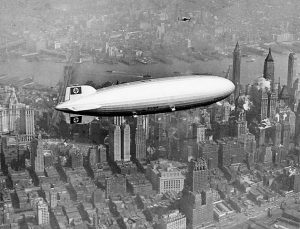
Hindenburg over New York hours prior to the disaster. (Public domain)

The event was caught on newsreel and on radio. Herbert Morrision’s radio coverage is classic and you can listen to at History.com. You can also listen to this one on YouTube which points out that Morrison’s voice was much higher than normal due to the tape recording speed (he was known for his deep voice). His actual audio report sounds different when you hear it as it ought to have been. A British Pathe newsreel of the disaster be viewed here.

While sabotage was suspected, neither the American or German inquiries concluded that was the cause. The American report concludes:

The cause of the accident was the ignition of a mixture of free hydrogen and air. Based upon the evidence, a leak at or in the vicinity of cell 4 and 5 caused a combustible mixture of hydrogen and air to form in the upper stern part of the ship in considerable quantity; the first appearance of an open flame was on the top of the ship and a relatively short distance forward of the upper vertical fin. The theory that a brush discharge ignited such mixture appears most probable.

The many theories that continue to persist are:

  • Sabotage
  • Lightning
  • Static Spark
  • Engine Failure
  • Incendiary Paint
  • Hydrogen Leak
  • Fuel Leak

Mythbusters examined the incendiary paint hypothesis and concluded it did not cause the catastrophe. Many believe the most likely reason for the explosion is that a tiny tear in the fabric or an exposed piece of metal was the entry point for static electricity to ignite the hydrogen. Hydrogen would never be used again for airships after this.

Airships faded from use though the famous Goodyear blimps over sports and other events are used to film the events below. And with the desire to conserve our environment these days, helium filled airships may yet return as a means of travel.

Sources

—. “The Hindenburg, Before and After Disaster.” Encyclopedia Britannica, www.britannica.com/story/the-hindenburg-before-and-after-disaster.

—. “The Hindenburg Disaster.” HISTORY, 5 May 2024, www.history.com/this-day-in-history/the-hindenburg-disaster.

—. “Hindenburg Disaster.” Wikipedia, 5 May 2024, en.wikipedia.org/wiki/Hindenburg_disaster.


Remembering History: The Hindenburg Disaster (6 May 1937)

Airship Hindenburg crash in Lakehurst, New Jersey on May 6, 1937
Photo originally taken by Murray Becker, AP
Public Domain

On 6 May 1937 the German passenger airship Hindenburg caught fire and was destroyed while trying to dock at Naval Air Station Lakehurst near Lakehurst, New Jersey. Of the 97 passengers and crew, 35 perished and one worker was killed on the ground.

Airships were a popular way to travel. They were comfortable and often afforded their passengers the ability to see things that passengers of airplanes would not often see. The Germans had perfected the use of airships while the United States suffered humiliating crashes that confounded designers. The German Zeppelins used hydrogen for many years without any major incident until 1937.

Hindenburg over New York hours prior to the disaster. (Public domain)

The event was caught on newsreel and on radio. Herbert Morrision’s radio coverage is classic and you can listen to at History.com. You can also listen to this one on YouTube which points out that Morrison’s voice was much higher than normal due to the tape recording speed (he was known for his deep voice). His actual audio report sounds different when you hear it as it ought to have been. A British Pathe newsreel of the disaster be viewed here.

While sabotage was suspected, neither the American or German inquiries concluded that was the cause. The American report concludes:

The cause of the accident was the ignition of a mixture of free hydrogen and air. Based upon the evidence, a leak at or in the vicinity of cell 4 and 5 caused a combustible mixture of hydrogen and air to form in the upper stern part of the ship in considerable quantity; the first appearance of an open flame was on the top of the ship and a relatively short distance forward of the upper vertical fin. The theory that a brush discharge ignited such mixture appears most probable.

The many theories that continue to persist are:

  • Sabotage
  • Lightning
  • Static Spark
  • Engine Failure
  • Incendiary Paint
  • Hydrogen Leak
  • Fuel Leak

Mythbusters examined the incendiary paint hypothesis and concluded it did not cause the catastrophe. Many believe the most likely reason for the explosion is that a tiny tear in the fabric or an exposed piece of metal was the entry point for static electricity to ignite the hydrogen. Hydrogen would never be used again for airships after this.

Airships faded from use though the famous Goodyear blimps over sports and other events are used to film the events below. And with the desire to conserve our environment these days, helium filled airships may yet return as a means of travel.

Sources

—. “The Hindenburg, Before and After Disaster.” Encyclopedia Britannica, www.britannica.com/story/the-hindenburg-before-and-after-disaster.

—. “The Hindenburg Disaster.” HISTORY, 5 May 2024, www.history.com/this-day-in-history/the-hindenburg-disaster.

—. “Hindenburg Disaster.” Wikipedia, 5 May 2024, en.wikipedia.org/wiki/Hindenburg_disaster.


Remembering History: The Hindenburg Disaster (6 May 1937)

Airship Hindenburg crash in Lakehurst, New Jersey on May 6, 1937
Photo originally taken by Murray Becker, AP
Public Domain

On 6 May 1937 the German passenger airship Hindenburg caught fire and was destroyed while trying to dock at Naval Air Station Lakehurst near Lakehurst, New Jersey. Of the 97 passengers and crew, 35 perished and one worker was killed on the ground.

Airships were a popular way to travel. They were comfortable and often afforded their passengers the ability to see things that passengers of airplanes would not often see. The Germans had perfected the use of airships while the United States suffered humiliating crashes that confounded designers. The German Zeppelins used hydrogen for many years without any major incident until 1937.

Hindenburg over New York hours prior to the disaster. (Public domain)

The event was caught on newsreel and on radio. Herbert Morrision’s radio coverage is classic and you can listen to at History.com. You can also listen to this one on YouTube which points out that Morrison’s voice was much higher than normal due to the tape recording speed (he was known for his deep voice). His actual audio report sounds different when you hear it as it ought to have been. A British Pathe newsreel of the disaster be viewed here.

While sabotage was suspected, neither the American or German inquiries concluded that was the cause. The American report concludes:

The cause of the accident was the ignition of a mixture of free hydrogen and air. Based upon the evidence, a leak at or in the vicinity of cell 4 and 5 caused a combustible mixture of hydrogen and air to form in the upper stern part of the ship in considerable quantity; the first appearance of an open flame was on the top of the ship and a relatively short distance forward of the upper vertical fin. The theory that a brush discharge ignited such mixture appears most probable.

The many theories that continue to persist are:

  • Sabotage
  • Lightning
  • Static Spark
  • Engine Failure
  • Incendiary Paint
  • Hydrogen Leak
  • Fuel Leak

Mythbusters examined the incendiary paint hypothesis and concluded it did not cause the catastrophe. Many believe the most likely reason for the explosion is that a tiny tear in the fabric or an exposed piece of metal was the entry point for static electricity to ignite the hydrogen. Hydrogen would never be used again for airships after this.

Airships faded from use though the famous Goodyear blimps over sports and other events are used to film the events below. And with the desire to conserve our environment these days, helium filled airships may yet return as a means of travel.

Remembering History: The Hindenburg Disaster (6 May 1937)

Airship Hindenburg crash in Lakehurst, New Jersey on May 6, 1937
Photo originally taken by Murray Becker, AP
Public Domain

On 6 May 1937 the German passenger airship Hindenburg caught fire and was destroyed while trying to dock at Naval Air Station Lakehurst near Lakehurst, New Jersey. Of the 97 passengers and crew, 35 perished and one worker was killed on the ground.

Airships were a popular way to travel. They were comfortable and often afforded their passengers the ability to see things that passengers of airplanes would not often see. The Germans had perfected the use of airships while the United States suffered humiliating crashes that confounded designers. The German Zeppelins used hydrogen for many years without any major incident until 1937.

Hindenburg over New York hours prior to the disaster. (Public domain)

The event was caught on newsreel and on radio. Herbert Morrision’s radio coverage is classic and you can listen to at History.com. You can also listen to this one on YouTube which points out that Morrison’s voice was much higher than normal due to the tape recording speed (he was known for his deep voice). His actual audio report sounds different when you hear it as it ought to have been. A British Pathe newsreel of the disaster be viewed here.

While sabotage was suspected, neither the American or German inquiries concluded that was the cause. The American report concludes:

The cause of the accident was the ignition of a mixture of free hydrogen and air. Based upon the evidence, a leak at or in the vicinity of cell 4 and 5 caused a combustible mixture of hydrogen and air to form in the upper stern part of the ship in considerable quantity; the first appearance of an open flame was on the top of the ship and a relatively short distance forward of the upper vertical fin. The theory that a brush discharge ignited such mixture appears most probable.

The many theories that continue to persist are:

  • Sabotage
  • Lightning
  • Static Spark
  • Engine Failure
  • Incendiary Paint
  • Hydrogen Leak
  • Fuel Leak

Mythbusters examined the incendiary paint hypothesis and concluded it did not cause the catastrophe. Many believe the most likely reason for the explosion is that a tiny tear in the fabric or an exposed piece of metal was the entry point for static electricity to ignite the hydrogen. Hydrogen would never be used again for airships after this.

Airships faded from use though the famous Goodyear blimps over sports and other events are used to film the events below. And with the desire to conserve our environment these days, helium filled airships may yet return as a means of travel.

Recent Titanic News

[Editors Note-Still catching up on news. Been busy as of late so I have not been able to post much]

1. Rare Titanic photo going under the hammer (Daily Echo, 10 Feb 2017)
A rare photograph of the ill-fated Titanic,which was bought for “a song” at a country auction, is now set to fetch hundreds of pounds when it is auctioned again next week. The black and white photograph, in a glazed oak frame, was taken shortly before the Titanic sank – with the loss of more than 1,500 lives – on its maiden voyage from Southampton to New York in April 1912.

2. Experts are disputing a documentary which says a fire was partly to blame for the Titanic sinking (thejournal.ie, 11 Feb 2017)
The programme argued that long-hidden photographs from the time showed that the Titanic’s hull had supposedly been damaged by a fire before it set off on its only journey, leaving it weak and susceptible when it hit an iceberg in the Atlantic Ocean. In the documentary, Moloney noted that researchers had known about the fire before but had tended to dismiss it as an ‘irrelevancy’, arguing that it should have been taken more seriously as a cause of the sinking. The documentary also claimed there were other issues which contributed to the ship sinking, such as substandard materials and shoddy workmanship, primarily due to cost-cutting. However a team of seven maritime historians has published an article completely refuting the programme’s claim that the coal fire was one of the main reasons why the ship sank. “However intriguing the claims set forth in Titanic: The New Evidence may be, they run counter to a wealth of well-researched facts about the ship and its sinking,” said J Kent Layton, a Titanic historian.

3. James Cameron really has a thin skin it seems when it comes to certain aspect of his famous Titanic movie. Fans debate the many points of this and that in the movie. One such example is whether or not Jack could have fit on the door Rose was on. Now I have not spent any real time dwelling on this point since we know this is just a movie. Apparently it got the attention of Mythbusters and they proved it was possible for Jack to have survived on the floating door with extra buoyancy. Okay that ought to have more or less settled it and we could move on. Not Cameron. So he recently commented on it by saying Jack would never have survived and that Mythbusters was full of poop (he used a barnyard word that is far more graphic for this family friendly blog). Of course he was on that episode of Mythbusters and never said is was all poop. He does say it was in the script he was to die. Okay. Moving on.
James Cameron Debunks ‘Titanic’ Theory That Jack Could Fit On The Door (Huffington Post Canada, 1 Feb 2017)


Science Friday: Can a Cell Phone Cause A Gas Station Fire?

You have likely seen or heard warnings about using cell phones while filling up at the gas station. The warning is not mandatory but many gas stations have them because many are convinced it can happen. Except it cannot. What does cause fires at gas stations is either static electricity that is not discharged prior to handling the gas pump or an ignition source like match being struck to light a cigarette (or possibly a discarded burning cigarette). What makes these fires worse is when a fire does break out right at where you are fueling the car. Many pull the fuel pump out and end up making it worse by dripping the burning fuel right on the ground. That always spreads the fire and then a major fire breaks out. At any rate those clever fellows over at Mythbusters looked into this and here is the result of their examination of this myth.


Cameron’s Titanic: Could Jack & Rose Both Survive?

Okay for those who did not see the movie, Jack and Rose both initially survive the sinking and cling to a piece of wood. But Jack decides to allow Rose to live by dying since both clinging to the wood might result in both dying. Was this right or wrong? It appears many out there believe that both could have lived. Time to call the dynamic duo! No, not the one with the bat as an emblem, but those clever guys at Mythbusters.

What did they find out when the put it to test (with James Cameron looking on)? Here are two clips from the show from YouTube on what they find out.

Update on Hartley Violin


The BBC has an interesting update on the Hartley Violin claim. To recap: Henry Aldridge Wallace Hartley's Violin& Son claims a violin has been authenticated as belonging to Titanic bandleader Wallace Hartley and was on his body when recovered. It was given to his fiancee where it remained until she died. It was then donated to the Salvation Army with its Titanic connection mentioned. Then it was given to the mother of the current owner (unidentified at this point) who contacted the auctioneer to have it authenticated (which took seven years).

Skepticism was quick in coming. Karen Kamuda of Titanic Historical Society has questioned the authenticity pointing out no such violin is listed in the official inventory of items found.  Tracey Beare of Belfast Titanic Society thinks the violin is Hartley’s but not the one used on Titanic. Titanic author Daniel Butler went further and accuses the auctioneer of fraud and got violin experts to render an opinion. You can read the blog entry about that here.

Aldridge refutes all of those claims and says there are explanations for each of them.

1. Inventory Issue: Violin Not Listed In Official Papers of Items Found On Body
Aldridge: “Larger items of luggage were frequently not recorded but small effects like watches were.” (BBC, 5 April 2013)

I have no idea whether this is correct or not, but one would have to go back through the documents to determine how they did handle luggage. What Aldridge is referring to are those things found on the body, i.e watches, notes, rings and other personal effects. Such things,when found,would be returned to relatives or loved ones.

The problem is Aldridge claims the violin was inside a leather bag strapped to Hartley’s body which floated upright on a cork and linen lifejacket for ten days. If that is true, then they could not have missed the bag and its contents. It would have been opened and inspected, and noted somewhere. Finding a bag strapped to a dead man’s body and not opening to inspect and inventory? That is rather hard to believe. One possibility is that the bag was found floating but not to a body but possibly on something else (a deck chair perhaps) or just by itself. Then it might be brought back and left for the authorities to examine. If this is true, it might explain why no official record of it exists with his body. It was not found on him but perhaps is buried in paperwork. So when Maria Robinson identified it in Nova Scotia, they gave it to her and hence why no official record exists.

Of course the other possibility is that no violin was found at all and thus the one at issue, while owned by Hartley, was not on Titanic.

2. Salt Water Issue
The claim: A violin immersed in salt water gets heavily damaged and comes apart.
Aldridge: The violin was inside a nearly waterproof leather bag strapped to Hartley’s body which floated upright for ten days. (BBC, 5 April 2013)

Assuming it was in a leather bag that floated upright on Hartley’s lifejacket, there are some things to be considered. Even in a bag, it would not entirely protect it from the cold temperatures nor moisture. We have to assume during that time waves passed over the body and presumably the leather case strapped to the body. At some point, the body would be submerged temporarily. The water stain on the violin could have come from this.

There is a way to test this though is Mythbusters style. You set up a tank to simulate the wave action of the North Atlantic and have the same salinity (salt) level in it. Also make sure the water matches the colder temperatures for that time of year. They you set up floating dummy with a leather sack and a violin inside (preferably one donated for the cause) along with detection gear to monitor for temperature and moisture level inside the sack. And run for ten days to and see what happens. And then also run another challenge of a violin afloat with a leather container for the same amount of time.  My guess is the one inside the leather bag might be less damaged than the one without.

The BBC article does have violin dealer Andrew Hooker (formerly of Sotheby’s) saying that violins have survived seawater immersions in the past. He says that an 18 century Stradivari violin was swept out to sea one day in 1952 and was swept back in the next with no problems being able to be played. Note what is left out. He does not say where that happened (for fact checking) because it may not have been swept out to the deep sea but was lodged nearby on a rock and then swept back in on the next tide. To say it was not damaged is probably not accurate. Hooker does say something interesting to the BBC:

“Mr Hooker examined the Hartley violin in person and says it has been restored since surviving the Titanic disaster.”

Note that key word restored in that sentence.  According to The Telegraph article on 14 Mar 2013, the violin has two long cracks on its body opened up by moisture damage. And later we have a letter to the current owner’s mother as to why the Salvation Army music teacher decided to give it away. “….I found it virtually unplayable, doubtless due to its eventful life.” So it begs the question as to what Mr. Hooker means it was restored.

Perhaps though, even if made playable again, it never sounded good. That would bolster the assertion by one of Butler’s experts that the metal plaque effects the tone and quality of the violin. If so that would support the theory this violin was not one used for public performances.

3. Second Violin Issue
Claim: The violin, while owned by Hartley, was of a lower grade than most performers were used. Likely a gift since the metal inscription would inhibit its tone and overall quality when played.
Aldridge:” Mr Aldridge says that Hartley was a “cafe violinist” not a concert-grade musician, and did not have spare money for extra violins. (BBC, 5 April 2013)

Aldridge does have a point here. Concert grade violins are not cheap but most performers save up to buy the high quality equipment. It sounds better and if treated right, will last a very long time.  But if he was smart, and I bet he was, he had a backup. One that in a pinch he could pull out and use. It would be old, perhaps not as good, but would get the job done until he got back his primary (which would be in the shop being repaired). He may have brought it aboard Titanic that voyage and that is what we found. We may never know for sure whether he had two violins or not aboard Titanic. I wonder though if any violins were found in the debris field and recovered. They did find some musical instruments. Perhaps if he did have a second it is there and he kept the one most dear nearest to his heart.

I think we have to at least consider the possibility he had a primary and a backup. And if the metal inscription did effect tonal quality, he may not have used for public performances even if he was a “café violinist.”

Wrapping Things Up
One proof submitted is a diary entry by Maria Robinson dated 19 Jul 1912. It apparently is the transcript of a telegram sent to the Provincial Secretary of Nova Scotia in which she states: “I would be most grateful if you could convey my heartfelt thanks to all who have made possible the return of my late fiance’s violin.” The actual telegram has not been found so, at this point, it cannot be ascertained it was sent. It would seem to confirm a violin was returned to her. If that is true, it certainly supports the theory the violin was found but not why it was not recorded. If it was in luggage (the leather bag) found floating, that might explain it. However the silence on the Nova Scotia end is odd. If it was found on his body, it would be noted. If it was found in a leather bag brought ashore, and then identified by Maria Robinson, there would be an entry somewhere. A further check of records might have to be done and perhaps looking into ancillary records that might contain that nugget.

I think it is wise to have a second pair of eyes, independent of Aldridge, go over all the findings and double-check everything. And it also is wise not to underestimate fakery. There have been great fakes in the past that have gotten by experts on the first examination. Aldridge, despite what some might want to believe, would never be part of this. The damage to his reputation and his business would not be worth it. However there are others out there who have no problems creating historical fakes using clever means. Getting an old violin from that period and using all the right things might very well create a fake Hartley violin that would pass muster. After all, if one can make seemingly historical inscriptions on ancient tombs to make them look real, then mocking up an old violin is not so difficult.

Source: ‘Titanic Violin’ Sparks Heated Debate(5 April 2013, BBC)