Prohibition agents destroying barrels of alcohol. Public Domain (via Wikipedia)
On January 16, 1919, the 18th Amendment to the U.S. Constitution was ratified, banning (except for industrial and religious uses) the sale, manufacture, and importation of alcohol. It was repealed by the 21st Amendment in 1933.
In the 19th century, temperance movements arose to address alcoholism, public drunkenness, and related social problems like gambling and prostitution. This religious-based movement gained support in many states with laws curtailing alcohol sales. It soon became national, calling on Congress to impose a nationwide ban. In 1917, Congress passed the 18th Amendment and sent it to the states for ratification. All but two states (Connecticut and Rhode Island) ratified it, though a few did so after the required number had been met.
A separate act, the Volstead Act, gave the Department of the Treasury enforcement power. It was vetoed by President Wilson, but Congress overrode the veto. The Supreme Court ruled in Dillon v. Gloss (1921) that Congress could set a ratification deadline. Controversy arose over the phrase “intoxicating liquor,” as many thought it applied only to hard liquor, not beer or wine. However, it was enforced as a total ban, leading to lax enforcement in many states due to its unpopularity. On January 17, 1920, the United States became a dry country.
Small-time bootlegging and smuggling from Canada, Mexico, or Cuba quickly emerged. Criminal syndicates and gangs in large cities launched their own operations, becoming wealthy and dangerous. They amassed enough money to bribe police, judges, and politicians. Ruthless gangs in Chicago and elsewhere fought lethally, killing rivals and sometimes innocent bystanders.
By the end of the 1920s, Prohibition was widely seen as a failure, having replaced alcohol’s social dangers with worse problems. A countermovement for repeal grew and was adopted by the Democratic Party in 1932, backed by presidential candidate Franklin Roosevelt. Congress proposed repeal in February 1933, requiring ratification by state conventions rather than legislatures. Ratification was swift, completed by December 5, 1933.
Henderson Daily Dispatch (Henderson, N.C.), December 5, 1933 U.S. Library of Congress, https://lccn.loc.gov/sn91068401 Public Domain
The repeal allowed states to ban alcohol if desired. A few did so initially, but none do now. Instead, most states let counties and cities decide on alcohol sales restrictions. The speakeasy era ended. Al Capone was imprisoned for tax evasion, and the Mafia, having earned enormous sums during Prohibition, turned to a then-small city in Nevada for its next major source of wealth.
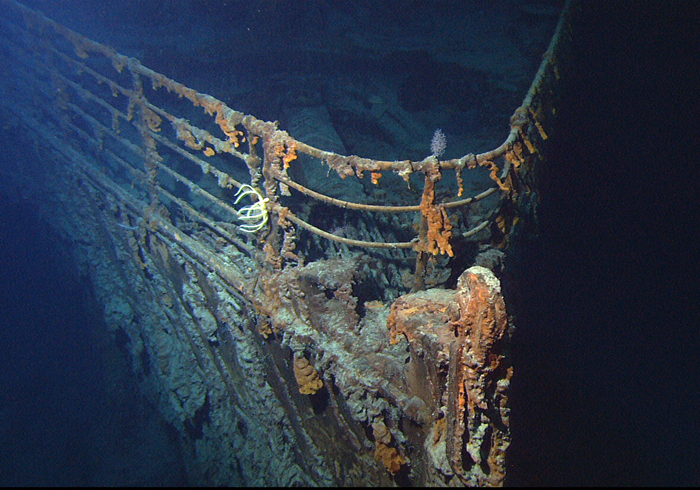
Titanic Wreck Bow Image: Public Domain (NOAA:http://www.gc.noaa.gov/images/gcil/ATT00561.jpg)
A full 3D scan of Titanic will result in the ability to explore Titanic without visiting the wreck itself according to a report at Earth.com. The project by Magellan and Atlantic productions has collected 715,000 deep-sea images of the wreck in striking clarity. The scan will allow researchers to really look at Titanic in a whole different way. Using all the data about Titanic from blueprints and other things, the 3D replica can be used to watch exactly what happened as the ship collided with the iceberg and see in detail about its sinking.
Quite remarkable technology. It will allow people who attend exhibitions to experience Titanic in a whole new way.
The sinking of the Greek passenger steamer Himara near South Evia on January 19, 1947, claimed at least 383 lives and has gone down in history as the “Greek Titanic.” Previously named Hertha, the vessel was handed over to Greece from Germany following WWII as part of war reparations.
Cleveland’s Great Lakes Science Center will offer a new way for guests to immerse themselves in one of history’s most iconic disasters with “TITANIC: The Artifact Exhibition.” The exhibition, opening May 21, features over 200 artifacts recovered from the site of the shipwreck, life-size reconstructions of rooms on the Ship of Dreams and a virtual reality experience billed as “the most detailed and complete VR tour of Titanic ever created, including areas of the Ship that weren’t previously visible to the public.”
A major Titanic exhibition is set to come to Liverpool in 2026. Titanic in Focus: White Star Line Hotel, will run from January 8 to March 10 and is set to be held in the former White Star Line headquarters, which is now the White Star Line Hotel. The White Star Line headquarters is the building where the liner was planned, managed, and intimately connected to the city’s maritime history.
On top of injuries from the wreck, the frigid temperature of the northern Atlantic Ocean resulted in many losing their lives to hypothermia. According to the Titanic Museum in Pigeon Forge, Tennessee, the water was 28°F—just below freezing, but kept liquid by the high concentrations of sea salt. To illustrate this fact, the Titanic Museum installed an exhibit that allows visitors to put their hands inside a container with 28ºF water. Multiple videos capture visitors trying their best, but giving up just a few seconds later. Those who held a little longer reported feeling a burning sensation on their hands.
Titanic News Channel is a participant in the Amazon Services LLC Associates Program, an affiliate advertising program designed to provide a means for sites to earn advertising fees by advertising and linking to Amazon.com.
For most of us, the notion that molasses would flood a city causing fatalities and destruction on its face seems implausible. Yet it happened in Boston in 1919.
Molasses tank in North End of Boston. Date unknown. Public Domain (via Wikipedia)
Industrial alcohol (used for machinery and other industrial applications) was very profitable and used for the war effort. It was made from fermented molasses so large tanks were constructed to hold it. A giant tank for it was built in 1915 along Boston’s waterfront on Commercial Street. Operated by the Purity Distribution Company (a subsidiary of United States Industrial Alcohol). The tank was immense measuring 50 feet high, 90 feet in diameter and could hold up to 2.5 million gallons. Back then, the usual standard was to use rivets (welding had not been invented yet) when connecting sections of metal together. Because of the fumes caused by fermentation and the pressure created, it posed a risk. There were leaks and occasional rumbles, but a vent was in place and open during the spring, summer, and fall. However, they were sealed during the winter since temperatures were usually very cool.
Shipments for molasses came in from ships in the harbor and transferred to the tank. Then later it would be transferred to an ethanol plant via pipeline in Cambridge. A recent delivery of molasses had nearly filled the tank. But for Purity, there was another issue. With the war over and Prohibition coming, the demand for industrial alcohol was going to be severely limited (there were still uses from industrial to baking but lower demand meant lower revenues for the company).
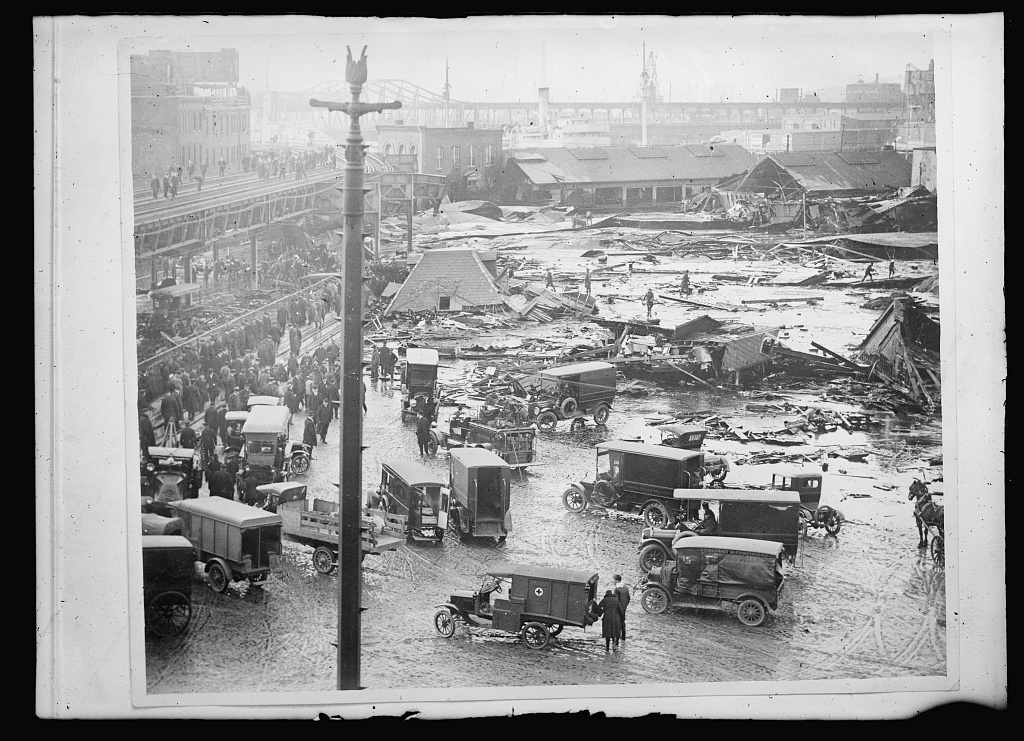
15 January 1920 was an unseasonably warm day with temperatures soaring up to 40 degrees Fahrenheit and higher possibly by noon that day. With the vents closed, the fumes had nowhere to go, and pressure built up inside the tank. At 12:30 pm people heard sounds that sounded like machine guns firing. It was likely the rivets being popped out by the pressure inside the tank. And then the tank exploded sending the nearly 2.5 million tons of molasses into Boston. The wave was estimated to be 15-40 feet and about 160 feet wide. Traveling at about 35 miles per hour, it destroyed several city blocks, leveled buildings, damaged autos and killed 21 people with 150 injured. Since molasses is very thick, it made for difficult breathing if it got into your nostrils or mouths. Many died from asphyxiation or drowned. Horses were knocked down and died on the spot with so many that many compared them to being sticky fly paper.
Boston Post,January 16, 1919, describing the Boston Molasses Disaster. Public Domain (via wikipedia)
Clean-up efforts started immediately but lasted for quite a while. Molasses went everywhere and no matter where you went in Boston, you were likely to encounter the sticky stuff in some form. It was on subway platforms, inside streetcars, pay telephones, even inside public buildings. Pedestrians tracked the molasses everywhere they went spreading further. Cleanup crews were kept busy cleaning it all up using salt water. And from many accounts, it appears the city would smell like molasses for some years to come.
Boston molasses explosion Source: U.S. Library of Congress,Digital ID: (digital file from original) anrc 1496
Aftermath
Fingers were pointed at the company, who tried initially to claim it was sabotage. An investigation into how it was built, and approvals were done showed a lot of corners were cut in its design and construction. Lawsuits were filed and consolidated into one of the first-class action suits ever to be done. Stories of known leaks where kids filled buckets with the leaking molasses did not help the company either. Ultimately the company paid out to victim’s families around $628,000.
The disaster highlighted the need for more rigorous standards for construction, required safety tests for tanks containing liquids, and ongoing safety checks. It was determined the company ignored basic safety tests when constructing and ignored the groaning sounds when tank was filled. Also, the company used thinner steel than was commonly used for tanks in that day. They also covered up the leaks by painting the tank brown. Later investigations have shown that as the molasses left the exploded tank, it cooled due to the Boston temperatures making it more viscous (meaning it thickened up) as it went through the streets. This made rescue efforts more difficult and cleanup more difficult as well.
The tank was never rebuilt, and the property became a yard for the Boston Elevated Railway (later the Massachusetts Bay Transportation Authority). Today is the site of a city owned recreational complex called Langone Park. To the east is the large Puopolo Park which has a small plaque on its entrance commemorating the disaster.
Titanic News Channel is a participant in the Amazon Services LLC Associates Program, an affiliate advertising program designed to provide a means for sites to earn advertising fees by advertising and linking to Amazon.com.
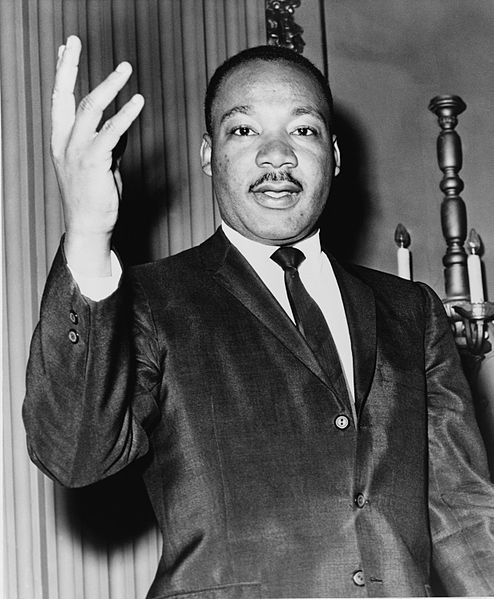
Martin Luther King, Jr.(1964) Photo:Public Domain (U.S. Library of Congress digital id cph 3c26559)
The following stirring speech by Martin Luther King, Jr. is one of the best calls for equality in modern times. King reminds us that in seeking freedom not only for African-Americans, it is also for everyone. He wanted all people to be treated fairly, justly and not by the color of their skin but on the content of their character. He did not want it done out of bitterness or hatred but to work towards brotherhood where all would be free. We honor and remember a man who sought freedom not by the gun but by peaceful and forceful demonstrations to remind many of the promises of this country and what God himself has taught us in Holy Scripture.
I Have A Dream
Lincoln Memorial
August 28, 1963
I am happy to join with you today in what will go down in history as the greatest demonstration for freedom in the history of our nation.
Five score years ago, a great American, in whose symbolic shadow we stand today, signed the Emancipation Proclamation. This momentous decree came as a great beacon light of hope to millions of Negro slaves who had been seared in the flames of withering injustice. It came as a joyous daybreak to end the long night of their captivity.
But 100 years later, the Negro still is not free. One hundred years later, the life of the Negro is still sadly crippled by the manacles of segregation and the chains of discrimination. One hundred years later, the Negro lives on a lonely island of poverty in the midst of a vast ocean of material prosperity. One hundred years later, the Negro is still languished in the corners of American society and finds himself an exile in his own land. And so we’ve come here today to dramatize a shameful condition.
In a sense we’ve come to our nation’s capital to cash a check. When the architects of our republic wrote the magnificent words of the Constitution and the Declaration of Independence, they were signing a promissory note to which every American was to fall heir. This note was a promise that all men — yes, black men as well as white men — would be guaranteed the unalienable rights of life, liberty, and the pursuit of happiness.
It is obvious today that America has defaulted on this promissory note insofar as her citizens of color are concerned. Instead of honoring this sacred obligation, America has given the Negro people a bad check, a check that has come back marked “insufficient funds.”
But we refuse to believe that the bank of justice is bankrupt. We refuse to believe that there are insufficient funds in the great vaults of opportunity of this nation. And so we’ve come to cash this check, a check that will give us upon demand the riches of freedom and security of justice. We have also come to his hallowed spot to remind America of the fierce urgency of now. This is no time to engage in the luxury of cooling off or to take the tranquilizing drug of gradualism. Now is the time to make real the promises of democracy. Now is the time to rise from the dark and desolate valley of segregation to the sunlit path of racial justice. Now is the time to lift our nation from the quicksands of racial injustice to the solid rock of brotherhood. Now is the time to make justice a reality for all of God’s children.
It would be fatal for the nation to overlook the urgency of the moment. This sweltering summer of the Negro’s legitimate discontent will not pass until there is an invigorating autumn of freedom and equality. 1963 is not an end but a beginning. Those who hoped that the Negro needed to blow off steam and will now be content will have a rude awakening if the nation returns to business as usual. There will be neither rest nor tranquility in America until the Negro is granted his citizenship rights. The whirlwinds of revolt will continue to shake the foundations of our nation until the bright day of justice emerges.
But there is something that I must say to my people who stand on the warm threshold which leads into the palace of justice. In the process of gaining our rightful place we must not be guilty of wrongful deeds. Let us not seek to satisfy our thirst for freedom by drinking from the cup of bitterness and hatred. We must forever conduct our struggle on the high plane of dignity and discipline. We must not allow our creative protest to degenerate into physical violence. Again and again we must rise to the majestic heights of meeting physical force with soul force. The marvelous new militancy which has engulfed the Negro community must not lead us to a distrust of all white people, for many of our white brothers, as evidenced by their presence here today, have come to realize that their destiny is tied up with our destiny. And they have come to realize that their freedom is inextricably bound to our freedom. We cannot walk alone.
As we walk, we must make the pledge that we shall always march ahead. We cannot turn back. There are those who are asking the devotees of civil rights, “When will you be satisfied?” We can never be satisfied as long as the Negro is the victim of the unspeakable horrors of police brutality. We can never be satisfied as long as our bodies, heavy with the fatigue of travel, cannot gain lodging in the motels of the highways and the hotels of the cities. We cannot be satisfied as long as the Negro’s basic mobility is from a smaller ghetto to a larger one. We can never be satisfied as long as our children are stripped of their selfhood and robbed of their dignity by signs stating “for whites only.” We cannot be satisfied as long as a Negro in Mississippi cannot vote and a Negro in New York believes he has nothing for which to vote. No, no we are not satisfied and we will not be satisfied until justice rolls down like waters and righteousness like a mighty stream.
I am not unmindful that some of you have come here out of great trials and tribulations. Some of you have come fresh from narrow jail cells. Some of you have come from areas where your quest for freedom left you battered by storms of persecution and staggered by the winds of police brutality. You have been the veterans of creative suffering. Continue to work with the faith that unearned suffering is redemptive.
Go back to Mississippi, go back to Alabama, go back to South Carolina, go back to Georgia, go back to Louisiana, go back to the slums and ghettos of our northern cities, knowing that somehow this situation can and will be changed.
Let us not wallow in the valley of despair. I say to you today my friends — so even though we face the difficulties of today and tomorrow, I still have a dream. It is a dream deeply rooted in the American dream.
I have a dream that one day this nation will rise up and live out the true meaning of its creed: “We hold these truths to be self-evident, that all men are created equal.”
I have a dream that one day on the red hills of Georgia the sons of former slaves and the sons of former slave owners will be able to sit down together at the table of brotherhood.
I have a dream that one day even the state of Mississippi, a state sweltering with the heat of injustice, sweltering with the heat of oppression, will be transformed into an oasis of freedom and justice.
I have a dream that my four little children will one day live in a nation where they will not be judged by the color of their skin but by the content of their character.
I have a dream today.
I have a dream that one day down in Alabama, with its vicious racists, with its governor having his lips dripping with the words of interposition and nullification — one day right there in Alabama little black boys and black girls will be able to join hands with little white boys and white girls as sisters and brothers.
I have a dream today.
I have a dream that one day every valley shall be exalted, and every hill and mountain shall be made low, the rough places will be made plain, and the crooked places will be made straight, and the glory of the Lord shall be revealed and all flesh shall see it together.
This is our hope. This is the faith that I go back to the South with. With this faith we will be able to hew out of the mountain of despair a stone of hope. With this faith we will be able to transform the jangling discords of our nation into a beautiful symphony of brotherhood. With this faith we will be able to work together, to pray together, to struggle together, to go to jail together, to stand up for freedom together, knowing that we will be free one day.
This will be the day, this will be the day when all of God’s children will be able to sing with new meaning “My country ’tis of thee, sweet land of liberty, of thee I sing. Land where my father’s died, land of the Pilgrim’s pride, from every mountainside, let freedom ring!”
And if America is to be a great nation, this must become true. And so let freedom ring from the prodigious hilltops of New Hampshire. Let freedom ring from the mighty mountains of New York. Let freedom ring from the heightening Alleghenies of Pennsylvania.
Let freedom ring from the snow-capped Rockies of Colorado. Let freedom ring from the curvaceous slopes of California.
But not only that; let freedom ring from Stone Mountain of Georgia.
Let freedom ring from Lookout Mountain of Tennessee.
Let freedom ring from every hill and molehill of Mississippi — from every mountainside.
Let freedom ring. And when this happens, and when we allow freedom ring — when we let it ring from every village and every hamlet, from every state and every city, we will be able to speed up that day when all of God’s children — black men and white men, Jews and Gentiles, Protestants and Catholics — will be able to join hands and sing in the words of the old Negro spiritual: “Free at last! Free at last! Thank God Almighty, we are free at last!”
Thomas Patrick Dillon is referred to as the “luckiest survivor” of the Titanic.
Thomas Patrick Dillon signed aboard the Titanic on April 6, 1912, as a trimmer, though rated as an able seaman. Trimmers ensured coal was evenly distributed in the ship’s bunkers to heat the massive boilers, a grueling task involving shovels and wheelbarrows in dark, hot conditions. Dillon was performing this duty when the Titanic struck the iceberg and was later ordered to the steerage deck to evacuate. By then, the lifeboats were gone, so he ended up in the water. Unexpectedly, a passing lifeboat plucked him out, and he survived. He later testified before the British Titanic Inquiry about what he witnessed that night. The Liverpool Echo recently reprinted his testimony, which is quite riveting. He continued serving on other ships, never married, and died in 1939, buried at Ford Cemetery, Sefton. His grave remained unmarked for 89 years until a descendant of his sister petitioned for a headstone.
Thomas Patrick Dillion was buried in an unmarked grave. A descendant of his sister petitioned to have a proper grave marker put up. British Titanic Society helped raise the funds for it. Image: MSN
The exhibition itself isn’t huge. I managed to get around it in about half an hour. Although there are not a museum’s-worth of artefacts on display, the things it has are pretty incredible. From a letter written onboard the ship to playing cards claimed to have been used by someone during the time the iceberg struck, it’s definitely a must visit for anyone with an interest in the Titanic story.
A “love child of the Titanic” spent her “whole life” searching for the truth after her mum narrowly escaped the sinking cruise ship with her life. Ellen Mary Walker was born to Kate Florence Philips on January 13 1913, nine months after the doomed vessel went down in the in the North Atlantic Ocean. Her dad, Henry Samuel Morley, died in the disaster. Ellen tirelessly fought all of her adult life to be recognised as Henry’s daughter but died in 2005 without that proof. For more than 20 years, her granddaughter Beverley Lynn Roberts carried out vast research on their family history and links with the Titanic, finally getting the proof her grandmother always wanted. Ellen tirelessly fought all of her adult life to be recognised as Henry’s daughter but died in 2005 with her dream unfulfilled. Finally, in December 2020, Beverley and Duncan Morley, the grandson of Henry’s younger brother Louis Morley, took DNA tests which confirmed that Henry Samuel Morley was indeed Ellen’s father. Beverley said: “We’ve got a plaque up in Worcestershire where one of his shops was in his memory. It was really special for me to do for gran because over the years people kept saying he wasn’t the father and things like that – so I needed to prove that for her.
Lord, Walter, A NIGHT TO REMEMBER, Holt Rinehart and Winston, New York, New York, 1955. Multiple revisions and reprints, notably Illustrated editions (1976,1977,1978 etc.)
Lord, Walter, THE NIGHT LIVES ON, Willian Morrow and Company, New York, New York, 1986 (First Edition)
Titanic News Channel is a participant in the Amazon Services LLC Associates Program, an affiliate advertising program designed to provide a means for sites to earn advertising fees by advertising and linking to Amazon.com.
Titanic News Channel Wishes All Our Friends In Eastern Orthodox a Joyous and Blessed Christmas Day!
The Adoration of the Shepherds (Gerard van Honthorst 1590–1656) Image: Public Domain (Wikipedia)
Why Does Eastern Orthodox Celebrate Christmas on January 7?
Eastern Orthodox follows the Julian calendar for their liturgical year. The Gregorian calendar, named for Pope Gregory XIII, was proclaimed in a Papal Bull in 1582. Its full implementation took 300 years owing to many countries not wanting to adopt a calendar proclaimed by a pope. Most Catholic countries quickly adopted while others adopted it later as the calendar was accurate and corrected the problems of the Julian. While dislike of the Catholic church was a reason in some cases, there were other reasons such governments being slow to act as well as local customs and traditions that had to be overcome. Adopting the new calendar required a major change, namely setting the calendar forward 13 days. That was a major feat implementing the change in many countries. The tradeoff though was clear. The newer calendar was more accurate so that you no longer had to make manual calculations to adjust for solstices, equinoxes, and other events under the old calendar. Those problems were now gone.
For Eastern Orthodox, the issue was not the accuracy of the new calendar but with the Papal Bull itself that had things in it they did not agree with and thus rejected it. The Congress of Constantinople (1923) created a Revised Julian Calendar that synchronized with the Gregorian on everything except Easter. This was accepted by Orthodox Churches in Constantinople, Alexandria, Antioch, Greece, Cyprus, Romania, Poland, and Bulgaria. It was rejected by Orthodox churches in Jerusalem, Russia, Serbia, Ukraine, and Georgia. Due to the split, the date for Easter is different between the two since the Revised Julian Calendar uses a different formula that the other churches rejected. That is why Christmas is celebrated by Greek Orthodox Church on December 25 but Russian Orthodox on January 7. The last country to adopt the Gregorian calendar was Saudi Arabia in 2016.
Wise Men Adoration Bartolomé Esteban Murillo ((1617–1682) Toledo Museum of Art Public Domain
We saw his star at its rising and have come to do him homage. (Matthew 2:2)
Epiphany Sunday is observed by most Christian denominations as a day in which Jesus is revealed to the world when the Magi arrive. It was practiced before Christmas was formally observed by the church.
In the early days, Christians set aside one day a week as the Lord’s Day which became Sunday. By the second century, Lent, Easter and the Pentecost were established as well. And by the third century, Epiphany was observed to celebrate Jesus’ birth, his baptism, the arrival of the Magi, and the miracle at Cana. Once Advent and Christmas began to be formally celebrated in the fourth century, Advent was the preparation for the birth, Christmas celebrated as the savior’s birth, and Epiphany was the day in which he was manifested to the world with arrival of the Magi and also his baptism and first miracle in Cana. Catholic Eastern Rite and Eastern Orthodox celebrate the day as when Jesus’ divinity was revealed at his baptism on the River Jordan (called Theophany). Not all Protestant denominations follow this observance such as the Anabaptists (Amish, Mennonite and others). In the Catholic church, the Sunday after Epiphany is celebrated as the Baptism of Jesus and his first miracle.
Adoration of the Magi El Greco (1541–1614) Museo Soumaya at Plaza Carso Public domain via Wikimedia Commons
The traditional date is January 6 and is twelve days after the birth of Jesus. It also marked the end of the Christmas season with this important holiday. The day before was usually the day to take down Christmas decorations and the day itself had its own traditions and feasts. Marking your front door by writing the names of the wise men with chalk became popular. Special cakes and processions took place as well such as Dia de los Reyes. Children would often get gifts and candy. In Italy, La Befana, the Christmas Witch, delivers gifts during the night for children. France has a special cake, Galette des Rois, with the figure of baby Jesus inside it to be found by a lucky person. And many Spanish speaking countries (and localities) have Los Reyes Magos festivities and gifts for kids as well. So, the day is a festive one for many people. And a nice way to wind down the Christmas season. These traditions and celebrations continue to this day.
However, in the United States and several European countries, the liturgical observation is no longer on January 6. One of the reforms of the Second Vatican Council allowed for the episcopal conference in each nation to request to move certain holy days of obligation to the nearest Sunday. Since it was hard to for people to attend mass during the week due to work, school, or travel, moving it to the nearest Sunday between January 2-8 seemed the best way to make sure people attended the mass. It is important to note that this was a pastoral not liturgical change. Both the historical and universal date remains unchanged.
Correale, Marta. “La Befana: All You Need to Know About Italy’s Most Beloved Witch (With Coloring Sheet for Kids) | Mama.” Mama Loves Italy, December 16, 2024. Accessed January 4, 2026. https://mamalovesitaly.com/la-befana-italy-christmas-witch/.
Titanic News Channel is a participant in the Amazon Services LLC Associates Program, an affiliate advertising program designed to provide a means for sites to earn advertising fees by advertising and linking to Amazon.com.
It was other people’s reactions to his surname which later set him off on a quest for the truth about what really happened the night the magnificent ocean liner sank on her maiden voyage with the loss of 1,500 passengers and crew. “I used to meet people, on a business or social level, introduce myself and they’d often ask me: ‘Are you related to the coward of the Titanic?’ ” That’s how he’s been portrayed down the years in films and books – as a villain – but I wanted to know the truth,” says Cliff, who has written a book on his ancestor. “I don’t think he was a hero but he was no coward either. During my own research I found he was responsible for actually saving lives as he patrolled the boat deck boats, both starboard and port sides, encouraging women and children to get into the lifeboats.
Titanic Sinks Tonight is a part-documentary, part-drama series playing across four nights, its episodes constructed from letters and diaries written by those on board, as well as interviews the survivors would give in the decades after. On the strength of the two episodes released for review, there’s no denying that it sates our appetite for Titanic-themed content. However, in centring the words and memories of those who lived through the terror of that night, it restores much-needed agency to those people. It also does well to bring a sense of reality to events that can sometimes feel unreal on account of their ubiquity, and that uncanny valley of Titanic-themed media. Central to its success is the presence of experts such as historian Suzannah Lipscomb and former Royal Navy admiral Lord West, to sharpen the corners of the story that Hollywood has sanded down.
When Robert Hichens, the quartermaster, took over the helm of RMS Titanic at 10pm on 14 April 1912, he had no inkling that in a few hours, he would be at the heart of one of the most catastrophic maritime disasters in history. Less than two hours into his shift, the 29 year old found himself wrestling with the wheel of the colossal ocean liner as it desperately tried to evade an iceberg in the icy North Atlantic. Hichens’ legacy has been marred by controversy. Post the sinking, he faced accusations ranging from steering in the wrong direction to avoid the iceberg, to being intoxicated in his lifeboat. He also declined to return to the site of the sinking to search for survivors – despite his lifeboat only being half-full – and later served time in prison for attempted murder.
Suggested Reading
[Titanic News Channel is a participant in the Amazon Services LLC Associates Program, an affiliate advertising program designed to provide a means for sites to earn advertising fees by advertising and linking to Amazon.com.]
Lord, Walter, A NIGHT TO REMEMBER, Holt Rinehart and Winston, New York, New York, 1955. Multiple revisions and reprints, notably Illustrated editions (1976,1977,1978 etc.)
Lord, Walter, THE NIGHT LIVES ON, Willian Morrow and Company, New York, New York, 1986 (First Edition)
Photo of Head of Janus Vatican Museum, Rome Source: Loudon Dodd (via Wikimedia)
January is the first month on the Gregorian and the Julian calendar. It is named after the Roman god of doors, Janus, as this month is a doorway into the new year. Janus is an interesting Roman god as he is two-faced. Thus, he can see both the future and the past. In January, you can see the previous year and view the upcoming one. The old Roman calendar ended in December and did not start up till March. This was changed later with the addition of January to replace March but was made official when the Julian calendar was adopted in 8 BC. The new Julian calendar used the solar cycle rather than the lunar making it more accurate. Unfortunately, its creator Sosigenes, an Alexandrian astronomer who helped create the Egyptian solar calendar, made a small mathematical error of 11 minutes and 14 seconds. Small but significant as the calendar started going out of sync with the solar cycle over time making it hard to use for holy days that required a precise measurement in order to be done at the correct date and time.
Très Riches Heures du duc de Berry Folio 1, verso: January Part of Très Riches Heures du duc de Berry by Limbourg brothers (fl. 1402–1416) Public Domain via Wikimedia Commons
This became apparent by the Middle Ages and calls for it to be resolved became more urgent. It was no longer minutes but by then 10 days. This would ultimately result in the Gregorian Calendar (named for Pope Gregory XIII) that was adopted in 1548 by the Catholic church and the Papal States. This resolved the major problem regarding the scheduling of Easter. Since however this was a civic reform, it was up to each nation to decide whether to implement or not. It would gradually be adopted by many countries. Spain was the first to switch over and that included much of Roman Catholic Europe. Protestant countries were not keen on changing right away since the reform was made by the Catholic Church. The British would adopt it 1750 but by a method to avoid saying it was from the Catholic Church. Sweden adopted in 1753. Turkey would switch to using the fiscal year as Gregorian in 1917 and then for the entire calendar in 1926. Russia, under the Communist government, changed in 1918. Greece would change in 1923. Saudi Arabia would formally adopt it in 2016. The change between calendars was startling at first. You might be in November and suddenly thirteen days back in October!
Eastern Orthodox denominations decided for religious purposes to use the Julian rather than Gregorian for their liturgical year (separate from the civic calendar). Which is why in countries like Greece or Russia the celebration of Christmas and Easter is currently 13 days after it is celebrated elsewhere.
.jpg)