Tag Archives: Mussolini forced out

Remembering History: Mussolini Ousted as Italian Leader (25 July 1943)

On 25 Jul 1943 the Fascist Grand Council formally voted Mussolini from power and was arrested later after meeting with King Victor Emmanuel III. Support for Mussolini had dropped dramatically because of Italy’s participation in World War II and most Italians were happy he was gone. How did Italy get to this point? Let’s take a look.

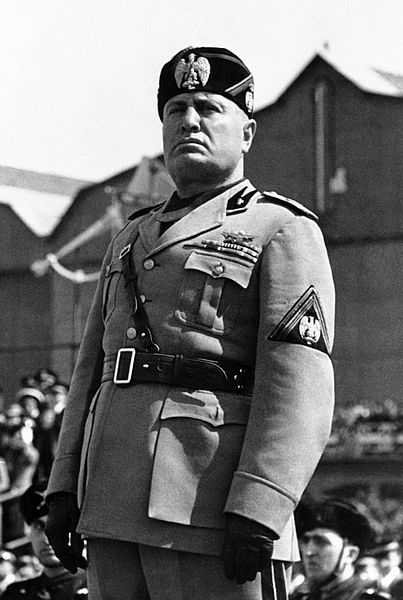
Benito Mussolini from the second edition of Adolf Dresler’s “Mussolini als Journalist” (1939)
Public Domain via Wikimedia Commons

 Italy Aligns with Germany

 On 22 May 1939 Italy signed a treaty with Germany that allied both countries militarily and politically. Mussolini nicknamed this treaty, formally known as the Pact of Friendship and Alliance, as the Pact of Steel. The treaty committed Italy to support Germany if attacked or if it declared war. Mussolini believed the pact would provide defense from other Western nations and provide support for his ambitions in the Balkans and elsewhere. Italy was in desperate need of resources due to international sanctions in using mustard gas to conquer Ethiopia. It also lacked the industrial capability at that time for a sustained military conflict. Germany and Italy shared similar interests in believing Fascism was on the march. Italy, like Germany, sided with Francisco Franco during the Spanish Civil War (1936-1939). A treaty of mutual interest in 1936 brought them closer together and paved the way for the Pact of Steel. It was also Mussolini who coined the term Axis regarding the countries that signed the treaty.

Mussolini had hoped both the British and French would give him concessions after the Munich Agreement of 1938, where both powers forced Czechoslovakia to hand over territory to Germany. There was none and Mussolini gave speeches laying out Italy’s desire to take territory in North Africa, France, a part of Switzerland, and Albania. He also threatened British control of the seas and of taking Gibraltar. In both London and Paris, such talk was seen as signaling his territorial ambitions. In 1938, Italy invaded and conquered Albania convincing the other powers of his territorial ambitions. The Pact of Steel in 1939 cemented the partnership between the two countries that had been going on informally. Not all Fascists in Italy agreed with aligning with Germany. Foreign Minister Count Galeazzo Ciano, married to Mussolini’s daughter Edda, became skeptical later as Germany failed to disclose the plan to invade Poland as required by the treaty. While Ciano and other Fascists believed war with Britain and France was inevitable as both powers were blocking their ambitions, they did not see it occurring for a few more years. They dreadfully miscalculated Hitler’s aims and ambitions.

World War II

 Mussolini knew that Italy was not ready for war until 1942 (and the Pact of Steel said neither side was to enter war till 1943). Lacking the raw resources and industrial capability, they needed to import both coal and steel. Countries like Britain banned those raw materials, making it difficult to acquire. Knowing this, Britain and France did try to lure Mussolini away from Germany by offering those resources. And it may have worked as Mussolini was preparing to sign documents to that effect. German pressure on Mussolini though scuttled it. They sent coal by train over the Alps to him to strengthen their friendship. The Italian Army was large on paper but lacked modern transport and weapons leaving them unable to hold their own against a fully trained and battle-ready army. Since supplies were critical to Italy, it failed to prepare its merchant fleet for war and lost many ships that were enemy ports when war was declared. Mussolini was warned by his military advisors to wait until war production would be able arm his military for war. While Italy easily took Albania, the British routed them in North Africa, and the Greeks were able to stop an Italian invasion of their country. In both cases, Germany sent troops to accomplish what the Italians failed to do. They were successful in Yugoslavia since German troops were with them. And they only declared war on France when Germany had defeated them so they could take territory in the south including Corsica. Thanks to Italian occupation in France though, Jews were safe as Italy refused German demands to turn them over.

Rationing of food and other supplies took its toll on the population. Due to a reduced merchant fleet, supplies became more difficult to acquire and had to rely on Germany for a lot of it. Inflation set in as well making it hard for many to buy the supplies. The poor military situation only made it worse and support for Mussolini began to slip. The army was lightly armored, the air force and navy were at odds with each other, poor leadership in the upper levels that were coupled with ill-defined goals. Additionally, Mussolini might decide to do things on a whim making it a chaotic situation. With the Allies taking Sicily, landing in the south, and dropping bombs on Rome, most people had enough of the war. Both King Victor Emmanuel III and members of the Fascist Grand Council wanted Italy out of the war. Mussolini had to go.

Mussolini Sacked

 The Fascist Grand Council met on 24 July 1943-a meeting that would last till the next morning-to discuss what to do. Mussolini, according to various accounts, looked sick, tired, and felt the burden of the military defeats suffered by the Italian military. For some, it appeared he wanted a way out and he got it. The Grand Council voted to remove him from power and transfer some of his powers to the king. There was opposition, but the majority voted for his removal. His son-in-law, Count Galeazzo Ciano, voted for his removal as well. Mussolini seemed stunned and dazed by it. His supporters tried to rally him, but he seemed deflated. He left for his meeting with King Emmanuel and arrived unshaven and groggy. He was informed by the king that he was under arrest and that General Pietro Badoglio would be taking over as Prime Minister. The war was seen as lost, King Emmanuel reportedly said. Mussolini did not resist and seemed to accept it. He was told his family would remain safe. He was whisked away and imprisoned.

The announcement of Mussolini’s downfall was greeted with a general sense of relief. It was hoped this would mean the end of the war. The Fascists did not stage any protests or marches over his removal and imprisonment. He was being held at La Maddalena and later removed to a safer location to prevent his being rescued. The new Italian government negotiated behind the scenes seeking an armistice that would lead to a peace treaty. For a moment Italians breathed a sigh of relief hoping the war would soon be over.

Aftermath

Hitler was furious at his removal and knew the Italians would sign an armistice. Several German battalions were sent into Italy despite objections from the new government. When the armistice was announced on 3 September 1943, Operation Asche was implemented. German troops seized control of northern Italy and marched on Rome. They also seized all its territory in the Balkans and France. Italian forces were told to disarm or be fired upon. Some resistance was done in Rome as the royal family fled with the government. Corsica, Calabria, and Sardinia were successfully defended by Italian troops and repelled German troops until the Americans arrived. The Germans quickly implemented their anti-Jewish policies. Hitler ordered Mussolini found and was rescued from imprisonment at Hotel Campo Imperatore atop Gran Sasso d’Italia mountain range on 12 September 1943. Italians in the north would have to wait until June 1944 to be liberated. Mussolini later would be forced to flee with his mistress but would be captured by partisans, executed, and his body hung upside down for the world to see.

Sources

Mussolini

Foote, John. “Benito Mussolini.” Encyclopedia Britannica. Last modified July 25, 2026. Accessed July 27, 2026. https://www.britannica.com/biography/Benito-Mussolini.

“Benito Mussolini Falls From Power.” History. Last modified May 27, 2026. Accessed July 27, 2026. https://www.history.com/this-day-in-history/july-25/mussolini-falls-from-power.

Taylor, Blaine. “Mussolini’s Fall From Powers.” Warfare History Network. Last modified June 2019. Accessed July 27, 2026. https://warfarehistorynetwork.com/article/mussolinis-fall-from-power/.

Italy Under Mussolini

Demetri, Justin. “Italy World War 2.” Life in Italy. Last modified June 6, 2020. Accessed July 27, 2026. https://lifeinitaly.com/italians-in-world-war-ii-2/.

Helga. “Italy Between 1922-1945 – the Rule of Mussolini.” Life in Italy. Last modified March 19, 2021. Accessed July 27, 2026. https://lifeinitaly.com/italy-between-1922-1945-the-rule-of-mussolini/.

Pact of Steel

“The Pact of Steel Is Signed; the Axis Is Formed.” HISTORY. Last modified January 31, 2025. Accessed July 27, 2026. https://www.history.com/this-day-in-history/May-22/the-pact-of-steel-is-signed-the-axis-is-formed.

“Axis Alliance in World War II | Holocaust Encyclopedia.” Holocaust Encyclopedia. Accessed July 27, 2026. https://encyclopedia.ushmm.org/content/en/article/axis-powers-in-world-war-ii.

“The Pact of Steel – the Pact of Friendship and Alliance Between Germany and Italy, May 22, 1939.” Historical Resources About the Second World War. Last modified September 10, 2008. Accessed July 27, 2026.https://historicalresources.wordpress.com/2008/09/10/the-pact-of-steel-the-pact-of-friendship-and-alliance-between-germany-and-italy-may-22-1939/.

Italy in World War II

Swick, Gerald, and Jim Heddlesten. “Italy in World War II.” HistoryNet. Last modified March 30, 2016. Accessed July 27, 2026. https://historynet.com/italy-in-world-war-ii/.

“Italian Campaign.” Encyclopedia Britannica. Last modified July 2, 2026. Accessed July 27, 2026. https://www.britannica.com/topic/Italian-Campaign.

Suggested Reading
[As an Amazon Associate, I earn from qualifying purchases. This may contain affiliate links, which means I may receive a small commission at no extra cost to you.]

Bosworth, R. J. B. (2006). Mussolini’s Italy: Life Under the Dictatorship, 1915-1945. Penguin Press HC.

Haynes, D. (2023). A brief history of Italy: Tracing the Renaissance, Unification, and the Lively Evolution of Art and Culture.

Hearder, H., & Morris, J. (2001). Italy: A Short History. Cambridge University Press.

Hibbert, C. (2008). Mussolini: The Rise and Fall of Il Duce. St. Martin’s Griffin.

Kertzer, D. I. (2015). The Pope and Mussolini: The Secret History of Pius XI and the Rise of Fascism in Europe. Random House Trade Paperbacks.

Moseley, R. (1999). Mussolini’s shadow: The Double Life of Count Galeazzo Ciano. Yale University Press.

Revision History

-2025: corrections for grammar and punctuation. New sources added.

-2026: Slight rewrite of intro. Sources updated.

Remembering History: Mussolini Executed by Italian Partisans (28 April 1945)


Benito Mussolini
Public Domain

Benito Mussolini, who once ruled Italy and created Fascism, was executed by Italian partisans while attempting to flee Italy.

Benito Mussolini started out as Communist, became dissatisfied with it, and conceived a new ideology called Fascism that fused elements of Communism with Nationalism. Italy after World War I was economically suffering. It had supported the Allies and was promised territory but got nothing. Mostly agrarian based with only a few centers of large industry, Italy was considered backward by European standards. Mussolini sought to change this by making people believe in Italy again. Being an ardent Communist and editing one of Italy’s prominent Communist newspapers, he originally believed in its principles but World War I disillusioned him. He crafted a new ideology, Fascism, that incorporated elements of both Communism and Nationalism, that would bring about a better nation.

His movement garnered many supporters eager to make Italy a better and stronger nation. After King Emmanuel III dissolved parliament in 1921, Mussolini used this to demand more power. His party had gained seats and with uniformed members out on the streets, highly visible as well. They gained power in cities, and the Black Shirts went after Communists and Socialists destroying their offices. In 1922, King Emmanuel was faced with major problems of civil unrest. Calling out the army did little good and the Fascists controlled many municipalities. A march on Rome brought Mussolini and thousands to Rome demanding he be put into power. To avoid more unrest, King Emmanuel appointed him as Prime Minister and would rule Italy from 1923-1943.

Fascism, like Communism, disdained democracy as weak and governed as a one-party state where dissent was limited. Dissidents were imprisoned or executed depending on the severity of their actions. All media–print, radio, and movies–had to reflect the views of the government. Journalists had to belong to a national organization that would bound them to support Mussolini. Every aspect of life in Italy came under its control as Mussolini envisioned it would. The Catholic Boy Scouts were dissolved and replaced by a Fascist one called Opera Nazionale Balilla and all young boys were encouraged to join but it became mandatory in 1937. Much of what the Fascists did in Italy would become the model for Adolf Hitler and his Nazi Party in Germany. Though Mussolini at first disdained Hitler, they eventually became friends. Both believed that Fascism was on the march and would replace the old order of Europe. The Spanish Civil War of 1936 saw both Hitler and Mussolini support General Francisco Franco against the Communist inspired government backed by Moscow.

Mussolini seized Ethiopia in 1935 sparking world-wide outrage over the use of mustard gas. Hitler backed him and both countries would exit the League of Nations in 1937. With the signing of the Pact of Steel in 1939, Mussolini had tied Italy to Germany’s war aims. Italy faced problems building up its military. It sorely lacked the industrial capability to build its own munitions, ships, and other necessities. Because of boycotts and refusals to sell resources from other countries, Italy became reliant on Germany for them. Germany also put pressure on Italy to adopt its policies about Jews and its eugenics policies. Scholars disagree on whether Mussolini was truly antisemitic or indifferent. He enacted some laws to satisfy them, but Germany was unhappy since they were considered lax by their standards. Only foreign-born Jews living in Italy would be deported. Jews in Italy and its territories faced no deportations until the Germans took control in 1943.

The signing of the Pact of Steel on 22 May 1939 in Berlin
Photographer unknown
Public Domain/WIkimedia Commons

World War II did not go well for Italy. From losing battles and needing German assistance in Greece and North Africa, it began to wear thin. Inflation and rationing caused unrest; Allied bombings of Rome and other places brought it home. The invasion of Sicily in 1943 and later southern Italy showed that the war was lost. Disillusionment with Mussolini was now louder resulting in the Fascist Grand Council, with the support of King Emmanuel, ousting Mussolini and starting negotiations to end the war. The Germans were furious and Mussolini, being held at Hotel Campo Imperatore on a remote mountain top, was rescued. Germany would invade and take control of Italy and its territories. Mussolini was put in charge of an Italian puppet state and would execute many who had removed him from power, including his son-in-law Count Galeazzo Ciano.

By April 1945 with increased partisan attacks and Allied troops making their way towards Milan, Mussolini and his mistress Clara Petacci fled inside German transports heading north near the Swiss border on April 27. Mussolini had hoped to flee to Spain where he hoped Franco would give him sanctuary. Unfortunately, partisans stopped the German transports on. After exchanging gunfire and lengthy negotiations, the partisans were allowed to search for Italians in the transports. Mussolini had put on a Wehrmacht noncommissioned officers coat and a helmet but was recognized. He, his mistress, and about fifty other Italians with him (some were wives and children) were arrested. Mussolini was taken to Dongo on Lake Como, interrogated and then put into a room with others who had been captured with him. He made a statement critical of Hitler and saying Stalin was the victor. He also signed a statement he had not been ill-treated.

The following day he, Clara, and others with him were shot and killed. Contradictory statements by different people over the years has made it difficult to pinpoint exactly who gave the order. Many of the partisans were aligned with Communist groups backed by Moscow, which used a radio beamed from Moscow (Radio Milano-Libertà) for Italians to announce his arrest. So many believe it was in the chain of command within those groups that ordered Mussolini’s execution. There are also different accounts as to what happened during the actual execution. They were executed with several bullets in their chests. The bodies were taken to the Piazzale Loreto in Milan and dumped there for all to see. People threw vegetables, spat on them, urinated, kicked the famous head of Mussolini, and even shot more bullets into their bodies. By the time American troops arrived, the scene was out of control. The bodies were taken to a half-built service station and hung upside down for all to see. The famous photograph was distributed showing to the world that the Duce was dead.

Piazzale Loreto, 29 April 1945, the displayed bodies of executed Italian fascists. From left to right, Nicola Bombacci, Benito Mussolini, Claretta Petacci, Alessandro Pavolini, Achille Starace
Photo: Vincenzo Carrese (1910–1981)
Public Domain via Wikimedia Commons

His body, first buried in an unmarked grave then stolen, recovered, and then hidden in a monastery, is now at the family crypt in Predappio in Romagna.

Sources

“Benito Mussolini: Children, Death & World War II – HISTORY | HISTORY.” HISTORY. Last modified June 30, 2025. https://www.history.com/articles/benito-mussolini.

Citno, Robert PhD. “Death of the Duce, Benito Mussolini.” The National WWII Museum | New Orleans. Last modified April 27, 2020. https://www.nationalww2museum.org/death-of-benito-mussolini.

Deac, Wil. “How Did Benito Mussolini Die? The Story Behind Il Duce’s Last Moments.” Warfare History Network. Last modified March 13, 2024. https://warfarehistorynetwork.com/article/how-did-benito-mussolini-die-the-story-behind-il-duces-last-moments/.

Foot, John. “Benito Mussolini.” Encyclopedia Britannica. Last modified April 24, 2026. https://www.britannica.com/biography/Benito-Mussolini.

“Mussolini, Mistress Executed by Firing Squad – UPI Archives.” UPI, April 29, 1945. https://www.upi.com/Archives/1945/04/29/Mussolini-mistress-executed-by-firing-squad/7511360114334/.

Videos

CriticalPast. “Dead Body of Benito Mussolini Lay on a Street of the Village Giulino Di Mezzegra …HD Stock Footage.” Video. YouTube, April 26, 2014. https://www.youtube.com/watch?v=DsnDmdVJtPE.

History Comes to Life. “Mussolini Dead, 1945 | Restored News Footage.” Video. YouTube, August 2, 2011. https://www.youtube.com/watch?v=mV7Cp9v13xI.

Mussolini Ousted as Italian Leader (25 July 1943)

On 25 Jul 1943 the Fascist Grand Council formerly voted Mussolini from power and was arrested later after meeting with King Victor Emmanuel III. So, what happened to the once all-powerful Duce? Let’s find out.

Benito Mussolini from the second edition of Adolf Dresler’s “Mussolini als Journalist” (1939)
Public Domain via Wikimedia Commons

Italy Aligns with Germany

On 22 May 1939 Italy signed a treaty with Germany that allied both countries militarily and politically. Mussolini nicknamed this treaty, formally known as the Pact of Friendship and Alliance, as the Pact of Steel. The treaty committed Italy to support Germany if attacked or if it declared war. Mussolini believed the pact would provide defense from other Western nations and provide support for his ambitions in the Balkans and elsewhere. Italy was in desperate need of resources due to international sanctions in using mustard gas to conquer Ethiopia. It also lacked the industrial capability at that time for a sustained military conflict. Germany and Italy shared similar interests in believing Fascism was on the march. Italy, like Germany, sided with Francisco Franco during the Spanish Civil War (1936-1939). A treaty of mutual interest in 1936 brought them closer together and paved the way for the Pact of Steel. It was also Mussolini who coined the term Axis regarding the countries that signed the treaty.

Mussolini had hoped both the British and French would give him concessions after the Munich Agreement of 1938, where both powers forced Czechoslovakia to hand over territory to Germany. There was none and Mussolini gave speeches laying out Italy’s desire to take territory in North Africa, France, a part of Switzerland, and Albania. He also threatened British control of the seas and of taking Gibraltar. In both London and Paris, such talk was seen as signaling his territorial ambitions. In 1938, Italy invaded and conquered Albania convincing the other powers of his territorial ambitions. The Pact of Steel in 1939 cemented the partnership between the two countries that had been going on informally. Not all Fascists in Italy agreed with aligning with Germany. Foreign Minister Count Galeazzo Ciano, married to Mussolini’s daughter Edda, became skeptical later as Germany failed to disclose the planned to invade Poland as required by the treaty. While Ciano and other Fascists believed war with Britain and France was inevitable as both powers were blocking their ambitions, they did not see it occurring for a few more years. They dreadfully miscalculated Hitler’s aims and ambitions.

World War II

Mussolini knew that Italy was not ready for war until 1942 (and the Pact of Steel said neither side was to enter war till 1943). Lacking the raw resources and industrial capability, they needed to import both coal and steel. Countries like Britain banned those raw materials, making it difficult to acquire. Knowing this, Britain and France did try to lure Mussolini away from Germany by offering those resources. And it may have worked as Mussolini was preparing to sign documents to that effect. German pressure on Mussolini though scuttled it. They sent coal by train over the Alps to him to strengthen their friendship. The Italian Army was large on paper but lacked modern transport and weapons leaving them unable to hold their own against a fully trained and battle-ready army. Since supplies were critical to Italy, it failed to prepare its merchant fleet for war and lost many ships that were enemy ports when war was declared. Mussolini was warned by his military advisors to wait until war production would be able arm his military for war. While Italy easily took Albania, the British routed them in North Africa, and the Greeks were able to stop an Italian invasion of their country. In both cases, Germany sent troops to accomplish what the Italians failed to do. They were successful in Yugoslavia since German troops were with them. And the only declared war on France when Germany had defeated them so they could take territory in the south including Corsica. Thanks to Italian occupation in France though, Jews were safe as Italy refused German demands to turn them over.

Rationing of food and other supplies took its toll on the population. Due to a reduced merchant fleet, supplies became more difficult to acquire and had to rely on Germany for a lot of it. Inflation set in as well making it hard for many to buy the supplies. The poor military situation only made it worse and support for Mussolini began to slip. The army was lightly armored, the air force and navy were at odds with each other, poor leadership in the upper levels that were coupled with ill defined goals. Additionally, Mussolini might decide to do things on a whim making it a chaotic situation. With the Allies taking Sicily, landing in the south, and dropping bombs on Rome, most people had enough of the war. Both King Victor Emmanuel III and members of the Fascist Grand Council wanted Italy out of the war. Mussolini had to go.

Mussolini Sacked

The Fascist Grand Council met on 24 July 1943-a meeting that would last till the next morning-to discuss what to do. Mussolini, according to various accounts, looked sick, tired, and felt the burden of the military defeats suffered by the Italian military. For some, it appeared he wanted a way out and he got it. The Grand Council voted to remove him from power and transfer some of his powers to the king. There was opposition, but the majority voted for his removal. His son-in-law, Count Galeazzo Ciano, voted for his removal as well. Mussolini seemed stunned and dazed by it. His supporters tried to rally him, but he seemed deflated. He left for his meeting with King Emmanuel and arrived unshaven and groggy. He was informed by the king that he was under arrest and that General Pietro Badoglio would be taking over as Prime Minister. The war was seen as lost, the King Emmanuel reportedly said. Mussolini did not resist and seemed to accept it. He was told his family would remain safe. He was whisked away and imprisoned.

The announcement of Mussolini’s downfall was greeted with a general sense of relief. It was hoped this would mean the end of the war. The Fascists did not stage any protests or marches over his removal and imprisonment. He was being held at La Maddalena and later removed to a safer location to prevent his being rescued. The new Italian government negotiated behind the scenes seeking an armistice that would lead to a peace treaty. For a moment Italians breathed a sigh of relief hoping the war would soon be over.

Aftermath

Hitler was furious at his removal and knew the Italians would sign an armistice. Several German battalions were sent into Italy despite objections from the new government. When the armistice was announced on 3 September 1943, Operation Asche was implemented. German troops seized control of northern Italy and marched on Rome. They also seized all its territory in the Balkans and France. Italian forces were told to disarm or be fired upon. Some resistance was done in Rome as the royal family fled with the government. Corsica, Calabria, and Sardinia were successfully defended by Italian troops and repelled German troops until the Americans arrived. The Germans quickly implemented their anti-Jewish policies. Hitler ordered Mussolini found and was rescued from imprisonment at Hotel Campo Imperatore atop Gran Sasso d’Italia mountain range on 12 September 1943. Italians in the north would have to wait until June 1944 to be liberated.

[This was rewritten for 2025 correcting spelling, punctuation, and brevity]

Sources

Hibbert et al., “Benito Mussolini | Biography, Definition, Facts, Rise, & Death,” Encyclopedia Britannica, last modified June 16, 2025, https://www.britannica.com/biography/Benito-Mussolini.

The Editors of Encyclopaedia Britannica, “Pact of Steel | Italy–Germany [1939] | Britannica,” Encyclopedia Britannica, last modified March 18, 2009, https://www.britannica.com/event/Pact-of-Steel.

HISTORY.com Editors, “Benito Mussolini Falls From Power | July 25, 1943 | HISTORY,” HISTORY, last modified May 27, 2025, https://www.history.com/this-day-in-history/july-25/mussolini-falls-from-power.

Helga, “Italy Between 1922-1945 – the Rule of Mussolini,” Life in Italy, last modified October 7, 2022, accessed July 24, 2025, https://lifeinitaly.com/italy-between-1922-1945-the-rule-of-mussolini/.

Warfare History Network and Blaine Taylor, “Mussolini’s Fall From Power – Warfare History Network,” Warfare History Network, last modified November 29, 2023, accessed July 24, 2025, https://warfarehistorynetwork.com/article/mussolinis-fall-from-power/.

“Axis Alliance in World War II,” Holocaust Encyclopedia, https://encyclopedia.ushmm.org/content/en/article/axis-powers-in-world-war-ii.

Justin Demetri, “Italians in World War II,” Life in Italy, last modified October 10, 2024, https://lifeinitaly.com/italians-in-world-war-ii-2/.

Gerald Swick and Jim Heddlesten, “Italy in World War II,” HistoryNet, last modified March 30, 2016, https://www.historynet.com/italy-in-world-war-ii/.

The Editors of Encyclopaedia Britannica, “Italian Campaign | Summary, Map, Significance, Date, & World War II,” Encyclopedia Britannica, last modified July 2, 2025, https://www.britannica.com/topic/Italian-Campaign.

Suggested Reading

Bosworth, R. J. B. (2006). Mussolini’s Italy: Life Under the Dictatorship, 1915-1945. Penguin Press HC.

Haynes, D. (2023). A brief history of Italy: Tracing the Renaissance, Unification, and the Lively Evolution of Art and Culture.

Hearder, H., & Morris, J. (2001). Italy: A Short History. Cambridge University Press.

Hibbert, C. (2008). Mussolini: The Rise and Fall of Il Duce. St. Martin’s Griffin.

Kertzer, D. I. (2015). The Pope and Mussolini: The Secret History of Pius XI and the Rise of Fascism in Europe. Random House Trade Paperbacks.

Moseley, R. (1999). Mussolini’s shadow: The Double Life of Count Galeazzo Ciano. Yale University Press.

Titanic News Channel is a participant in the Amazon Services LLC Associates Program, an affiliate advertising program designed to provide a means for sites to earn advertising fees by advertising and linking to Amazon.com.

Remembering History: Mussolini Ousted (25 July 1943)

Benito Mussolini
Public Domain

On 25 Jul 1943 the Fascist Grand Council formally voted Mussolini from power and was arrested later after meeting with King Victor Emmanuel III. So, what happened to the once all-powerful Duce? Let’s find out.

Italy had entered into the Pact of Steel with Germany in 1939 which committed Italy to fighting along with Germany if it declared war or was attacked. Mussolini entered the agreement knowing full well Italy did not have the resources or industrial capability for a sustained military conflict. Mussolini had grand ambitions about expanding the Italian sphere of influence in the region and even into central Europe. Mussolini believed that Fascism was on the march and aligning with Hitler seemed a good choice at the time. Italy had successfully invaded Ethiopia (1935-1937) though not without them putting up a strong fight. Using mustard gas against troops and civilians had gotten Mussolini severely criticized and international sanctions.

The war in Ethiopia and his intervention on the side of Franco in the Spanish Civil War had brought Italy closer to Germany with a treaty of mutual interest in 1936.  And he needed coal from Germany since international sanctions over Ethiopia had made acquiring it more difficult. Mussolini believed a German-Rome Axis would be how Europe would turn but relying on Germany to supply items like coal meant Italy was more dependent on Germany rather than a true partnership. Mussolini tried to get all kinds of concessions from the British and French after the Munich Agreement in 1938; none were given. He made it clear in speeches (and those by others) that they wanted territory in France, Tunisia, a small part of Switzerland, and Albania. He upped his demands to demand free access to the world’s oceans by breaking British control of key places such as Gibraltar.

From the viewpoint in London, Paris, and elsewhere, his bellicose talk signaled major territorial ambitions. The Fascists mostly supported this though some, like his foreign minister Count Galeazzo Ciano, were concerned about aligning with Germany. Taking on both Britain and France became accepted since they were the major colonial powers that Italy saw as blocking them from achieving their rightful position in the world. On 7 April 1938, Italy invaded Albania and took control in three days. The formal military alliance with Germany (the Pact of Steel) was signed on 2 May 1939 cementing further the military ambitions of both countries together. The Italians thought war with Britain and France would not occur for years but dreadfully miscalculated Hitler’s ambitions.

Italy was not ready for major war operations until 1942 according to his own advisors. The Pact of Steel had said neither side was to enter war until 1943. Italy desperately needed this time in order to get its industry running and lacked critical military industrial production. Both Britain and France had highly developed military industrial production, but Italy was woefully behind in key areas such as automobile production (key to making tanks and other mobile artillery). Additionally, Italy needed to acquire all the needed raw resources needed for war production. Italy was primarily an agriculturally based economy with small pockets of industrial sectors. They needed to setup a supply chain to bring in all the raw materials like coal and import steel. Italy’s merchant marine was not managed in preparation for war and would lose those ships as they were in foreign ports when war was declared by Italy in 1940.

Prior to that, raw materials being sent from European ports to Italy were subject to seizure. Coal, for instance, was shipped out of Rotterdam. The British declared it contraband and seized it, infuriating Mussolini. The Germans offered to ship by train over the Alps while the British countered saying they would supply all of his country’s needs if Italy supplied them armaments. The British hoped to lure Italy away from its alliance with Germany. And it appeared to work as Mussolini had approved a draft contract to provide military equipment. It was suddenly scrapped under intense pressure from Germany caused Mussolini to fold. This decision would come back to haunt him much later down the road.

Italian debt, already large when Mussolini, came to power, had increased thanks to his generous support of General Franco in Spain that increased it. The blockade of coal was strengthened and deeper reliance on German imports of raw materials occurred. The economy was bolstered by the important of goods from Germany, but inflation was occurring causing basic goods and service to become more expensive. When Italy entered the war in 1940, its merchant marine in foreign ports were seized leaving the country without hardly any means of getting needed supplies by cargo vessels.

Adding more to the woes, the warnings of his advisors were accurate. Italy’s army was huge making it a major land force on paper but in reality, lacked modern transport and weapons. The army, because of the weak economy, did not have the needed armaments or supplies for war, and was the major reason it failed. Lightly armored infantry is no match for a fully equipped company of troops with full battle-ready equipment like the British had. Along with both a navy and air force that did not work together well, Italy was ill-prepared for general warfare except for a country that had a worse military than it had. There was poor leadership as well at the top that never had clearly defined military objectives and seemed to go at the whim of whatever Duce wanted them to do. They easily took the lower portions of Vichy France and Corsica. About the only good thing they did in taking that was providing a refuge for fleeing Jews. The Italians did not follow the German lead much regarding the Jews, which caused the Germans frustration over the Italian non-compliance in this area.

The succeeding campaigns in North Africa and Greece ended badly. In North Africa the British put up a good fight and had routed the Italians. Then the Germans arrived with Rommel in charge making it a much tougher campaign for the British and later the Americans; Greece was a total debacle. They invaded from Albania, but the Greeks pushed them back into Albania ending up in a stalemate that cost both sides. Once again, the Germans invaded (the British were using Greece to fly bombing raids into Romania) and successfully took Greece and Crete. Only Yugoslavia was a success but that was because the Germans were part of the campaign and once the country was divided up, Italy got the coastal area.

By 1943 though, things had gotten worse for most Italians. Food and other items were rationed, wartime inflation made everything more expensive, and the war itself was unpopular with most Italians. Mussolini was no longer seen as the great leader and the recent bombing of Rome showed how his boasts were hollow. The invasion of Sicily and later the south by Allied forces showed the proverbial “writing was on the wall.” Mussolini knew that his military could not successfully fight the Allies but stuck to the war because he saw no other option but to fight it out. The Fascist Grand Council knew the war was lost and that Mussolini had lost his stature with the people.

On the night of 24 July and in the early morning of 25 July, the Grand Council met with Mussolini. Accounts of the meeting indicate he was sick, tired, and felt the burden of the military reverses suffered by the Italian military. To some, it seemed he was looking for a way out and it was given to him. The Grand Council voted to remove him from power and transfer some of his duties to the King. While some opposed it, the vote was carried by the majority. Even his son-in-law Count Galeazzo Ciano voted for his ouster. Mussolini seemed dazed by the vote and while his supporters tried to get him to act, he seemed unable to do anything. He would go to his meeting with the King (unshaven and groggy) where he would be arrested. The King told him that General Pietro Badoglio would be taking over as Prime Minister and that the war was lost. He and his family were assured of their safety, and he was whisked away. Mussolini accepted his fall as it absolved him of any more responsibility for the war.

When it was declared Mussolini was out, the general response was one of relief. His fellow Fascists did not stage marches or protests over his dismissal and did nothing to release him from his incarceration on La Maddalena (he would be moved elsewhere). Hitler was furious and knew that the Italians would seek an armistice with the Allies (which was true but in public said otherwise to keep the Germans at bay). For the Allies his dismissal was good news as they hoped it might bring an end to the Italian campaign. And many Italians thought it would as well, Unfortunately the Germans had other plans and that would drag out the war in Italy until June 1944, but that is a story for another time.

Sources:

Foot, J., & Hibbert, C. (2024, July 8). Benito Mussolini | Biography, Definition, Facts, rise, & Death. Encyclopedia Britannica. https://www.britannica.com/biography/Benito-Mussolini

The Editors of Encyclopaedia Britannica. (2009, March 18). Pact of Steel | Italy–Germany [1939]. Encyclopedia Britannica. https://www.britannica.com/event/Pact-of-Steel

Mullen, M. (2020b, July 23). Benito Mussolini falls from power. HISTORY. https://www.history.com/this-day-in-history/mussolini-falls-from-power

Italy between 1922-1945 – The Rule of Mussolini. (n.d.). Life in Italy. Retrieved July 23, 2024, from https://lifeinitaly.com/italy-between-1922-1945-the-rule-of-mussolini/

Warfare History Network. (2023, November 29). Mussolini’s Fall from Power – Warfare History Network. https://warfarehistorynetwork.com/article/mussolinis-fall-from-power/

Axis Alliance in World War II. (n.d.). https://encyclopedia.ushmm.org/content/en/article/axis-powers-in-world-war-ii

Wikipedia contributors. (2024d, July 23). Military history of Italy during World War II. Wikipedia. https://en.wikipedia.org/wiki/Military_history_of_Italy_during_World_War_II

Suggested Reading

Bosworth, R. J. B. (2006). Mussolini’s Italy: Life Under the Dictatorship, 1915-1945. Penguin Press HC.

Haynes, D. (2023). A brief history of Italy: Tracing the Renaissance, Unification, and the Lively Evolution of Art and Culture.

Hearder, H., & Morris, J. (2001). Italy: A Short History. Cambridge University Press.

Hibbert, C. (2008). Mussolini: The Rise and Fall of Il Duce. St. Martin’s Griffin.

Kertzer, D. I. (2015). The Pope and Mussolini: The Secret History of Pius XI and the Rise of Fascism in Europe. Random House Trade Paperbacks.

Moseley, R. (1999). Mussolini’s shadow: The Double Life of Count Galeazzo Ciano. Yale University Press.

Titanic News Channel is a participant in the Amazon Services LLC Associates Program, an affiliate advertising program designed to provide a means for sites to earn advertising fees by advertising and linking to Amazon.com.

Il Duce Gets The Boot-Mussolini Dismissed From Office (25 July 1943)

Benito Mussolini
Public Domain

On 25 Jul 1943 the Fascist Grand Council formerly voted Mussolini from power and was arrested later after meeting with King Victor Emmanuel III. So what happened to the once all powerful Duce? Let’s find out.

Italy had entered into the Pact of Steel with Germany in 1939 which committed Italy to fighting along with Germany if it declared war or was attacked. Mussolini entered the agreement knowing full well Italy did have the resources or industrial capability for a sustained military conflict. Mussolini had grand ambitions about expanding the Italian sphere of influence in the region and even into central Europe. Mussolini believed that Fascism was on the march and aligning with Hitler seemed a good choice at the time. Italy had successfully invaded Ethiopia (1935-1937) though not without them putting up a strong fight. Using mustard gas against troops and civilians had gotten Mussolini severely criticized and international sanctions.

The war in Ethiopia and his intervention on the side of Franco in the Spanish Civil War had brought Italy closer to Germany with a treaty of mutual interest in 1936.  And he needed coal from Germany since international sanctions over Ethiopia had made acquiring it more difficult. Mussolini believed a German-Rome Axis would be how Europe would turn but relying on Germany to supply items like coal meant Italy was more dependent on Germany rather than a true partnership. Mussolini tried to get all kinds of concessions from the British and French after the Munich Agreement in 1938; none were given. He made it clear in speeches (and those by others) that they wanted territory in France, Tunisia, a small part of Switzerland, and Albania. He upped his demands to demand free access to the world’s oceans by breaking British control of key places such as Gibraltar.

From the viewpoint in London, Paris, and elsewhere, his bellicose talk signaled major territorial ambitions. The Fascists mostly supported this though some, like his foreign minister Count Galeazzo Ciano, were concerned about aligning with Germany. Taking on both Britain and France became accepted since they were the major colonial powers that Italy saw as blocking them from achieving their rightful position in the world. On 7 April 1938, Italy invaded Albania and took control in three days. The formal military alliance with Germany (the Pact of Steel) was signed on 2 May 1939 cementing further the military ambitions of both countries together. The Italians thought war with Britain and France would not occur for years but dreadfully miscalculated Hitler’s ambitions.

Italy was not ready for major war operations until 1942 according to his own advisors. The Pact of Steel had said neither side was to enter war until 1943. Italy desperately needed this time in order to get its industry running and lacked critical military industrial production. Both Britain and France had highly developed military industrial production, but Italy was woefully behind in key areas such as automobile production (key to making tanks and other mobile artillery). Additionally Italy needed to acquire all the needed raw resources needed for war production. Italy was primarily an agriculturally based economy with small pockets of industrial sectors. They needed to setup a supply chain to bring in all the raw materials like coal and import steel. Italy’s merchant marine was not managed in preparation for war and would lose those ships as they were in foreign ports when war was declared by Italy in 1940.

Prior to that, raw materials being sent from European ports to Italy were subject to seizure. Coal, for instance, was shipped out of Rotterdam. The British declared it contraband and seized it, infuriating Mussolini. The Germans offered to ship by train over the Alps while the British countered saying they would supply all of his country’s needs if Italy supplied them armaments. The British hoped to lure Italy away from its alliance with Germany. And it appeared to work as Mussolini had approved a draft contract to provide military equipment. It was suddenly scrapped under intense pressure from Germany caused Mussolini to fold. This decision would come back to haunt him much later down the road.

Italian debt, already large when Mussolini, came to power, had increased thanks to his generous support of General Franco in Spain that increased it. The blockade of coal was strengthened and deeper reliance on German imports of raw materials occurred. The economy was bolstered by the important of goods from Germany, but inflation was occurring causing basic goods and service to become more expensive. When Italy entered the war in 1940, its merchant marine in foreign ports were seized leaving the country without hardly any means of getting needed supplies by cargo vessels.

Adding more to the woes, the warnings of his advisors were accurate. Italy’s army was huge making it a major land force on paper but in reality lacked modern transport and weapons. The army, because of the weak economy, did not have the needed armaments or supplies for war, and was the major reason it failed. Lightly armored infantry is no match for a fully equipped company of troops with full battle-ready equipment like the British had. Along with both a navy and air force that did not work together well, Italy was ill-prepared for general warfare except for a country that had a worse military than it had. There was poor leadership as well at the top that never had clearly defined military objectives and seemed to go at the whim of whatever Duce wanted them to do. They easily took the lower portions of Vichy France and Corsica. About the only good thing they did in taking that was providing a refuge for fleeing Jews. The Italians did not follow the German lead much regarding the Jews, which caused the Germans frustration over the Italian non-compliance in this area.

The succeeding campaigns in North Africa and Greece ended badly. In North Africa the British pulled up a good fight and had routed the Italians. Then the Germans arrived with Rommel in charge making it a much tougher campaign for the British and later the Americans, Greece was a total debacle. They invaded from Albania, but the Greeks pushed them back into Albania ending up in a stalemate that cost both sides. Once again, the Germans invaded (the British were using Greece to fly bombing raids into Romania) and successfully took Greece and Crete. Only Yugoslavia was a success but that was because the Germans were part of the campaign and once the country was divided up, Italy got the coastal area.

By 1943 though, things had gotten worse for most Italians. Food and other items were rationed, wartime inflation made everything more expensive, and the war itself was unpopular with most Italians. Mussolini was no longer seen as the great leader and the recent bombing of Rome showed how his boasts were hollow. The invasion of Sicily and later the south by Allied forces showed the proverbial “writing was on the wall.” Mussolini knew that his military could not successfully fight the Allies but stuck to the war because he saw no other option but to fight it out. The Fascist Grand Council knew the war was lost and that Mussolini had lost his stature with the people.

On the night of 24 July and in the early morning of 25 July, the Grand Council met with Mussolini. Accounts of the meeting indicate he was sick, tired, and felt the burden of the military reverses suffered by the Italian military. To some, it seemed he was looking for a way out and it was given to him. The Grand Council voted to remove him from power and transfer some of his duties to the King. While some opposed it, the vote was carried by the majority. Even his son-in-law Count Galeazzo Ciano voted for his ouster. Mussolini seemed dazed by the vote and while his supporters tried to get him to act, he seemed unable to do anything. He would go to his meeting with the King (unshaven and groggy) where he would be arrested. The King told him that General Pietro Badoglio would be taking over as Prime Minister and that the war was lost. He and his family were assured of their safety, and he was whisked away.

When it was declared Mussolini was out, the general response was one of relief. His fellow Fascists did not stage marches or protests over his dismissal and did nothing to release him from his incarceration on La Maddalena (he would be moved elsewhere). Hitler was furious and knew that the Italians would seek an armistice with the Allies (which was true but in public said otherwise to keep the Germans at bay). For the Allies his dismissal was good news as they hoped it might bring an end to the Italian campaign. And many Italians thought it would as well, Unfortunately the Germans had other plans and that would drag out the war in Italy until June 1944, but that is a story for another time.


Sources