Tag Archives: Hitler

Mussolini Ousted as Italian Leader (25 July 1943)

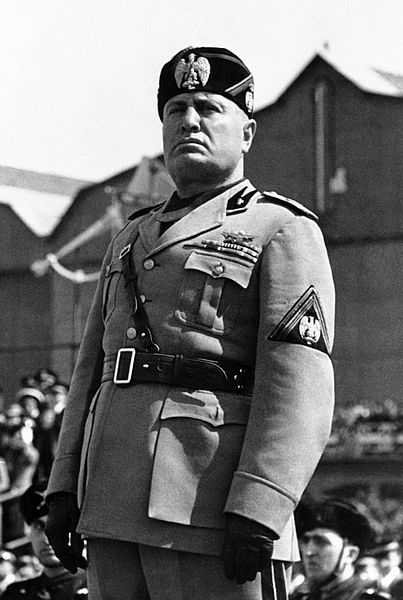
On 25 Jul 1943 the Fascist Grand Council formerly voted Mussolini from power and was arrested later after meeting with King Victor Emmanuel III. So, what happened to the once all-powerful Duce? Let’s find out.

Benito Mussolini from the second edition of Adolf Dresler’s “Mussolini als Journalist” (1939)
Public Domain via Wikimedia Commons

Italy Aligns with Germany

On 22 May 1939 Italy signed a treaty with Germany that allied both countries militarily and politically. Mussolini nicknamed this treaty, formally known as the Pact of Friendship and Alliance, as the Pact of Steel. The treaty committed Italy to support Germany if attacked or if it declared war. Mussolini believed the pact would provide defense from other Western nations and provide support for his ambitions in the Balkans and elsewhere. Italy was in desperate need of resources due to international sanctions in using mustard gas to conquer Ethiopia. It also lacked the industrial capability at that time for a sustained military conflict. Germany and Italy shared similar interests in believing Fascism was on the march. Italy, like Germany, sided with Francisco Franco during the Spanish Civil War (1936-1939). A treaty of mutual interest in 1936 brought them closer together and paved the way for the Pact of Steel. It was also Mussolini who coined the term Axis regarding the countries that signed the treaty.

Mussolini had hoped both the British and French would give him concessions after the Munich Agreement of 1938, where both powers forced Czechoslovakia to hand over territory to Germany. There was none and Mussolini gave speeches laying out Italy’s desire to take territory in North Africa, France, a part of Switzerland, and Albania. He also threatened British control of the seas and of taking Gibraltar. In both London and Paris, such talk was seen as signaling his territorial ambitions. In 1938, Italy invaded and conquered Albania convincing the other powers of his territorial ambitions. The Pact of Steel in 1939 cemented the partnership between the two countries that had been going on informally. Not all Fascists in Italy agreed with aligning with Germany. Foreign Minister Count Galeazzo Ciano, married to Mussolini’s daughter Edda, became skeptical later as Germany failed to disclose the planned to invade Poland as required by the treaty. While Ciano and other Fascists believed war with Britain and France was inevitable as both powers were blocking their ambitions, they did not see it occurring for a few more years. They dreadfully miscalculated Hitler’s aims and ambitions.

World War II

Mussolini knew that Italy was not ready for war until 1942 (and the Pact of Steel said neither side was to enter war till 1943). Lacking the raw resources and industrial capability, they needed to import both coal and steel. Countries like Britain banned those raw materials, making it difficult to acquire. Knowing this, Britain and France did try to lure Mussolini away from Germany by offering those resources. And it may have worked as Mussolini was preparing to sign documents to that effect. German pressure on Mussolini though scuttled it. They sent coal by train over the Alps to him to strengthen their friendship. The Italian Army was large on paper but lacked modern transport and weapons leaving them unable to hold their own against a fully trained and battle-ready army. Since supplies were critical to Italy, it failed to prepare its merchant fleet for war and lost many ships that were enemy ports when war was declared. Mussolini was warned by his military advisors to wait until war production would be able arm his military for war. While Italy easily took Albania, the British routed them in North Africa, and the Greeks were able to stop an Italian invasion of their country. In both cases, Germany sent troops to accomplish what the Italians failed to do. They were successful in Yugoslavia since German troops were with them. And the only declared war on France when Germany had defeated them so they could take territory in the south including Corsica. Thanks to Italian occupation in France though, Jews were safe as Italy refused German demands to turn them over.

Rationing of food and other supplies took its toll on the population. Due to a reduced merchant fleet, supplies became more difficult to acquire and had to rely on Germany for a lot of it. Inflation set in as well making it hard for many to buy the supplies. The poor military situation only made it worse and support for Mussolini began to slip. The army was lightly armored, the air force and navy were at odds with each other, poor leadership in the upper levels that were coupled with ill defined goals. Additionally, Mussolini might decide to do things on a whim making it a chaotic situation. With the Allies taking Sicily, landing in the south, and dropping bombs on Rome, most people had enough of the war. Both King Victor Emmanuel III and members of the Fascist Grand Council wanted Italy out of the war. Mussolini had to go.

Mussolini Sacked

The Fascist Grand Council met on 24 July 1943-a meeting that would last till the next morning-to discuss what to do. Mussolini, according to various accounts, looked sick, tired, and felt the burden of the military defeats suffered by the Italian military. For some, it appeared he wanted a way out and he got it. The Grand Council voted to remove him from power and transfer some of his powers to the king. There was opposition, but the majority voted for his removal. His son-in-law, Count Galeazzo Ciano, voted for his removal as well. Mussolini seemed stunned and dazed by it. His supporters tried to rally him, but he seemed deflated. He left for his meeting with King Emmanuel and arrived unshaven and groggy. He was informed by the king that he was under arrest and that General Pietro Badoglio would be taking over as Prime Minister. The war was seen as lost, the King Emmanuel reportedly said. Mussolini did not resist and seemed to accept it. He was told his family would remain safe. He was whisked away and imprisoned.

The announcement of Mussolini’s downfall was greeted with a general sense of relief. It was hoped this would mean the end of the war. The Fascists did not stage any protests or marches over his removal and imprisonment. He was being held at La Maddalena and later removed to a safer location to prevent his being rescued. The new Italian government negotiated behind the scenes seeking an armistice that would lead to a peace treaty. For a moment Italians breathed a sigh of relief hoping the war would soon be over.

Aftermath

Hitler was furious at his removal and knew the Italians would sign an armistice. Several German battalions were sent into Italy despite objections from the new government. When the armistice was announced on 3 September 1943, Operation Asche was implemented. German troops seized control of northern Italy and marched on Rome. They also seized all its territory in the Balkans and France. Italian forces were told to disarm or be fired upon. Some resistance was done in Rome as the royal family fled with the government. Corsica, Calabria, and Sardinia were successfully defended by Italian troops and repelled German troops until the Americans arrived. The Germans quickly implemented their anti-Jewish policies. Hitler ordered Mussolini found and was rescued from imprisonment at Hotel Campo Imperatore atop Gran Sasso d’Italia mountain range on 12 September 1943. Italians in the north would have to wait until June 1944 to be liberated.

[This was rewritten for 2025 correcting spelling, punctuation, and brevity]

Sources

Hibbert et al., “Benito Mussolini | Biography, Definition, Facts, Rise, & Death,” Encyclopedia Britannica, last modified June 16, 2025, https://www.britannica.com/biography/Benito-Mussolini.

The Editors of Encyclopaedia Britannica, “Pact of Steel | Italy–Germany [1939] | Britannica,” Encyclopedia Britannica, last modified March 18, 2009, https://www.britannica.com/event/Pact-of-Steel.

HISTORY.com Editors, “Benito Mussolini Falls From Power | July 25, 1943 | HISTORY,” HISTORY, last modified May 27, 2025, https://www.history.com/this-day-in-history/july-25/mussolini-falls-from-power.

Helga, “Italy Between 1922-1945 – the Rule of Mussolini,” Life in Italy, last modified October 7, 2022, accessed July 24, 2025, https://lifeinitaly.com/italy-between-1922-1945-the-rule-of-mussolini/.

Warfare History Network and Blaine Taylor, “Mussolini’s Fall From Power – Warfare History Network,” Warfare History Network, last modified November 29, 2023, accessed July 24, 2025, https://warfarehistorynetwork.com/article/mussolinis-fall-from-power/.

“Axis Alliance in World War II,” Holocaust Encyclopedia, https://encyclopedia.ushmm.org/content/en/article/axis-powers-in-world-war-ii.

Justin Demetri, “Italians in World War II,” Life in Italy, last modified October 10, 2024, https://lifeinitaly.com/italians-in-world-war-ii-2/.

Gerald Swick and Jim Heddlesten, “Italy in World War II,” HistoryNet, last modified March 30, 2016, https://www.historynet.com/italy-in-world-war-ii/.

The Editors of Encyclopaedia Britannica, “Italian Campaign | Summary, Map, Significance, Date, & World War II,” Encyclopedia Britannica, last modified July 2, 2025, https://www.britannica.com/topic/Italian-Campaign.

Suggested Reading

Bosworth, R. J. B. (2006). Mussolini’s Italy: Life Under the Dictatorship, 1915-1945. Penguin Press HC.

Haynes, D. (2023). A brief history of Italy: Tracing the Renaissance, Unification, and the Lively Evolution of Art and Culture.

Hearder, H., & Morris, J. (2001). Italy: A Short History. Cambridge University Press.

Hibbert, C. (2008). Mussolini: The Rise and Fall of Il Duce. St. Martin’s Griffin.

Kertzer, D. I. (2015). The Pope and Mussolini: The Secret History of Pius XI and the Rise of Fascism in Europe. Random House Trade Paperbacks.

Moseley, R. (1999). Mussolini’s shadow: The Double Life of Count Galeazzo Ciano. Yale University Press.

Titanic News Channel is a participant in the Amazon Services LLC Associates Program, an affiliate advertising program designed to provide a means for sites to earn advertising fees by advertising and linking to Amazon.com.
Remembering History: The Failed Plot to Assassinate Hitler (20 July 1944)

Martin Bormann, Hermann Göring, and Bruno Loerzer surveying the damaged conference room
20 Jul 1944
Source: German Federal Archives via Wikimedia Commons

On 20 July 1944 a bomb placed in the briefing room of  Wolf’s Lair would explode in an attempt to kill Hitler. It failed and many of the conspirators, including Field Marshal Erwin Rommel, would either be executed or commit suicide. So, who were the conspirators and why did it fail? Let’s find out.

The conspirators were a combination of both civilians and military and had varying reasons for coming together. Some opposed the anti-Jewish policies and were shocked by Kristallnacht; others were upset with how Hitler had mismanaged the war. Many wanted to save Germany from a catastrophic defeat they saw coming. Some of them no doubt would have faced a military tribunal had they survived for war crimes for working or assisting with the elimination of Jews. An earlier plot to kill Hitler on his airplane had failed, so the plan was changed. Called Operation Valkyrie, the plan was to take control of cities, disarming the SS, and arresting Nazi leaders.

Colonel Claus von Stauffenberg was to place a bomb under a table at the East Prussian headquarters called Wolf’s Lair. Then once Hitler was confirmed dead, a radio announcement would go out saying that the Nazi Party had murdered Hitler and ordering the Reserve Army to take control of key installations in Berlin, arresting Nazi leaders. Carl Friedrich Goerdeler, former mayor of Leipzig would become chancellor with former army chief of staff Ludwig Beck becoming president. Then the new government would begin negotiating for an armistice.

Stauffenberg arrived with two bombs on 20 Jul 1944 but was unable to arm one of them. In the briefing room where military aides were briefing Hitler, he placed the briefcase with the bomb under the table and near Hitler. He excused himself and left the room. Unfortunately, the briefcase was moved to under a thick leg of the table. When it detonated at 12:42 PM, Stauffenberg believed Hitler had been killed and put Operation Valkyrie into action. Hitler was wounded but not killed but the stenographer and three officers died. However instead of acting right away, many of the conspirators waited until Stauffenberg arrived in Berlin three hours later. By that time rumors of Hitler’s survival sapped the courage of many to go through with their plans. Precious time was lost, and it was too late now.

General Friedrich Fromm, who knew of the plot and condoned it, quickly saved himself by arresting the key conspirators and executing them. Hitler would go on the radio on 21 July 1944 to announce his survival to the nation and that those who had done this would be taken care of. The Gestapo swung into action arresting and torturing the remaining conspirators. Some were hauled before the infamous Volksgericht (People’s Court). There the infamous Nazi judge Roland Freisler handed out death sentences. Some were hung or shot, and a few were strangled with piano wire. Fromm did not escape eventually being arrested, tried, and executed. General Beck was allowed to commit suicide but only wounded himself and had to be shot. The surprising revelation that Field Marshal Erwin Rommel was involved (he knew of the plot but took no active role in its planning or execution) shocked Hitler. Due to his popularity-and to avoid a trial-he was told if he committed suicide his family would be spared. Upon his death from an “illness”, he was given a full military funeral.

The assassination attempt did not weaken Hitler but strengthened it. His grip was tightened, and they went after not just those involved but other enemies, they could get rid of at the same time by claiming they were part of the plot as well. Over 7,000 were arrested and 4,980 were executed. The barbaric deaths of some by piano wire was specifically ordered by Hitler.

Memorials

Memorial to the 20 July Plotters
Bendlerblock (Berlin) in 2007
Image: Coenen via Wikimedia Commons

The German government in 1980 decided to create a memorial to the anti-Nazi resistance. Bendlerblock, which was the German Army Headquarters at the time, now has an area set aside as a memorial for Stauffenberg and the other July 20 plotters. Additionally, a permanent exhibition was established showing the various resistance groups that existed in Germany. Finally, the street outside Bendlerblock was renamed Stauffenbergstrasse.

Sources

The Editors of Encyclopaedia Britannica, “July Plot | History, Leaders, Executions, & Facts,” Encyclopedia Britannica, last modified July 13, 2025, https://www.britannica.com/event/July-Plot.

HISTORY.com Editors, “Assassination Plot Against Hitler Fails,” HISTORY, last modified May 28, 2025, https://www.history.com/this-day-in-history/july-20/assassination-plot-against-hitler-fails.

“The July 20, 1944, Plot to Assassinate Adolf Hitler,” Holocaust Encyclopedia, https://encyclopedia.ushmm.org/content/en/article/the-july-20-1944-plot-to-assassinate-adolf-hitler.

Suggested Reading

Allen, W. S. (1984). The Nazi Seizure of Power: The Experience of a Single German Town, 1922-1945. Franklin Watts.

Gregory, D. A. (2018). After Valkyrie: Military and Civilian Consequences of the Attempt to Assassinate Hitler.McFarland.

Jones, N. (2019). Countdown to Valkyrie: The July Plot to Assassinate Hitler. Frontline Books.

Keegan, J. (2005). The Second World War. Penguin Books.

Schmidt, E. (2021). The Hitler Conspirator: The Story of Kurt Freiherr von Plettenberg and Stauffenberg’s Valkyrie Plot to Kill the Fuhrer. Frontline Books.

Shirer, W. L. (2011). The Rise and Fall Of The Third Reich: A History of Nazi Germany. Simon and Schuster.

Titanic News Channel is a participant in the Amazon Services LLC Associates Program, an affiliate advertising program designed to provide a means for sites to earn advertising fees by advertising and linking to Amazon.com.
Remembering History: Night of the Long Knives (30 June 1934)

On 30 June 1934 Hitler purged his own party of members he feared would become his enemies. Why did this happen? Let’s dive in and find out.

The National Socialist German Workers Party (Nationalsozialistische deutsche Arbeiterpartei Or NSDAP) was formed in the early 1920’s by Adolf Hitler hoping to draw people away from Marxist groups that were attracting many followers. The NSDAP (later to be called simply Nazi) fused elements of Socialism with nationalism creating something similar to what Benito Mussolini did in Italy with Fascism. Both Fascists and Nazis believed in a strong central state, a single party and a strong leader, and that citizens serve the national will in all that they do. They both reject democracy as weak, disdain for civil liberties, and capitalism that seeks profit over that of the state. They agree with Communists and Socialists about the political structure of the state but disagree over nationalism, worker’s rights, and its private ownership. Fascists and Nazis both believe in nationalism as a cornerstone of their ideology, unlike Communists and Socialists who believe they have to be torn down.

Hitler’s party targeted those who felt betrayed by the stinging defeat of World War I. It meant the end of both the German Empire and Austria-Hungary. Austria would be reduced down to its present size of what Austria is today and no longer a major power in the world. On top of that, the hated Versailles Treaty of 1919 levied huge reparations on Germany and stripped her of land and its overseas territories. His party absorbed other parties, some more extreme, as well. Antisemitism would also be a major draw for this party. Many in Germany believed, or were convinced, that Jews had conspired to bring down what happened. Jews owned banks, newspaper and other key businesses were profiteers and grifters who betrayed the German people. It would become a major feature of the party in the years to come.

Inspired by Mussolini’s Black Shirts, Hitler created his own paramilitary called Sturmabteilung (Storm Troops) or SA or simply called Brown Shirts to be used to threaten and intimidate enemies of the party and Germany. It was composed in the early days with war veterans and those that had been members of the Free Corps (Freikorps) which had been formed to counter left wing groups. In 1923 under the leadership of General Erich Ludendorff there was the famous Beer Hall Putsch to seize control of the Bavarian State. It failed and Hitler was imprisoned. While in jail, he composed his seminal book that told the world what his beliefs were and what the Nazi Party would do. Mein Kampf would, when published, become popular reading. It still is today in many parts of the world influenced by elements of fascism and antisemitism.

1932 Berlin
SA-Propagandamarsch in Spandau
Bundesarchiv, B 145 Bild-P049500 / CC-BY-SA 3.0
German Federal Archives via Wikimedia Commons

The Nazi Party would continue to grow through the 1920’s and as economic conditions got worse, found many willing to hear about rebuilding Germany and tossing out the current ruling elites that had made a mess of things. Mussolini made the same type of appeal much earlier and was swept into power after his march on Rome where the king appointed him prime minister even though there had not been a vote to put his party into full power. The Nazi Party, though it used the SA to bully and intimidate, used the ballot box to gain seats in the Reichstag. By 1928, it had gained lots of members but only held 12 seats. Its support came primarily from those who had served in the war, the disillusioned, and many who felt Germany was on the wrong path. Despite its name of being a worker’s party, most industrial workers were not drawn to Nazis. Hitler was not worried about this as he was building a national movement that would draw people into counter those who feared Communism and Socialism. Nazis used posters, slogans, parades, and other things to convey their message to the masses, which was we are to hear to fix Germany and toss out the weak Weimar government.

By the late 1920’s and early 1930’s, both the Nazis and Communists were popular. Both sought to fix the problems but in strikingly different ways. The SA got more active and soon fights were breaking out in the streets, assassinations were occurring. All of this convinced many that a strong central figure was needed to end the chaos, which was what Hitler sought to achieve. The antisemitic leanings were downplayed in general elections but anyone who attended their meetings knew that hatred of Jews was deeply ingrained in its leadership. In the July 1932 elections they got 37% of the vote and 230 seats in the Reichstag. It was a great victory for Hitler, but the November elections saw their fortunes had dissipated. The Nazi Party lost seats (down to 196) while the Communists gained. The other conservative and moderate political parties did well but no one had a clear majority to govern leaving it without a government for a time. President Hindenburg had defeated Hitler who had run for the same position.

The reasons that the Nazis lost votes has been debated, but by this time the Germany economy seemed better, and the Weimar government looked better as a result. This stung the Nazi leadership because the last thing they wanted was Weimar to stay in power. Hitler and those that supported him worked hard to negotiate with the other conservative parties to gain their support. They appealed to the old military aristocracy, the industrialists, and other leaders they needed to get support from. They played up the fear that the Communists would gain power. Most of the other conservative parties were wary of Hitler and his Nazis but ultimately decided to join with him to create a majority so that government could be formed.

And on 30 January 1933, President Hindenburg appointed Hitler as chancellor. Hindenburg and the others who had allied with him thought  they could control him. That would prove to be a disastrous miscalculation on their part. Hitler moved quickly to solidify the power of the Nazi party. While technically a coalition government, they quickly began suppressing and abridging press freedoms and individual liberties. All those who opposed the Nazis now had the SA, now part of the government, being given police powers. Jews would be dismissed from government posts. Hitler convinced Hindenburg to dissolve the Reichstag, a clever move so that when elections would be held only his party would be seated. They quickly worked to suppress all other parties except the ones that had supported them.

By 1934 the Nazi’s had swept away the old order and through elections (which in many cases were fraudulent) got all the seats they needed to fill the Reichstag. Things looked good but there were some problems. Internal corruption was an issue but so was the issue of continued violence the SA was doing. The SA, like the Black Shirts, served a vital role but also tended to be more purist about their doctrines than most in the party were. The SA had swelled in size to 4.5 million making it a very large paramilitary organization. As revolutionaries know, the greatest threat is not from outsiders but from those inside who build powerful groups internally that might topple ?you. Stalin had purged most of the early revolutionaries because they wanted more radical ideas and threatened his power. Mussolini had issues. Now Hitler was facing it as well.

The German army also was worried. There was a fully armed paramilitary organization that ran parallel to it. That would inevitably cause friction, especially in times of war when you needed clear operational structures. The SS, by contrast, was both a bodyguard for Hitler and oversaw the administration of specific areas designated to them by Hitler. They did not act as a paramilitary organization. Also, the public began to complain as well. That seems odd in a dictatorship they would care about public opinion, but the Nazis knew if they lost support of the populace, it would be an even bigger issue to contend with. The violence of the SA was getting loud feedback from the local Nazi leaders. In short, it had to be curtailed. Some saw its leader Ernst Rohm as the German equivalent of the Roman Sejanus who had become very powerful under Emperor Tiberius and threatened his reign. Both Himmler and Goering played on this fear when trying to convince Hitler that its leader, Ernst Röhm, was planning a coup.

Photo of Ernst Roehm, probably taken in Munich (München), Germany (Weimar Republic) on 1 April, 1924 National Archives and Records Administration (NAID) 162122137 Public Domain

And so, on the night of 30 June 1934, called the Night of the Long Knives came about. Rohm and all the leaders of the SA were arrested and ultimately executed (often brutally). Nazis took advantage of this event to also to eliminate other political opponents including former chancellor Kurt von Schleicher.

Aftermath

The SA was downsized and a new leader, Viktor Lutze, was appointed as Stabschef (the equivalent of chief of staff) to the SA. The SA would continue to be used to go after those opposing Hitler and later the Jews. The SA was used in Kristallnacht in November 1938 to destroy over 7,500 glass storefronts on Jewish shops and businesses along with ransacking Jewish homes. The also helped destroy nearly all the Jewish synagogues (the only ones that were spared were ones next to important buildings-they could be ransacked but not burned). The SA also carried out mass beatings of Jews and arrested many who were taken to concentration camps. They became overshadowed by the SS that now handled policing and security. By

1939 it had lost significance in the Nazi Party. It was converted into a training school for the armed forces. Once war began, it lost its members to the Wehrmacht (German armed forces). It continued to exist though and when the SS and the Foreign Office had major issues, he appointed SA members to diplomatic posts to counter the SS. When Lutze died in a car accident in 1943, the new leader tried to smooth out the tensions between the SS and the SA. The SA would formally cease to exist when the war ended in 1945.

Sources

The Editors of Encyclopaedia Britannica, “Night of the Long Knives | Date, Victims, Summary, & Facts,” Encyclopedia Britannica, last modified March 25, 2009, https://www.britannica.com/event/Night-of-the-Long-Knives.

“Hitler Purges Members of His Own Nazi Party in Night of the Long Knives,” last modified May 27, 2025, accessed June 30, 2025, https://www.history.com/this-day-in-history/june-30/night-of-the-long-knives.

“Röhm Purge,” https://encyclopedia.ushmm.org/content/en/article/roehm-purge.

The SA. (n.d.). https://encyclopedia.ushmm.org/content/en/article/the-sa

Suggested Reading

Allen, W. S. (1984). The Nazi seizure of power: The Experience of a Single German Town, 1922-1945. Franklin Watts.

Engelmann, B. (1986). In Hitler’s Germany: Daily Life in the Third Reich. Pantheon.

Shirer, W. L. (2011). The rise and fall of the Third Reich: A History of Nazi Germany. Simon and Schuster.

Titanic News Channel is a participant in the Amazon Services LLC Associates Program, an affiliate advertising program designed to provide a means for sites to earn advertising fees by advertising and linking to Amazon.com.

Fascinating History: Hitler Learns War Is Lost (22 April 1945)

Berlin June 1945 (Carl Weinrother 1898–1976)
German Federal Archives via Wikimedia Commons

By April 1945, victories by Allied and Russian forces had reduced the once formidable German state to a shadow of its former self. Due to increased Allied air attacks on Berlin, Hitler had relocated his headquarters from the Reich Chancellery to the Fuhrerbunker, an underground complex that would serve as the command center for the remnants of the Third Reich earlier in the year. 19th April saw the Soviet Army mobilize its troops to encircle Berlin. Hitler had gone above on 20 April 1945, his 56th birthday, to award the Iron Cross to boys from the Hitler Youth.

It was on 22 April 1945 that Hitler, in an afternoon meeting, learned that Soviets were entering the northern suburbs of Berlin meeting no resistance. It enraged Hitler, who denounced the Army, and made him realize the war was lost. Hitler decided to stay in Berlin rather than flee south.

Sources:

Bullock et al., “Adolf Hitler | History, Biography, Actions, & Facts,” Encyclopedia Britannica, last modified April 21, 2025, https://www.britannica.com/biography/Adolf-Hitler/World-War-II.

Mark Milligan, “Führerbunker – Hitler’S Last Bunker,” HeritageDaily – Archaeology News, last modified March 22, 2022, https://www.heritagedaily.com/2021/03/fuhrerbunker-hitlers-last-bunker/137885.

HISTORY.com Editors, “Hitler Admits Defeat | April 22, 1945 | HISTORY,” HISTORY, last modified February 18, 2025, https://www.history.com/this-day-in-history/april-22/hitler-admits-defeat.

Richard J Evans, “Bitter End: Hitler’s Downfall and the End of the War and the Third Reich,” HistoryExtra, last modified October 18, 2024, https://www.historyextra.com/period/second-world-war/adolf-hitler-downfall-ww2-bunker/.


Remembering History: Mussolini Ousted (25 July 1943)

Benito Mussolini
Public Domain

On 25 Jul 1943 the Fascist Grand Council formally voted Mussolini from power and was arrested later after meeting with King Victor Emmanuel III. So, what happened to the once all-powerful Duce? Let’s find out.

Italy had entered into the Pact of Steel with Germany in 1939 which committed Italy to fighting along with Germany if it declared war or was attacked. Mussolini entered the agreement knowing full well Italy did not have the resources or industrial capability for a sustained military conflict. Mussolini had grand ambitions about expanding the Italian sphere of influence in the region and even into central Europe. Mussolini believed that Fascism was on the march and aligning with Hitler seemed a good choice at the time. Italy had successfully invaded Ethiopia (1935-1937) though not without them putting up a strong fight. Using mustard gas against troops and civilians had gotten Mussolini severely criticized and international sanctions.

The war in Ethiopia and his intervention on the side of Franco in the Spanish Civil War had brought Italy closer to Germany with a treaty of mutual interest in 1936.  And he needed coal from Germany since international sanctions over Ethiopia had made acquiring it more difficult. Mussolini believed a German-Rome Axis would be how Europe would turn but relying on Germany to supply items like coal meant Italy was more dependent on Germany rather than a true partnership. Mussolini tried to get all kinds of concessions from the British and French after the Munich Agreement in 1938; none were given. He made it clear in speeches (and those by others) that they wanted territory in France, Tunisia, a small part of Switzerland, and Albania. He upped his demands to demand free access to the world’s oceans by breaking British control of key places such as Gibraltar.

From the viewpoint in London, Paris, and elsewhere, his bellicose talk signaled major territorial ambitions. The Fascists mostly supported this though some, like his foreign minister Count Galeazzo Ciano, were concerned about aligning with Germany. Taking on both Britain and France became accepted since they were the major colonial powers that Italy saw as blocking them from achieving their rightful position in the world. On 7 April 1938, Italy invaded Albania and took control in three days. The formal military alliance with Germany (the Pact of Steel) was signed on 2 May 1939 cementing further the military ambitions of both countries together. The Italians thought war with Britain and France would not occur for years but dreadfully miscalculated Hitler’s ambitions.

Italy was not ready for major war operations until 1942 according to his own advisors. The Pact of Steel had said neither side was to enter war until 1943. Italy desperately needed this time in order to get its industry running and lacked critical military industrial production. Both Britain and France had highly developed military industrial production, but Italy was woefully behind in key areas such as automobile production (key to making tanks and other mobile artillery). Additionally, Italy needed to acquire all the needed raw resources needed for war production. Italy was primarily an agriculturally based economy with small pockets of industrial sectors. They needed to setup a supply chain to bring in all the raw materials like coal and import steel. Italy’s merchant marine was not managed in preparation for war and would lose those ships as they were in foreign ports when war was declared by Italy in 1940.

Prior to that, raw materials being sent from European ports to Italy were subject to seizure. Coal, for instance, was shipped out of Rotterdam. The British declared it contraband and seized it, infuriating Mussolini. The Germans offered to ship by train over the Alps while the British countered saying they would supply all of his country’s needs if Italy supplied them armaments. The British hoped to lure Italy away from its alliance with Germany. And it appeared to work as Mussolini had approved a draft contract to provide military equipment. It was suddenly scrapped under intense pressure from Germany caused Mussolini to fold. This decision would come back to haunt him much later down the road.

Italian debt, already large when Mussolini, came to power, had increased thanks to his generous support of General Franco in Spain that increased it. The blockade of coal was strengthened and deeper reliance on German imports of raw materials occurred. The economy was bolstered by the important of goods from Germany, but inflation was occurring causing basic goods and service to become more expensive. When Italy entered the war in 1940, its merchant marine in foreign ports were seized leaving the country without hardly any means of getting needed supplies by cargo vessels.

Adding more to the woes, the warnings of his advisors were accurate. Italy’s army was huge making it a major land force on paper but in reality, lacked modern transport and weapons. The army, because of the weak economy, did not have the needed armaments or supplies for war, and was the major reason it failed. Lightly armored infantry is no match for a fully equipped company of troops with full battle-ready equipment like the British had. Along with both a navy and air force that did not work together well, Italy was ill-prepared for general warfare except for a country that had a worse military than it had. There was poor leadership as well at the top that never had clearly defined military objectives and seemed to go at the whim of whatever Duce wanted them to do. They easily took the lower portions of Vichy France and Corsica. About the only good thing they did in taking that was providing a refuge for fleeing Jews. The Italians did not follow the German lead much regarding the Jews, which caused the Germans frustration over the Italian non-compliance in this area.

The succeeding campaigns in North Africa and Greece ended badly. In North Africa the British put up a good fight and had routed the Italians. Then the Germans arrived with Rommel in charge making it a much tougher campaign for the British and later the Americans; Greece was a total debacle. They invaded from Albania, but the Greeks pushed them back into Albania ending up in a stalemate that cost both sides. Once again, the Germans invaded (the British were using Greece to fly bombing raids into Romania) and successfully took Greece and Crete. Only Yugoslavia was a success but that was because the Germans were part of the campaign and once the country was divided up, Italy got the coastal area.

By 1943 though, things had gotten worse for most Italians. Food and other items were rationed, wartime inflation made everything more expensive, and the war itself was unpopular with most Italians. Mussolini was no longer seen as the great leader and the recent bombing of Rome showed how his boasts were hollow. The invasion of Sicily and later the south by Allied forces showed the proverbial “writing was on the wall.” Mussolini knew that his military could not successfully fight the Allies but stuck to the war because he saw no other option but to fight it out. The Fascist Grand Council knew the war was lost and that Mussolini had lost his stature with the people.

On the night of 24 July and in the early morning of 25 July, the Grand Council met with Mussolini. Accounts of the meeting indicate he was sick, tired, and felt the burden of the military reverses suffered by the Italian military. To some, it seemed he was looking for a way out and it was given to him. The Grand Council voted to remove him from power and transfer some of his duties to the King. While some opposed it, the vote was carried by the majority. Even his son-in-law Count Galeazzo Ciano voted for his ouster. Mussolini seemed dazed by the vote and while his supporters tried to get him to act, he seemed unable to do anything. He would go to his meeting with the King (unshaven and groggy) where he would be arrested. The King told him that General Pietro Badoglio would be taking over as Prime Minister and that the war was lost. He and his family were assured of their safety, and he was whisked away. Mussolini accepted his fall as it absolved him of any more responsibility for the war.

When it was declared Mussolini was out, the general response was one of relief. His fellow Fascists did not stage marches or protests over his dismissal and did nothing to release him from his incarceration on La Maddalena (he would be moved elsewhere). Hitler was furious and knew that the Italians would seek an armistice with the Allies (which was true but in public said otherwise to keep the Germans at bay). For the Allies his dismissal was good news as they hoped it might bring an end to the Italian campaign. And many Italians thought it would as well, Unfortunately the Germans had other plans and that would drag out the war in Italy until June 1944, but that is a story for another time.

Sources:

Foot, J., & Hibbert, C. (2024, July 8). Benito Mussolini | Biography, Definition, Facts, rise, & Death. Encyclopedia Britannica. https://www.britannica.com/biography/Benito-Mussolini

The Editors of Encyclopaedia Britannica. (2009, March 18). Pact of Steel | Italy–Germany [1939]. Encyclopedia Britannica. https://www.britannica.com/event/Pact-of-Steel

Mullen, M. (2020b, July 23). Benito Mussolini falls from power. HISTORY. https://www.history.com/this-day-in-history/mussolini-falls-from-power

Italy between 1922-1945 – The Rule of Mussolini. (n.d.). Life in Italy. Retrieved July 23, 2024, from https://lifeinitaly.com/italy-between-1922-1945-the-rule-of-mussolini/

Warfare History Network. (2023, November 29). Mussolini’s Fall from Power – Warfare History Network. https://warfarehistorynetwork.com/article/mussolinis-fall-from-power/

Axis Alliance in World War II. (n.d.). https://encyclopedia.ushmm.org/content/en/article/axis-powers-in-world-war-ii

Wikipedia contributors. (2024d, July 23). Military history of Italy during World War II. Wikipedia. https://en.wikipedia.org/wiki/Military_history_of_Italy_during_World_War_II

Suggested Reading

Bosworth, R. J. B. (2006). Mussolini’s Italy: Life Under the Dictatorship, 1915-1945. Penguin Press HC.

Haynes, D. (2023). A brief history of Italy: Tracing the Renaissance, Unification, and the Lively Evolution of Art and Culture.

Hearder, H., & Morris, J. (2001). Italy: A Short History. Cambridge University Press.

Hibbert, C. (2008). Mussolini: The Rise and Fall of Il Duce. St. Martin’s Griffin.

Kertzer, D. I. (2015). The Pope and Mussolini: The Secret History of Pius XI and the Rise of Fascism in Europe. Random House Trade Paperbacks.

Moseley, R. (1999). Mussolini’s shadow: The Double Life of Count Galeazzo Ciano. Yale University Press.

Titanic News Channel is a participant in the Amazon Services LLC Associates Program, an affiliate advertising program designed to provide a means for sites to earn advertising fees by advertising and linking to Amazon.com.

Remembering History: Rome Bombed by United States (19 Jul 1943)

[Editors note: This has been updated from 2023 with updated source information.]

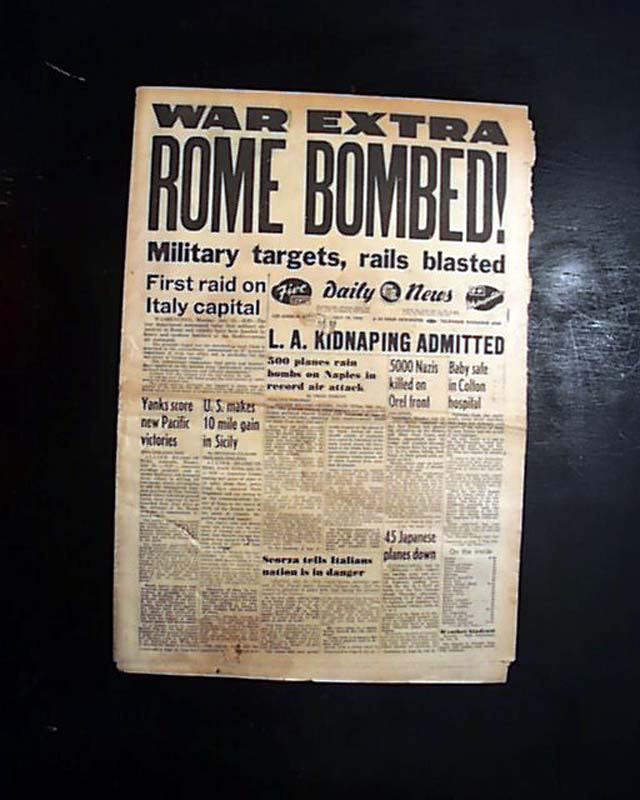
Daily News, Los Angeles- Headline on Bombing of Rome
Source: RareEarlyNewspapers.com All Rights Reserved

By 1943, Italians had seen shortages in basic goods and supplies requiring rationing as their merchant marine had been decimated by the war. This led to a lot of grumbling about the war and its effects on Italy. Mussolini’s popularity had begun to wane. He had convinced Italians that the Allies would never bomb the eternal city of Rome. Then on 19 July 1943, the U.S. bombed the Rome railway yards.

Both President Franklin Roosevelt and British Prime Minister Winston Churchill had made a public appeal for Italians to reject Mussolini and save their country. The Allies by this time had invaded Sicily, and thanks to a clever deception, Hitler thought it initially a diversion. The Axis had been furthered weakened by its defeat in North Africa which had seen losses by both German and Italian forces. The advance of the Allied troops shook the Italian government. The bombing of Rome really caused panic in Rome as people went out into the streets.

It was much worse though as panic gave way to anger at Mussolini. People started destroying effigies of the dictator. And oddly, there was actually celebration of the attack as it was seen as leading to Mussolini’s demise. Hitler met with Mussolini to shore up his confidence after the attack. The attack had shaken him as well. Mussolini appeared unusually quiet in the meeting (he spoke poor German) and relied on the transcript later. Hitler tried to restore his confidence worried he might cave in and seek an armistice with the Allies. In the end, Mussolini agreed to continue the war though by this time he knew the truth. The Italian army was beaten and there was no way they could win the war. He could not tell that to Hitler fearing what he might do in response.

Hitler for his part was concerned that either Mussolini would surrender, or his own people might remove him. He quietly ordered Rommel to take control of the Greek islands in case something went wrong in Rome. The Germans would be ready to pounce when it did. And events happened faster than expected. Within a week the Fascist Grand Council would relieve Mussolini and he was put under arrest by the King.

Sources

Mullen, M. (2020, July 16). America bombs Rome. HISTORY. https://www.history.com/this-day-in-history/america-bombs-rome

This day in History: The Americans Bomb Rome (1943) – History collection. (n.d.). History Collection. https://historycollection.com/day-history-americans-bomb-rome-1943/

Americans bomb Rome in 2-hour daylight raid – UPI Archives. (1943, July 19). UPI. https://www.upi.com/Archives/1943/07/19/Americans-bomb-Rome-in-2-hour-daylight-raid/6801563205263/

MarshallV. (2022, May 22). The Allied Campaign in Italy, 1943-45: A Timeline, Part one. The National WWII Museum | New Orleans. https://www.nationalww2museum.org/war/articles/allied-campaign-italy-1943-45-timeline-part-one


Remembering History: Night of the Long Knives (30 June 1934)

On 30 June 1934 Hitler purged his own party of members he feared would become his enemies. Why did this happen? Let’s dive in and find out.

The National Socialist German Workers Party (Nationalsozialistische deutsche Arbeiterpartei Or NSDAP) was formed in the early 1920’s by Adolf Hitler hoping to draw people away from Marxist groups that were attracting many followers. The NSDAP (later to be called simply Nazi) fused elements of Socialism with nationalism creating something similar to what Benito Mussolini did in Italy with Fascism. Both Fascists and Nazis believed in a strong central state, a single party and a strong leader, and that citizens serve the national will in all that they do. They both reject democracy as weak, disdain for civil liberties, and capitalism that seeks profit over that of the state. The agree with Communists and Socialists about the political structure of the state but disagree over nationalism, worker’s rights, and its private ownership. Fascists and Nazis both believe in nationalism as a cornerstone of their ideology, unlike Communists and Socialists who believe they have to be torn down.

Hitler’s party targeted those who felt betrayed by the stinging defeat of World War I. It meant the end of both the German Empire and Austria-Hungary. Austria would be reduced down to its present size of what Austria is today and no longer a major power in the world. On top of that, the hated Versailles Treaty of 1919 levied huge reparations on Germany and stripped her of land and its overseas territories. His party absorbed other parties, some more extreme, as well. Antisemitism would also be a major draw for this party. Many in Germany believed, or were convinced, that Jews had conspired to bring down what happened. Jews owned banks, newspaper and other key businesses were profiteers and grifters who betrayed the German people. It would become a major feature of the party in the years to come.

Inspired by Mussolini’s Black Shirts, Hitler created his own paramilitary called Sturmabteilung (Storm Troops) or SA or simply called Brown Shirts to be used to threaten and intimidate enemies of the party and Germany. It was composed in the early days with war veterans and those that had been members of the Free Corps (Freikorps) which had been formed to counter left wing groups. In 1923 under the leadership of General Erich Ludendorff there was the famous Beer Hall Putsch to seize control of the Bavarian State. It failed and Hitler was imprisoned. While in jail, he composed his seminal book that told the world what his beliefs were and what the Nazi Party would do. Mein Kampf would, when published, become popular reading. It still is today in many parts of the world influenced by elements of fascism and antisemitism.

1932 Berlin
SA-Propagandamarsch in Spandau
Bundesarchiv, B 145 Bild-P049500 / CC-BY-SA 3.0
German Federal Archives via Wikimedia Commons

The Nazi Party would continue to grow through the 1920’s and as economic conditions got worse, found many willing to hear about rebuilding Germany and tossing out the current ruling elites that had made a mess of things. Mussolini made the same type of appeal much earlier and was swept into power after his march on Rome where the king appointed him prime minister even though there had not been a vote to put his party into full power. The Nazi Party, though it used the SA to bully and intimidate, used the ballot box to gain seats in the Reichstag. By 1928, it had gained lots of members but only held 12 seats. Its support came primarily from those who had served in the war, the disillusioned, and many who felt Germany was on the wrong path. Despite its name of being a worker’s party, most industrial workers were not drawn to Nazis. Hitler was not worried about this as he was building a national movement that would draw people into counter those who feared Communism and Socialism. Nazis used posters, slogans, parades, and other things to convey their message to the masses, which was we are to hear to fix Germany and toss out the weak Weimar government.

By the late 1920’s and early 1930’s, both the Nazis and Communists were popular. Both sought to fix the problems but in strikingly different ways. The SA got more active and soon fights were breaking out in the streets, assassinations were occurring. All of this convinced many that a strong central figure was needed to end the chaos, which was what Hitler sought to achieve. The antisemitic leanings were downplayed in general elections but anyone who attended their meetings knew that hatred of Jews was deeply ingrained in its leadership. In the July 1932 elections they got 37% of the vote and 230 seats in the Reichstag. It was a great victory for Hitler, but the November elections saw their fortunes had dissipated. The Nazi Party lost seats (down to 196) while the Communists gained. The other conservative and moderate political parties did well but no one had a clear majority to govern leaving it without a government for a time. President Hindenburg had defeated Hitler who had run for the same position.

The reasons that the Nazis lost votes has been debated, but by this time the Germany economy seemed better, and the Weimar government looked better as a result. This stung the Nazi leadership because the last thing they wanted was Weimar to stay in power. Hitler and those that supported him worked hard to negotiate with the other conservative parties to gain their support. They appealed to the old military aristocracy, the industrialists, and other leaders they needed to get support from. They played up the fear that the Communists would gain power. Most of the other conservative parties were wary of Hitler and his Nazis but ultimately decided to join with him to create a majority so that government could be formed.

And on 30 January 1933, President Hindenburg appointed Hitler as chancellor. Hindenburg and the others who had allied with him though they could control him. That would prove to be a disastrous miscalculation on their part. Hitler moved quickly to solidify the power of the Nazi party. While technically a coalition government, they quickly began suppressing and abridging press freedoms and individual liberties. All those who opposed the Nazis now had the SA, now part of the government, being given police powers. Jews would be dismissed from government posts. Hitler convinced Hindenburg to dissolve the Reichstag, a clever move so that when elections would be held only his party would be seated. They quickly worked to suppress all other parties except the ones that had supported them.

By 1934 the Nazi’s had swept away the old order and through elections (which in many cases were fraudulent) got all the seats they needed to fill the Reichstag. Things looked good but there were some problems. Internal corruption was an issue but so was the issue of continued violence the SA was doing. The SA, like the Black Shirts, served a vital role but also tended to be more purist about their doctrines than most in the party were. The SA had swelled in size to 4.5 million making it a very large paramilitary organization. As revolutionaries know, the greatest threat is not from outsiders but from those inside who build powerful groups internally that might topple ?you. Stalin had purged most of the early revolutionaries because they wanted more radical ideas and threatened his power. Mussolini had issues. Now Hitler was facing it as well.

The German army also was worried. There was a fully armed paramilitary organization that ran parallel to it. That would inevitably cause friction, especially in times of war when you needed clear operational structures. The SS, by contrast, was both a bodyguard for Hitler and oversaw the administration of specific areas designated to them by Hitler. They did not act as a paramilitary organization. Also, the public began to complain as well. That seems odd in a dictatorship they would care about public opinion, but the Nazis knew if they lost support of the populace, it would be an even bigger issue to contend with. The violence of the SA was getting loud feedback from the local Nazi leaders. In short, it had to be curtailed. Some saw its leader Ernst Rohm as the German equivalent of the Roman Sejanus who had become very powerful under Emperor Tiberius and threatened his reign. Both Himmler and Goering played on this fear when trying to convince Hitler that its leader, Ernst Röhm, was planning a coup.

Photo of Ernst Roehm, probably taken in Munich (München), Germany (Weimar Republic) on 1 April, 1924 National Archives and Records Administration (NAID) 162122137 Public Domain

And so, on the night of 30 June 1934, called the Night of the Long Knives came about. Rohm and all the leaders of the SA were arrested and ultimately executed (often brutally). Nazis took advantage of this event to also to eliminate other political opponents including former chancellor Kurt von Schleicher.

Aftermath

The SA was downsized and a new leader, Viktor Lutze, was appointed as Stabschef (the equivalent of chief of staff) to the SA. The SA would continue to be used to go after those opposing Hitler and later the Jews. The SA was used in Kristallnacht in November 1938 to destroy over 7,500 glass storefronts on Jewish shops and businesses along with ransacking Jewish homes. The also helped destroy nearly all the Jewish synagogues (the only ones that were spared were ones next to important buildings-they could be ransacked but not burned). The SA also carried out mass beatings of Jews and arrested many who were taken to concentration camps. They became overshadowed by the SS that now handled policing and security. By

1939 it had lost significance in the Nazi Party. It was converted into a training school for the armed forces. Once war began, it lost its members to the Wehrmacht (German armed forces). It continued to exist though and when the SS and the Foreign Office had major issues, he appointed SA members to diplomatic posts to counter the SS. When Lutze died in a car accident in 1943, the new leader tried to smooth out the tensions between the SS and the SA. The SA would formally cease to exist when the war ended in 1945.

Sources

Mullen, M. (2021, June 28). Hitler purges members of his own Nazi party in Night of the Long Knives. HISTORY. https://www.history.com/this-day-in-history/night-of-the-long-knives

The Night of Long Knives – The Holocaust Explained: Designed for schools. (1933, June 22). https://www.theholocaustexplained.org/the-nazi-rise-to-power/how-did-the-nazi-gain-power/night-of-long-knives/

The SA. (n.d.). https://encyclopedia.ushmm.org/content/en/article/the-sa


Suggested Reading

Allen, W. S. (1984). The Nazi seizure of power: The Experience of a Single German Town, 1922-1945. Franklin Watts.

Engelmann, B. (1986). In Hitler’s Germany: Daily Life in the Third Reich. Pantheon.

Shirer, W. L. (2011). The rise and fall of the Third Reich: A History of Nazi Germany. Simon and Schuster.

Titanic News Channel is a participant in the Amazon Services LLC Associates Program, an affiliate advertising program designed to provide a means for sites to earn advertising fees by advertising and linking to Amazon.com.

Remembering History: Napoleon Invades Russia (24 June 1812)

The Emperor Napoleon in His Study at the Tuileries, 1812
Jacques-Louis David (1748–1825)
Public Domain/Wikimedia Commons

French Emperor Napoleon Bonaparte invaded Russia on 24 June 1812 in retaliation for Czar Alexander I not accepting Bonaparte’s Continental System. Napoleon assembled the largest fighting force up to that time called the Grande Armee. With over 500,000 soldiers and staff, it marched into Russia seeking a quick victory. It was not to be. The Russian Army under General Mikhail Kutuzov was in retreat refusing a full-scale engagement against the powerful French. As Russia troops retreated, they burned everything leaving nothing for the French to find.


IV corps of the Grande Armeé in the invasion of Russia (1812)
Albrecht Adam (1786 – 1862)
Public Domain via Wikimedia Commons

By September, Napoleon had engaged the Russians at Battle of Borodino. The battle was indecisive but resulted in large losses on both sides. On 14 September he arrived in Moscow to find it empty as the people had evacuated. The Russian Army too had left leaving the city to Napoleon. With winter approaching, Napoleon decided to rest and use it for his winter quarters. Russian partisans though set fires in the city the next day resulting in the quarters he had selected destroyed. He waited for a month hoping for a surrender which never came. Now with winter closing in, Napoleon decided to leave. The retreat though was more difficult than they could have imagined.

Fire of Moscow (1812)
Viktor Mazurovsky (1859–1944)
Public Domain via Wikimedia Commons

An early winter set in making it harder on his troops and food was rationed. The Russians, it seems, had not fully retreated, and began attacking the troops in the rear. Cossacks with very sharp lances attacked ruthlessly. They made it to the Berezina River in November but found Russians waiting for them. Using makeshift bridges, Napoleon and his troops started crossing but the Russians attacked. Napoleon burned the bridges stranding over 10,000 on the other side to be captured or killed by the Russians. Napoleon, in a hurry to return to Paris, would eventually leave his troops behind. The remaining force would eventually return home but fewer than a 100,000 made it back home. The loss of over 400,000 was staggering and called into question his leadership of the French Empire.

Napoleon’s withdrawal from Russia by Adolph Northen (1828-1876)
Public Domain (via Wikimedia Commons)


Aftermath

The disastrous invasion of Russia has long been studied by historians and military strategists. His basic idea of invading was sound, but he underestimated how long it would take and the will of the Russians to make him pay dearly for every inch he gained. Napoleon thought it would be a quick victory, but it turned into a long painful retreat with an early winter, few food supplies, and his army being attacked by Russians. If you read accounts of those who survived, it is truly horrific the conditions they had to retreat under. Dead animals used for fuel; bodies stacked in windows for insulation. If you recall Star Wars: The Empire Strikes Back scene where Han Solo rips open his now dead ride so they can crawl inside it for warmth, this happened for real here.

His defeat in Russia strengthened his enemies. Austria, Britain, Prussia, and Sweden would now ally with Russia against Napoleon. British forces under Wellington were slowly but steadily pushing the French out of Spain. While Napoleon would have some victories, two defeats hurt his reign enormously. The Battle of Vittoria in Spain on 21 June 1813 would end French domination of Spain. His brother Joseph that he had put on the throne, was forced to flee for his life. Sadly, the royal crown worn by Spanish kings was lost in the melee of the retreat and never to be found again. And in October 1813, he suffered a crushing defeat in the Battle of Leipzig. Paris would fall the following March forcing him into exile. He would briefly return in 1815 but be defeated again in the Battle of Waterloo

Invading Russia has not proven successful for any conquering general. You might get initial successes, as Hitler did, but it seems to always turn around against the invader. Hitler, like Napoleon, thought the campaign would be quick. Instead after their initial victories, Operation Barbarossa ran into real problems. General Franz Halder realized he had sorely underestimated how many divisions the Russians could field. And because of the long distances involved, it became very hard for Germans to hold their lines. Moscow was in at sight at one point, but they never got there due to the long expanse of territory, supply issues, and underestimating the strength of Russia. Like Napoleon, the German forces were stalled. Halder believed without a powerful lightning strike, there was little chance for success. Owing to policy and strategy differences with Hitler, he was dismissed. The damage was done and the losses substantial. The Russians would push eventually the Germans out of their country and follow them all the way back to Berlin.

Sources:

Sullivan, M. (2024b, June 20). Napoleon’s Grande Armée invades Russia. HISTORY. https://www.history.com/this-day-in-history/napoleons-grande-armee-invades-russia

Greenspan, J., & Greenspan, J. (2023, August 11). Why Napoleon’s invasion of Russia was the beginning of the end. HISTORY. https://www.history.com/news/napoleons-disastrous-invasion-of-russia

Knighton, A. (2017, July 15). 6 reasons why Napoleon invaded Russia. Warhistoryonline. https://www.warhistoryonline.com/napoleon/6-reasons-napoleon-invaded-russia.html

Suggested Reading

Allen, W. S. (1984). The Nazi seizure of power: The Experience of a Single German Town, 1922-1945. Franklin Watts.

De Segur, P. (2008). Defeat: Napoleon’s Russian Campaign. New York Review of Books.

Foord, E. (2022). Napoleon’s Russian campaign of 1812. Independently published.

Engelmann, B. (1986). In Hitler’s Germany: Daily Life in the Third Reich. Pantheon.

Gilbert, Martin. The Second World War: A Complete History. Macmillan, 2004.

Lieven, D. (2011). Russia against Napoleon: The True Story of the Campaigns of War and Peace. National Geographic Books.

Titanic News Channel is a participant in the Amazon Services LLC Associates Program, an affiliate advertising program designed to provide a means for sites to earn advertising fees by advertising and linking to Amazon.com.

Remembering History: Nazis Begin Killing Mentally Ill Patients in East Prussia (21 May 1940)

Poster from March 1935 exhibition in Berlin called ‘Miracles of Life.” The poster depicts the results of inferior people having more children than pure Germans thus outnumbering them over time. This and other things were used to show why the Nazi eugenics programs were important to preserve purity of the German people.
Source: German Federal Archives (Bild 102-16748 ) via Wikimedia Commons

The systematic killing of children deemed “mentally defective” (Kinder-Euthanasie) was begun in 1939 under the code name T-4 to hide its purpose, which was to restore the genetic purity of the German people. Children that had been certified as mentally ill, schizophrenic, or incapable of murder were either killed by lethal injection or gassed to death. Children who met this classification were removed from the facility they were in and taken to one of six centers for “disinfection.” Both Jewish and non-Jewish children were targets of this program. The successful implementation of this plan led to its expansion to adults who met the same classification as well.

Starting on 21 May 1940, Aktion T-4 had mentally ill patients in East Prussia transferred to Soldau concentration camp. There they would be killed by an SS unit under the command of Herbert Lange, who was paid 10 Reichsmarks for each person killed. However, since many of the patients were deported without notice to their legal guardians, this caused unexpected legal issues to arise. The death certificates that were eventually issued were ambiguous as to the cause of death often citing a contagious disease. This raised suspicion that something was going on (the same issue would also arise around the deaths of children killed already under this program). The Nazi’s tried covering their tracks by making it hard for the guardians and their doctors from tracking the movements of their patients or wards by transporting them first to transit centers and then later to an extermination camp (or done at the transit center).

The uproar that resulted from this not-so-secret extermination of children and adult mentally ill patients would force Hitler to suspend and then cancel the program in August 1941.

Sources

Euthanasia Program and Aktion T4. encyclopedia.ushmm.org/content/en/article/euthanasia-program.

—. “Hitler Suspends Euthanasia Program.” HISTORY, 14 Aug. 2019, www.history.com/this-day-in-history/hitler-suspends-euthanasia-program.

—. “Nazis Begin Killing ‘Unfit’ People in East Prussia.” HISTORY, 19 May 2020, www.history.com/this-day-in-history/nazis-kill-unfit-people-in-east-prussia.

Lutz   Kaelber (Author): Kinderfachabteilungen (“Special Children’s Wards”):  Sites of Nazi “Children’s ‘Euthanasia’” Crimes and Their Commemoration. www.uvm.edu/~lkaelber/children.

—. “Child Euthanasia in Nazi Germany.” Wikipedia, 22 Jan. 2024, en.wikipedia.org/wiki/Child_euthanasia_in_Nazi_Germany.

Snyder, Louis Leo. Encyclopedia of the Third Reich. 1976.

Remembering History: Hitler Learns War Is Lost (22 April 1945)

Berlin June 1945 (Carl Weinrother 1898–1976)
German Federal Archives via Wikimedia Commons

By April 1945, victories by Allied and Russian forces had reduced the once formidable German state to a shadow of its former self. Due to increased Allied air attacks on Berlin, Hitler had relocated his headquarters from the Reich Chancellery to the Fuhrerbunker, an underground complex that would serve as the command center for the remnants of the Third Reich earlier in the year. 19th April saw the Soviet Army mobilize its troops to encircle Berlin. Hitler had gone above on 20 April 1945, his 56th birthday, to award the Iron Cross to boys from the Hitler Youth.

It was on 22 April 1945 that Hitler, in an afternoon meeting, learned that Soviets were entering the northern suburbs of Berlin meeting no resistance. It enraged Hitler, who denounced the Army, and made him realize the war was lost. Hitler decided to stay in Berlin rather than flee south.

Sources:

Britannica.com
HeritageDaily.com
History.com