
Tag Archives: Thanksgiving

Why is the Day after Thanksgiving called Black Friday?

Black Friday
Petr Kratochvil
publicdomainpibtures.net

Black Friday, the day after Thanksgiving, origins are confusing owing to how retailers remade the day.

The first reference to Black Friday comes from a financial crisis in 1869. U.S. gold markets crashed on September 23, 1869, triggered by the actions of financiers Jim Fisk and Jay Gould trying to buy up gold and selling at a high price. It worked and the price of gold had skyrocketed allowing them to sell for a huge profit. When the sell off began, it caused panic in the stock market as investors who had put money into gold suddenly were dealt with losing their investments. Banks and farmers were hard hit losing substantial money. Since it occurred on a Friday it became known as Black Friday.

Its connection to retail came from a different route. News reports circulated that the day after Thanksgiving was a make-or-break day for retailers. Retailers struggling to make profits looked to the day after Thanksgiving to put them into the black meaning they are making money rather than in the red or losing money. So, retailers called the day Black Friday in the expectation of making big money not only for that day but for the entire Christmas season. Retail forecasts for seasonal buying were made from the sales and revealed whether people were spending or holding back. While this is factual, it is not where the modern use of the term comes from. It comes from the 1950’s and the city of Philadelphia.

In Philadelphia the police referred to the day as Black Friday owing to the high volume of shoppers hitting the stores since Saturday was the Army-Navy game. It was total bedlam in the streets with hordes of people and cars in the streets. And this led to criminals to take advantage of the situation by stealing wallets, purses, and shoplift as well and why it was called Black Friday in Philadelphia. To counter the bad image this created, retailers used the name Big Friday to get shoppers to come in. While this was local to Philadelphia, the term Black Friday had spread and they were worried it would affect retailing nationwide. Using Big Friday was a bust so retailers got clever and adopted the term positively that it was a day for people to find exceptional sales. It worked and its darker origins from Philadelphia were forgotten.

Another darker origin story is that it comes from Southern plantations in the 1800’s. The story is that owners would buy slaves at a discount the day after Thanksgiving. And many in the African American community argued that Thanksgiving be boycotted. However historical research has not found any truth to this story, nor any records to indicate that it happened. There are those that argued at one time the term picnic was a racial slur (for hanging a black person) except that it comes from the French word pique-nique which is people gathering outdoors to eat.

The origins of Black Friday thus come from the world of finance, retail, and a day of bedlam in Philadelphia. Retailers turned a bad connotation into a day where shoppers will find great bargains at local stores (and now online as well). It is a day of bedlam when the stores do open and frantic shoppers race in. Sometimes it gets wild in the process but has become an important day of its own in the United States. And the concept has spread overseas as well through the Internet touting Black Friday sales. Border countries Canada and Mexico have their own versions as well to promote cross trading. It spread to Britain, parts of Europe, and Asia-Pacific as well. It is observed in both Australia and New Zealand as well as China. A few countries in South America have a version of it as well.

Sources

Sarah Pruitt, “What’s the Real History of Black Friday?,” HISTORY, last modified November 24, 2025, accessed November 25, 2025, https://www.history.com/articles/black-friday-thanksgiving-origins-history.

Shannon Flynn, “What Is Black Friday? Black Friday History and Statistics,” BlackFriday.Com, November 17, 2025, https://blackfriday.com/news/black-friday-history.

“Black Friday,” Grokipedia, https://grokipedia.com/page/Black_Friday.

The Humble Turkey and Thanksgiving

Here are some fun and interesting facts about the turkey and Thanksgiving.

Turkey is native to North America and has two breeds:

Wild Turkey (Meleagris gallopavo)
This is found in eastern and central North America and Mexico.

Ocellated Turkey (Meleagris ocellata)
Found in the Yucatan Peninsula and Central America.

A wild turkey, photographed in Berkeley, California, 29 April 2010.
Image credit: Feezo
Image via Wikimedia Commons

Turkeys were domesticated by native peoples. The Spanish brought back turkeys to Spain and from there they gradually made their way into the cuisine of Europe. English explorers and settlers would bring back turkey to England where they were apparently domesticated since records indicate they were being eaten by the British in the 16th century.

Ocellated Turkey, Belize 2010.
Image credit: TonyCastro
Image via Wikimedia Commons

Due to its abundance in North America, Mexico, and Central America, the turkey was not seen as something special due to its availability. This is probably the reason why it was not mentioned as a meat served at the first Thanksgiving though it was likely served.

Beef and pork were seen as holiday meats and were generally only eaten on important days like Christmas, Easter, or other special events. The Irish, for example, preferred pork for St. Patrick’s Day since it was easier than cattle since they take up lots of space while pigs could be kept in a pen. This only changed when Irish came to America and found beef in easy abundance and luckily for them delicatessens had corned beef.

By the 18th and 19th centuries, turkey starts showing up more as a meat to be used when you did not want to slaughter a pig or a cow. Turkey also started becoming popular for feasts as well, though not at center stage just yet. In A Christmas Carol the kids were waiting excitedly for the goose to come back from the baker showing its importance for Christmas feasting. Turkey starts showing up more in books and illustrations as a Christmas food. In 18th and 19th century America lobster was seen as a poor man’s food since people of wealth could afford beef, pork, goose, or turkey.

During the latter part of the Victorian Era (1837-1901), turkey would replace beef and pork for Christmas. As upper-class people and Queen Victoria embraced it, others followed suit, and it would replace the goose for Christmas. In the United States, turkey became associated with Thanksgiving due to both images and stories of it being eaten at the first Thanksgiving. As stated earlier, there is no mention of turkeys at that meal, but it is more than likely they were served. As the image of turkeys being part of that Thanksgiving seeped into the American consciousness, it eventually found its way to become part of the celebration itself. Turkey quickly displaced beef and pork (to the displeasure of their producers) as the central part of the feast. Today it is mostly unthinkable to not think of turkey as part of the Thanksgiving feast (with apologies to my vegetarian friends).

Today millions of turkeys are sold at Thanksgiving either frozen, fresh, or sometimes smoked. While the U.S. is a major consumer of the bird, more turkey is eaten in Israel than anywhere else. They really like turkey for their big feasts but of course it is served with Kosher accompaniments so you will not be having mashed potatoes made of milk and butter (since Kosher forbids the mixing of meat and dairy).

Despite their numbers being severely dropped for a while due to hunting and other things, the wild turkey is making a comeback, and large flocks have been seen in the wild and sometimes in suburbs as well. Wild turkeys can fly short distances, but their domesticated cousins are flightless. The possible exception might be heritage turkeys raised outdoors and free to roam and eat.

Wild turkeys can be a bit of a nuisance though. They can get nasty, sometimes bite, and they leave some of their presence behind to be cleaned up. Sometimes it requires effort to chase them away though if a coyote or mountain lion should appear (and attack the flock) that generally gives them the hint to move on.

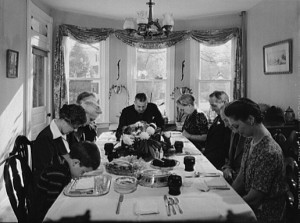
Thanksgiving Grace (1942)
Photo: Public Domain (US Library of Congress, digital id#fsa.8d10749)

Roasting turkey in an oven is traditional but, in many areas, not always possible. In the early days, many homes did not have ovens as we know them. They might have open hearths or perhaps an area where they could heat up and put a turkey in. This led to bakers, who had ovens, often for a fee leasing out their ovens to cook a bird. Others would cook them in fat in large open containers in pits dug for this purpose or found ways to roast over an open fire by turning them often (a sometimes risky and tiring task since you had to stand close and manually turn it like today’s rotisserie sans electricity).

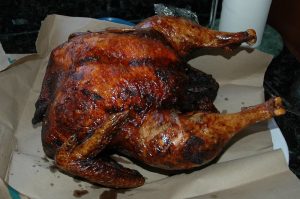
Fried Turkey
Image: Cygnus921
Filckr

Deep frying turkey may have started in the American South but went back further possibly to England, France and perhaps even to the Romans. Deep frying does cook faster and keeps it moist, but the key is the amount of oil used and how stable the platform to cook is. Some used deep pits, so this prevented fires or leakage. Above the ground requires the cooking platform to be kept clear of anything that might burn if there is a leak resulting in a fire.

The most common reason for mishaps with deep frying turkey is people do not pay attention to the amount of oil used to the weight of the bird. One hilarious video on YouTube had this guy lowering the turkey into the pot outdoors while saying he had followed the Archimedes rule of displacement. He miscalculated, hot oil spilled out of the pot and ignited with the open flame below, and then fully ignited. The other common reason is that people put a frozen bird into hot oil thinking there will be no problem. I am not sure if they didn’t pay attention in chemistry class or never heard why you do not put water into a hot pan with oil in it. The result in an explosion that can, if too close to the home (or foolishly enough inside it) means your home or apartment is going to be severely damaged. Or worse.

During World War II, the military tried to make sure troops everywhere had Thanksgiving even front-line troops. Those who served on military bases, ships, or in London probably had the best. For submarines the cook(s) had to contend with the unexpected action of the sub diving as they were cooking made Thanksgiving meal an adventure both in cooking and serving. And for those on the field with Germans in sight, getting those meals meant coming under direct enemy fire causing some commanders to question the wisdom of delivering meals while in an active fire zone.

And of course, Thanksgiving can be a source of humor as well. Just look at some vintage clips from shows past and present about it. The most classic one of course is the famous and never duplicated one from WKRP. As a promotion they decided to drop turkeys into a parking lot in front of a mall. And, well, you must watch to find out.

Sources

“Turkey,” Encyclopedia Britannica, last modified September 26, 2025, accessed November 23, 2025, https://www.britannica.com/animal/turkey-bird.

Boeckmann, Catherine “The Wild Turkey: History of an All-American Bird,” Almanac.Com, last modified November 20, 2024, accessed November 23, 2025, https://www.almanac.com/wild-turkey-history-all-american-bird.

Pruitt, Sarah “Why We Eat Turkey on Thanksgiving,” HISTORY, last modified November 17, 2025, accessed November 23, 2025, https://www.history.com/articles/turkey-thanksgiving-meal.

English Heritage, “What’s on the Table? Christmas Turkey in Victorian England | English Heritage,” English Heritage, accessed November 23, 2025, https://www.english-heritage.org.uk/visit/inspire-me/blog/blog-posts/victorian-christmas-turkey/.

“A Brief History of Turkeys, Plus Why We Eat a Turkey Dinner at Christmas,” HistoryExtra, last modified November 5, 2023, accessed November 23, 2025, https://www.historyextra.com/period/tudor/the-history-of-turkeys/.

Happy Thanksgiving (4th Thursday November U.S.)

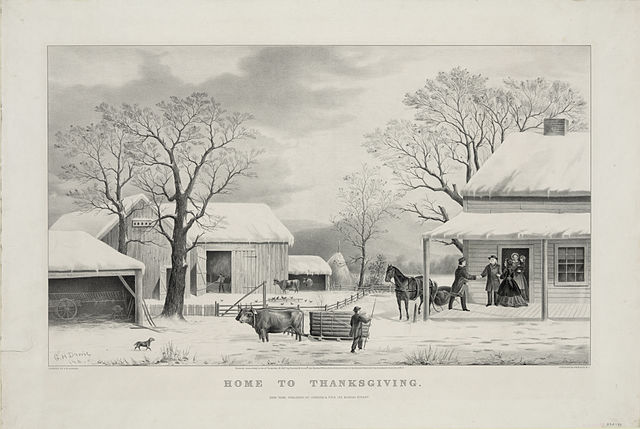
Home To Thanksgiving, Currier & Ives, 1867
Public Domain (U.S. Library of Congress, digital id# pga 00780)

Thanksgiving was not an official national holiday until 1863. A letter from a 74-year-old magazine editor, Sarah Josepha Hale, inspired President Abraham Lincoln to create a national holiday. She wrote in 1863 that we needed to have a national day of Thanksgiving so that everyone could celebrate it on the same day. At the time Thanksgiving was celebrated by the various states but not on the same date. She wanted President Lincoln to make it a national day so it would become a permanent part of “American custom and institution.”

Thanksgiving Grace (1942)
Photo: Public Domain (US Library of Congress, digital id#fsa.8d10749)

Other presidents had ignored such requests. Lincoln decided to act on her request and directed a proclamation be drawn up. On 3 October 1863, President Lincoln’s proclamation that establishes Thanksgiving as a national day was issued. It sets aside the last Thursday of November as a “day of Thanksgiving and Praise to our Father who dwelleth in the Heavens.” Secretary of State William Seward actually drafted the proclamation which Lincoln signed. Thanksgiving became a national holiday and was celebrated on that date until 1939. President Roosevelt in 1939, 1940 and 1941 changed it to the third Thursday (to extend the Christmas season) causing considerable controversy. A joint resolution of Congress in 1941 resolved it by decreeing Thanksgiving would fall on the fourth Thursday of November.

(Scene from the 1942 movie Holiday Inn starring Bing Crosby and Fred Astaire. At the time the movie was made in 1941, Thanksgiving had shifted back and forth starting in 1939. This animation from the movie illustrates this perfectly.)

Lincoln’s proclamation was written during the American Civil War, a terrible time in U.S. history. Today we forget why this day was made a national holiday. It was to thank God for the blessings of liberty but also to ask his help. In our politically correct times, this proclamation is not always read in full or edited. So here is the original proclamation. Read it and understand why Lincoln thought a National Day of Thanksgiving was needed for the United States of America.

 ==

Proclamation Establishing Thanksgiving Day
October 3, 1863

The year that is drawing towards its close, has been filled with the blessings of fruitful fields and healthful skies. To these bounties, which are so constantly enjoyed that we are prone to forget the source from which they come, others have been added, which are of so extraordinary a nature, that they cannot fail to penetrate and soften even the heart which is habitually insensible to the ever watchful providence of Almighty God.

In the midst of a civil war of unequalled magnitude and severity, which has sometimes seemed to foreign States to invite and to provoke their aggression, peace has been preserved with all nations, order has been maintained, the laws have been respected and obeyed, and harmony has prevailed everywhere except in the theatre of military conflict; while that theatre has been greatly contracted by the advancing armies and navies of the Union.

Needful diversions of wealth and of strength from the fields of peaceful industry to the national defence, have not arrested the plough, the shuttle, or the ship; the axe had enlarged the borders of our settlements, and the mines, as well of iron and coal as of the precious metals, have yielded even more abundantly than heretofore. Population has steadily increased, notwithstanding the waste that has been made in the camp, the siege and the battle-field; and the country, rejoicing in the consciousness of augmented strength and vigor, is permitted to expect continuance of years, with large increase of freedom.

No human counsel hath devised nor hath any mortal hand worked out these great things. They are the gracious gifts of the Most High God, who, while dealing with us in anger for our sins, hath nevertheless remembered mercy.

It has seemed to me fit and proper that they should be solemnly, reverently, and gratefully acknowledged as with one heart and voice by the whole American people. I do therefore invite my fellow citizens in every part of the United States, and also those who are at sea and those who are sojourning in foreign lands, to set apart and observe the last Thursday of November next, as a day of Thanksgiving and Praise to our beneficent Father who dwelleth in the Heavens. And I recommend to them that while offering up the ascriptions justly due to Him for such singular deliverances and blessings, they do also, with humble penitence for our national perverseness and disobedience, commend to his tender care all those who have become widows, orphans, mourners or sufferers in the lamentable civil strife in which we are unavoidably engaged, and fervently implore the interposition of the Almighty Hand to heal the wounds of the nation and to restore it as soon as may be consistent with the Divine purposes to the full enjoyment of peace, harmony, tranquility and Union.

In testimony whereof, I have hereunto set my hand, and caused the seal of the United States to be affixed.

Done at the city of Washington, this third day of October, in the year of our Lord one thousand eight hundred and sixty-three, and of the independence of the United States the eighty-eighth.

By the President: Abraham Lincoln

William H. Seward, Secretary of State

=

Sources

“Abraham Lincoln’s Proclamation of Thanksgiving,” American Battlefield Trust, https://www.battlefields.org/learn/primary-sources/abraham-lincolns-proclamation-thanksgiving.

“Thanksgiving 2025 – Tradition, Origins & Meaning | HISTORY.” HISTORY. Last modified November 21, 2025. Accessed November 23, 2025. https://www.history.com/articles/history-of-thanksgiving.

Current, Richard N. “Abraham Lincoln.” Encyclopedia Britannica. Last modified November 2025. Accessed November 23, 2025. https://www.britannica.com/biography/Abraham-Lincoln.

Silverman, David J. “Thanksgiving Day.” Encyclopedia Britannica. Last modified November 12, 2025. Accessed November 23, 2025. https://www.britannica.com/topic/Thanksgiving-Day.

Why is the Day after Thanksgiving called Black Friday?

Black Friday
Petr Kratochvil
publicdomainpibtures.net

The day after Thanksgiving in the United States has been called Black Friday for quite a long time, yet its origins are somewhat confusing owing to some clever remaking of the day by the retailers.

Its historical origins had nothing to do with Thanksgiving but a financial crisis in 1869. On 23 September 1869 a crash occurred in the U.S gold markets that was likely triggered by the actions of Jim Fisk and Jay Gould who tried to buy up as much gold as they could. In doing so, it drove the price of gold sky-high allowing them to sell at a huge profit. When their actions became known, it sent the gold market crashing down but also spread to the stock market resulting in bankers and farmers losing substantial sums of money. Thus, that date on a Friday became known as Black Friday.

The link to retail appears to come from a story about making huge profits on the day after Thanksgiving. In origin story, retailers lived on or near the infamous red line. That red line means they are operating at a near loss or in fact “in the red” meaning they were not making profits. The day after Thanksgiving brought in so many shoppers that they went into the black (meaning making profits), so it became known a Black Friday. While this version is somewhat accurate in that many retailers looked forward to the start of the Christmas season to generate high revenues, it is not the origin of Black Friday either.  Shopping on the day after Thanksgiving, often considered the start of the Christmas season in the United States, does give an indicator as to what consumers are willing to spend If the economy is good. On the other hand, if the economy is not doing well people may not spend much and only buy things they need and items on sale.

There are some who believe it has ties to racism on Southern plantations in the 1800’s. According to this story, it is claimed that owners would buy slaves at a discount on the day after Thanksgiving. This has led to some in the African American community to call for the boycott of stores on Back Friday. Except there appears to be no basis for this story. So far nothing has been found to show that slave auctions of this kind took place the day after Thanksgiving in that era. Like misinterpreting the word picnic as racist (picnic comes from a French word about eating outside and has nothing to do with race), this appears to have been created to fit someone’s perspective on the origins of the day.

The modern use of the term in fact comes from the 1950’s and from the city of Philadelphia. Police called it Black Friday to describe all the chaos that ensued from shoppers racing to shop before the Army-Navy game that was held on Saturday. The bedlam was so bad that no day off was granted to police on this day to deal with the hordes of cars and people in the city. Another factor was that criminals would take advantage of the large crowds to steal wallets, purses, and of course shoplift as well. Retailers were not happy with this connotation and tried unsuccessfully to change it to “Big Friday.” This was unsuccessful, so they tried to remake the day by saying this was the day retailers needed to make a profit. This appears to have worked and the darker roots from Philadelphia have been largely forgotten.
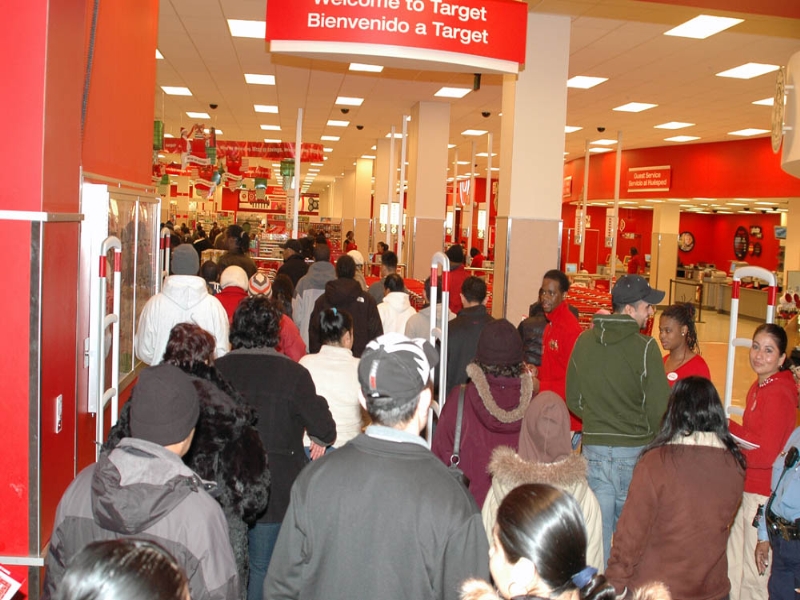
Black Friday Shopping
Photo: Public Domain

By remaking the day using sales to drive people into stores, it became an event on its own that spawned other major retails days. Black Friday was marketed as a day to get great bargains and all the major retailers jumped aboard. People began lining up early and some retailers decided to open on Thanksgiving (usually in the evening) to take advantage of the desire to buy discounted items. Ironically it then created things that harkened back to Philadelphia. In recent years when stores opened to the throngs waiting outside, chaos ensued when people raced into the store to grab what they wanted. People got trampled, fights broke out between adults bickering over who was entitled to the product. Many stores started to regulate the number of people in their store at any given time. This has been somewhat successful but when a surge of people all stampede at the door, the best the security guards can do is jump aside or be trampled on.

While Philadelphia is rarely mentioned, the chaos outside usually hearkens back to it. Mall parking lots are jammed, streets are full of cars trying to get in or out, and even freeways near those shopping malls are impacted as well. Up in the air, helicopters fly overhead filming the chaos below. And in major cities or areas where crowds are enormous, the police are often around to manage as best they can the traffic and crime that is going on. The Internet has made a dent, but you must wait for the product to arrive, so it is off to the store! In recent years retailers had started opening on Thanksgiving so people could get in early. Some like Target have rethought that and now are closed for Thanksgiving Day. And that is a good sign. Thanksgiving is a special holiday that should be treated on its own. And Black Friday is all about the shopping.

Sources

Sarah Pruitt, “What’s the Real History of Black Friday?,” HISTORY, last modified November 21, 2024, accessed November 26, 2024, https://www.history.com/news/black-friday-thanksgiving-origins-history.

Shannon Flynn, “Black Friday History and Statistics,” BlackFriday.Com, August 19, 2024, https://blackfriday.com/news/black-friday-history.

Wikipedia contributors, “Black Friday (Shopping),” Wikipedia, last modified November 26, 2024, https://en.wikipedia.org/wiki/Black_Friday_(shopping).

Happy Thanksgiving (4th Thursday November U.S.)

Home To Thanksgiving, Currier & Ives, 1867
Public Domain (U.S. Library of Congress, digital id# pga 00780)

Thanksgiving was not an official national holiday until 1863. A letter from a 74-year-old magazine editor, Sarah Josepha Hale, inspired President Abraham Lincoln to create a national holiday. She wrote in 1863 that we needed to have a national day of Thanksgiving so that everyone could celebrate it on the same day. At the time Thanksgiving was celebrated by the various states but not on the same date. She wanted President Lincoln to make it a national day so it would become a permanent part of “American custom and institution.”

Thanksgiving Grace (1942)
Photo: Public Domain (US Library of Congress, digital id#fsa.8d10749)

Other presidents had ignored such requests. Lincoln decided to act on her request and directed a proclamation be drawn up. On 3 October 1863, President Lincoln’s proclamation that establishes Thanksgiving as a national day was issued. It sets aside the last Thursday of November as a “day of Thanksgiving and Praise to our Father who dwelleth in the Heavens.” Secretary of State William Seward actually drafted the proclamation which Lincoln signed. Thanksgiving became a national holiday and was celebrated on that date until 1939. President Roosevelt in 1939, 1940 and 1941 changed it to the third Thursday (to extend the Christmas season) causing considerable controversy. A joint resolution of Congress in 1941 resolved it by decreeing Thanksgiving would fall on the fourth Thursday of November.

(Scene from the 1942 movie Holiday Inn starring Bing Crosby and Fred Astaire. At the time the movie was made in 1941, Thanksgiving had shifted back and forth starting in 1939. This animation from the movie illustrates this perfectly.)

Lincoln’s proclamation was written during the American Civil War, a terrible time in U.S. history. Today we forget why this day was made a national holiday. It was to thank God for the blessings of liberty but also to ask his help. In our politically correct times, this proclamation is not always read in full or edited. So here is the original proclamation. Read it and understand why Lincoln thought a National Day of Thanksgiving was needed for the United States of America.

 ==

Proclamation Establishing Thanksgiving Day
October 3, 1863

The year that is drawing towards its close, has been filled with the blessings of fruitful fields and healthful skies. To these bounties, which are so constantly enjoyed that we are prone to forget the source from which they come, others have been added, which are of so extraordinary a nature, that they cannot fail to penetrate and soften even the heart which is habitually insensible to the ever watchful providence of Almighty God.

In the midst of a civil war of unequalled magnitude and severity, which has sometimes seemed to foreign States to invite and to provoke their aggression, peace has been preserved with all nations, order has been maintained, the laws have been respected and obeyed, and harmony has prevailed everywhere except in the theatre of military conflict; while that theatre has been greatly contracted by the advancing armies and navies of the Union.
Needful diversions of wealth and of strength from the fields of peaceful industry to the national defence, have not arrested the plough, the shuttle, or the ship; the axe had enlarged the borders of our settlements, and the mines, as well of iron and coal as of the precious metals, have yielded even more abundantly than heretofore. Population has steadily increased, notwithstanding the waste that has been made in the camp, the siege and the battle-field; and the country, rejoicing in the consciousness of augmented strength and vigor, is permitted to expect continuance of years, with large increase of freedom.

No human counsel hath devised nor hath any mortal hand worked out these great things. They are the gracious gifts of the Most High God, who, while dealing with us in anger for our sins, hath nevertheless remembered mercy.

It has seemed to me fit and proper that they should be solemnly, reverently, and gratefully acknowledged as with one heart and voice by the whole American people. I do therefore invite my fellow citizens in every part of the United States, and also those who are at sea and those who are sojourning in foreign lands, to set apart and observe the last Thursday of November next, as a day of Thanksgiving and Praise to our beneficent Father who dwelleth in the Heavens. And I recommend to them that while offering up the ascriptions justly due to Him for such singular deliverances and blessings, they do also, with humble penitence for our national perverseness and disobedience, commend to his tender care all those who have become widows, orphans, mourners or sufferers in the lamentable civil strife in which we are unavoidably engaged, and fervently implore the interposition of the Almighty Hand to heal the wounds of the nation and to restore it as soon as may be consistent with the Divine purposes to the full enjoyment of peace, harmony, tranquility and Union.

In testimony whereof, I have hereunto set my hand, and caused the seal of the United States to be affixed.

Done at the city of Washington, this third day of October, in the year of our Lord one thousand eight hundred and sixty-three, and of the independence of the United States the eighty-eighth.

By the President: Abraham Lincoln

William H. Seward, Secretary of State

=

Sources

“Abraham Lincoln’s Proclamation of Thanksgiving.” American Battlefield Trust. https://www.battlefields.org/learn/primary-sources/abraham-lincolns-proclamation-thanksgiving.

Richard N. Current, “Abraham Lincoln | Biography, Childhood, Quotes, Death, & Facts,” Encyclopedia Britannica, last modified November 25, 2024, https://www.britannica.com/biography/Abraham-Lincoln.

“Thanksgiving 2024: History of Thanksgiving,” History.Com, last modified November 19, 2024, accessed November 26, 2024, https://www.history.com/topics/thanksgiving/history-of-thanksgiving.

David J. Silverman, “Thanksgiving Day | Meaning, History, & Facts,” Encyclopedia Britannica, last modified November 26, 2024, https://www.britannica.com/topic/Thanksgiving-Day.

Victorian Traditions/Shutterstock.com

The Humble Turkey and Thanksgiving

Here are some fun and interesting facts about the turkey and Thanksgiving.

Turkey is native to North America and has two breeds:

Wild Turkey (Meleagris gallopavo)
This is found in eastern and central North America and Mexico.

Ocellated Turkey (Meleagris ocellata)
Found in the Yucatan Peninsula and Central America.

A wild turkey, photographed in Berkeley, California, 29 April 2010.
Image credit: Feezo
Image via Wikimedia Commons

Turkeys were domesticated by native peoples. The Spanish brought back turkeys to Spain and from there they gradually made their way into the cuisine of Europe. English explorers and settlers would bring back turkey to England where they were apparently domesticated since records indicate they were being eaten by the British in the 16th century.

Ocellated Turkey, Belize 2010.
Image credit: TonyCastro
Image via Wikimedia Commons

Due to its abundance in North America, Mexico, and Central America, the turkey was not seen as something special due to its availability. This is probably the reason why it was not mentioned as a meat served at the first Thanksgiving though it was likely served.

Beef and pork were seen as holiday meats and were generally only eaten on important days like Christmas, Easter, or other special events. The Irish, for example, preferred pork for St. Patrick’s Day since it was easier than cattle since they take up lots of space while pigs could be kept in a pen. This only changed when Irish came to America and found beef in easy abundance and luckily for them delicatessens had corned beef.

By the 18th and 19th centuries, turkey starts showing up more as a meat to be used when you did not want to slaughter a pig or a cow. Turkey also started becoming popular for feasts as well, though not at center stage just yet. In A Christmas Carol the kids were waiting excitedly for the goose to come back from the baker showing its importance for Christmas feasting. Turkey starts showing up more in books and illustrations as a Christmas food. In 18th and 19th century America lobster was seen as a poor man’s food since people of wealth could afford beef, pork, goose, or turkey.

During the latter part of the Victorian Era (1837-1901), turkey would replace beef and pork for Christmas. As upper-class people and Queen Victoria embraced it, others followed suit, and it would replace the goose for Christmas. In the United States, turkey became associated with Thanksgiving due to both images and stories of it being eaten at the first Thanksgiving. As stated earlier, there is no mention of turkeys at that meal, but it is more than likely they were served. As the image of turkeys being part of that Thanksgiving seeped into the American consciousness, it eventually found its way to become part of the celebration itself. Turkey quickly displaced beef and pork (to the displeasure of their producers) as the central part of the feast. Today it is mostly unthinkable to not think of turkey as part of the Thanksgiving feast (with apologies to my vegetarian friends).

Today millions of turkeys are sold at Thanksgiving either frozen, fresh, or sometimes smoked. While the U.S. is a major consumer of the bird, more turkey is eaten in Israel than anywhere else. They really like turkey for their big feasts but of course it is served with Kosher accompaniments so you will not be having mashed potatoes made of milk and butter (since Kosher forbids the mixing of meat and dairy).

Despite their numbers being severely dropped for a while due to hunting and other things, the wild turkey is making a comeback, and large flocks have been seen in the wild and sometimes in suburbs as well. Wild turkeys can fly short distances, but their domesticated cousins are flightless. The possible exception might be heritage turkeys raised outdoors and free to roam and eat.

Wild turkeys can be a bit of a nuisance though. They can get nasty, sometimes bite, and they leave some of their presence behind to be cleaned up. Sometimes it requires effort to chase them away though if a coyote or mountain lion should appear (and attack the flock) that generally gives them the hint to move on.

Thanksgiving Grace (1942)
Photo: Public Domain (US Library of Congress, digital id#fsa.8d10749)

Roasting turkey in an oven is traditional but, in many areas, not always possible. In the early days, many homes did not have ovens as we know them. They might have open hearths or perhaps an area where they could heat up and put a turkey in. This led to bakers, who had ovens, often for a fee leasing out their ovens to cook a bird. Others would cook them in fat in large open containers in pits dug for this purpose or found ways to roast over an open fire by turning them often (a sometimes risky and tiring task since you had to stand close and manually turn it like today’s rotisserie sans electricity).

Fried Turkey
Image: Cygnus921
Filckr

Deep frying turkey may have started in the American South but went back further possibly to England, France and perhaps even to the Romans. Deep frying does cook faster and keeps it moist, but the key is the amount of oil used and how stable the platform to cook is. Some used deep pits, so this prevented fires or leakage. Above the ground requires the cooking platform to be kept clear of anything that might burn if there is a leak resulting in a fire.

The most common reason for mishaps with deep frying turkey is people do not pay attention to the amount of oil used to the weight of the bird. One hilarious video on YouTube had this guy lowering the turkey into the pot outdoors while saying he had followed the Archimedes rule of displacement. He miscalculated, hot oil spilled out of the pot and ignited with the open flame below, and then fully ignited. The other common reason is that people put a frozen bird into hot oil thinking there will be no problem. I am not sure if they didn’t pay attention in chemistry class or never heard why you do not put water into a hot pan with oil in it. The result in an explosion that can, if too close to the home (or foolishly enough inside it) means your home or apartment is going to be severely damaged. Or worse.

During World War II, the military tried to make sure troops everywhere had Thanksgiving even front-line troops. Those who served on military bases, ships, or in London probably had the best. For submarines the cook(s) had to contend with the unexpected action of the sub diving as they were cooking made Thanksgiving meal an adventure both in cooking and serving. And for those on the field with Germans in sight, getting those meals meant coming under direct enemy fire causing some commanders to question the wisdom of delivering meals while in an active fire zone.

And of course, Thanksgiving can be a source of humor as well. Just look at some vintage clips from shows past and present about it. The most classic one of course is the famous and never duplicated one from WKRP. As a promotion they decided to drop turkeys into a parking lot in front of a mall. And, well, you must watch to find out.

Sources

———. “Turkey | Description, Habitat, & Facts.” Encyclopedia Britannica. Last modified November 22, 2024. https://www.britannica.com/animal/turkey-bird.

Catherine Boeckmann, “The Wild Turkey: History of an All-American Bird,” Almanac.Com, last modified November 20, 2024, https://www.almanac.com/wild-turkey-history-all-american-bird.

Sarah Pruitt, “Why We Eat Turkey on Thanksgiving,” HISTORY, last modified November 20, 2023, https://www.history.com/news/turkey-thanksgiving-meal.

English Heritage, “What’s on the Table? Christmas Turkey in Victorian England | English Heritage,” English Heritage, https://www.english-heritage.org.uk/visit/inspire-me/blog/blog-posts/victorian-christmas-turkey/.

“A Brief History of Turkeys, Plus Why We Eat a Turkey Dinner at Christmas,” HistoryExtra, last modified November 5, 2023, https://www.historyextra.com/period/tudor/the-history-of-turkeys/.

How Did Black Friday Come to Be?

Black Friday
Petr Kratochvil
publicdomainpibtures.net

The day after Thanksgiving in the United States has been called Black Friday for quite a long time, yet its origins are somewhat confusing owing to some clever remaking of the day by the retailers.

Its historical origins had nothing to do with Thanksgiving but a financial crisis in 1869. On 23 September 1869 a crash occurred in the U.S gold markets that was likely triggered by the actions of Jim Fisk and Jay Gould who tried to buy up as much gold as they could. In doing so, it drove the price of gold sky-high allowing them to sell at a huge profit. When their actions became known, it sent the gold market crashing down but also spread to the stock market resulting in bankers and farmers losing substantial sums of money. Thus, that date on a Friday became known as Black Friday.

The link to retail appears to come from a story about making huge profits on the day after Thanksgiving. In origin story, retailers lived on or near the infamous red line. That red line means they are operating at a near loss or in fact “in the red” meaning they were not making profits. The day after Thanksgiving brought in so many shoppers that they went into the black (meaning making profits), so it became known a Black Friday. While this version is somewhat accurate in that many retailers looked forward to the start of the Christmas season to generate high revenues, it is not the origin of Black Friday either.  Shopping on the day after Thanksgiving, often considered the start of the Christmas season in the United States, does give an indicator as to what consumers are willing to spend If the economy is good. On the other hand, if the economy is not doing well people may not spend much and only buy things they need and items on sale.

There are some who believe it has ties to racism on Southern plantations in the 1800’s. According to this story, it is claimed that owners would buy slaves at a discount on the day after Thanksgiving. This has led to some in the African American community to call for the boycott of stores on Back Friday. Except there appears to be no basis for this story. So far nothing has been found to show that slave auctions of this kind took place the day after Thanksgiving in that era. Like misinterpreting the word picnic as racist (picnic comes from a French word about eating outside and has nothing to do with race), this appears to have been created to fit someone’s perspective on the origins of the day.

The modern use of the term in fact comes from the 1950’s and from the city of Philadelphia. Police called it Black Friday to describe all the chaos that ensued from shoppers racing to shop before the Army-Navy game that was held on Saturday. The bedlam was so bad that no day off was granted to police on this day to deal with the hordes of cars and people in the city. Another factor was that criminals would take advantage of the large crowds to steal wallets, purses, and of course shoplift as well. Retailers were not happy with this connotation and tried unsuccessfully to change it to “Big Friday.” This was unsuccessful, so they tried to remake the day by saying this was the day retailers needed to make a profit. This appears to have worked and the darker roots from Philadelphia have been largely forgotten.

Black Friday Shopping
Photo: Public Domain

By remaking the day using sales to drive people into stores, it became an event on its own that spawned other major retails days. Black Friday was marketed as a day to get great bargains and all the major retailers jumped aboard. People began lining up early and some retailers decided to open on Thanksgiving (usually in the evening) to take advantage of the desire to buy discounted items. Ironically it then created things that harkened back to Philadelphia. In recent years when stores opened to the throngs waiting outside, chaos ensued when people raced into the store to grab what they wanted. People got trampled, fights broke out between adults bickering over who was entitled to the product. Many stores started to regulate the number of people in their store at any given time. This has been somewhat successful but when a surge of people all stampede at the door, the best the security guards can do is jump aside or be trampled on.

While Philadelphia is rarely mentioned, the chaos outside usually hearkens back to it. Mall parking lots are jammed, streets are full of cars trying to get in or out, and even freeways near those shopping malls are impacted as well. Up in the air, helicopters fly overhead filming the chaos below. And in major cities or areas where crowds are enormous, the police are often around to manage as best they can the traffic and crime that is going on. The Internet has made a dent, but you must wait for the product to arrive, so it is off to the store! In recent years retailers had started opening on Thanksgiving so people could get in early. Some like Target have rethought that and now are closed for Thanksgiving Day. And that is a good sign. Thanksgiving is a special holiday that should be treated on its own. And Black Friday is all about the shopping.

Sources

What’s the Real History of Black Friday? (History.com)
Black Friday History and Statistics  (BlackFriday.com)
Black Friday (Wikipedia)


The Humble Turkey and Thanksgiving

Here are some fun and interesting facts about the turkey and Thanksgiving.

Turkey is native to North America and has two breeds:

Wild Turkey (Meleagris gallopavo)
This is found in eastern and central North America and Mexico.

Ocellated Turkey (Meleagris ocellata)
Found in the Yucatan Peninsula and Central America.

A wild turkey, photographed in Berkeley, California, 29 April 2010.
Image credit: Feezo
Image via Wikimedia Commons

Turkeys were domesticated by native peoples. The Spanish brought back turkeys to Spain and from there they gradually made their way into the cuisine of Europe. English explorers and settlers would bring back turkey to England where they were apparently domesticated since records indicate they were being eaten by the British in the 16th century.

Ocellated Turkey, Belize 2010.
Image credit: TonyCastro
Image via Wikimedia Commons

Due to its abundance in North America, Mexico, and Central America, the turkey was not seen as something special due to its availability. This is probably the reason why it was not mentioned as a meat served at the first Thanksgiving though it was likely served.

Beef and pork were seen as holiday meats and were generally only eaten on important days like Christmas, Easter, or other special events. The Irish, for example, preferred pork for St. Patrick’s Day since it was easier than cattle since they take up lots of space while pigs could be kept in a pen. This only changed when Irish came to America and found beef in easy abundance and luckily for them delicatessens had corned beef.

By the 18th and 19th centuries, turkey starts showing up more as a meat to be used when you did not want to slaughter a pig or a cow. Turkey also started becoming popular for feasts as well, though not at center stage just yet. In A Christmas Carol the kids were waiting excitedly for the goose to come back from the baker showing its importance for Christmas feasting. Turkey starts showing up more in books and illustrations as a Christmas food. In 18th and 19th century America lobster was seen as a poor man’s food since people of wealth could afford beef, pork, goose, or turkey.

During the latter part of the Victorian Era (1837-1901), turkey would replace beef and pork for Christmas. As upper-class people and Queen Victoria embraced it, others followed suit and it would replace the goose for Christmas. In the United States, turkey became associated with Thanksgiving due to both images and stories of it being eaten at the first Thanksgiving. As stated earlier, there is no mention of turkeys at that meal, but it is more than likely they were served. As the image of turkeys being part of that Thanksgiving seeped into the American consciousness, it eventually found its way to become part of the celebration itself. Turkey quickly displaced beef and pork (to the displeasure of their producers) as the central part of the feast. Today it is mostly unthinkable to not think of turkey as part of the Thanksgiving feast (with apologies to my vegetarian friends).

Today millions of turkeys are sold at Thanksgiving either frozen, fresh, or sometimes smoked. While the U.S. is a major consumer of the bird, more turkey is eaten in Israel than anywhere else. They really like turkey for their big feasts but of course it is served with Kosher accompaniments so you will not be having mashed potatoes made of milk and butter (since Kosher forbids the mixing of meat and dairy).

Despite their numbers being severely dropped for a while due to hunting and other things, the wild turkey is making a comeback and large flocks have been seen in the wild and sometimes in suburbs as well. Wild turkeys can fly short distances, but their domesticated cousins are flightless. The possible exception might be heritage turkeys raised outdoors and free to roam and eat.

Wild turkeys can be a bit of a nuisance though. They can get nasty, sometimes bite, and they leave some of their presence behind to be cleaned up. Sometimes it requires effort to chase them away though if a coyote or mountain lion should appear (and attack the flock) that generally gives them the hint to move on.

Thanksgiving Grace (1942)
Photo: Public Domain (US Library of Congress, digital id#fsa.8d10749)

Roasting turkey in an oven is traditional but, in many areas, not always possible. In the early days, many homes did not have ovens as we know them. They might have open hearths or perhaps an area where they could heat up and put a turkey in. This led to bakers, who had ovens, often for a fee leasing out their ovens to cook a bird. Others would cook them in fat in large open containers in pits dug for this purpose. Others found ways to roast over an open fire by turning them often (a sometimes risky and tiring task since you had to stand close and manually turn it like today’s rotisserie sans electricity).

Fried Turkey
Image: Cygnus921
Filckr

Deep frying turkey may have started in the American South but went back further possibly to England, France and perhaps even to the Romans. Deep frying does cook faster and keeps it moist, but the key is the amount of oil used and how stable the platform to cook is. Some used deep pits, so this prevented fires or leakage. Above the ground requires the cooking platform to be kept clear of anything that might burn if there is a leak resulting in a fire.

The most common reason for mishaps with deep frying turkey is people do not pay attention to the amount of oil used to the weight of the bird. One hilarious video on YouTube had this guy lowering the turkey into the pot outdoors while saying he had followed the Archimedes rule of displacement. He miscalculated, hot oil spilled out of the pot and ignited with the open flame below, and then fully ignited. The other common reason is that people put a frozen bird into hot oil thinking there will be no problem. I am not sure if they didn’t pay attention in chemistry class or never heard why you do not put water into a hot pan with oil in it. The result in an explosion that can, if too close to the home (or foolishly enough inside it) means your home or apartment is going to be severely damaged. Or worse.

During World War II, the military tried to make sure troops everywhere had Thanksgiving even front-line troops. Those who served on military bases, ships, or in London probably had the best. For submarines the cook(s) had to contend with the unexpected action of the sub diving as they were cooking made Thanksgiving meal an adventure both in cooking and serving. And for those on the field with Germans in sight, getting those meals meant coming under direct enemy fire causing some commanders to question the wisdom of delivering meals while in an active fire zone.

And of course, Thanksgiving can be a source of humor as well. Just look at some vintage clips from shows past and present about it. The most classic one of course is the famous and never duplicated one from WKRP. As a promotion they decided to drop turkeys into a parking lot in front of a mall. And, well, you have to watch to find out.


Happy Thanksgiving (4th Thursday November U.S.)

[Note: This has been updated with new source information, grammatical corrections, and more images]

Home To Thanksgiving, Currier & Ives, 1867
Public Domain (U.S. Library of Congress, digital id# pga 00780)

Thanksgiving was not an official national holiday until 1863. A letter from a 74-year-old magazine editor, Sarah Josepha Hale, inspired President Abraham Lincoln to create a national holiday. She wrote in 1863 that we needed to have a national day of Thanksgiving so that everyone could celebrate it on the same day. At the time Thanksgiving was celebrated by the various states but not on the same date. She wanted President Lincoln to make it a national day so it would become a permanent part of “American custom and institution.”

Thanksgiving Grace (1942)
Photo: Public Domain (US Library of Congress, digital id#fsa.8d10749)

Other presidents had ignored such requests. Lincoln decided to act on her request and directed a proclamation be drawn up. On 3 October 1863, President Lincoln’s proclamation that establishes Thanksgiving as a national day was issued. It sets aside the last Thursday of November as a “day of Thanksgiving and Praise to our Father who dwelleth in the Heavens.” Secretary of State William Seward actually drafted the proclamation which Lincoln signed. Thanksgiving became a national holiday and was celebrated on that date until 1939. President Roosevelt in 1939, 1940 and 1941 changed it to the third Thursday (to extend the Christmas season) causing considerable controversy. A joint resolution of Congress in 1941 resolved it by decreeing Thanksgiving would fall on the fourth Thursday of November.

(Scene from the 1942 movie Holiday Inn starring Bing Crosby and Fred Astaire. At the time the movie was made in 1941, Thanksgiving had shifted back and forth starting in 1939. This animation from the movie illustrates this perfectly.)

Lincoln’s proclamation was written during the American Civil War, a terrible time in U.S. history. Today we forget why this day was made a national holiday. It was to thank God for the blessings of liberty but also to ask his help. In our politically correct times, this proclamation is not always read in full or edited. So here is the original proclamation. Read it and understand why Lincoln thought a National Day of Thanksgiving was needed for the United States of America.

 ==

Proclamation Establishing Thanksgiving Day
October 3, 1863

The year that is drawing towards its close, has been filled with the blessings of fruitful fields and healthful skies. To these bounties, which are so constantly enjoyed that we are prone to forget the source from which they come, others have been added, which are of so extraordinary a nature, that they cannot fail to penetrate and soften even the heart which is habitually insensible to the ever watchful providence of Almighty God.

In the midst of a civil war of unequalled magnitude and severity, which has sometimes seemed to foreign States to invite and to provoke their aggression, peace has been preserved with all nations, order has been maintained, the laws have been respected and obeyed, and harmony has prevailed everywhere except in the theatre of military conflict; while that theatre has been greatly contracted by the advancing armies and navies of the Union.
Needful diversions of wealth and of strength from the fields of peaceful industry to the national defence, have not arrested the plough, the shuttle, or the ship; the axe had enlarged the borders of our settlements, and the mines, as well of iron and coal as of the precious metals, have yielded even more abundantly than heretofore. Population has steadily increased, notwithstanding the waste that has been made in the camp, the siege and the battle-field; and the country, rejoicing in the consciousness of augmented strength and vigor, is permitted to expect continuance of years, with large increase of freedom.

No human counsel hath devised nor hath any mortal hand worked out these great things. They are the gracious gifts of the Most High God, who, while dealing with us in anger for our sins, hath nevertheless remembered mercy.

It has seemed to me fit and proper that they should be solemnly, reverently, and gratefully acknowledged as with one heart and voice by the whole American people. I do therefore invite my fellow citizens in every part of the United States, and also those who are at sea and those who are sojourning in foreign lands, to set apart and observe the last Thursday of November next, as a day of Thanksgiving and Praise to our beneficent Father who dwelleth in the Heavens. And I recommend to them that while offering up the ascriptions justly due to Him for such singular deliverances and blessings, they do also, with humble penitence for our national perverseness and disobedience, commend to his tender care all those who have become widows, orphans, mourners or sufferers in the lamentable civil strife in which we are unavoidably engaged, and fervently implore the interposition of the Almighty Hand to heal the wounds of the nation and to restore it as soon as may be consistent with the Divine purposes to the full enjoyment of peace, harmony, tranquility and Union.

In testimony whereof, I have hereunto set my hand, and caused the seal of the United States to be affixed.

Done at the city of Washington, this third day of October, in the year of our Lord one thousand eight hundred and sixty-three, and of the independence of the United States the eighty-eighth.

By the President: Abraham Lincoln

William H. Seward, Secretary of State

=

Sources

“Abraham Lincoln’s Proclamation of Thanksgiving.” American Battlefield Trust, www.battlefields.org/learn/primary-sources/abraham-lincolns-proclamation-thanksgiving.

Current, Richard N. “Abraham Lincoln | Biography, Childhood, Quotes, Death, and Facts.” Encyclopedia Britannica, 18 Oct. 2023, www.britannica.com/biography/Abraham-Lincoln.

History.com Editors. “Thanksgiving 2023.” History.com, 16 Nov. 2023, www.history.com/topics/thanksgiving/history-of-thanksgiving.   Accessed 22 Nov. 2023.

Silverman, David J. “Thanksgiving Day | Meaning, History, and Facts.” Encyclopedia Britannica, 22 Nov. 2023, www.britannica.com/topic/Thanksgiving-Day.

Victorian Traditions/Shutterstock.com


Happy Thanksgiving

Home To Thanksgiving, Currier & Ives, 1867
Public Domain (U.S. Library of Congress, digital id# pga 00780)

Thanksgiving was not an official national holiday until 1863. A letter from a 74-year magazine editor, Sarah Josepha Hale, inspired President Abraham Lincoln to create a national holiday. She wrote in 1863 that we needed to have a national day of Thanksgiving so that everyone could celebrate it on the same day. At the time Thanksgiving was celebrated by the various states but not on the same date. She wanted President Lincoln to make it a national day so it would become a permanent part of “American custom and institution.”

According to Abraham Lincoln Online , other presidents had ignored such requests. Lincoln decided to act on her request and directed a proclamation be drawn up. On 3 October 1863, President Lincoln’s proclamation that establishes Thanksgiving as a national day was issued. It sets aside the last Thursday of November as a “day of Thanksgiving and Praise to our Father who dwelleth in the Heavens.” Secretary of State William Seward actually drafted the proclamation which Lincoln signed. Thanksgiving became a national holiday and was celebrated on that date until 1939. President Roosevelt in 1939, 1940 and 1941 changed it to the third Thursday (to extend the Christmas season) causing considerable controversy. A joint resolution of Congress in 1941 resolved it by decreeing Thanksgiving would fall on the fourth Thursday of November.


(Scene from the 1942 movie Holiday Inn starring Bing Crosby and Fred Astaire. At the time the movie was made in 1941, Thanksgiving had shifted back and forth starting in 1939. This animation from the movie illustrates this perfectly.)

Lincoln’s proclamation was written during the American Civil War, a terrible time in U.S. history. Today we forget why this day was made a national holiday. It was to thank God for the blessings of liberty but also to ask his help. In our politically correct times, this proclamation is not always read in full or edited. So here is the original proclamation. Read it and understand why Lincoln thought a national day of Thanksgiving was needed for the United States of America.


Proclamation Establishing Thanksgiving Day
October 3, 1863

The year that is drawing towards its close, has been filled with the blessings of fruitful fields and healthful skies. To these bounties, which are so constantly enjoyed that we are prone to forget the source from which they come, others have been added, which are of so extraordinary a nature, that they cannot fail to penetrate and soften even the heart which is habitually insensible to the ever watchful providence of Almighty God. In the midst of a civil war of unequalled magnitude and severity, which has sometimes seemed to foreign States to invite and to provoke their aggression, peace has been preserved with all nations, order has been maintained, the laws have been respected and obeyed, and harmony has prevailed everywhere except in the theatre of military conflict; while that theatre has been greatly contracted by the advancing armies and navies of the Union. Needful diversions of wealth and of strength from the fields of peaceful industry to the national defence, have not arrested the plough, the shuttle, or the ship; the axe had enlarged the borders of our settlements, and the mines, as well of iron and coal as of the precious metals, have yielded even more abundantly than heretofore. Population has steadily increased, notwithstanding the waste that has been made in the camp, the siege and the battle-field; and the country, rejoicing in the consciousness of augmented strength and vigor, is permitted to expect continuance of years, with large increase of freedom.

No human counsel hath devised nor hath any mortal hand worked out these great things. They are the gracious gifts of the Most High God, who, while dealing with us in anger for our sins, hath nevertheless remembered mercy. It has seemed to me fit and proper that they should be solemnly, reverently and gratefully acknowledged as with one heart and voice by the whole American people. I do therefore invite my fellow citizens in every part of the United States, and also those who are at sea and those who are sojourning in foreign lands, to set apart and observe the last Thursday of November next, as a day of Thanksgiving and Praise to our beneficent Father who dwelleth in the Heavens. And I recommend to them that while offering up the ascriptions justly due to Him for such singular deliverances and blessings, they do also, with humble penitence for our national perverseness and disobedience, commend to his tender care all those who have become widows, orphans, mourners or sufferers in the lamentable civil strife in which we are unavoidably engaged, and fervently implore the interposition of the Almighty Hand to heal the wounds of the nation and to restore it as soon as may be consistent with the Divine purposes to the full enjoyment of peace, harmony, tranquillity and Union.

In testimony whereof, I have hereunto set my hand, and caused the seal of the United States to be affixed.
Done at the city of Washington, this third day of October, in the year of our Lord one thousand eight hundred and sixty-three, and of the independence of the United States the eighty-eighth.
A. Lincoln

Victorian Traditions/Shutterstock.com