
Image: Public Domain
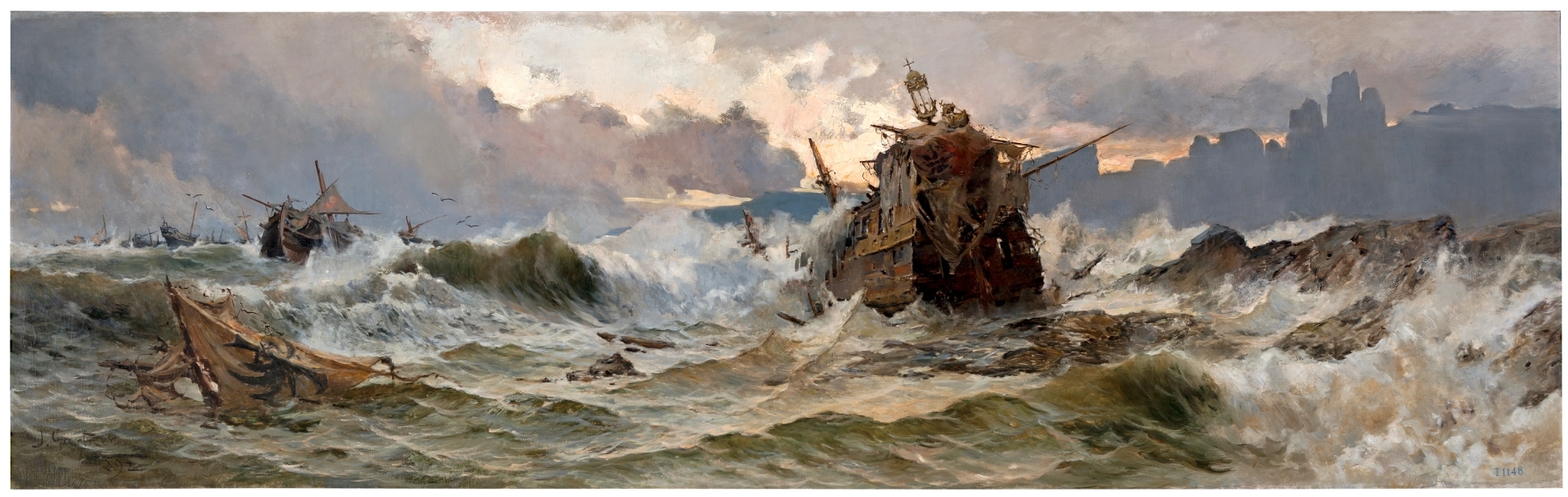
The Napoleonic Wars (1799-1815) saw many battles on land but the most pivotal naval one was on 21 Oct 1805. It was the naval battle that established British naval supremacy for 100 years. It was fought west of Cape Trafalgar, Spain putting it between Cadiz and the Strait of Gibraltar. 18 French and 15 Spanish ships would fight a British fleet of 27 ships. Admiral Pierre de Villeneuve commanded the combined French/Spanish fleet while Admiral Horatio Nelson commanded the British fleet. Villeneuve had hoped to avoid battle with the British when he slipped the fleet out of Cadiz on 19-20 October heading for the Mediterranean Sea. Unfortunately, Nelson caught him off of Cape Trafalgar on 21 October. Villeneuve ordered his ships to form a single line heading north. Nelson order his fleet into two squadrons and to attack from the west at right angles.
He signaled his famous message at 11:50 am from his ship Victory: “England expects that every man will do his duty.” Nelson’s squadron attacked the van and center in Villeneuve’s line.* Nelson’s squadron broke through ignoring six leading French and Spanish ships in the first attack. Those six ships under Admiral Pierre Dumanoir did turn around to help but were driven off. The rear of Villeneuve’s fleet was destroyed, and Villeneuve was himself captured. The battle ended around 5:00 pm with 19 or 20 French & Spanish ships surrendering with crews and prisoners of war around 14,000 men. Admiral Nelson died during the battle but knew before he died of British victory. The British lost no ships but 1,500 crewmen were either killed or injured. The Battle of Trafalgar ended forever any dreams Napoleon had to invade England.
Aftermath
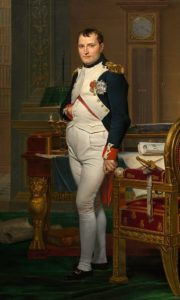
Jacques-Louis David (1748–1825)
Public Domain/Wikimedia Commons
Napoleon did not learn of the defeat for many weeks due to being involved in military battles on land. He censored news of the defeat in Paris for a month. And then in a brazen propaganda move had the French newspapers portray it as a great victory over the British. Villeneuve would return to France in 1806 but was found dead in an inn room with six stab wounds from a knife. It was ruled a suicide, but some suspect he was killed. The battle made it clear Britain was master of the seas, but it did not slow Napoleon down on his strategy to conquer and defeat the Third Coalition and Austria. Napoleon buttoned up the continent to deprive British trade. French and Spanish armies would occupy Portugal in 1807. In 1808, Napoleon uneasy with his Spanish allies, invaded and took control of Spain. French troops and their supporters were disliked by many Spanish who took up arms. The British, after liberating Portugal, would drive out the French and used the Spanish guerrillas to harass the French. British forces under General Wellington would drive the Spanish out after the Battle of Salamanca in 1812. The French forces in Madrid would surrender ending the Peninsular War but starting the final campaign to drive Napoleon from power. *During the age of sail, fleets were divided into van, center, or rear squadrons and named after each squadrons place in the line of battle. ” You can read about how this was developed here.
Sources
“Battle of Trafalgar.” https://www.britishbattles.com/napoleonic-wars/battle-of-trafalgar/.
———. “Battle of Trafalgar | Summary, Facts, & Significance.” Encyclopedia Britannica. Last modified October 15, 2024. Accessed October 18, 2024. https://www.britannica.com/event/Battle-of-Trafalgar-European-history.
Onion, Amanda. “Battle of Trafalgar – Map, 1805 & Winner | HISTORY.” HISTORY, June 6, 2023. https://www.history.com/topics/european-history/battle-of-trafalgar.
Wiki, Contributors to Military. “Line of Battle.” Military Wiki. https://military-history.fandom.com/wiki/Line_of_battle.
Suggested Reading
Adkins, Roy A. Nelson’s Trafalgar: The Battle that Changed the World. Viking Adult, 2005.
Keegan, John. The Price of Admiralty: The Evolution of Naval Warfare from Trafalgar to Midway. Penguin, 1990.
Kennedy, Paul M. The Rise and Fall of British Naval Mastery. Palgrave, 2013.
Titanic News Channel is a participant in the Amazon Services LLC Associates Program, an affiliate advertising program designed to provide a means for sites to earn advertising fees by advertising and linking to Amazon.com.





 ,
,
 ,
,
 ,
,
