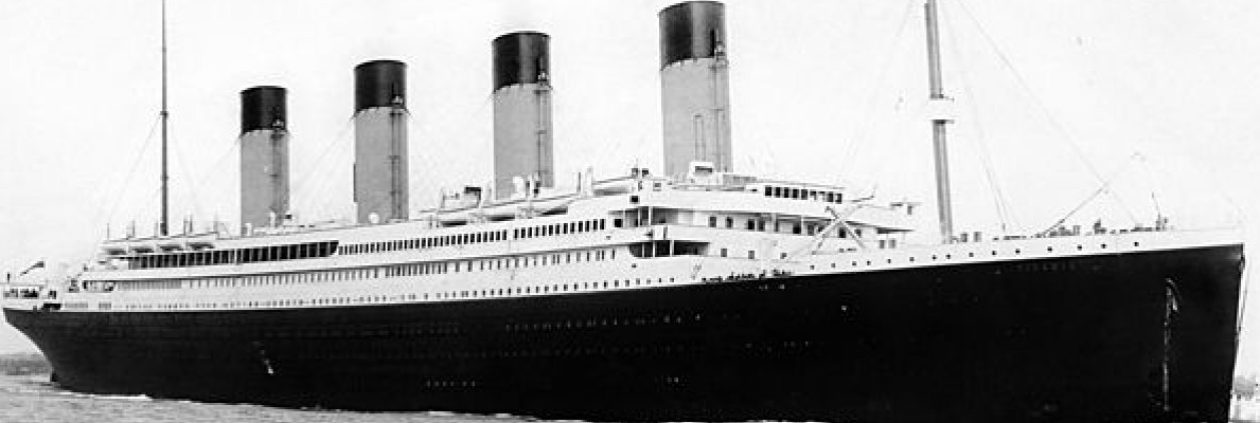

Public Domain (U.S. Library of Congress,www.loc.gov)
As the world awaits news of who survived Titanic, the White Star Line decides to hire ships to go out and retrieve bodies. Reports of bodies floating in the Atlantic had been reported and White Star wanted to retrieve them as quickly as possible for several practical reasons. Ocean currents would eventually move them out of the area, so getting them retrieved as soon as possible would allow families to lay them to rest. Another reason for speed was that sea creatures and birds would start consuming the bodies making identification difficult as well. The cable ship Mackay Bennett was the first ship hired by White Star. Three other ships would be hired as well: Minia (a cable ship), Montmagny (lighthouse supply ship), and the sealing vessel Algerine.

Artist Unknown
Public Domain/Wikimedia Commons
Each ship would carry the necessary supplies to retrieve and embalm the bodies. The Mackay Bennett emptied itself of its normal stores in Halifax, Nova Scotia and brought aboard supplies for its new mission:
- Embalming supplies and coffins (100)
- Chief embalmer of John Snow & Co., John R. Snow Jr.
- 100 tons of ice to store the bodies
Canon Kenneth Hind of All Saints Cathedral, Halifax was aboard to officiate burials at sea.
As the Mackay Bennett had capacity for 125 coffins in her hold (and ice as well), she would carry most of the coffins being brought back to Halifax. Mackay Bennet departed Halifax at 12:28 pm on 17 April 1912. Heavy fog and rough seas delayed her arrival at the location where Titanic sank. Recovery started early in the morning using skiffs to bring back bodies to the shop. They quickly realized they did not have enough embalming supplies aboard to bring them ashore in Halifax. The law required that bodies be embalmed before unloading in a Canadian port. The following procedure was established to handle this:
- First class passengers were embalmed and placed in coffins.
- Second class passengers embalmed but wrapped in canvas.
- Third class, crew, and bodies that were too decomposed or disfigured were buried at sea.
They found the bodies of John Jacob Astor IV (identified by his unique diamond ring and initials sewn on jacket label), American architect Edward Austin Kent, and Isidor Straus (Macy’s owner). Wallace Hartley, the Titanic band leader, was found with his violin strapped to his body. It was sent back to England aboard the SS Arabic and buried on 18 May 1912 at the Keighley Road Cemetery, Colne, Lancashire. Bodies buried at sea were officiated by Canon Hind.
Bodies that were brought back were either transported by relatives to their final resting place or interred in Halifax, Nova Scotia. Back in Halifax John Henry Barnstead, the Registrar of Vital Statistics, developed a system of identifying the bodies and protect personal possessions of the deceased. With Halifax having both rail and steamship connections, families could easy come to identify bodies of loved ones. A temporary morgue was set up using a local curling rink with undertakers to assist from all over the area. Many did send bodies back to their hometowns in the United States or Europe. Unclaimed and unidentified bodies were buried in Halifax. A total of 150 bodies is interred in Halifax cemeteries with the largest number at the Fairview Lawn Cemetery followed by Mount Olivet and Baron de Hirsch cemeteries.
Bodies from Titanic were reported in May. The Oceanic found three in Titanic’s Collapsible A two hundred miles from where Titanic sank. They had been left behind when Carpathia rescued the survivors in April. Oceanic retrieved their bodies and buried them at sea. One of the last to be found was steward James McCrady on 22 May by the SS Algerine. His body was brought back to Halifax and was buried in the Fairview Lawn Cemetery.

Public Domain (Wikipedia)
By the end of its seven-day recovery operation, Mackay Bennett had recovered 306 of the 328 bodies they found. 116 were buried at sea and of them only 56 could be identified. They would return to Halifax with 190 bodies where they were transferred to the temporary morgue. Astor’s son had put up $100,000 reward for recovering his body, which was split among the crew ($2500 each). The body of a young child, unidentified at the time, which brought hardened men to tears, was given a grave at Fairview in which the entire ship’s crew attended along with many from Halifax. The child had become a symbol of the loss of life that occurred on Titanic. In 2007 using mitochondrial DNA the child was identified as 19-month-old Sidney Leslie Goodwin.
Only 333 bodies would be recovered of the more than 1,500 dead. Many bodies were swept away by currents never to be recovered. Life jackets would eventually degrade over time allowing bodies to sink; bodies would be consumed by sea life and birds. For many there would be no opportunity to bid farewell to family or friends that perished that fateful day in the cold Atlantic Ocean.
Sources
(Disclosure: As an Amazon Associate, I earn from qualifying purchases. This may contain affiliate links, which means I may receive a small commission at no extra cost to you.)
Behe, George TITANIC: SAFETY, SPEED AND SACRIFICE, Transportation Trails, Polo, IL 1997
Behe, G. (2012). On board RMS Titanic: Memories of the Maiden Voyage. The History Press.
Ballard, Robert D. Exploring the Titanic. Reprint. Madison Press Books, 2014.
Ballard, Robert D., and Rick Archbold. The Discovery of the Titanic. New York, N.Y.?: Warner Books, 1987.
Ballard, Robert D., Lost Liners: From the Titanic to the Andrea Doria the Ocean Floor Reveals Its Greatest Lost Ships(Hyperion, 1998).
Brewster, H. (2013). Gilded Lives, Fatal Voyage: The Titanic’s First-Class Passengers and Their World. National Geographic Books.
Cameron, Stephen. Titanic: Belfast’s Own. Colourpoint, 2011.
Eaton John P. & Haas Charles, TITANIC TRIUMPH AND TRAGEDY, SECOND EDITION, W.W. Norton & Company, New York, New York, 1995 First American Edition
Fitch, Tad, J. Kent Layton, and Bill Wormstedt. On a Sea of Glass: The Life & Loss of the RMS Titanic. Reprint. Amberley Publishing, 2015.
Lord, Walter, A NIGHT TO REMEMBER, Holt Rinehart and Winston, New York, New York, 1955. Multiple revisions and reprints, notably Illustrated editions (1976,1977,1978 etc.)
Lord, Walter, THE NIGHT LIVES ON, Willian Morrow and Company, New York, New York, 1986 (First Edition)
Lynch, Don & Marshall Ken, TITANIC AN ILLUSTRATED HISTORY, Madison Press Books, Toronto, Ontario Canada, 1992
Marshall, L. (2019). Sinking of the Titanic: The Greatest Disaster At Sea – Special Edition with Additional Photographs. Independently Published.
Internet
“The Titanic: Sinking & Facts | HISTORY.” HISTORY. Last modified March 26, 2026. https://www.history.com/articles/titanic.
“Encyclopedia Titanica.” https://www.encyclopedia-titanica.org/.
Videos
Titanic: Honor & Glory, “Titanic’s Final Day at Sea – April 14th, 1912,” Video, YouTube, April 14, 2026, https://www.youtube.com/watch?v=0hA9Yt9nbQk.
National Geographic, “New CGI of How Titanic Sank | Titanic 100,” Video, YouTube, April 5, 2012, https://www.youtube.com/watch?v=FSGeskFzE0s.
Titanic. DVD. A+E Networks, Greystone Communications, 1994. Also known as Titanic: Death of a Dream and Titanic: The Complete Story