Tag Archives: Olympic

Titanic History: Olympic Departure Delayed Over Lifeboats (24 April 1912)

RMS Olympic Arrives In New York on Maiden Voyage, 21 June 1911
Source: U.S. Library of Commerce/Wikimedia Commons
Public Domain

In the wake of the Titanic sinking, all passenger ships were equipped with lifeboats for everyone aboard. Olympic, like her sister ship, did not have enough lifeboats but they were quickly added for her upcoming departure from Southampton on 24 April 1912. 40 collapsible lifeboats (all second-hand) had come from troopships. However, there was concern amongst the crew that these lifeboats were not seaworthy.  A request sent by crewman that they should be replaced by wooden lifeboats was declined by White Star which said that it was impossible to do that and they had passed as seaworthy by the Board of Trade inspector.

New lifeboats being loaded on RMS Olympic, Titanic’s sister-ship
Circa 22 April 1912-30 April 1912
Author Unknown
Public Domain via Wikimedia Commons

Not convinced of this, 284 firemen went on strike delaying the departure. Non-union crew were hired from Southampton and from Liverpool to make up the difference. On 25 April 1912, representatives of the strikers witnessed a test of four of the collapsible boats. One was found unseaworthy. The representatives said they would recommend the strikers return to work as a result. A separate objection about the non-union workers who were hired came up as an issue. White Star refused to fire them. This resulted in 54 crewmembers leaving the ship in protest causing the cancellation of the sailing. Later they would be charged and convicted of mutiny, but no punishment was awarded due to the circumstances. White Star Line hired them back in end fearing a public backlash in support of the strikers. Olympic would sail for New York on 15 May 1912.

Sources

Books

Behe, George TITANIC: SAFETY, SPEED AND SACRIFICE, Transportation Trails, Polo, IL 1997

Behe, George (2012). On board RMS Titanic: Memories of the Maiden Voyage. The History Press.

Eaton John P. & Haas Charles, TITANIC TRIUMPH AND TRAGEDY, SECOND EDITION, W.W. Norton & Company, New York, New York, 1995 First American Edition

Lord, Walter, A NIGHT TO REMEMBER, Holt Rinehart and Winston, New York, New York, 1955. Multiple revisions and reprints, notably Illustrated editions (1976,1977,1978 etc.)

Lord, Walter, THE NIGHT LIVES ON, Willian Morrow and Company, New York, New York, 1986 (First Edition)

Lynch, Don & Marshall Ken, TITANIC AN ILLUSTRATED HISTORY, Madison Press Books, Toronto, Ontario Canada, 1992

Internet

Tikkanen and Amy, “Titanic | History, Sinking, Rescue, Survivors, Movies, & Facts,” Encyclopedia Britannica, last modified April 7, 2025, https://www.britannica.com/topic/Titanic.

Encyclopedia Titanica, last modified April 9, 2025, https://www.encyclopedia-titanica.org/.

History.com Editors, “The Titanic: Sinking & Facts | HISTORY,” HISTORY, last modified February 27, 2025, https://www.history.com/articles/titanic.

Titanic Historical Society, Inc., “Titanic Museum | Titanic Historical Society Collection,” Titanic Historical Society, Inc., last modified January 19, 2023, https://titanichistoricalsociety.org/titanic-museum/.

British Pathé, “Titanic: The Facts Told by Real Survivors | British Pathé,” Video, YouTube, August 1, 2011, https://www.youtube.com/watch?v=_xKDRmhp6lQ.

Wikipedia contributors, “Titanic,” Wikipedia, last modified April 6, 2025, https://en.wikipedia.org/wiki/Titanic#Collecting_passengers.

Titanic News Channel is a participant in the Amazon Services LLC Associates Program, an affiliate advertising program designed to provide a means for sites to earn advertising fees by advertising and linking to Amazon.com.


Titanic History: Construction Begins on Titanic (31 Mar 1909)

RMS Titanic ready for launch(1911)
Public Domain (U.S. Library of Congress, digital id#cph.3a27541)

Due to the immense size in constructing the Olympic class vessels for White Star Line, Harland & Wolff had to demolish three existing slipways on Queen’s Island in Belfast Harbor. The two new ones, the largest ever built at that time, would be where both Olympic and Titanic would be constructed. The keel for Olympic was laid on 16 December 1908 and Titanic on 31 March 1909. Both ships would be constructed parallel to each other. Queen’s Island became known as Titanic Quarter and an enormous gantry was built to hold the cranes needed during construction. Expedited completion for each ship was 26 months. The base of both ships had a double bottom of 5 feet 3 inches deep supporting 300 frames (each were 24 and 36 inches apart and measured up to 66 feet) which terminated at the bridge deck (B deck). These were covered with steel plates which provided the outer skin of both ships. Both ships were floating box girders with the keel as the backbone of the ship.

Sources:

Books

Purchase Titanic Books on Amazon.

Behe, George TITANIC: SAFETY, SPEED AND SACRIFICE, Transportation Trails, Polo, IL 1997

Eaton John P. & Haas Charles, TITANIC TRIUMPH AND TRAGEDY, SECOND EDITION, W.W. Norton & Company, New York, New York, 1995 First American Edition

Lord, Walter, A NIGHT TO REMEMBER, Holt Rinehart and Winston, New York, New York, 1955. Multiple revisions and reprints, notably Illustrated editions (1976,1977,1978 etc)

Lord, Walter, THE NIGHT LIVES ON, Willian Morrow and Company, New York, New York, 1986 (First Edition)

Lynch, Don & Marshall Ken, TITANIC AN ILLUSTRATED HISTORY, Madison Press Books, Toronto, Ontario Canada, 1992

Internet

Britannica.com
Encyclopedia Titanica
History.com

Olympic Departure Delayed Over Lifeboats (24 April 1912)

RMS Olympic Arrives In New York on Maiden Voyage, 21 June 1911
Source: U.S. Library of Commerce/Wikimedia Commons
Public Domain

In the wake of the Titanic sinking, all passenger ships were equipped with lifeboats for everyone aboard. Olympic, like her sister ship, did not have enough lifeboats but they were quickly added for her upcoming departure from Southampton on 24 April 1912. 40 collapsible lifeboats (all second-hand) had come from troopships. However, there was concern amongst the crew that these lifeboats were not seaworthy.  A request sent by crewman that they should be replaced by wooden lifeboats was declined by White Star which said that it was impossible to do that and they had passed as seaworthy by the Board of Trade inspector.

New lifeboats being loaded on RMS Olympic, Titanic’s sister-ship
Circa 22 April 1912-30 April 1912
Author Unknown
Public Domain via Wikimedia Commons

Not convinced of this, 284 firemen went on strike delaying the departure. Non-union crew were hired from Southampton and from Liverpool to make up the difference. On 25 April 1912, representatives of the strikers witnessed a test of four of the collapsible boats. One was found unseaworthy. The representatives said they would recommend the strikers return to work as a result. A separate objection about the non-union workers who were hired came up as an issue. White Star refused to fire them. This resulted in 54 crewmembers leaving the ship in protest causing the cancellation of the sailing. Later they would be charged and convicted of mutiny, but no punishment was awarded due to the circumstances. White Star Line hired them back in end fearing a public backlash in support of the strikers. Olympic would sail for New York on 15 May 1912.


Sources:

“April 1912: Olympic’s Canceled Sailing.” Encyclopedia Titanica Message Board, 25 Apr. 2002, www.encyclopedia-titanica.org/community/threads/april-1912-olympics-canceled-sailing.3699.

Edwards, John. “The Olympic Mutiny – Ocean Liners Magazine.” Ocean Liners Magazine, 3 May 2020, oceanlinersmagazine.com/2020/05/03/olympic-mutiny-2.

“RMS Olympic.” Wikipedia, 24 Apr. 2024, en.wikipedia.org/wiki/RMS_Olympic#cite_note-Brewster78-68.
 

Titanic Chronology: Construction Begins on Titanic (31 Mar 1909)

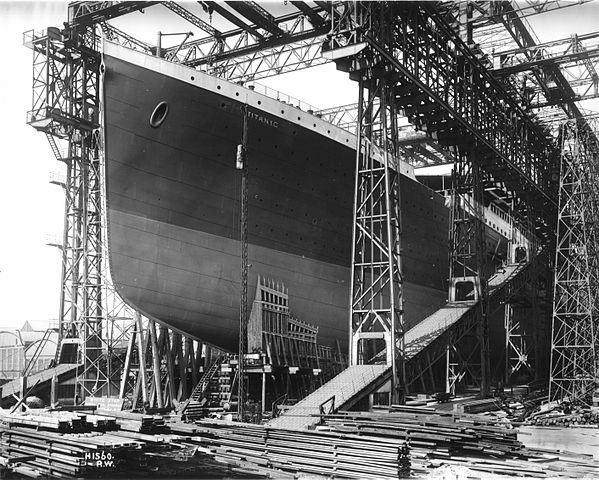
RMS Titanic ready for launch(1911)
Public Domain (U.S. Library of Congress, digital id#cph.3a27541)

Due to the immense size in constructing the Olympic class vessels for White Star Line, Harland & Wolff had to demolish three existing slipways on Queen’s Island in Belfast Harbor. The two new ones, the largest ever built at that time, would be where both Olympic and Titanic would be constructed. The keel for Olympic was laid on 16 December 1908 and Titanic on 31 March 1909. Both ships would be constructed parallel to each other. Queen’s Island became known as Titanic Quarter and an enormous gantry was built to hold the cranes needed during construction. Expedited completion for each ship was 26 months. The base of both ships had a double bottom of 5 feet 3 inches deep supporting 300 frames (each were 24 and 36 inches apart and measured up to 66 feet) which terminated at the bridge deck (B deck). These were covered with steel plates which provided the outer skin of both ships. Both ships were floating box girders with the keel as the backbone of the ship.

Sources:

Books

Purchase Titanic Books on Amazon.

Behe, George TITANIC: SAFETY, SPEED AND SACRIFICE, Transportation Trails, Polo, IL 1997

Eaton John P. & Haas Charles, TITANIC TRIUMPH AND TRAGEDY, SECOND EDITION, W.W. Norton & Company, New York, New York, 1995 First American Edition

Lord, Walter, A NIGHT TO REMEMBER, Holt Rinehart and Winston, New York, New York, 1955. Multiple revisions and reprints, notably Illustrated editions (1976,1977,1978 etc)

Lord, Walter, THE NIGHT LIVES ON, Willian Morrow and Company, New York, New York, 1986 (First Edition)

Lynch, Don & Marshall Ken, TITANIC AN ILLUSTRATED HISTORY, Madison Press Books, Toronto, Ontario Canada, 1992

Internet

Britannica.com
Encyclopedia Titanica
History.com

Olympic Departure Delayed Over Lifeboats (24 April 1912)

RMS Olympic Arrives In New York on Maiden Voyage, 21 June 1911
Source: U.S. Library of Commerce/Wikimedia Commons
Public Domain

In the wake of the Titanic sinking, all passenger ships were equipped with lifeboats for everyone aboard. Olympic, like her sister ship, did not have enough lifeboats but they were quickly added for her upcoming departure from Southampton on 24 April 1912. 40 collapsible lifeboats (all second-hand) had come from troopships. However, there was concern amongst the crew that these lifeboats were not seaworthy.  A request sent by crewman that they should be replaced by wooden lifeboats was declined by White Star which said that it was impossible to do that and they had passed as seaworthy by the Board of Trade inspector.

New lifeboats being loaded on RMS Olympic, Titanic’s sister-ship
Circa 22 April 1912-30 April 1912
Author Unknown
Public Domain via Wikimedia Commons

Not convinced of this, 284 firemen went on strike delaying the departure. Non-union crew were hired from Southampton and from Liverpool to make up the difference. On 25 April 1912, representatives of the strikers witnessed a test of four of the collapsible boats. One was found unseaworthy. The representatives said they would recommend the strikers return to work as a result. A separate objection about the non-union workers who were hired came up as an issue. White Star refused to fire them. This resulted in 54 crewmembers leaving the ship in protest causing the cancellation of the sailing. Later they would be charged and convicted of mutiny, but no punishment was awarded due to the circumstances. White Star Line hired them back in end fearing a public backlash in support of the strikers. Olympic would sail for New York on 15 May 1912.


Sources:

“April 1912: Olympic’s Canceled Sailing.” Encyclopedia Titanica Message Board, 25 Apr. 2002, www.encyclopedia-titanica.org/community/threads/april-1912-olympics-canceled-sailing.3699.

Edwards, John. “The Olympic Mutiny – Ocean Liners Magazine.” Ocean Liners Magazine, 3 May 2020, oceanlinersmagazine.com/2020/05/03/olympic-mutiny-2.

“RMS Olympic.” Wikipedia, 24 Apr. 2024, en.wikipedia.org/wiki/RMS_Olympic#cite_note-Brewster78-68.


Titanic Chronology: Titanic Fitted Out (31 March 1912)

RMS Titanic under construction. Photo taken between February-March 1912
Original source: Robert John Welch (1859-1936), official photographer for Harland & Wolff
Public Domain/Wikimedia Commons

Titanic is nearly completely filled out with just a few things left before her upcoming sea trials. The ship is nearly identical to Olympic, but some changes were made so it was exteriorly different. It had a steel screen with sliding windows on the forward half of the A Deck promenade. This was done at the personal request of Bruce Ismay to provide additional shelter for First Class passengers. B Deck saw changes as well. The promenade space was converted into additional First Class cabins, which included two parkour suites with their own promenade spaces. The À la Carte restaurant was made bigger and the Café Parisien was added as well (it was not on the Olympic). The additional fitting out delayed Titanic and was delayed further by additional work needed on Olympic from a 1911 collision.


Titanic Chronology: Olympic Departure Delayed Over Lifeboats (24 April 1912)

RMS Olympic Arrives In New York on Maiden Voyage, 21 June 1911
Source: U.S. Library of Commerce/Wikimedia Commons
Public Domain

In the wake of the Titanic sinking, all passenger ships were equipped with lifeboats for everyone aboard. Olympic, like her sister ship, did not have enough lifeboats but they were quickly added for her upcoming departure from Southampton on 24 April 1912. 40 collapsible lifeboats (all second-hand) had come from troopships. However, there was concern amongst the crew that these lifeboats were not seaworthy.  A request sent by crewman that they should be replaced by wooden lifeboats was declined by White Star which said that it was impossible to do that and they had passed as seaworthy by the Board of Trade inspector.

Not convinced of this, 284 firemen went on strike delaying the departure. Non-union crew were hired from Southampton and from Liverpool to make up the difference. On 25 April 1912, representatives of the strikers witnessed a test of four of the collapsible boats. One was found unseaworthy. The representatives said they would recommend the strikers return to work as a result. A separate objection about the non-union workers who were hired came up as an issue. White Star refused to fire them. This resulted in 54 crewmembers leaving the ship in protest causing the cancellation of the sailing. Later they would be charged and convicted of mutiny, but no punishment was awarded due to the circumstances. White Star Line hired them back in end fearing a public backlash in support of the strikers. Olympic would sail for New York on 15 May 1912.


Sources:

Encyclopedia Titanica
Ocean Liners Magazine
RMS Olympic (Wikipedia)


,,,

Titanic Chronology: Olympic Departure Delayed Over Lifeboats (24 April 1912)

RMS Olympic Arrives In New York on Maiden Voyage, 21 June 1911
Source: U.S. Library of Commerce/Wikimedia Commons
Public Domain

In the wake of the Titanic sinking, all passenger ships were equipped with lifeboats for everyone aboard. Olympic, like her sister ship, did not have enough lifeboats but they were quickly added for her upcoming departure from Southampton on 24 April 1912. 40 collapsible lifeboats (all second-hand) had come from troopships. However, there was concern amongst the crew that these lifeboats were not seaworthy.  A request sent by crewman that they should be replaced by wooden lifeboats was declined by White Star which said that it was impossible to do that and they had passed as seaworthy by the Board of Trade inspector.

Not convinced of this, 284 firemen went on strike delaying the departure. Non-union crew were hired from Southampton and from Liverpool to make up the difference. On 25 April 1912, representatives of the strikers witnessed a test of four of the collapsible boats. One was found unseaworthy. The representatives said they would recommend the strikers return to work as a result. A separate objection about the non-union workers who were hired came up as an issue. White Star refused to fire them. This resulted in 54 crewmembers leaving the ship in protest causing the cancellation of the sailing. Later they would be charged and convicted of mutiny, but no punishment was awarded due to the circumstances. White Star Line hired them back in end fearing a public backlash in support of the strikers. Olympic would sail for New York on 15 May 1912.


Sources:

Encyclopedia Titanica
Ocean Liners Magazine
RMS Olympic (Wikipedia)


,,,

Titanic Chronology: Titanic Fitted Out (31 March 1912)

RMS Titanic under construction. Photo taken between February-March 1912
Original source: Robert John Welch (1859-1936), official photographer for Harland & Wolff
Public Domain/Wikimedia Commons

Titanic is nearly completely filled out with just a few things left before her upcoming sea trials. The ship is nearly identical to Olympic, but some changes were made so it was exteriorly different. It had a steel screen with sliding windows on the forward half of the A Deck promenade. This was done at the personal request of Bruce Ismay to provide additional shelter for First Class passengers. B Deck saw changes as well. The promenade space was converted into additional First Class cabins, which included two parkour suites with their own promenade spaces. The À la Carte restaurant was made bigger and the Café Parisien was added as well (it was not on the Olympic). The additional fitting out delayed Titanic and was delayed further by additional work needed on Olympic from a 1911 collision.


Titanic news to Start the new year

Happy New Year! I hope everyone had a wonderful New Year celebration. To get the year off, here is some Titanic news for your consideration.

Shutterstock

The Titanic’s Forgotten Sister (Forbes, 1 Jan 2019)
Olympic’s story illustrates an important lesson that technologies generally evolve gradually and not in sudden spurts. As Henry Petroski reminds us, engineers learn from failure and innovate to avoid making mistakes in the future. From the sinking of the Titanic, naval architects learned how to properly design watertight compartments, company managers realized the business value in having fancier staterooms and of course, everyone saw the necessity of having more lifeboats, safety drills and radio communications. Olympic, in large measure, was only able to have a long and successful career because her owners and captains had learned from the loss of her younger sister.
Source:https://www.forbes.com/sites/berniecarlson/2019/01/01/the-titanics-forgotten-sister/#3e3bad942706

Book Your Place For The Last Chance To See The Titanic Shipwreck (Forbes, 31 Dec 2018)
And now, more than a century after her sinking, the Titanic is about to welcome new guests courtesy of OceanGate’s Titanic Survey Expedition, conducting six missions to the wreck between June and August 2019 in its appropriately named Titan submersible. And while such expeditions are usually reserved for experts and researchers, OceanGate has opened up its invitation to regular citizen explorers like you and me.
Source:https://www.forbes.com/sites/duncanmadden/2018/12/31/book-your-place-for-the-last-chance-to-see-the-titanic-shipwreck/#20eaee4537ca

‘Night to Remember’ featured Titanic survivor from Alabama (AdvanceLocal-Alabama,21 Dec 2018)
As the ship slipped under, Gracie jumped into the frigid water, eventually managing to cling to an overturned collapsible lifeboat until he was rescued and taken aboard the Carpathia. He was traumatized and injured, however; his body covered with cuts and bruised. He never fully recovered from the ordeal and died in Dec. 4, 1912. Before he died, he completed a rough manuscript of a book of his experiences called “The Truth about the Titanic.” It was published in 1913.Gracie IV is buried in Woodlawn Cemetery in New York. His headstone is etched with the words “Hero of the S.S. Titanic.”
Source:https://www.al.com/alabama/2018/12/night-to-remember-featured-titanic-survivor-from-alabama.html

https://youtu.be/iJ-ZU1QBkHY