Senator William Alden Smith of Michigan Unknown date (between 1905 and 1945) Public Domain
The shocking news of the Titanic sinking had people on both sides of the Atlantic wanting an inquiry into how it happened. The United States would be the first to do so, but not without criticism from the British. U.S. Senator William Alden Smith, a Republican from Michigan, believed that rapid action was needed. He was also concerned that many of the surviving witnesses aboard Carpathia would disperse and head home. This led to his proposal on 17 April 1912 that an official inquiry be held on the sinking. President Taft concurred having lost his good friend and military advisor Archibald Butt in the sinking. Taft ordered a U.S. naval escort for Carpathia as well.
Smith along with fellow subcommittee member Francis G. Newlands (and other officials) quickly traveled to New York by train in order to meet Carpathia when it docked on 18 April in the evening. Smith, Newlands, and the other officials boarded Carpathia and served subpoenas upon J. Bruce Ismay and all the surviving officers requiring them to stay in the U.S. for the hearings which started the next day in New York. Survivors and other witnesses who had knowledge would also testify as well. The hearings would begin at the Waldorf-Astoria Hotel in New York and later be moved to Washington D.C. at the Russell Senate Office Building. The hearings, with many recesses in-between, would run for 18 days till May 25, 1912.
Sketch of J. Bruce Ismay giving testimony before U.S. Senate Titanic inquiry. Public Domain (via Wikipedia)Witnesses who attended the United States Senate inquiry into the sinking of the RMS Titanic Author: Louis Grant, The Graphic, 11 May 1912 Public Domain via Wikimedia Commons
The subcommittee was composed of seven senators (three Republicans and three Democrats) with Smith as chair. The composition was carefully chosen to include the various wings of the two parties. Members of the committee asked questions, but Smith personally handled the questioning of the chief witnesses. This led to friction within the committee as some felt he was trying to seize the limelight. The result was some members would only infrequently attend the hearings as there was little for them to do. Harsher criticism came from the British press and also the British government as well. Smith was not portrayed well and was called an opportunist. The British government (and the press as well) said the U.S. had no jurisdiction since this was a British ship. This conveniently forgot that White Star Line was owned by an American, J.P. Morgan. The British would hold their own inquiry much later after the American one had concluded.
Sources
Books
Behe, George TITANIC: SAFETY, SPEED AND SACRIFICE, Transportation Trails, Polo, IL 1997
Eaton John P. & Haas Charles, TITANIC TRIUMPH AND TRAGEDY, SECOND EDITION, W.W. Norton & Company, New York, New York, 1995 First American Edition
Lord, Walter, A NIGHT TO REMEMBER, Holt Rinehart and Winston, New York, New York, 1955. Multiple revisions and reprints, notably Illustrated editions (1976,1977,1978 etc)
Lord, Walter, THE NIGHT LIVES ON, Willian Morrow and Company, New York, New York, 1986 (First Edition)
Lynch, Don & Marshall Ken, TITANIC AN ILLUSTRATED HISTORY, Madison Press Books, Toronto, Ontario Canada, 1992
Wade, Wyn Craig. THE TITANIC: END OF A DREAM. Penguin Mass Market, 1992.
Sunday, 14 April 1912 was what many survivors’ thought was the best day of the journey so far. Religious service was held in the First-Class dining room at 10:30 am. Many in first and second class had a very nice meal afterwards, followed by a stroll around the deck. Ice warnings had been received from other ships in the past two days, but no one had plotted them or gave them deep thought. Icebergs were common and no one thought they were that serious of an issue at the time. At noon the ship’s officers got together on the wing bridge to calculate the Titanic’s position.
About 1:42 pm, White Star Liner Baltic reported large quantities of field ice along with the coordinates. The message was delivered to Captain Edward J. Smith who passed it on to Joseph Bruce Ismay, chairman of White Star Line. The Amerika sighted a large iceberg at 1:45 pm and transmitted notice and its coordinates as well. As the afternoon progressed, air temperature began to drop and by 7:30 pm was at 33F. At 5:50 pm, Captain Smith orders the course to south and west of the usual course taken, possibly, due to the ice warnings.
The only picture of the Marconi radio room onboard the Titanic. Harold Bride is seated at his station. Photo was taken by Father Francis Browne, SJ, while aboard Titanic. Public Domain/Wikimedia Commons
At 7:30 pm, the Californian reported three large icebergs, which were reported to the bridge while Second Officer Charles Lightoller is on duty. Captain Smith was attending a dinner in the First-Class Dining Room. Contrary to what is shown in A Night to Remember, messages were not delivered by the wireless operators but by the Titanic crew. Lightoller would order the crew to watch the fresh water supply as the temperature was dropping to freezing. Smith would return to the bridge at 8:55 pm and discuss with Lightoller the weather and icebergs. Captain Smith would retire for the night at 9:20 pm telling Lightoller to wake him “if becomes at all doubtful’. At 9:30 pm, Lightoller would advise the lookouts to watch for icebergs.
The Mesaba sent a warning of heavy pack ice and icebergs at 9:40 pm. However, due to heavy wireless passenger traffic, Jack Phillips was too busy to have it sent to the bridge. At 10:00 pm, First Officer William Murdoch would relieve Second Officer Lightoller. Lightoller would tell Murdoch of current conditions. The lookouts were also relieved by the new watch. Lookouts Frederick Fleet and Reginald Lee are advised to watch for icebergs. Since it is a moonless night and the sea calm, they will need to be extra alert in looking for any ice fields or icebergs that might appear. Also, they have no binoculars as they have been misplaced. The temperature continues to drop and is recorded at 31F.
The Californian decides to stop at 10:55 pm due to large field ice in its way. Warnings were sent out to all shipping in the area. The wireless operator contacts Titanic with additional ice warning. Jack Phillips sends back a blunt response telling him to shut up as he was sending messages through Cape Race. At around 11:00 pm, most people are either in bed or heading back to their cabins. A few might still be enjoying a drink, a card game, or reading. By 11:30 pm, the Californian wireless operator, after listening to Titanic’s message traffic, shuts down and goes to bed.
Photograph of iceberg taken by chief steward of Prinz Adalbert on morning of 15 April 1912 near where Titanic sank. At the time he had not learned of the Titanic disaster. Smears of red paint along the base caught his attention. The photo and accompanying statement were sent to Titanic’s lawyers, which hung in their boardroom until the firm dissolved in 2002. Public Domain
Just before 11:40 pm, lookouts spot an iceberg 500 feet away. Lookout Frederick Fleet rings the bell three times and calls the bridge telling Murdoch ‘Iceberg, right ahead.’ Titanic was doing around 21 knots (or slightly less) at the time. Murdoch gives the order “hard a starboard,” orders the engines stopped then full astern, and seals the watertight doors. Due to the size, ships of this size have a larger turning radius then most. At first it looked like Titanic would hit the iceberg dead on but then slowly veered to port to pass by on the starboard. Some speculate the iceberg may have been inverted making it larger underwater than on top. The iceberg makes contact with the ship causing large and small punctures in the process as it scraped the ship.
Thomas Andrews, 1911 Public Domain/Wikimedia Commons
Captain Smith would come to the bridge to determine what happened and was informed they struck an iceberg. Reports started coming in of water in the mail room and other areas of the ship. Titanic designer Thomas Andrews assesses the damage along with Captain Smith. With water coming in the mail room and in the first five compartments of the ship, Andrews informs Smith that Titanic will stay afloat for 1 ½ to 2 hours. The ship could survive one compartment being damaged but all not all five with water coming pulling it down at the bow. Captain Smith was in a state of shock at this news and had to be prodded to order lifeboats be lowered, muster the crew, and evacuate the passengers. Since lifeboats were based on tonnage (per British Board of Trade regulations) and not capacity, 1,178 of 2,227 passengers could be put into them if filled to capacity.
RMS Carpathia (date unknown) Image: public domain
At 12:15 am, Captain Smith orders wireless operators Jack Phillips and Harold Bride to send out distress messages. While SOS is the new distress signal, they also send out the older one CQD (come quick distress). Many ships will hear the distress but many like the Frankfurt are too far away to respond. On Carpathia, approximately 58 miles away, its wireless operator heard the message at 12.20 am, “Come at once. We have struck a berg. It’s a CQD, old man.” Once informed of this, Captain Arthur Rostron immediately orders his ship make to the coordinates provided by Titanic. As the ship speeds to the scene at top speed, he issues a flurry of orders to make ready the ship for receiving survivors. It would take three hours for Carpathia to arrive.
Since Titanic lacked a central alarm system to notify passengers to evacuate the ship, it fell to stewards and others to knock on passenger’s doors to rouse them. At first many did not believe the ship was in any danger but that would become apparent as time went on. Since the crew had not had any training or drills in lowering the lifeboats, they were unsure if the davits were strong enough or the capacity of the lifeboats. And the system of who could board lifeboats varied from port or starboard side. Lightoller was strict about women and children first. At 12:45 am, lifeboat number 7 on the starboard side was lowered but only had 27 people instead of full capacity of 65.
Titanic fired distress rockets as well to get the attention of any nearby ships. They were seen by the Californian, but they did not know the source and did not investigate. A ship appeared to be ten miles away but did not respond to rockets or the Morse lamp. Later some thought this was a Norwegian fishing vessel illegally hunting seals, but evidence did not confirm it. Whether this ship was a mirage caused by conditions on the sea or atmospherics, or the real thing, has never been confirmed. By 12:55 am, lifeboats 5 and 6 are lowered. Number 6 had passenger Molly Brown and lookout Frederick Fleet. Quartermaster Robert Hitchens, who was at the helm when Titanic struck the iceberg, would be criticized later for refusing to look for survivors.
By 1:00 am, lifeboat 3 is lowered and only carries 39 people, 12 from the crew. Lifeboat 1 is lowered with only 12 people. It is one of the emergency cutters designed for quick lowering and raising in cases of a person overboard. It can hold up to 40. Both Sir Cosmo Edmund-Duff Gordon and his wife, Lucy Duff-Gordon, are aboard this lifeboat. They would be accused, but denied it, of bribing the crew by giving them £5 each to keep others from using the boat. Sir Cosmo would say the money was offered to them for them to replace lost clothing and gear.
At 1:10 am, the first lifeboat on the port side is lowered. Number 8 only had 28 people on it and included the Countess of Rothes, Lucy Noel Martha. Ida and Isidor Strauss were offered seats on this lifeboat but declined. Isidor believed women and children should go first and Ida did not want to leave her husband. “Where you go, I go,” she said. Both would remain aboard Titanic and perish when it sank. Lifeboat 10 is launched at 1:20 am and had the nine-week-old Milvina Dean on it. She would become later one of the survivors often interviewed about Titanic and lived a long life till dying in 2009 at the age of 97. Lifeboat 9 is launched and is near capacity at 56 people aboard. Benjamin Guggenheim’s mistress was aboard, but he remained with his valet aboard the ship dressed in formal attire.
On Olympic, there was some confusion about the distress call they received. It is possible that with all the signals going out that night, that some got jumbled up (this proved true later when apparently confusing messages were received in New York). About 1:25 am, they radioed Titanic asking if they were steaming to meet them. The response was simple: that they were putting women off in the boats. Later Olympic would be informed by Carpathia of the sinking. Panic was starting to set in aboard the ship as it became very obvious by this time she was sinking and filling up with water. A panic near lifeboat 14 caused Fifth Officer Boxhall to discharge his weapon. He took command of the lifeboat and would later transfer people into other lifeboats so they could look for survivors. The lowering of lifeboat 13 is quickly followed by 15. However, it drifts underneath the lowering lifeboat but quick action by crewman in 13 saves it by cutting the ropes and rowing away.
Between 1:35-1:40 am lifeboat 16 and collapsible C is lowered. On C is White Star chairman J. Bruce Ismay. Later he would be criticized for boarding before women and children. He would claim that neither were around when he boarded the lifeboat. True or not, it would stick with him for the rest of his life with some calling him a coward. By 1:45 am, Emergency Cutter 2 is launched with Boxhall with 20 people. Lifeboats 11 and 4 would be launched as well. Madeline Astor, five months pregnant, is aboard number 4. Her husband, John Jacob Astor, would ask to join her but Lightoller, who followed the order of women and children first, declined. Astor’s body would later be recovered.
Titanic Captain Edward J Smith, 1911 Author unknown. Published after sinking in 1912 Public Domain/Wikipedia Commons
By 2 am only the collapsible boats remain. Titanic had sunk low enough that the stern propellers were now visible. Collapsible lifeboat D is launched from the roof of the officer’s quarters and would have 20 people in it. Collapsible A is washed off the deck and partly filled with water. Fifth Officer Harold Lowe in lifeboat 14 finds only 12 of the 20 that got into it are alive. Collapsible B falls and is swept off before it can be righted. The now overturned lifeboats are used by 30 people including Lightoller and wireless operator Bride. At this point, Captain Smith releases the crew saying, “it’s every man for himself.” Smith was last seen on the bridge and his body was never recovered. Wireless operator Phillips sends the final distress signal at 2:17 am. He made it to collapsible lifeboat B but died from exposure. His body would not be recovered.
Titanic is plunged into darkness as its power generators fail. The bow continues its inexorable pull downward as the stern rises higher out of the water. Around 2:18 am, the tremendous strain on the midsection of the ship causes it to break in two between the third and fourth funnels. The bow would disappear beneath the waves while the stern settled back in the water. At this moment, those on the stern can literally swim away before it starts rising. Water would fill into the stern causing it to rise and becoming vertical. At 2:20 am, it would begin the final plunge and disappear. The Titanic was gone.
Collapsible lifeboat D photographed by passenger on Carpathia on the morning of 15 April 1912. Public Domain(Wikipedia)
Carpathia would arrive in the area firing rockets to get attention at around 3:30 am. Lifeboat 2 was the first to reach the rescue ship. It would take several hours to pick up all the survivors. Ismay would send a message to the White Star Line office informing Titanic sank. He then would isolate himself in a cabin for the remainder of the voyage to New York. The Californian arrived on scene at 8:30 am. They learned of the sinking around 5:30 am. They find no survivors.
At 8:50 am, Carpathia sounded her whistle and began heading to New York with the 705 survivors aboard. Due to garbled and mixed-up messages, the American press believed at first disaster had been averted and she was in tow. People were gathering outside of the White Star Liner offices in New York, London, and other offices for information. The White Star Line office in New York believed Titanic was okay and conveyed that to the public that morning. However, that changed by the afternoon when Ismay’s message from Californian was received, and other information also confirmed it as well. Titanic, the pride of the White Star Line, had sunk on her maiden voyage taking 1,500 lives with only 705 survivors.
Sources:
Books
Behe, George TITANIC: SAFETY, SPEED AND SACRIFICE, Transportation Trails, Polo, IL 1997
Eaton John P. & Haas Charles, TITANIC TRIUMPH AND TRAGEDY, SECOND EDITION, W.W. Norton & Company, New York, New York, 1995 First American Edition
Lord, Walter, A NIGHT TO REMEMBER, Holt Rinehart and Winston, New York, New York, 1955. Multiple revisions and reprints, notably Illustrated editions (1976,1977,1978 etc)
These photos offer a look inside a historic mansion with links to the Titanic which went unseen by the public for 140 years. Beach Lawn House is a stunning Victorian Villa in Waterloo, that was built for Thomas Henry Ismay who founded the White Star Line. He paid £2,500 for the Grade-II listed house on December 17, 1860.
Hinke’s latest book, “Titanic: The Official Cookbook: 40 Timeless Recipes for Every Occasion” (Insight Editions, 144 pages), celebrates the culinary elegance and history of the ship as seen through the lens of James Cameron’s Oscar-winning film “Titanic,” which celebrated the 25th anniversary of its release in 2022.
Although the extravagance of the voyage is well known, the pastries that Joughin was responsible for creating are not why he is remembered. Instead, Joughin is best known for his remarkable survival in the face of imminent death. Historians and scientists attribute his survival to one thing: the sheer amount of alcohol he consumed that night.
[I guess this comes under the heading of advanced notice! This exhibition does not begin till July 2024, so I guess the promoter sent out notices to the local media. People will rush to the article thinking that this opens soon in Birmingham (UK) only to find they have many months to wait. I guess you can watch several Titanic movies and books while you wait for it to open.]
But a titanic ‘Titanic Exhibition’ will soon tell its tragic story like you’ve seen never before when it comes to Birmingham in 2024. Tracing the ocean liner’s journey from its construction at a shipyard in Belfast, through its fateful voyage, to its rediscovery at the bottom of the ocean. You’ll be able to see everything from interactive exhibits to footage of the wreckage, as well as props from the 1997 blockbuster film.
Sailing into the NEC Birmingham from Saturday, July 27 to Sunday, August 25, 2024, the exhibition will use imagery, audio and real objects from the Titanic to convey life onboard the ship. Visitors will be able to see items and read stories about the first, second and third-class passengers, plus crew and engineers. There’s even a photographic collection from onboard passenger and survivor, Father Browne.
Wishing Everyone a Joyful and Prosperous New Year.
Happy New Year (publicdomainpictures.net) Photo: Larisa Koshkina
With Titanic’s sinking, U.S. Senator William Alden Smith saw this as an opportunity to investigate marine safety issues. Smith, a Republican Senator from Michigan, had experience in investigating railroad safety issues. Smith believed due to the sensational nature of this disaster that rapid action was needed. Another concern was that many of the witnesses-surviving passengers and crew-would disperse and return home. On 17 April 1912, Smith proposed that a hearing be done to investigate the sinking. President Taft, who lost his friend and military advisor Archibald Butt in the sinking, concurred. A U.S. naval escort was set up for Carpathia to make sure no one left before it docked.
Senator William Alden Smith of Michigan Unknown date (between 1905 and 1945) Public Domain
Smith, accompanied by Francis G. Newlands and other officials traveled to New York and were there when Carpathia docked in New York. They boarded the ship and served subpoenas on J.Bruce Ismay and on surviving officers and crew. The hearings began on 19 April 1912 at the Waldorf-Astoria Hotel in New York and later moved to Washington D.C. The hearings, with many recesses in-between, would run for 18 days till May 25, 1912.
Sources:
Books
Behe, George TITANIC: SAFETY, SPEED AND SACRIFICE, Transportation Trails, Polo, IL 1997
Eaton John P. & Haas Charles, TITANIC TRIUMPH AND TRAGEDY, SECOND EDITION, W.W. Norton & Company, New York, New York, 1995 First American Edition
Lord, Walter, A NIGHT TO REMEMBER, Holt Rinehart and Winston, New York, New York, 1955. Multiple revisions and reprints, notably Illustrated editions (1976,1977,1978 etc)
Lord, Walter, THE NIGHT LIVES ON, Willian Morrow and Company, New York, New York, 1986 (First Edition)
Lynch, Don & Marshall Ken, TITANIC AN ILLUSTRATED HISTORY, Madison Press Books, Toronto, Ontario Canada, 1992
Poster Advertising Vinolia Otto Soap for Titanic Image: Public Domain via Wikimedia Commons
Sunday, 14 April 1912 was what many survivors thought was the best day of the journey so far. Religious service was held in the First-Class dining room at 10:30 am. Many in first and second class had a very nice meal afterwards, followed by a stroll around the deck. Ice warnings had been received from other ships in the past two days, but no one had plotted them or gave them deep thought. Icebergs were common and no one thought they were that serious of an issue at the time. At noon the ship’s officers got together on wing bridge to calculate the Titanic’s position.
About 1:42 pm, White Star Liner Baltic reported large quantities of field ice along with the coordinates. The message was delivered to Captain Edward J. Smith who passed it on to Joseph Bruce Ismay, chairman of White Star Line. The Amerika sighted a large iceberg at 1:45 pm and transmitted notice and its coordinates as well. As the afternoon progressed, air temperature began to drop and by 7:30 pm was at 33F. At 5:50 pm, Captain Smith orders the course to south and west of the usual course taken possibly due to the ice warnings.
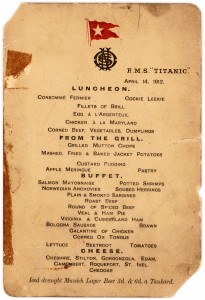
Titanic Lunch Menu 14 April 1912 Photo: AP
At 7:30 pm, the Californian reported three large icebergs, which was reported to the bridge while Second Officer Charles Lightoller is on duty. Captain Smith was attending a dinner in the First-Class Dining Room. Contrary to what is shown in A Night To Remember, messages were not delivered by the wireless operators but by Titanic crew. Lightoller would order the crew to watch the fresh water supply as the temperature was dropping to freezing. Smith would return to the bridge at 8:55 pm and discuss with Lightoller to the weather and icebergs. Captain Smith would retire for the night at 9:20 pm telling Lightoller to wake him “if becomes at all doubtful’. At 9:30 pm, Lightoller would advise the lookouts to watch for icebergs.
The Mesaba sent a warning of heavy pack ice and icebergs at 9:40 pm. However due to heavy wireless passenger traffic, Jack Phillips was too busy to have it sent to the bridge. At 10:00 pm, First Officer William Murdoch would relieve Second Officer Lightoller. Lightoller would tell Murdoch of current conditions. The lookouts were also relieved by the new watch. Lookouts Frederick Fleet and Reginald Lee are advised to watch for icebergs. Since it is a moonless night and the sea calm, they will need to be extra alert in looking for any ice fields or icebergs that might appear. Also, they have no binoculars as they have been misplaced. The temperature continues to drop and is recorded at 31F.
The Californian decides to stop at 10:55 pm due to large field ice in its way. Warnings were sent out to all shipping in the area. The wireless operator contacts Titanic with additional ice warning. Jack Phillips sends back a blunt response telling him to shut up as he was sending messages through Cape Race. At around 11:00 pm, most people are either in bed or heading back to their cabins. A few might still be enjoying a drink, a card game, or reading. By 11:30 pm, the Californian wireless operator, after listening to Titanic’s message traffic, shuts down and goes to bed.
Photograph of iceberg taken by chief steward of Prinz Adalbert on morning of 15 April 1912 near where Titanic sank. At the time he had not learned of the Titanic disaster. Smears of red paint along the base caught his attention. The photo and accompanying statement were sent to Titanic’s lawyers, which hung in their boardroom until the firm dissolved in 2002. Public Domain
Just before 11:40 pm, lookouts spot an iceberg 500 feet away. Lookout Frederick Fleet rings the bell three times and calls the bridge telling Murdoch ‘Iceberg, right ahead.’ Titanic was doing around 21 knots (or slightly less) at the time. Murdoch gives the order “hard a starboard,” orders the engines stopped then full astern, and seals the watertight doors. Due to the size, ships of this size have a larger turning radius then most. At first it looked like Titanic would hit the iceberg dead on but then slowly veers to port to pass by on the starboard. Some speculate the iceberg may have been inverted making it larger underwater than on top. The iceberg makes contact with the ship causing large and small punctures in the process as it scraped the ship.
Thomas Andrews, 1911 Public Domain/Wikimedia Commons
Captain Smith would come to the bridge to determine what happened and informed they struck an iceberg. Reports started coming in of water in the mail room and other areas of the ship. Titanic designer Thomas Andrews assesses the damage along with Captain Smith. With water coming in the mail room and in the first five compartments of the ship, Andrews informs Smith that Titanic will stay afloat for 1 ½ to 2 hours. The ship could survive one compartment being damaged but all not all five with water coming pulling it down at the bow. Captain Smith was in a state of shock at this news and had to be prodded to order lifeboats be lowered, muster the crew, and evacuate the passengers. Since lifeboats were based on tonnage (per British Board of Trade regulations) and not capacity, 1,178 of 2,227 passengers could be put into them if filled to capacity.
At 12:15 am, Captain Smith orders wireless operators Jack Phillips and Harold Bride to send out distress messages. While SOS is the new distress signal, they also send out the older one CQD (come quick distress). Many ships will hear the distress but many like the Frankfurt are too far away to respond. On Carpathia, approximately 58 miles away, its wireless operator heard the message at 12.20 am, “Come at once. We have struck a berg. It’s a CQD, old man.” Once informed of this, Captain Arthur Rostron immediately orders his ship make to the coordinates provided by Titanic. As the ship speeds to the scene at top speed, he issues a flurry of orders to make ready the ship for receiving survivors. It would take three hours for Carpathia to arrive.
Since Titanic lacked a central alarm system to notify passengers to evacuate the ship, it fell to stewards and others to knock on passenger’s doors to rouse them. At first many did not believe the ship was in any danger but that would become apparent as time went on. Since the crew had not had any training or drills in lowering the lifeboats, they were unsure the davits were strong enough or the capacity of the lifeboats. And the system of who could board lifeboats varied from port or starboard side. Lightoller was strict about women and children first. At 12:45 am, lifeboat number 7 on the starboard side was lowered but only had 27 people instead of full capacity of 65.
Titanic fired distress rockets as well to get the attention of any nearby ships. They were seen by the Californian, but they did not know the source and did not investigate. A ship appeared to be ten miles away but did not respond to rockets or the Morse lamp. Later some thought this was a Norwegian fishing vessel illegally hunting seals, but evidence did not confirm it. Whether this ship was a mirage caused by conditions on the sea or atmospherics, or the real thing, has never been confirmed. By 12:55 am, lifeboats 5 and 6 are lowered. Number 6 had passenger Molly Brown and lookout Frederick Fleet. Quartermaster Robert Hitchens, who was at the helm when Titanic struck the iceberg, would be criticized later for refusing to look for survivors
By 1:00 am, lifeboat 3 is lowered and only carries 39 people, 12 from the crew. Lifeboat 1 is lowered with only 12 people. It is one of the emergency cutters designed for quick lowering and raising in cases of a person overboard. It can hold up to 40. Both Sir Cosmo Edmund-Duff Gordon are aboard this lifeboat. They would be accused, but denied it, of bribing the crew by giving them £5 each to keep others from using the boat. Sir Cosmo would say the money was offered to them for them to replace lost clothing and gear.
At 1:10 am, the first lifeboat on the port side is lowered. Number 8 only had 28 people on it and included the Countess of Rothes, Lucy Noel Martha. Ida and Isidor Strauss were offered seats on this lifeboat but decline. Isidor believed women and children should go first and Ida did not want to leave her husband. “Where you go, I go,” she said. Both would remain aboard Titanic and perish when it sank. Lifeboat 10 is launched at 1:20 am and had the nine-week-old Milvina Dean on it. She would become later one of the survivors often interviewed about Titanic and lived a long life till dying in 2009 at the age of 97. Lifeboat 9 is launched and is near capacity at 56 people aboard. Benjamin Guggenheim’s mistress was aboard, but he remained with his valet aboard the ship dressed in formal attire.
On Olympic, there was some confusion about the distress call they received. It is possible that with all the signals going out that night, that some got jumbled up (this proved true later when apparently confusing messages were received in New York). About 1:25 am, they radioed Titanic asking if they steaming to meet them. The response was simple that they were putting women off in the boats. Later Olympic would be informed by Carpathia of the sinking. Panic was starting to set in aboard the ship as it became very obvious by this time she was sinking and filling up with water. A panic near lifeboat 14 caused Fifth Officer Boxhall to discharge his weapon. He took command of the lifeboat and would later transfer people into other lifeboats so they could look for survivors. The lowering of lifeboat 13 is quickly followed by 15. However, it drifts underneath the lowering lifeboat but quick action by crewman in 13 save it by cutting the ropes and rowing away.
Between 1:35-1:40 am lifeboat 16 and collapsible C is lowered. On C is White Star chairman J. Bruce Ismay. Later he would be criticized that he boarded before women and children. He would claim that neither were around when he boarded the lifeboat. True or not, it would stick with him for the rest of his life with some calling him a coward. By 1:45 am, Emergency Cutter 2 is launched with Boxhall with 20 people. Lifeboats 11 and 4 would be launched as well. Madeline Astor, five months pregnant, is aboard number 4. Her husband, John Jacob Astor, would ask to join her but Lightoller, who followed the order of woman and children first, declined. Astor’s body would later be recovered.
Titanic Captain Edward J Smith, 1911 Author unknown. Published after sinking in 1912 Public Domain/Wikipedia Commons
By 2 am only the collapsible boats remain. Titanic had sunk low enough that the stern propellors were now visible. Collapsible lifeboat D is launched from the roof of the officer’s quarters and would have 20 people in it. Collapsible A is washed off the deck and partly filled with water. Fifth Officer Harold Lowe in lifeboat 14 finds only 12 of the 20 that got into it are alive. Collapsible B falls and swept off before it can be righted. The now overturned lifeboats is used by 30 people including Lightoller and wireless operator Bride. At this point, Captain Smith releases the crew saying, “it’s every man for himself.” Smith was last seen on the bridge and his body was never recovered. Wireless operator Phillips sends the final distress signal at 2:17 am. He made it to collapsible lifeboat B but died from exposure. His body would not be recovered.
Titanic is plunged into darkness as its power generators fail. The bow continues its inexorable pull downward as the stern rises higher out of the water. Around 2:18 am, the tremendous strain on the midsection of the ship causes it to break in two between the third and fourth funnels. The bow would disappear beneath the waves while the stern settles back in the water. At this moment, those on the stern can literally swim away before it starts rising. Water would fill into the stern causing it to rise and becoming vertical. At 2:20 am, it would begin the final plunge and disappear. Titanicwas gone.
RMS Carpathia (date unknown) Image: public domain
Carpathia would arrive in the area firing rockets to get attention at around 3:30 am. Lifeboat 2 was the first to reach the rescue ship. It would take several hours to pick up all the survivors. Ismay would send a message to the White Star Line office informing them Titanic sank. He then would isolate himself in a cabin for the remainder of the voyage to New York. The Californian arrived on scene at 8:30 am. They learned of the sinking around 5:30 am. They find no survivors.
Collapsible lifeboat D photographed by passenger on Carpathia on the morning of 15 April 1912. Public Domain(Wikipedia)
At 8:50 am, Carpathia sounded her whistle and began heading to New York with the 705 survivors aboard. Due to garbled and mixed-up messages, the American press believed at first disaster had been averted and she was in tow. People were gathering outside of the White Star Liner offices in New York, London and other offices for information. The White Star Line office in New York believed Titanic was okay and conveyed that to the public that morning. However, that changed by the afternoon when Ismay’s message from Californian was received and other information also confirmed it as well. Titanic, the pride of the White Star Line, had sunk on her maiden voyage taking 1,500 lives with only 705 survivors.
Sources:
Books
Behe, George TITANIC: SAFETY, SPEED AND SACRIFICE, Transportation Trails, Polo, IL 1997
Eaton John P. & Haas Charles, TITANIC TRIUMPH AND TRAGEDY, SECOND EDITION, W.W. Norton & Company, New York, New York, 1995 First American Edition
Lord, Walter, A NIGHT TO REMEMBER, Holt Rinehart and Winston, New York, New York, 1955. Multiple revisions and reprints, notably Illustrated editions (1976,1977,1978 etc)
Lord, Walter, THE NIGHT LIVES ON, Willian Morrow and Company, New York, New York, 1986 (First Edition)
Lynch, Don & Marshall Ken, TITANIC AN ILLUSTRATED HISTORY, Madison Press Books, Toronto, Ontario Canada, 1992
With Titanic’s sinking, U.S. Senator William Alden Smith saw this as an opportunity to investigate marine safety issues. Smith, a Republican Senator from Michigan, had experience in investigating railroad safety issues. Smith believed due to the sensational nature of this disaster that rapid action was needed. Another concern was that many of the witnesses-surviving passengers and crew-would disperse and return home. On 17 April 1912, Smith proposed that a hearing be done to investigate the sinking. President Taft, who lost his friend and military advisor Archibald Butt in the sinking, concurred. A U.S. naval escort was set up for Carpathia to make sure no one left before it docked.
Senator William Alden Smith of Michigan Unknown date (between 1905 and 1945) Public Domain
Smith, accompanied by Francis G. Newlands and other officials traveled to New York and were there when Carpathia docked in New York. They boarded the ship and served subpoenas on J.Bruce Ismay and on surviving officers and crew. The hearings began on 19 April 1912 at the Waldorf-Astoria Hotel in New York and later moved to Washington D.C. The hearings, with many recesses in-between, would run for 18 days till May 25, 1912.
Sources:
Books
Behe, George TITANIC: SAFETY, SPEED AND SACRIFICE, Transportation Trails, Polo, IL 1997
Eaton John P. & Haas Charles, TITANIC TRIUMPH AND TRAGEDY, SECOND EDITION, W.W. Norton & Company, New York, New York, 1995 First American Edition
Lord, Walter, A NIGHT TO REMEMBER, Holt Rinehart and Winston, New York, New York, 1955. Multiple revisions and reprints, notably Illustrated editions (1976,1977,1978 etc)
Lord, Walter, THE NIGHT LIVES ON, Willian Morrow and Company, New York, New York, 1986 (First Edition)
Lynch, Don & Marshall Ken, TITANIC AN ILLUSTRATED HISTORY, Madison Press Books, Toronto, Ontario Canada, 1992
Poster Advertising Vinolia Otto Soap for Titanic Image:Public Domain
Sunday, 14 April 1912 was what many survivors thought was the best day of the journey so far. Religious service was held in the First-Class dining room at 10:30 am. Many in first and second class had a very nice meal afterwards, followed by a stroll around the deck. Ice warnings had been received from other ships in the past two days, but no one had plotted them or gave them deep thought. Icebergs were common and no one thought they were that serious of an issue at the time. At noon the ship’s officers got together on wing bridge to calculate the Titanic’s position.
About 1:42 pm, White Star Liner Baltic reported large quantities of field ice along with the coordinates. The message was delivered to Captain Edward J. Smith who passed it on to Joseph Bruce Ismay, chairman of White Star Line. The Amerika sighted a large iceberg at 1:45 pm and transmitted notice and its coordinates as well. As the afternoon progressed, air temperature began to drop and by 7:30 pm was at 33?F. At 5:50 pm, Captain Smith orders the course to south and west of the usual course taken possibly due to the ice warnings.
Titanic Lunch Menu 14 April 1912 Photo: AP
At 7:30 pm, the Californian reported three large icebergs, which was reported to the bridge while Second Officer Charles Lightoller is on duty. Captain Smith was attending a dinner in the First-Class Dining Room. Contrary to what is shown in A Night To Remember, messages were not delivered by the wireless operators but by Titanic crew. Lightoller would order the crew to watch the fresh water supply as the temperature was dropping to freezing. Smith would return to the bridge at 8:55 pm and discuss with Lightoller to the weather and icebergs. Captain Smith would retire for the night at 9:20 pm telling Lightoller to wake him “if becomes at all doubtful’. At 9:30 pm, Lightoller would advise the lookouts to watch for icebergs.
The Mesaba sent a warning of heavy pack ice and icebergs at 9:40 pm. However due to heavy wireless passenger traffic, Jack Phillips was too busy to have it sent to the bridge. At 10:00 pm, First Officer William Murdoch would relieve Second Officer Lightoller. Lightoller would tell Murdoch of current conditions. The lookouts were also relieved by the new watch. Lookouts Frederick Fleet and Reginald Lee are advised to watch for icebergs. Since it is a moonless night and the sea calm, they will need to be extra alert in looking for any ice fields or icebergs that might appear. Also, they have no binoculars as they have been misplaced. The temperature continues to drop and is recorded at 31?F.
The Californian decides to stop at 10:55 pm due to large field ice in its way. Warnings were sent out to all shipping in the area. The wireless operator contacts Titanic with additional ice warning. Jack Phillips sends back a blunt response telling him to shut up as he was sending messages through Cape Race. At around 11:00 pm, most people are either in bed or heading back to their cabins. A few might still be enjoying a drink, a card game, or reading. By 11:30 pm, the Californian wireless operator, after listening to Titanic’s message traffic, shuts down and goes to bed.
Photograph of iceberg taken by chief steward of Prinz Adalbert on morning of 15 April 1912 near where Titanic sank. At the time he had not learned of the Titanic disaster. Smears of red paint along the base caught his attention. The photo and accompanying statement were sent to Titanic’s lawyers, which hung in their boardroom until the firm dissolved in 2002. Public Domain
Just before 11:40 pm, lookouts spot an iceberg 500 feet away. Lookout Frederick Fleet rings the bell three times and calls the bridge telling Murdoch ‘Iceberg, right ahead.’ Titanic was doing around 21 knots (or slightly less) at the time. Murdoch gives the order “hard a starboard,” orders the engines stopped then full astern, and seals the watertight doors. Due to the size, ships of this size have a larger turning radius then most. At first it looked like Titanic would hit the iceberg dead on but then slowly veers to port to pass by on the starboard. Some speculate the iceberg may have been inverted making it larger underwater than on top. The iceberg makes contact with the ship causing large and small punctures in the process as it scraped the ship.
Thomas Andrews, 1911 Public Domain/Wikimedia Commons
Captain Smith would come to the bridge to determine what happened and informed they struck an iceberg. Reports started coming in of water in the mail room and other areas of the ship. Titanic designer Thomas Andrews assesses the damage along with Captain Smith. With water coming in the mail room and in the first five compartments of the ship, Andrews informs Smith that Titanic will stay afloat for 1 ½ to 2 hours. The ship could survive one compartment being damaged but all not all five with water coming pulling it down at the bow. Captain Smith was in a state of shock at this news and had to be prodded to order lifeboats be lowered, muster the crew, and evacuate the passengers. Since lifeboats were based on tonnage (per British Board of Trade regulations) and not capacity, 1,178 of 2,227 passengers could be put into them if filled to capacity.
At 12:15 am, Captain Smith orders wireless operators Jack Phillips and Harold Bride to send out distress messages. While SOS is the new distress signal, they also send out the older one CQD (come quick distress). Many ships will hear the distress but many like the Frankfurt are too far away to respond. On Carpathia, approximately 58 miles away, its wireless operator heard the message at 12.20 am, “Come at once. We have struck a berg. It’s a CQD, old man.” Once informed of this, Captain Arthur Rostron immediately orders his ship make to the coordinates provided by Titanic. As the ship speeds to the scene at top speed, he issues a flurry of orders to make ready the ship for receiving survivors. It would take three hours for Carpathia to arrive.
Since Titanic lacked a central alarm system to notify passengers to evacuate the ship, it fell to stewards and others to knock on passenger’s doors to rouse them. At first many did not believe the ship was in any danger but that would become apparent as time went on. Since the crew had not had any training or drills in lowering the lifeboats, they were unsure the davits were strong enough or the capacity of the lifeboats. And the system of who could board lifeboats varied from port or starboard side. Lightoller was strict about women and children first. At 12:45 am, lifeboat number 7 on the starboard side was lowered but only had 27 people instead of full capacity of 65.
Titanic fired distress rockets as well to get the attention of any nearby ships. They were seen by the Californian, but they did not know the source and did not investigate. A ship appeared to be ten miles away but did not respond to rockets or the Morse lamp. Later some thought this was a Norwegian fishing vessel illegally hunting seals, but evidence did not confirm it. Whether this ship was a mirage caused by conditions on the sea or atmospherics, or the real thing, has never been confirmed. By 12:55 am, lifeboats 5 and 6 are lowered. Number 6 had passenger Molly Brown and lookout Frederick Fleet. Quartermaster Robert Hitchens, who was at the helm when Titanic struck the iceberg, would be criticized later for refusing to look for survivors
By 1:00 am, lifeboat 3 is lowered and only carries 39 people, 12 from the crew. Lifeboat 1 is lowered with only 12 people. It is one of the emergency cutters designed for quick lowering and raising in cases of a person overboard. It can hold up to 40. Both Sir Cosmo Edmund-Duff Gordon are aboard this lifeboat. They would be accused, but denied it, of bribing the crew by giving them £5 each to keep others from using the boat. Sir Cosmo would say the money was offered to them for them to replace lost clothing and gear.
At 1:10 am, the first lifeboat on the port side is lowered. Number 8 only had 28 people on it and included the Countess of Rothes, Lucy Noel Martha. Ida and Isidor Strauss were offered seats on this lifeboat but decline. Isidor believed women and children should go first and Ida did not want to leave her husband. “Where you go, I go,” she said. Both would remain aboard Titanic and perish when it sank. Lifeboat 10 is launched at 1:20 am and had the nine-week-old Milvina Dean on it. She would become later one of the survivors often interviewed about Titanic and lived a long life till dying in 2009 at the age of 97. Lifeboat 9 is launched and is near capacity at 56 people aboard. Benjamin Guggenheim’s mistress was aboard, but he remained with his valet aboard the ship dressed in formal attire.
On Olympic, there was some confusion about the distress call they received. It is possible that with all the signals going out that night, that some got jumbled up (this proved true later when apparently confusing messages were received in New York). About 1:25 am, they radioed Titanic asking if they steaming to meet them. The response was simple that they were putting women off in the boats. Later Olympic would be informed by Carpathia of the sinking. Panic was starting to set in aboard the ship as it became very obvious by this time she was sinking and filling up with water. A panic near lifeboat 14 caused Fifth Officer Boxhall to discharge his weapon. He took command of the lifeboat and would later transfer people into other lifeboats so they could look for survivors. The lowering of lifeboat 13 is quickly followed by 15. However, it drifts underneath the lowering lifeboat but quick action by crewman in 13 save it by cutting the ropes and rowing away.
Between 1:35-1:40 am lifeboat 16 and collapsible C is lowered. On C is White Star chairman J. Bruce Ismay. Later he would be criticized that he boarded before women and children. He would claim that neither were around when he boarded the lifeboat. True or not, it would stick with him for the rest of his life with some calling him a coward. By 1:45 am, Emergency Cutter 2 is launched with Boxhall with 20 people. Lifeboats 11 and 4 would be launched as well. Madeline Astor, five months pregnant, is aboard number 4. Her husband, John Jacob Astor, would ask to join her but Lightoller, who followed the order of woman and children first, declined. Astor’s body would later be recovered.
Titanic Captain Edward J Smith, 1911 Author unknown. Published after sinking in 1912 Public Domain/Wikipedia Commons
By 2 am only the collapsible boats remain. Titanic had sunk low enough that the stern propellors were now visible. Collapsible lifeboat D is launched from the roof of the officer’s quarters and would have 20 people in it. Collapsible A is washed off the deck and partly filled with water. Fifth Officer Harold Lowe in lifeboat 14 finds only 12 of the 20 that got into it are alive. Collapsible B falls and swept off before it can be righted. The now overturned lifeboats is used by 30 people including Lightoller and wireless operator Bride. At this point, Captain Smith releases the crew saying, “it’s every man for himself.” Smith was last seen on the bridge and his body was never recovered. Wireless operator Phillips sends the final distress signal at 2:17 am. He made it to collapsible lifeboat B but died from exposure. His body would not be recovered.
Titanic is plunged into darkness as its power generators fail. The bow continues its inexorable pull downward as the stern rises higher out of the water. Around 2:18 am, the tremendous strain on the midsection of the ship causes it to break in two between the third and fourth funnels. The bow would disappear beneath the waves while the stern settles back in the water. At this moment, those on the stern can literally swim away before it starts rising. Water would fill into the stern causing it to rise and becoming vertical. At 2:20 am, it would begin the final plunge and disappear. Titanicwas gone.
RMS Carpathia (date unknown) Image: public domain
Carpathia would arrive in the area firing rockets to get attention at around 3:30 am. Lifeboat 2 was the first to reach the rescue ship. It would take several hours to pick up all the survivors. Ismay would send a message to the White Star Line office informing them Titanic sank. He then would isolate himself in a cabin for the remainder of the voyage to New York. The Californian arrived on scene at 8:30 am. They learned of the sinking around 5:30 am. They find no survivors.
Collapsible lifeboat D photographed by passenger on Carpathia on the morning of 15 April 1912. Public Domain(Wikipedia)
At 8:50 am, Carpathia sounded her whistle and began heading to New York with the 705 survivors aboard. Due to garbled and mixed-up messages, the American press believed at first disaster had been averted and she was in tow. People were gathering outside of the White Star Liner offices in New York, London and other offices for information. The White Star Line office in New York believed Titanic was okay and conveyed that to the public that morning. However, that changed by the afternoon when Ismay’s message from Californian was received and other information also confirmed it as well. Titanic, the pride of the White Star Line, had sunk on her maiden voyage taking 1,500 lives with only 705 survivors.
Sources:
Books
Behe, George TITANIC: SAFETY, SPEED AND SACRIFICE, Transportation Trails, Polo, IL 1997
Eaton John P. & Haas Charles, TITANIC TRIUMPH AND TRAGEDY, SECOND EDITION, W.W. Norton & Company, New York, New York, 1995 First American Edition
Lord, Walter, A NIGHT TO REMEMBER, Holt Rinehart and Winston, New York, New York, 1955. Multiple revisions and reprints, notably Illustrated editions (1976,1977,1978 etc)
Lord, Walter, THE NIGHT LIVES ON, Willian Morrow and Company, New York, New York, 1986 (First Edition)
Lynch, Don & Marshall Ken, TITANIC AN ILLUSTRATED HISTORY, Madison Press Books, Toronto, Ontario Canada, 1992
OceanGate Expeditions announces its second annual expedition to the wreck of the Titanic, the 2022 Titanic Expedition. OceanGate Expeditions will charter the Cyclops-class carbon fiber and titanium submersible, Titan, to carry crewmembers to the historic maritime heritage site which sits at 3,800 meters on the floor of the North Atlantic Ocean. Citizen explorers, trained as Mission Specialists, will join a cadre of archaeologists, marine biologists, and Titanic experts on the second annual expedition to study and document the Titanic in more detail than ever before. The Titan submersible is outfitted with the latest camera technologies to capture ultra-high-resolution imagery that will help determinethe wreck’s rate of decay and assess the marine life that dwell on the wreck.
==
Collapsible lifeboat D photographed by passenger on Carpathia on the morning of 15 April 1912. Public Domain(Wikipedia)
Firstly, she looked at CS Mackay-Bennett, a recovery boat that ended up finding the majority of the victims of the tragedy. She continued: “The recovery boat didn’t leave Nova Scotia until three days after the wreckage and didn’t arrive at the site until a full week later. By this time, bodies had scattered and been exposed to the elements like sea life and birds, so the men didn’t find pristine preserved corpses floating on the surface.” According to Caitlin, many of the bodies did cluster together “like a flock of seagulls in their white life jackets”. The first day, they recovered 51 bodies, and in total, the Mackay-Bennett recovered 306 bodies. She continued: “Another boat recovered 17, another boat recovered three, yet another boat recovered three people in a lifeboat a month later over 200 miles away.” Because of this, it would be impossible to figure out how many people sank to the bottom of the ocean or floated away.
They belong to Bruce’s grandson whom Clifford visited and spoke to at his home in Scotland – and, he says, they tell a very different story about this so-called cowardly man. One thing they redress is the criticism Bruce received for resigning from the White Star Line after the disaster “Documents show Bruce had actually planned to retire before Titanic sailed and had found a successor in Harold Sanderson,” says Clifford. “Also he wanted to give up the presidency of International Mercantile Marine Company – the White Star’s American parent company – but actually continue as chairman of the White Star Line, but the remaining directors didn’t want him to remain as chair in the end.” Clifford explains he hadn’t really wanted to be president of IMM in the first place and only accepted the post reluctantly after his colleagues persuaded him. So it wasn’t as if he had jumped ship after the disaster like a coward.
The historic Titanic pump-house is set to become a whiskey distillery and new tourist attraction. Titanic Distillers have been given the green light for the redevelopment of the listed building by Belfast City Council planning committee. Based in the heart of the Titanic Quarter, it first opened in 1911 alongside its neighbouring dock and the distillery will also feature a visitors attraction so that people will be able to see the authentic Titanic landmark. Titanic Distillers Director Richard Irwin, said the company was excited that the application had been approved.
Now, a hundred years since Northern Ireland was born, this industrial site has been transformed into one of the country’s main tourism draws, home to the Titanic Belfast attraction and several historic maritime sites. The slipways where the Titanic was built are now a top outdoor performance venue in Belfast, which has just been awarded UNESCO City of Music status in recognition of its dynamic live music scene. The yards also grace the big screen in Kenneth Branagh’s new movie, Belfast, inspired by his childhood here during the turbulent 1960s.
And for your Thanksgiving Day. Here is an excerpt from the now infamous Turkey Drop episode of WKRP.
Neither the Lusitania nor the Titanic was the largest maritime disaster, not by a long shot. Yet somehow, their fateful journeys remain a source of intrigue for both researchers and curiosity seekers. The largest loss of lives occurred during World War II in the frigid Baltic Sea. On Jan. 30, 1945, a Soviet submarine sunk Germany’s Wilhelm Gustloff. On board the transport ship were thousands of German civilians. It is estimated that 6,000 to 9,000 people perished.
Funds are needed to ensure the lifesaving service is able to keep everyone safe and the RNLI is asking people to come down to the Maritime Mile and take part in the wonderful experience and complete their very own mile and donate to help raise those vital funds. RNLI lifeboats in Northern Ireland launched 234 times last year and their volunteer lifeboat crews brought 253 people to safety. Eighty-nine of those launches were carried out in the hours of darkness. The charity’s lifeguards responded to 225 incidents last summer on beaches, helping 285 people and saving the lives of six people.
Members of the British Titanic Society think the wooden carriages, found in a yard in South Wales, formed part of a train that carried passengers from London to Southampton on 10 April 1912. Five days later the Southampton-based liner sank in the North Atlantic Ocean. It is hoped the carriages, which are due to be scrapped, can be restored.
J. Bruce Ismay, president of the White Star Line, in 1912 Public Domain(Wikipedia)
Ismay fully co-operated with the congressional inquiry, but nothing could stop the jeering on the streets in both the US and the UK. London society would have nothing more to do with him and he resigned from all his company positions, hoping to disappear, as the media continued to label him as the biggest coward in history.
With his wife Julia, Ismay was to find comfort in Costello Lodge, however, and among the local people who looked upon the pair as a solid source of employment, although the locals referred to Ismay in Irish as “Brú síos mé” (‘lower me down’ i.e. into a lifeboat ). He was said by the locals to be a kind, warm-hearted man, even inquiring of the fisherman he’d fish with on a Sunday if they had had time to go to Mass. Casla Lodge was burned down by the IRA in 1922, but the home was rebuilt on an even grander scale. Ismay remained a Connemara resident for 25 years before moving back to England after he was diagnosed with diabetes. He died in London in 1937, aged 74.
One of the last great mysteries of the Titanic was solved in 2013 thanks to a DNA test which proved a woman who claimed she was a child survivor of the tragic Titanic sinking was a fraud. Two-year-old Loraine Allison is believed to have been the only child from first or second class who died during the sinking of the Titanic. However, in 1940, Helen Loraine Kramer, now styling herself Loraine Kramer, claimed to be the missing child. She told a radio show that she had been saved at the last moment when her father placed her in a lifeboat with a man whom she had always thought was her father.Kramer launched a legal bid to be considered part of the wealthy Allison family and entitled to part of their fortune. Before her death in 1992, she contended that she was entitled to the vast majority of the Allison family’s wealth in Canada. The dispute led to the founding of The Loraine Allison Identification Project by Tracy Oost, a forensic scientist at Laurentian University, Ontario, and Titanic expert. While Woods declined to participate, Oost obtained DNA samples from Deanne Jennings, Woods’ half-sister, and Sally Kirkelie, the great-niece of Bess Allison, Loraine Allison’s mother. No genetic link was found between descendants from both sides of the dispute. The results proved that Helen Loraine Kramer was not the little girl who was lost on the Titanic.
Titanic Memorial Lighthouse,South Street Seaport Museum, New York (2008) Image: Andy C (Wikipedia)
The campaign to landmark and restore the Titanic Memorial Lighthouse, a monument in New York City built in 1913 to honor those who died aboard the Titanic, continues. Designed by Warren and Wetmore, the architecture firm behind Grand Central Terminal, the 60-foot-tall lighthouse originally sat atop the roof of the Seamen’s Church Institute and featured a working time ball that dropped down the pole each day, along with a green light. Preservationists are now raising funds that would help restore the lighthouse, currently located at the entrance to the South Street Seaport, to its original condition.
With Titanic’s sinking, U.S. Senator William Alden Smith saw this as an opportunity to investigate marine safety issues. Smith, a Republican Senator from Michigan, had experience in investigating railroad safety issues. Smith believed due to the sensational nature of this disaster that rapid action was needed. Another concern was that many of the witnesses-surviving passengers and crew-would disperse and return home. On 17 April 1912, Smith proposed that a hearing be done to investigate the sinking. President Taft, who lost his friend and military advisor Archibald Butt in the sinking, concurred. A U.S. naval escort was set up for Carpathia to make sure no one left before it docked.
Senator William Alden Smith of Michigan Unknown date (between 1905 and 1945) Public Domain
Smith, accompanied by Francis G. Newlands and other officials traveled to New York and were there when Carpathia docked in New York. They boarded the ship and served subpoenas on J.Bruce Ismay and on surviving officers and crew. The hearings began on 19 April 1912 at the Waldorf-Astoria Hotel in New York and later moved to Washington D.C. The hearings, with many recesses in-between, would run for 18 days till May 25, 1912.
Sources:
Books
Behe, George TITANIC: SAFETY, SPEED AND SACRIFICE, Transportation Trails, Polo, IL 1997
Eaton John P. & Haas Charles, TITANIC TRIUMPH AND TRAGEDY, SECOND EDITION, W.W. Norton & Company, New York, New York, 1995 First American Edition
Lord, Walter, A NIGHT TO REMEMBER, Holt Rinehart and Winston, New York, New York, 1955. Multiple revisions and reprints, notably Illustrated editions (1976,1977,1978 etc)
Lord, Walter, THE NIGHT LIVES ON, Willian Morrow and Company, New York, New York, 1986 (First Edition)
Lynch, Don & Marshall Ken, TITANIC AN ILLUSTRATED HISTORY, Madison Press Books, Toronto, Ontario Canada, 1992