Tag Archives: European history

Remembering History: Spanish Armada Defeated Ending Spain’s Invasion of Britain (8 August 1588)

Defeat of the Spanish Armada (Philip James de Loutherbourg, 1796)
Public Domain

[Important Note :England was still under the old Julian calendar in 1588, so the original date is shown in parentheses. England adopted it in 1752 and had to skip ahead 11 days accounting for the difference. Wherever possible, the original and new date are shown.]

On 8 Aug 1588 (29 July 1588) naval forces of England and Spain engaged in an 8-hour furious battle off the coast of France that determined the fate of both countries control of the seas. Spain had created the armada to not only gain control of the English Channel but also to land an invasion force in England. England since the early 1580s had been conducting raids against Spanish commerce and had supported Dutch rebels in the Spanish Netherlands. The other reason was to restore Catholicism that had been outlawed since the reign of King Henry VIII.

The invasion fleet was authorized by King Philip II and was completed in 1587 but delayed by a raid by Sir Francis Drake on the Armada’s supplies. It did not depart until 29 May 1588 (May 19, 1588) The fleet consisted of 130 ships under the command of the Duke of Medina-Sidonia. It had 2,500 guns, 8,000 seamen, and 20,000 soldiers. The Spanish ships though were slower than their English counterparts and lighter armed as well despite their guns. Their tactic was to force boarding when their ships were close enough. They believed with the superior numbers of Spanish infantry they could overwhelm the English ships.

The English were commanded by Charles Howard, 2nd Baron Howard of Effingham. Like his counterpart, he was an admiral with not much sea experience but proved to be the better leader. His second in command was Sir Francis Drake. The English fleet was at its height 200 ships but in actual combat was at most 100. Only 40 were warships and the rest smaller, but they were armed with heavy artillery that were able to fire at longer ranges without having to get close to the enemy to be effective. The English strategy was to bombard their enemy from a distance and not give them the opportunity to get close and possibly board their ships (which had a smaller number of soldiers aboard than the Spanish had).

As the Spanish Armada made its way, it would be harassed by English ships that bombarded them at a distance, negating Spanish attempts to board. The Armada anchored near Calais, France on 27 July (16 July). The Spanish forces on land were in Flanders and would take time to get to Calais. However, since there was no safe port and enemy Dutch and English ships patrolled the coastal shallows, it meant those troops had no safe way to get to the Armada.

Around midnight on 7- 8 Aug 1588 (28-29 July), the English sent 8 fire ships into the anchored Spanish fleet. The Spanish were forced to quickly scatter to avoid the fire ships. This meant the Armada formation was now broken making them easier targets for the English to attack. They closed to effective range and attacked. Surprising to the English, the return fire was mostly small arms. It turns out most of the heavy cannons had not been mounted. And those that were did not have properly trained crews on how to reload. Three Spanish ships were sunk or driven ashore. Other ships were battered and moved away. The English also were low on ammunition, so they had to drop back and follow the Spanish fleet.

The Spanish fleet had to flee north and around Scotland and from there head back to Spain. The English fleet turned back for resupply. It was a long road back to Spain for the Armada. Autumn had arrived and gales in the North Atlantic made passage tough. Ships were lost to bad weather, navigational errors, foundered near Ireland, and possibly battle damage as well. Only 60 of the 130 survived with an estimated loss of 15,000 men. The English losses were much smaller with fewer men wounded or killed in battle. It appears most of the deaths that came later were due to disease (possibly scurvy). Damages to the English ships were negligible.

Destrucción de la Armada Invencible by José Gartner (1866–1918)
1892
Original located at Museo de Málaga, Spain
Public Domain via Wikimedia Commons

Significance

With the defeat of the Spanish Armada, England was made safe from invasion. The Dutch rebels the English backed in the Spanish Netherlands were saved as well. Spain up to that point had been the greatest European power, so it was a major blow to their prestige that would have ramifications down the road for them. Also, it heralded a major change for naval battles. This was the first major naval gun battle where the combatants fought at a distance rather than closing and boarding. Warships that could move quickly and had artillery that fire at long range would become the norm on the seas from that point on. England would now become a major world power. Spain still was in the game for several decades (the English were not successful either in trying their own invasion) and was still a major colonial power. England and Spain formally ended their conflict in 1604. Spain, however, would eventually go into decline as England and other European powers would successfully expand into Asia and establish their own colonies and trade routes.

Sources

Cartwright, Mark, and Cornelis Claesz Van Wieringen. “Spanish Armada.” World History Encyclopedia (September 21, 2023). https://www.worldhistory.org/Spanish_Armada/.

“Spanish Armada.” Encyclopedia Britannica. Last modified July 9, 2026. Accessed July 29, 2026. https://www.britannica.com/topic/Armada-Spanish-naval-fleet#ref284702.

“The Spanish Armada, 1588.” Historic UK. Last modified February 6, 2025. Accessed July 29, 2026. https://www.historic-uk.com/HistoryUK/HistoryofEngland/Spanish-Armada/.

“Elizabeth I and the Spanish Armada.” Royal Museums Greenwich. Accessed July 29, 2026. https://www.rmg.co.uk/stories/royal-history/elizabeth-i-spanish-armada.

“Spanish Armada Defeated | August 8, 1588 | HISTORY.” HISTORY. Last modified May 28, 2025. Accessed July 29, 2026. https://www.history.com/this-day-in-history/august-8/spanish-armada-defeated.

Suggested Reading
[As an Amazon Associate, I earn from qualifying purchases. This may contain affiliate links, which means I may receive a small commission at no extra cost to you.]

Fernández-Armesto, F. (1989). The Spanish Armada: The Experience of War in 1588. Oxford University Press, USA. This is written from the Spanish point of view. Some have criticized it as glorifying the Spanish Armada, which failed all its strategic and tactical aims. Worth reading though to see it viewed outside of the normal British view on the event.

History, C. (2020). History of Spain: A Captivating Guide to Spanish History, Starting from Roman Hispania Through the Visigoths, the Spanish Empire, the Bourbons, and the War of Spanish Independence to the Present.

Martin, C., & Parker, G. (1999). The Spanish Armada: Revised Edition. Manchester University Press. This is an update to an earlier book by the same authors. The prior book was well researched and considered the standard for this subject. This revised edition has updated information both from Spanish Armada shipwrecks that have been found and more archival data found. If you really want to know the full details as to what led up to the battle, the battle itself, and its aftermath, this would be the book to read.

Sheane, M. (2023). Ireland, 1588: Wreck of the Spanish Armada. A H Stockwell Limited.

Remembering History: Storming Bastille Starts French Revolution (14 July 1789)

The storming of the Bastille, a formidable stone prison on 14 July 1789, is considered the start of the French Revolution.

The Storming of the Bastille by Jean-Pierre Houël (1735–1813)
National Library of France
Public Domain via Wikimedia Commons

The Bastille, originally built to protect the eastern entrance to Paris, had become a symbol of tyranny for the political prisoners it often housed there. At this time in 1789, there were only seven prisoners and none of them were political prisoners. Four had been charged with forgery while two were considered mad or lunatics. The building itself was going to be demolished to create a public square.

France at this time was facing both economic and social problems inherited from previous monarchs. King Louis XVI, despite inheriting considerable debt from his predecessor, continued to spend lavishly making the debt grow even larger. Crop failures, particularly one in 1788, created unrest as the cost of bread soared. Additionally, many were unemployed adding fuel to the unrest. Some blamed it on the lowering of customs duties with England which had created more jobs there but lost them in France. With unrest brewing and riots breaking, King Louis XVI summoned the Estates-General, a national assembly of clergy, nobility, and the commoners to resolve the situation.

In theory, all three were equal but two parts could outvote the third leaving many deputies upset demanding a larger voice. This led to the creation of the National Assembly with the famous Tennis Court Oath of 20 June 1789 that it would not separate until a constitution was created. The National Assembly drew many nobles and clergy to it and King XVI gave his consent to it. However, the assembly of army regiments in Paris led to fears he was going to break it by force. His dismissal of Jacques Necker, a non-noble minister, on 11 July led to massive protests resulting in custom posts being destroyed. Since these posts imposed taxes on goods, they were despised.

A mob seized muskets on 14 July from a military hospital and marched on the Bastille. Seeing them approach, the governor invited the leaders in to discuss surrender terms. The crowd though was restless and began to believe the delegates had been arrested. Climbing the outer wall a group managed to bring down the drawbridge in the courtyard. The governor, breaking a pledge not to fire, ordered his guards to open fire killing 100 outright and wounding others. The arrival of French Guards though changed the situation. They sided with the mob, fired cannons at the Bastille, and forced the governor to surrender. Some of the royalist troops inside the Bastille would be killed and the governor was beheaded by the mob.

Aftermath
The French Revolution began in earnest from this point on. What began to reform France into a constitutional monarchy like Britain or a republic modeled on the United States, became instead a revolutionary government that completely changed France (the ancien regime). And the new order went viciously against royalists and supporters of the old order. King Louis XIV and his wife Marie Antoinette were beheaded. Ironically, he was the last prisoner of the Bastille before it was demolished. Revolutionary France soon found itself embroiled in its own civil war as various factions within it fought for control begetting more violence and bloody executions using the guillotine. That device would become the symbol of the revolution. Many churches too had become part of this revolution fully supporting its aims and failure to attend brought consequences causing many to flee.

It would come to an end as people, tired of the turmoil, wanted order which allowed a man named Napoleon Bonaparte, largely unknown to most French, to take over. Soon everyone would know about him and the subsequent Napoleonic Wars showed the revolutionary zeal now had changed into creating a new French empire in Europe and elsewhere.

Sources

Videos

Suggested Reading
[Disclosure: As an Amazon Associate, I earn from qualifying purchases. This post may contain affiliate links, which means I may receive a small commission at no extra cost to you.]

Clarke, S. (2019). The French Revolution and What Went Wrong. Arrow.

Davidson, I. (2018). The French Revolution. Pegasus Books.

Dickens, C. (1998). A Tale of Two Cities. Courier Corporation.

Doyle, W. (2018). The Oxford History of the French Revolution. Oxford University Press.

De Tocqueville, A. (2020). The State of Society in France Before the Revolution of 1789: And the Causes Which Led to That Event (H. Reeve, Trans.). Independently Published.

Palmer, R. R. (2017). Twelve Who ruled: The Year of Terror in the French Revolution. Princeton University Press.

Assassination of Archduke Ferdinand Leads to World War I (28 June 1914)

The assassination of Archduke Franz Ferdinand and his wife in Sarajevo  on 28 June 1914 would result in a chain of events leading to World War I in August 1914.

Map of Europe 1914 (in French)
Varmin, 2010 via Wikimedia Commons

In 1914 Europe was divided into several major players: Great Britain, France, Germany, and Austria-Hungary. Russia, the largest country of all because of its sheer territory, was not considered a major player. It was a country that had a small industrial base but was mostly agrarian based society. Its defeat in a recent war with Japan showed how it was quite behind the Europeans in terms of building up a powerful military to protect its interests. Britain and Germany (with France often supporting, but not always the British) often clashed over colonies and related interests.

The Austrian Hungarian Empire was the second largest country in Europe after Russia and a multinational state with many different peoples under it. It was also a major industrial power and with its access to the Adriatic, a naval power as well. It was a dual monarchy-Austria Empire and Kingdom of Hungary-and coequal in power. Both states conducted joint foreign relations, defense, and financial policies but left the administration under their individual states. Because it was a polyglot empire, it had a lot of different languages. The major ones were German, Hungarian and Croatian. Because of its industrial capacity, Austria-Hungary was a major exporter of electric home and industrial appliances making it third after the United States and Germany.

Unrest though within Austria-Hungary had become an issue with various groups wanting independence for their peoples. And on this particular day, Archduke Ferdinand was visiting the Imperial armed forces in Bosnia and Herzegovina. This area had been annexed by Austria-Hungary in 1908, which angered Serbian nationalists who believed it should be part of Serbia. His visit hatched a plot to assassinate the archduke. 19-year-old Gavrilo Princip shot the royal couple at point-blank range while they were in their official procession. Princip was part of a group that was well armed, trained, and assisted by the Serbian government. Serbia though had a major supporter in Russia. This meant any reaction to Serbian support of the assassination team would draw in Russia, so Austria asked Germany to back them should conflict break out.

The first page of the edition of the Domenica del Corriere, an Italian paper, with a drawing by Achille Beltrame depicting Gavrilo Princip killing Archduke Franz Ferdinand of Austria in Sarajevo. (Cropped)
12 July 1914, Achille Beltrame
Public Domain (via Wikimedia Commons)

Germany warned to do it quickly while sympathy for Ferdinand was still high. Austria debated its action, and this took time and was not until mid-July they delivered an ultimatum to Serbia.

Russia had already decided to intervene while Serbia was preparing its reply. However, the Russian military knew it was not yet ready for a general war. Yet they saw the hand of Germany in the ultimatum and were determined to show support for Serbia. Once the Serbians knew that Russia was mobilizing, it made it easier for Serbia to defy Austria-Hungary. Germany became nervous about the possibility of Russian troops massing on its border. Russia was allied with France, and Germans had figured on fighting France first rather than Russia. They thought Russia would take longer to get its forces ready. France, for its part, now realizing war with Germany and Austria-Hungary was a real possibility, began mobilizing as well.

Britain, which had an informal alliance with France and Russia, was not committed to war with Germany. At that point, they were still on friendly terms and wanted to remain neutral. Germany made some promises to further that neutrality. However, the German plans to invade France would involve it invading Belgium, a neutral state. This upset many in British leadership and it was decided on moral terms they had to enter the conflict.

By the end of July, the assassination of an archduke had become barely remembered as the belligerents all lined up. Germany and Austria Hungary (central powers) vs Britain, France, and Russia. Austria-Hungary declared war on Serbia on 28 July. On 1 August, Germany declared war on Belgium, France, and Russia. On 4 August, Britain declared war on Germany and on 6 August, Austria-Hungary declared war on Russia. The “Guns of August” had arrived, and war would be on until 1918.

The peace that had existed, fragile at best of times, was shattered.

Sources

Suggested Reading

[Disclosure: As an Amazon Associate, I earn from qualifying purchases. This post may contain affiliate links, which means I may receive a small commission at no extra cost to you.]

Gilbert, M. (2004). The First World War, second edition: A Complete History. Macmillan.

Keegan, J. (1999). The First World War. Knopf.

Tuchman, B. W. (2004). The Guns of August. Presidio Press.

Tuchman, B. W. (1996). The Proud Tower: A Portrait of the World Before the War, 1890-1914; Barbara W. Tuchman’s Great War Series. Random House Trade Paperbacks.

Documentaries & Movies

World War I. (2018, December 11). CBS Mod.

HISTORY, “How a Wrong Turn Started World War I | History,” Video, YouTube, September 25, 2018, https://www.youtube.com/watch?v=IIK9Lkf02TE.

Remembering History: German & Italy Sign Pact of Steel (22 May 1939)

The signing of the Pact of Steel on 22 May 1939 in Berlin
Photographer unknown
Public Domain/WIkimedia Commons

On 22 May 1939, Germany and Italy signed the Pact of Friendship and Alliance that became known later as the Pact of Steel. This began the formal military and political alliance between the two countries. Initially Japan was to be part of the agreement but there was disagreement on the focus of the pact. Germany and Italy wanted it aimed at the British Empire and France, while Japan wanted the Soviet Union to be the focus. The agreement was signed without Japan but would later join in September 1940.

The agreement brought together two countries that opposed each other in World War I. It also required each country to come to the aid of the other if it were in armed conflict with another nation. Neither party could make peace without the agreement of the other. One of the assumptions of the agreement was that war would start in three years at the latest. Italy needed the time to get its war production into high gear. The agreement was for ten years but there was some concern within the Italian government the agreement would suppress Italian autonomy. The agreement was still signed despite these objections, which also came from Mussolini’s son-in-law, Galeazzo Ciano, who was the Minister of Foreign Affairs.

Hitler, however, would soon declare his intentions of invading Poland. Mussolini was not happy he was not consulted on this, nor about the Molotov-Ribbentrop Agreement. Italian forces did not commit fully to war until June 1940 when German forces had defeated British and French forces with lightning speed. Italy seized Nice as its prize. Other countries it tried to invade proved more difficult. Greek partisans brought the Italian force to a halt. Germany would intervene to help there and in Yugoslavia where Italian troops also pushed back by partisans. A disastrous attack on British Egypt from Italian Libya required German assistance as well. The economic consequences of the war were bad for most Italians generating widespread resentment that would lead one day to Mussolini’s fall from power in 1943.

Nations of the Pact of Friendship and Alliance (Pact of Steel)

  • Germany (1939)
  • Italy (1939
  • Japan (1940)

Nations That Joined the Axis Powers

  • Hungary (1940)
  • Romania (1940)
  • Slovakia (1940)
  • Bulgaria (1941)
  • Yugoslavia (1941)
  • Croatia (1941)
  • Finland (1941)

Sources

“The Pact of Steel Is Signed; the Axis Is Formed.” HISTORY.Com. Last modified January 31, 2025. Accessed May 22, 2026. https://www.history.com/this-day-in-history/may-22/the-pact-of-steel-is-signed-the-axis-is-formed.

“The ‘Pact of Steel’: The Signing of The German-Italian Military Alliance in The New Reich Chancellery (May 22, 1939).” German History in Documents and Images. Accessed May 22, 2026. https://germanhistorydocs.org/en/nazi-germany-1933-1945/the-pact-of-steel-the-signing-of-the-german-italian-military-alliance-in-the-new-reich-chancellery-may-22-1939.

“Axis Alliance in World War II | Holocaust Encyclopedia.” Holocaust Encyclopedia. Accessed May 22, 2026. https://encyclopedia.ushmm.org/content/en/article/axis-powers-in-world-war-ii.

“The Pact of Steel – the Pact of Friendship and Alliance Between Germany and Italy, May 22, 1939.” Historical Resources About the Second World War. Last modified September 10, 2008. Accessed May 22, 2026. https://historicalresources.wordpress.com/2008/09/10/the-pact-of-steel-the-pact-of-friendship-and-alliance-between-germany-and-italy-may-22-1939/.


Remembering History: Hitler and the Beer Hall Putsch (8-9 November 1923)

Munich Marienplatz during the failed Beer Hall Putsch (9 Nov 1923)
Photographer unknown
German Federal Archives via Wikimedia Commons

The end of World War I had left Germany in dire economic straits. The allies demanded reparations through the Versailles Treaty resulting in staggering inflation as Germany tried to pay. By 1923 the German mark was valued at four billion marks per dollar causing many who disliked the new democratic government to join the nationalist Nazi Party. Others were drawn the Nazi’s as well for their strong anti-communist views and their vocal dislike of Jews.

Adolf Hitler planned a coup in Bavaria that he hoped would spread and bring down the central government. On 8 November 1923, Hermann Goering surrounded the Munich beer hall where Bavarian officials were meeting with local business leaders. Hitler, with the aid of Nazi stormtroopers, charged into the hall with Hitler firing off a gun proclaiming the revolution has begun. The Bavarian officials decided to reluctantly support Hitler. However, the following day they would rescind that support and ordered troops to surround the Nazi forces that had taken control of the War Ministry building. Hitler decided to lead a March to the center of Munich. He had 3,000 marchers with him to 100 or more policemen blocking them. Shots were fired and 16 Nazis and 3 policemen were killed. Goering was wounded the groin and Hitler had a dislocated shoulder and managed to escape.

Defendants in the Munich Beer Hall Putsch, 1 April 1924
Photographer: Heinrich Hoffmann (1885–1957)
Source: German Federal Archives via Wikimedia Commons

The Beer Hall Putsch collapsed, and Hitler was arrested. He was charged with treason and sentenced to 5 years in jail. During his time in the Landsberg fortress, he wrote his autobiography Mein Kampf. Political pressure on the Bavarian government got his sentence commutated and he ended up serving only nine months in jail. The Nazi movement would continue to grow in strength in the 1920’s gaining more support against the Weimar government, Communism and Jews. The Beer Hall Putsch would be remembered by the Nazi Party.  Although they lost, they used it for propaganda purposes and celebrated the heroes of that day.

Sources

“Beer Hall Putsch | Facts, Summary, & Outcome,” Encyclopedia Britannica, last modified November 1, 2025, accessed November 3, 2025, https://www.britannica.com/event/Beer-Hall-Putsch.

“Beer Hall Putsch Begins | November 8, 1923 | HISTORY,” HISTORY, last modified May 28, 2025, accessed November 3, 2025, https://www.history.com/this-day-in-history/november-8/beer-hall-putsch-begins..

The Great Lisbon Earthquake (1 November 1755)

Copper engraving from 1755 showing the catastrophe of the day when the earthquakes hit, the tsunami, and the fires.
Unknown author
Public domain via Wikimedia Commons


Portugal was a prosperous country in the 18th century. It had acquired immense wealth thanks to its colony in Brazil and its trade in Asia. Lisbon had become a bustling center of trade and one of the busiest ports in the Atlantic. Roughly 10 percent of its population lived in Lisbon and many had become wealthy off the trade generated in gold and diamonds. It would all change on All Saints Day in 1755.

Around 9:40 am three tremors struck Lisbon and one of them is thought to have been 8.0. The shaking was so violent that it was felt in Morocco. The earthquakes caused considerable damage but something far worse occurred. A 20-foot tsunami generated by the earthquakes raced ashore knocking down everything in its path. Since it was All Saints Day many were in churches where candles were lit. When the earthquakes hit, churches and buildings were toppled killing many right away and injuring scores others. The lit candles then ignited fires and were fanned by the winds. The fires would burn for days, and aftershocks would cause more damage and death,

Most of the destruction in Lisbon took place along the Tagus River and the center of the city. The destruction took with it priceless works of art and homes of both the wealthy and the poor. Other areas of Portugal were affected by the earthquake and tsunami. Lisbon saw great cathedrals toppled along with the grand library and the royal palace. Those who had fled down to the docklands saw water had retreated. Some went into the shallow water to try to retrieve treasure from sunken ships not knowing the great danger they were in. When the tsunami hit, everyone in docklands were swept away and perished. Many who had made it out of the city after the earthquake or after the tsunami would never return. Great works of art, literature and prized buildings for their architecture were all gone.

It was a stunning blow to Portugal, and the city had to be rebuilt from scratch. 85% percent of the infrastructure was gone. The old city had been built in medieval times with narrow streets and confusing layout. The Marquis of Pombal, the prime minister, was given the task of rebuilding Lisbon. Lisbon would be modeled on French architectural trends of the time that called for wider streets, squares, and avenues. Using the military as a guide, buildings were put up in manner followed an exact pattern making it prefabricated for its time. And they made sure the buildings were made strong so as not to collapse from an earthquake again. The earthquake greatly affected the economy of Portugal that took a while to recover. While price controls were enacted, there were still volatile swings in prices. If there was an upside, construction workers got paid well for their efforts (comparative to what they made before the catastrophe). Also, the economy was reformed in the process making the country less dependent on Great Britain.

The Marquis of Pombal sent out a survey to all local parishes asking them for information about what happened. He was the first person to do this and the preserved detailed responses he got back are a wealth of information as to how much the earthquake did in many areas of the country. This has allowed a scientific reconstruction of the earthquake (and tsunami as well) allowing scientists to understand more fully what these natural forces can do. In effect, Pombal began the science of seismology, the collecting of data about such events.

Today if you visit Lisbon, you can see the effects of the reconstruction and how its people adapted to this massive reconstruction. Rick Steves covers it in his travel to Lisbon. Old world charm with very modern touches.

Sources

“Lisbon Earthquake of 1755 | Great Lisbon Quake, Tsunami & Fire,” Encyclopedia Britannica, last modified October 25, 2025, accessed November 3, 2025, https://www.britannica.com/event/Lisbon-earthquake-of-1755.

“Earthquake Takes Heavy Toll on Lisbon | November 1, 1755 | HISTORY,” HISTORY, last modified May 27, 2025, accessed November 3, 2025, https://www.history.com/this-day-in-history/november-1/earthquake-takes-heavy-toll-on-lisbon.

Cohen, Isabel. “The Lisbon Earthquake of 1755: The Day the World Was Shaken.” bePortugal. Last modified July 8, 2024. Accessed November 3, 2025. https://www.beportugal.com/lisbon-earthquake/.

“Lisbon Pre 1755 Earthquake  » Blog Archive  ?» the Lisbon Earthquake of 1755: The Catastrophe and Its European Repercussions,” accessed November 3, 2025, https://web.archive.org/web/20110405084546/http:/lisbon-pre-1755-earthquake.org/the-lisbon-earthquake-of-1755-the-catastrophe-and-its-european-repercussions/.


News That Stunned The World: Hitler and Stalin Sign Non-Aggression Treaty (23 Aug 1939)

On 23 August 1939 it was announced that Nazi Germany and the Soviet Union had signed a non-aggression treaty. The announcement was a complete surprise since Hitler had both in his writings and public speaking had denounced Communism and the Soviet Union. So why did this happen and what were its effects? Let’s find out.

Map of Europe and Western Asia in 1923 after World War I.
Image via Wikimedia Commons

Both Germany and Russia had suffered in World War I. Germany was defeated by the Allies, lost its monarchy and colonial territories, and was ordered to pay huge reparations per the Versailles Treaty. Russia had gotten into the war to protect Serbia but was ill-equipped for a major war due to its limited resources and industrial capability. It suffered humiliating defeats during the war and its people suffered with reduced goods and services. This fed to unrest which led to Tsar Nicholas II to abdicate and allow a more democratic government to take over. Alas, that did not last as it continued in the war despite its unpopularity. This allowed the Communists, led by Lenin (who had been sent back to the country by Germany to foment chaos) to seize power and overturn the entire social and political structure of the country. In Germany, after a decade of vacillating leadership and discontent over inflation and Germany’s loss of status in the world, Adolf Hitler would lead the Nazi Party to victory after he was given the chancellorship in in 1933. Both Germany and Russia (now called the Union of Soviet Socialist Republics or just Soviet Union), were led by authoritarian governments that ruled with an iron fist.

The Soviet Union in its early days sought a promised world-wide revolution that never happened causing its leader Lenin and later Stalin to realize that building up the country first was needed before worldwide revolution. Hitler and the Nazi’s had a different view as they wanted to expand their country and restore pride in Germany. A new Germany was being formed with a clear ideology they were the people that would lead to change Europe and the world. By 1939, Germany was making its moves in Europe by invading Czechoslovakia. In 1938, they demanded and got a piece of Czechoslovakia when Britain and France, desperate to avoid war, forced Czechoslovakia to accept the deal breaking a treaty they had signed to defend it. Germany also annexed Austria that year as well uniting both countries. The invasion of Czechoslovakia told Britain and France that Hitler would not honor his agreements.

On the Russian side, Stalin had instituted programs to industrialize the country, but his brutal dictatorship had resulted in people being denounced, tried, and either imprisoned for years or executed. A climate of fear existed and not knowing whether someone had denounced you in secret made you wonder if you would come home that night. The Great Purge of 1936-1938  saw its officer corps depleted. The German Gestapo, feeding on Stalin’s paranoia, used the situation to use create documents that implicated many in the officer corps but also in government as well. The era became known for its show trials where the accused would be brought in, tried of a crime they didn’t commit, and faced imprisonment or death depending on the severity of the charge. Those who had become important members of government or close to Stalin that had been purged would be removed from the public record as well. Photos were retouched to show they were no longer walking, standing, or near Stalin or other people.

Stalin looked at expanding the Soviet Union by stealth or force into Europe. He hoped the war between the European nations would so weaken them so he could achieve his aims. Poland was, like Czechoslovakia a means to an end for both powers. Germany’s racial theory held the Polish people were, like the Jews, to be eliminated. For all the bad reasons, both Hitler and Stalin would come to terms and agree to a treaty that divided Poland into two spheres. Secret protocols to the pact indicated the demarcation lines and other things as well. The countries of Lithuania, Latvia, Estonia, Finland were secretly divided up as well giving both Germany and the Soviet Union access to raw materials. This allowed Hitler to invade Poland in September. Russia would move to claim its share of Poland, which the German military was not quite happy about since in some areas they had to withdraw back to the lines agreed to in the secret protocols.

“Nothing more unbelievable could be imagined. Astonishment and skepticism turned quickly to consternation and alarm”. (Gunther, John (1940). Inside Europe. New York: Harper & Brothers.)

Stalin and Ribbentrop shaking hands over the newly signed pact between Germany and Soviet Union. August 23,1939
Source: German Federal Archive

The news of the agreement, popularly called the Molotov-Ribbentrop Pact, stunned the world. No one expected that Hitler would make a deal with Stalin. There had been some leaks suggesting of it, but no one thought it credible this would occur. The British and French had been in negotiations with the Soviets for months and were blindsided. Soviet propaganda heralded the agreement while others questioned secret protocols that were signed. Italy and the U.S. were given some limited information about them, but the full details were not disclosed. Soviet propaganda downplayed the previous attacks on Germany and Molotov himself made it clear they harbored no ill will.  Nazi propaganda also had to do an about face as well. The Nazi’s had shut down the German Communist Party, imprisoned its leaders, and shut down its press. And they had nothing good to say about the Soviet Union either. Now they had to say everything was good with the hated Communist state.

Meanwhile the Baltic States began to worry how the rumored secret protocols would soon impact them. British and French attempts to meet with the Soviet negotiator over the agreement were rebuffed. Hitler said that with the treaty in place Britain should recognize Germany’s claims over Poland since it changed the situation from that of World War I. Instead, and to the German leader’s surprise, Britain announced a defense pact with Poland on 25 August 1939. Needless to say, Poland now realized it was being divided up by the two powers and war was coming.

How Central Europe would be divided up according the agreement. And what actually happened before Germany broke the treaty and attacked the Soviet Union.
Author: Peter Hanula via Wikimedia Commons

The British and French governments had reached their end with Hitler; they no longer trusted him. In both countries the appeasement supporters diminished as reality set in that war was most certainly coming now with Germany. Neville Chamberlain, the chief supporter of the Munich Agreement a year before to avoid war, now realized his failure. He made it clear to Germany it would stand by Britain’s agreement to defend Poland. Hitler considered Chamberlain a fool and ordered the military to invade Poland as planned. The only question the Germans really had was whether those powers would do anything while they were attacking Poland. Both the British and French declared war on Germany when it invaded Poland on 1 September 1939 but took no immediate military action. It was a mistake that would prove costly for both countries later.

Aftermath

Stalin gambled that Hitler would focus on Europe and not on Russia. His goal was to build up the Soviet Union for war or to move in when his forces had subverted the country they wanted to take. Like many (including the German military high command) a two-front war was to be avoided. All of that went out of the window when Hitler decided he would invade Russia in 1941 under Operation Barbarossa. The goal of the operation was to remove and execute the leadership of Russia, take control of Russia, and make it a place for German resettlement. Stalin was not prepared for war and had discounted warnings Germany was about to invade as an attempt to get Russia to scuttle the treaty. Germany got the initial success and took territory easily defeating the military forces it encountered. However, they never took Moscow despite being twenty miles from it. And as time went on, faced more stiffer resistance and a military helped by American military equipment sent to help Russia defeat Hitler.

A vicious war broke out between the German and Russian forces creating now an Eastern Front that began to demand more resources than initially thought needed. The Soviet Union was getting supplies from the Allies using the dangerous North Atlantic to Murmansk route. And when the Allies landed in Europe in June 1944, this caused even more strain already on the limited resources Germany had. The Soviet troops started pushing back and ultimately forced Germany into retreat and ultimately to Berlin in 1945 where Hitler would commit suicide rather than be captured.

Stalin though did achieve his war aims in the end. Now with their troops in Poland and throughout Central Europe in countries they had liberated from Nazi rule, they would undermine the return of its former governments and subverted their political structure to ensure Communists would take charge. Albania, Bulgaria, Czechoslovakia, East Germany, Hungary, Poland, Romania and Yugoslavia all came to be controlled by the Soviet Union through governments that were installed and supported by them. It gave them access to sources of raw materials they had not had before and created a buffer around Russia. For people that had survived living under the yoke of Nazi controlled governments, it was simply swapping out one ideology for another with the same type of tyranny running things. Yugoslavia under Tito did break away from Moscow (he was fiercely independent but Communist) but that was about it.

The Iron Curtain, in black. Countries to the East of it are noted in Red and Warsaw Pact countries. NATO countries are blue, neutral states gray. Green depicts Yugoslavia which broke away from Moscow in 1948. Albania also had its own split starting in 1961 and in 1968 withdrew from the Pact but remained Communist. While a small part of Austria was occupied by the Soviet Union from 1945-1955, it did not join the Warsaw Pact and declared its neutrality. The small black dot in East Germany indicates West Berlin which was circled with the infamous Berlin Wall starting in 1961.
Image: Sémhur via Wikimedia Commons

Until the fall of Communism began in 1991, these countries would remain either directly or indirectly controlled by Moscow through their governments. Some countries such as Czechoslovakia would break up (Czech Republic and Slovakia) after Communism ended. Yugoslavia would also break up as well into Bosnia, Croatia, Macedonia, Slovenia and the Federal Republic of Yugoslavia. Romania had the most violent uprising (Poland had strikes that forced out the Communists) that ended with its leader being executed in the end. East Germany would be unified with West Germany ending the separation that had begun in 1945.


Sources

“German-Soviet Nonaggression Pact | History, Facts, & Significance,” Encyclopedia Britannica, last modified August 16, 2025, accessed August 19, 2025, https://www.britannica.com/event/German-Soviet-Nonaggression-Pact.

“German-Soviet Pact | Holocaust Encyclopedia,” Holocaust Encyclopedia, https://encyclopedia.ushmm.org/content/en/article/german-soviet-pact.

Christopher Klein, “How a Secret Hitler-Stalin Pact Set the Stage for WWII,” History.Com, last modified August 13, 2025, accessed August 19, 2025, https://www.history.com/articles/the-secret-hitler-stalin-nonagression-pact.

“Molotov-Ribbentrop Pact,” History.Com, last modified August 13, 2025, accessed August 19, 2025, https://www.history.com/articles/molotov-ribbentrop-pact.

Suggested Reading

Gunther, J. (1940). Inside Europe (Revised Edition 1940). Harper Brothers. (Original work published 1936)

Moorhouse, R. (2014). The Devils’ Alliance: Hitler’s Pact with Stalin, 1939-1941. Basic Books (AZ).

Pipes, R. (1995). Russia under the Bolshevik Regime. Vintage.

Pipes, R. (2001). Communism: A History. Random House Digital, Inc.

Read, A., & Fisher, D. (1989). The Deadly Embrace: Hitler, Stalin and the Nazi-Soviet Pact, 1939-1941. W. W. Norton.

Shirer, W. L. (2011). The Rise and Fall of the Third Reich: A History of Nazi Germany. Simon and Schuster.

Titanic News Channel is a participant in the Amazon Services LLC Associates Program, an affiliate advertising program designed to provide a means for sites to earn advertising fees by advertising and linking to Amazon.com.
England Defeats Spanish Armada (29 July 1588)

Defeat of the Spanish Armada (Philip James de Loutherbourg, 1796)
Public Domain

On 8 Aug 1588 (29 July 1588) * naval forces of England and Spain engaged in an 8-hour furious battle off the coast of France that determined the fate of both countries control of the seas. Spain had created the armada to not only gain control of the English Channel but also to land an invasion force in England. England since the early 1580s had been conducting raids against Spanish commerce and had supported Dutch rebels in Spanish Netherlands. The other reason was to restore Catholicism that had been outlawed since the reign of King Henry VIII.

The invasion fleet was authorized by King Philip II and was completed in 1587 but delayed by a raid by Sir Francis Drake on the Armada’s supplies. It did not depart until 29 May 1588 (May 19, 1588) The fleet consisted of 130 ships under the command of the Duke of Medina-Sidonia. It had 2,500 guns, 8,000 seamen, and 20,000 soldiers. The Spanish ships though were slower than their English counterparts and lighter armed as well despite their guns. Their tactic was to force boarding when their ships were close enough. They believed with the superior numbers of Spanish infantry they could overwhelm the English ships.

The English were commanded by Charles Howard, 2nd Baron Howard of Effingham. Like his counterpart, he was an admiral with not much sea experience but proved to be the better leader. His second in command was Sir Francis Drake. The English fleet was at its height 200 ships but in the actual combat was at most 100. Only 40 were warships and the rest smaller, but they were armed with heavy artillery that were able to fire at longer ranges without having to get close to the enemy to be effective. The English strategy was to bombard their enemy from a distance and not give them the opportunity to get close and possibly board their ships (which had smaller number of soldiers aboard than the Spanish had).

As the Spanish Armada made its way, it would be harassed by English ships that bombarded them at a distance negating Spanish attempts to board. The Armada anchored near Calais, France on 27 July (16 July). The Spanish forces on land were in Flanders and would take time to get Calais. However, since there was no safe port and enemy Dutch and English ships patrolled the coastal shallows, it meant those troops had no safe way to get to the Armada.

Around midnight on 7- 8 Aug 1588 ( 28-29 July), the English sent 8 fire ships into the anchored Spanish fleet. The Spanish were forced to quickly scatter to avoid the fire ships. This meant the Armada formation was now broken making them easier targets for the English to attack. They closed to effective range and attacked. Surprising to the English, the return fire was mostly small arms. It turns out most of the heavy cannons had not been mounted. And those that were did not have properly trained crews on how to reload. Three Spanish ships were sunk or driven ashore. Other ships were battered and moved away. The English also were low on ammunition, so they had to drop back and follow the Spanish fleet.

Destrucción de la Armada Invencible by José Gartner (1866–1918)
1892
Original located at Museo de Málaga, Spain
Public Domain via Wikimedia Commons

The Spanish fleet had to flee north and around Scotland and from there head back to Spain. The English fleet turned back for resupply. It was a long road back to Spain for the Armada. Autumn had arrived and gales in the North Atlantic made passage tough. Ships were lost to bad weather, navigational errors, foundered near Ireland, and possibly battle damage as well. Only 60 of the 130 survived with an estimated loss of 15,000 men. The English losses were much smaller with fewer men wounded or killed in battle. It appears most of the deaths that came later were due to disease (possibly scurvy). Damages to the English ships were negligible.

Significance

With the defeat of the Spanish Armada, England was made safe from invasion. The Dutch rebels the English backed in Spanish Netherlands were saved as well. Spain up to that point had been the greatest European power, so it was a major blow to their prestige that would have ramifications down the road for them. Also, it heralded a major change for naval battles. This was the first major naval gun battle where the combatants fought at a distance rather than closing and boarding. Warships that could move quickly and had artillery that fire at long range would become the norm on the seas from that point on. England would now become a major world power. Spain still was in the game for several decades (the English were not successful either in trying their own invasion) and was still a major colonial power. England and Spain formally ended their conflict in 1604. Spain, however, would eventually go into decline as England and other European powers would successfully expand into Asia and establish their own colonies and trade routes.

*England was still under the old Julian calendar in 1588, so the original date is shown in parentheses. England adopted it in 1752 and had to skip ahead 11 days accounting for the difference. Wherever possible, the original and new date are shown.

Sources

Mark Cartwright and Cornelis Claesz Van Wieringen, “Spanish Armada,” World History Encyclopedia (September 21, 2023), https://www.worldhistory.org/Spanish_Armada/.

The Editors of Encyclopaedia Britannica, “Spanish Armada | Definition, Defeat, & Facts,” Encyclopedia Britannica, last modified July 20, 1998, accessed July 29, 2025, https://www.britannica.com/topic/Armada-Spanish-naval-fleet#ref284702.

“The Spanish Armada, 1588,” Historic UK, last modified February 6, 2025, https://www.historic-uk.com/HistoryUK/HistoryofEngland/Spanish-Armada/.

“Elizabeth I and the Spanish Armada,” Royal Museums Greenwich, https://www.rmg.co.uk/stories/royal-history/elizabeth-i-spanish-armada.

HISTORY.com Editors, “Spanish Armada Defeated | August 8, 1588 | HISTORY,” HISTORY, last modified May 28, 2025, https://www.history.com/this-day-in-history/august-8/spanish-armada-defeated.

Suggested Reading

Fernández-Armesto, F. (1989). The Spanish Armada: The Experience of War in 1588. Oxford University Press, USA. This is written from the Spanish point of view. Some have criticized it as glorifying the Spanish Armada, which failed all its strategic and tactical aims. Worth reading though to see it viewed outside of the normal British view on the event.

History, C. (2020). History of Spain: A Captivating Guide to Spanish History, Starting from Roman Hispania Through the Visigoths, the Spanish Empire, the Bourbons, and the War of Spanish Independence to the Present.

Martin, C., & Parker, G. (1999). The Spanish Armada: Revised Edition. Manchester University Press. This is an update to an earlier book by the same authors. The prior book was well researched and considered the standard for this subject. This revised edition has updated information both from Spanish Armada shipwrecks that have been found and more archival data found. If you really want to know the full details as to what led up to the battle, the battle itself, and its aftermath, this would be the book to read.

Sheane, M. (2023). Ireland, 1588: Wreck of the Spanish Armada. A H Stockwell Limited.

Titanic News Channel is a participant in the Amazon Services LLC Associates Program, an affiliate advertising program designed to provide a means for sites to earn advertising fees by advertising and linking to Amazon.com.

Bastille Day(14 July 1789)

The Storming of the Bastille by Jean-Pierre Houël (1735–1813)
National Library of France
Public Domain via Wikimedia Commons

On 14 July 1789, the storming of the Bastille, a formidable stone prison originally built to protect the eastern entrance to Paris, is considered the launch of the French Revolution and celebrated as a holiday in France. The prison often held political prisoners and was seen as a sign of tyranny. By this time in 1789, the prison only held seven prisoners none of whom were of a political nature. Four were charged with forgery and two were considered mad or lunatics. The Bastille was actually being scheduled for demolition to make way for public square.

France was facing economic and social problems. Louis XVI had inherited considerable debt from his predecessor but continued to spend (along with his wife Marie Antoinette) considerable sums of money further deepening government debt. Crop failures in 1788 led to a national famine and the cost bread prices to soar. Unemployment was a factor as well and many thought they had lost jobs due to lessening of customs duties with England (resulting in more jobs there than in France). With violent food riots breaking out, King Louis XVI tried to resolve it through the Estates-General (a national assembly of clergy, nobility and the common person).

While in theory all three were equal, two of the other parts could outvote the third. This left many deputies upset demanding a greater voice and proclaiming their own National Assembly. This would lead to the famous Tennis Court Oath of 20 June 1789 not to separate until they had a constitution. Many nobles and clergy crossed over to this National Assembly which Louis XVI gave consent to. His ordering of army regiments into Paris though made many fear he was going to break up the assembly by force. The dismissal of Jacques Necker, a non-noble minister for the government on 11 July, triggered massive protests and destruction of custom posts. Custom posts were hated as they imposed taxes on goods.

On 14 July a mob seized muskets and cannons from a military hospital and then decided to get more at the Bastille. The governor of the Bastille saw the mob and invited them in to discuss terms of surrender. Outside the crowd grew restless awaiting word and it is possible some thought the delegates had been arrested. A group climbed over the outer wall and climbed in to open the drawbridge to the courtyard. The governor broke his pledge not to fire and bullets rang out killing 100 outright leaving others wounded. The royals only lost one soldier. The arrival of the French Guards, sympathetic to the mob, would force the governor to surrender after having cannons blasting away at the Bastille. Without adequate provisions, he surrendered the Bastille. Some of the royalist troops would be butchered after the surrender. The governor was taken prisoner and beheaded by the mob.

Aftermath

The Bastille was dismantled, and its only prisoner later would be Louis XVI. He would be executed on 21 January 1793 along with his wife. The French Revolution, once thought a means to reform France into a constitutional monarchy, slid into a revolutionary government that completely overturned the ancien regime. During its tenure, it became increasingly bloody killing off enemies of the new order. Anyone who was thought to disagree with them could be denounced and executed. Instead of creating a better stable system, it became one long food riot as one professor said to me once. And the revolutionaries fought amongst themselves as to who was the better one to lead. That led to more bloody executions and the guillotine became the image of the French Revolution. Ultimately the people tired of this turmoil and wanted order. And it would come from Napoleon Bonaparte, but that is another story.


Sources

The Editors of Encyclopaedia Britannica, “Bastille Day | Definition, History, Traditions, Celebrations, & Facts,” Encyclopedia Britannica, last modified July 14, 2025, https://www.britannica.com/topic/Bastille-Day.

The Editors of Encyclopaedia Britannica, “French Revolution | History, Summary, Timeline, Causes, & Facts,” Encyclopedia Britannica, last modified June 13, 2025, https://www.britannica.com/event/French-Revolution.

HISTORY.com Editors, “Bastille Day – Definition, Date & Facts | HISTORY,” HISTORY, last modified February 27, 2025, https://www.history.com/articles/bastille-day.

Suggested Reading

Clarke, S. (2019). The French Revolution and What Went Wrong. Arrow.

Davidson, I. (2018). The French Revolution. Pegasus Books.

Dickens, C. (1998). A Tale of Two Cities. Courier Corporation.

Doyle, W. (2018). The Oxford History of the French Revolution. Oxford University Press.

De Tocqueville, A. (2020). The State of Society in France Before the Revolution of 1789: And the Causes Which Led to That Event (H. Reeve, Trans.). Independently Published.

Palmer, R. R. (2017). Twelve Who ruled: The Year of Terror in the French Revolution. Princeton University Press.

Titanic News Channel is a participant in the Amazon Services LLC Associates Program, an affiliate advertising program designed to provide a means for sites to earn advertising fees by advertising and linking to Amazon.com.
The Assassination of Archduke Ferdinand Leads To World War I (28 June 1914)

How did the assassination of an Austrian archduke end up starting World War I? Let’s find out.

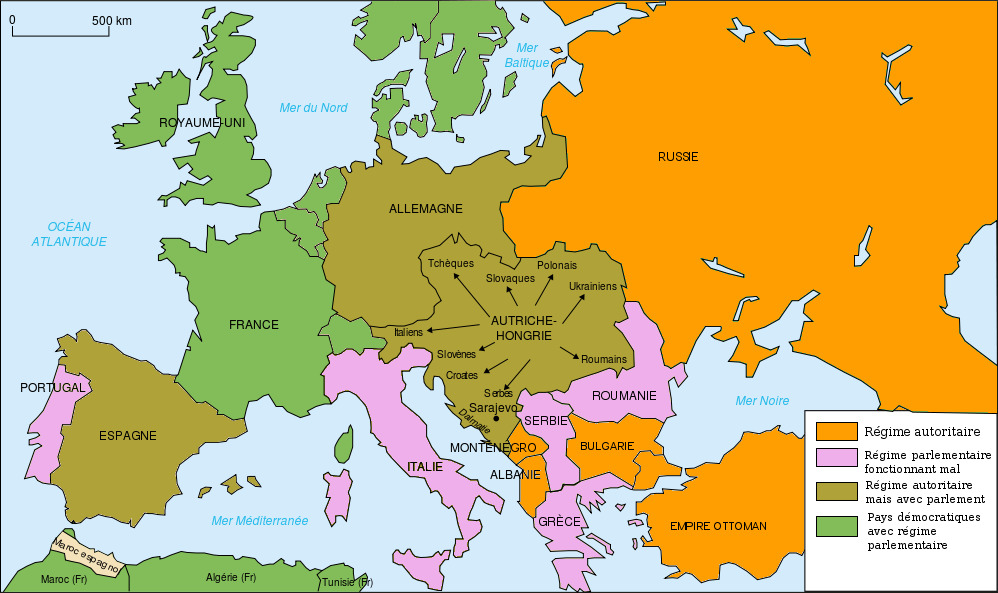
Map of Europe 1914 (in French)
Varmin, 2010 (Wikimedia Commons)

In 1914 Europe was divided into several major players: Great Britain, France, Germany, and Austria-Hungary. Russia, the largest country of all because of its sheer territory, was not considered a major player. It was a country that had a small industrial base but was mostly agrarian based society. Its defeat in a recent war with Japan showed how it was quite behind the Europeans in terms of building up a powerful military to protect its interests. Britain and Germany (with France often supporting, but not always the British) often clashed over colonies and related interests.

The Austrian-Hungarian Empire was the second largest country in Europe after Russia and a multinational state with many different peoples under it. It was also a major industrial power and with its access to the Adriatic, a naval power as well. It was a dual monarchy-Austria Empire and Kingdom of Hungary-and coequal in power. Both states conducted joint foreign relations, defense, and financial policies but left the administration under their individual states. Because it was a polyglot empire, it had a lot of different languages. The major ones were German, Hungarian and Croatian. Because of its industrial capacity, Austria-Hungary was a major exporter of electric home and industrial appliances making it third after the United States and Germany.

The first page of the edition of the Domenica del Corriere, an Italian paper, with a drawing by Achille Beltrame depicting Gavrilo Princip killing Archduke Franz Ferdinand of Austria in Sarajevo. (Cropped)
12 July 1914, Achille Beltrame
Public Domain (via Wikimedia Commons)

Unrest though within Austria-Hungary had become an issue with various groups wanting independence or territory for their peoples. And on this particular day, the Archduke Ferdinand was visiting the Imperial armed forces in Bosnia and Herzegovina. This area had been annexed by Austria-Hungary in 1908, which angered Serbian nationalists who believed it should be part of Serbia. His visit hatched a plot to assassinate the archduke. 19-year-old Gavrilo Princip shot the royal couple at point-blank range while they were in their official procession. Princip was part of a group that was well armed, trained, and assisted by the Serbian government. Serbia though had a major supporter in Russia. This meant any reaction to Serbian support of the assassination team would draw in Russia, so Austria asked Germany to back them should conflict break out. Germany warned to do it quickly while sympathy for Ferdinand was still high. Austria debated its action, and this took time and was not until mid-July they delivered an ultimatum to Serbia.

Russia though had already decided to intervene while Serbia was preparing its reply. However, the Russian military knew it was not yet ready for a general war. Yet they saw the hand of Germany in the ultimatum and were determined to show support for Serbia. Once the Serbians knew that Russia was mobilizing, that made it easier for Serbia to defy Austria-Hungary. Germany became nervous about the possibility of Russian troops amassing on its border. Russia was allied with France, and Germans had figured on fighting France first rather than Russia. They thought Russia would take longer to get its forces ready. France, for its part, now realizing war with Germany and Austria-Hungary was a real possibility, began mobilizing as well.

Britain, which an informal alliance with France and Russia, was not committed to war with Germany. At that point, they were still on friendly terms and wanted to remain neutral. Germany made some promises to further that neutrality. However, the German plans to invade France would involve it invading Belgium, a neutral state. This upset many in British leadership and it was decided on moral terms they had to enter the conflict.

By the end of July, the assassination of an archduke had become barely remembered as the belligerents all lined up. Germany and Austria Hungary (central powers) vs Britain, France, and Russia. Austria-Hungary declared war on Serbia on 28 July. On 1 August, Germany declared war on Belgium, France, and Russia. On 4 August, Britain declared war on Germany and on 6 August, Austria-Hungary declares war on Russia. The “Guns of August” had arrived, and war would be on until 1918.

The peace that had existed, fragile at best of times, was shattered.

Sources

Showalter et al., “World War I | Causes, Years, Combatants, Casualties, Maps, & Facts,” Encyclopedia Britannica, last modified June 27, 2025, https://www.britannica.com/event/World-War-I.

HISTORY.com Editors, “Austria’s Archduke Ferdinand Assassinated | June 28, 1914 | HISTORY,” HISTORY, last modified May 27, 2025, https://www.history.com/this-day-in-history/june-28/archduke-ferdinand-assassinated.

“July Crisis 1914 / 1.1 / Handbook – 1914-1918-Online (WW1) Encyclopedia,” 1914-1918-Online (WW1) Encyclopedia, last modified July 9, 2024, https://encyclopedia.1914-1918-online.net/article/july-crisis-1914-1-1/.

Suggested Reading

Gilbert, M. (2004). The First World War, second edition: A Complete History. Macmillan.

Keegan, J. (1999). The First World War. Knopf.

Tuchman, B. W. (2004). The Guns of August. Presidio Press.

Tuchman, B. W. (1996). The Proud Tower: A Portrait of the World Before the War, 1890-1914; Barbara W. Tuchman’s Great War Series. Random House Trade Paperbacks.

Documentaries & Movies

World War I. (2018, December 11). CBS Mod.

Titanic News Channel is a participant in the Amazon Services LLC Associates Program, an affiliate advertising program designed to provide a means for sites to earn advertising fees by advertising and linking to Amazon.com.