Tag Archives: volcano

Tragic History: The Devastating Eruption of Mount Pelée on 8 May 1902

[Important note: This has been revised and written for 2026 and includes new sources.]

One of the most devastating volcanic eruptions in modern times occurred on 8 May 1902 on the Caribbean island of Martinique. 30,000 people died from the eruption making it the deadliest eruption in modern times.

Martinique
Image: Alexandrin (2012)
Via Wikimedia Commons

Mount Pelée had been active for several weeks prior to its eruption. In April, explosions began at its summit, followed by numerous quakes, ash showers, boiling mud, and thick sulfurous gas clouds affecting the region. This drove ground insects and snakes into Saint-Pierre, causing serious problems for residents and livestock. Fifty people, mostly children, died from snakebites. As volcanic activity persisted, ash contaminated water sources, killing livestock. Outdoor activities near the mountain were canceled, and by May, many were worried.

On 5 May, a crater collapsed sending scalding water and pyroclastic debris in a river which buried both the owner and workers at a sugar works. The lahar traveled at 62 mph (100 kph) until it hit the sea resulting in a small tsunami that flooded lower areas of Saint Pierre. Conditions were worse by May 7 with more ash clouds and ominously a reddish-orange glow could be seen.

 The local government had initially taken little notice despite the occurrences happening near the mountain. A scientific commission headed up by a local science teacher concluded it was no threat despite continued warnings of its activity. People near the mountain were either leaving or being evacuated. Some were also leaving Saint Pierre as well and that was a problem for Governor Louis Mouttet. Saint Pierre was not called the Paris of the Antilles for nothing. It was a major economic hub for the island and while not its capitol, it was the cultural one. With 16 rum distilleries, sugar works, and other production activity, the city generated enormous wealth from its exports. If people became frightened and decided to leave, the economic activity of the city would diminish causing problems for Martinique. So the governor put pressure on the local paper to print reassuring articles that everything would be okay.

Mount Pelée had last erupted in 1851 and despite the ominous roaring from it, was said not to be a threat since lava would not be able to get there owing to the topography of the land. Residents were assured that despite the ash and other issues it raised that they would be safe. Anyone who raised concerns challenging this view were criticized. Those who did choose to leave were lucky as those who remained would die but not from lava but something few knew or truly understood yet: superheated gas coupled with hot ash.

Around 8 am on May 8, 1902, Mount Pelée erupted sending a massive pyroclastic flow to Saint Pierre. Traveling at an estimated speed of 100 mph (160 km) and while cooled by the time it reached the city, was 752 F (400 C).  The superheated gas melted glass, warped metal, and nearly all the 2,000 buildings reduced to rubble or skeleton framework. Only a few walls facing the coastline were left intact; statues had been hurled into the air by the force of the flow. Barrels of rum exploded sending flaming liquid into the streets. Everyone in their homes, places of work or worship, were killed instantly from the superheated gas and ash that was with it. Out in the harbor, 20 ships were destroyed and set ablaze by the heat. One ship–SS Roddam­ from England–managed to escape and make it to St. Lucia to report what happened. However, the hot ash had fallen on the ship, and many passengers were terribly burned and some parts of the ship had fires burning that were put out.

A large black cloud composed of superheated gas, ash and rock rolled headlong down the south flank of Mt. Pelée at more than 100 miles per hour, its path directed by the V-shaped notch at the summit. In less than one minute it struck St. Pierre with hurricane force. The blast was powerful enough to carry a three-ton statue sixteen meters from its mount. One-meter-thick masonary walls were blown into rubble and support girders were mangled into twisted strands of metal. The searing heat of the cloud ignited huge bonfires. Thousands of barrels of rum stored in the city’s warehouses exploded, sending rivers of the flaming liquid through the streets and into the sea. The cloud continued to advance over the harbor where it destroyed at least twenty ships anchored offshore. The hurricane force of the blast capsized the steamship Grappler, and its scorching heat set ablaze the American sailing ship Roraima, killing most of her passengers and crew. The Roraima had the misfortune of arriving only a few hours before the eruption. Those on board could only watch in horror as the cloud descended on them after annihilating the city of St. Pierre. Of the 28,000 people in St. Pierre, there were only two known survivors.

(How Volcanoes Work: MT. PELÉE ERUPTION (1902),Geology Department,University of San Diego)

Remains of St. Pierre by Angelo Heilprin (United States, 1853-1907), 1902.
Public Domain

It was a scene of utter devastation: The French cruiser Suchet was the first on the scene around 12:30 and saw the still burning town. Other ships would soon arrive and were astonished at what they saw. The once prosperous city was gone and unrecognizable. Smoldering fires and flames burned for days keeping rescue parties at a distance. Additionally, the toxic gasses lingering from the pyroclastic flow made the entire area too dangerous to walk around in. There are fifty known survivors; two from Saint Pierre itself. One was a prisoner in the city’s jail. Louis-Auguste Cyparis was in a solitary cell that was thick walled that shielded him from the full force of the pyroclastic flow. He was left with burns on his arms and legs. Pardoned, he became the “Man Who Lived Through Doomsday” with the Barnum and Bailey Circus. A shoemaker survived as he was on a hilltop outside of the city core, so the heat wave only singed and burned him. A young girl was out rowing when it happened and headed to a cave and was not directly hurt from the superheated gas. She did suffer burns later from falling ash and burning debris.

This is not a photo of the eruption on 8 May 1902 but a subsequent one on 27 May 1902
Photo: Angelo Heilprin, American geologist (1853-1907)
Public Domain via Wikimedia Commons

An eruption on 20 May would cause more devastation killing rescuers, engineers, and those bringing aid to the island. The second eruption also sent a pyroclastic flow that decimated what remained of Saint Pierre. Another eruption August would be its final one and has not erupted since then. It would take weeks to recover all the bodies from under the ash and the death toll was staggering in the end: 28,000-30,000 had perished in the cataclysm. The Paris of the Antilles was gone and never to return. The destruction left Martinique without its primary export hub, which was switched to Fort-de-France, and it was unable to replace it fully due to logistical issues. The sugar cane and banana growers had their crops destroyed by ash and would take until 1906 before it started to come back. The rum distillers were all destroyed causing further economic damage to the island. Other manufacturing in the city had also been destroyed as well. Aid from France and other countries helped those displaced by the eruption and to help rebuild the island. Saint Pierre would never be wholly rebuilt; small villages would take over some of the area it once had. Today it is a small town that people visit to see the ruins and the museum.

Mount Pelée , Saint-Pierre, Martinique
22 May 2019
Image: Rehcral
Via Wikimedia Commons


A new science, Vulcanology, was born from this disaster that would scientifically study volcanoes. The Mount Pelée eruption also provided scientific documentation for a phenomenon called nuée ardente, a dangerous pyroclastic flow with an incandescent cloud containing hot gas, ash, bits of the volcano itself. This changed the understanding of volcanic hazards of certain volcanoes and how truly lethal they could be. Today Mount Pelée, like Vesuvius, is closely monitored. According to the Volcanic explosivity index established later, the eruption is measured at 4 making it Cataclysmic.

Sources

Mount Pelee Volcanic Eruption – May 8, 1902 – Devastating Disasters.” Accessed May 11, 2026. https://devastatingdisasters.com/natural/89416459/2016/03/mount-pelee-volcanic-eruption-may-8-1902/.

“Mount Pelée Begins to Erupt, Burying Caribbean City | May 8, 1902 | HISTORY.” HISTORY. Last modified May 27, 2025. Accessed May 11, 2026. https://www.history.com/this-day-in-history/May-8/volcanic-eruption-buries-caribbean-city.

“The Catastrophe.” Memorial De Catastrophe 1902. Accessed May 11, 2026. https://www.memorial1902.org/the-catastrophe/.

Evans, Frank. The Tragedy of Pelee. U.S.Naval Institute. Proceedings, September 1938. Accessed May 11, 2026. https://www.usni.org/magazines/proceedings/1938/september/tragedy-pelee.

“How Volcanoes Work – the Eruption of Mt. Pelee, Martinique.” Accessed May 11, 2026. https://volcanoes.sdsu.edu/Pelee.html.

“Discover Saint-Pierre.” La Martinique. Accessed May 11, 2026. https://www.martinique.org/en/towns/saint-pierre.

Tragic History: The Devastating Eruption of Mount Pelée on 8 May 1902

On Martinique, Mount Pelée erupted at 7:50 a.m. on 8 May1902 killing 30,000 people, mostly in Saint-Pierre.

Mount Pelée , Saint-Pierre, Martinique
22 May 2019
Image: Rehcral
Via Wikimedia Commons

Concern over the volcano grew due to its recent activity. In April, explosions began at its summit, followed by numerous quakes, ash showers, and thick sulfurous gas clouds affecting the region. This drove ground insects and snakes into Saint-Pierre, causing serious problems for residents and livestock. Fifty people, mostly children, died from snakebites. As volcanic activity persisted, ash contaminated water sources, killing livestock. Outdoor activities near the mountain were canceled, and by May, many were worried.

On 5 May, a crater collapsed, sending scalding water and pyroclastic debris into a river, burying workers at a sugar works. The lahar, traveling at 62 mph (100 kph), hit the sea, causing a small tsunami that flooded low-lying areas of Saint-Pierre. By 7 May, conditions worsened with more ash clouds and reddish-orange glows visible from the craters at night.

Many began fleeing into the city (it was believed safe from lava flows)while many were trying to flee. Those that did leave would realize later how lucky they were.

A relief map of Mount Pelee (Montagne Pelee in French) showing the area affected by the eruptions of 8 May and 30 August, 1902.
Public Domain via Wikimedia Commons

A large black cloud composed of superheated gas, ash and rock rolled headlong down the south flank of Mt. Pelée at more than 100 miles per hour, its path directed by the V-shaped notch at the summit. In less than one minute it struck St. Pierre with hurricane force. The blast was powerful enough to carry a three-ton statue sixteen meters from its mount. One-meter-thick masonary walls were blown into rubble and support girders were mangled into twisted strands of metal. The searing heat of the cloud ignited huge bonfires. Thousands of barrels of rum stored in the city’s warehouses exploded, sending rivers of the flaming liquid through the streets and into the sea. The cloud continued to advanced over the harbor where it destroyed at least twenty ships anchored offshore. The hurricane force of the blast capsized the steamship Grappler, and its scorching heat set ablaze the American sailing ship Roraima, killing most of her passengers and crew. The Roraima had the misfortune of arriving only a few hours before the eruption. Those on on board could only watch in horror as the cloud descended on them after annihilating the city of St. Pierre. Of the 28,000 people in St. Pierre, there were only two known survivors.
(How Volcanoes Work: MT. PELÉE ERUPTION (1902),Geology Department,University of San Diego)
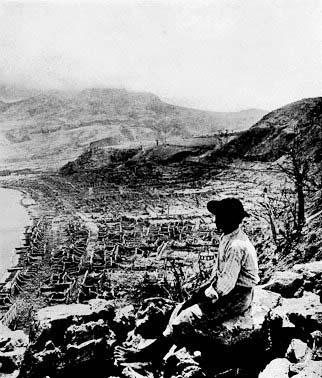
Remains of St. Pierre by Angelo Heilprin (United States, 1853-1907), 1902.
Public Domain

The 1902 Mount Pelée eruption was the deadliest volcanic disaster of the 20th century and the only fatal volcano in French history, as Martinique is a French department. It obliterated Saint-Pierre, leaving ruins and corpses. The French warship Suchet reported total destruction within the 8-square-mile pyroclastic flow path. Beyond this zone, damage was lighter, and more survived. Another eruption on May 20 killed 2,000, mostly rescuers, engineers, and mariners. On August 30, a further eruption caused fatalities and a tsunami, marking Mount Pelée’s last deadly event. A 1929 eruption saw no deaths due to evacuations.

The city of Saint-Pierre was never rebuilt and small villages now exists where it once did. Mount Pelee has been quiet but is under constant watch and considered an active volcano.


Sources

Devastating Disasters. devastatingdisasters.com/mount-pelee-volcanic-eruption-may-8-1902.

—. “Mount Pelée Begins to Erupt, Burying Caribbean City.” HISTORY, 6 May 2024, www.history.com/this-day-in-history/volcanic-eruption-buries-caribbean-city.

“The Eruption of La Montagne Pelée.” History Today, www.historytoday.com/archive/months-past/eruption-la-montagne-pelee.

Remembering History: The Devastating Eruption of Mount Pelée on 8 May 1902

This is not a photo of the eruption on 8 May 1902 but a subsequent one on 27 May 1902
Photo: Angelo Heilprin, American geologist (1853-1907)
Public Domain via Wikimedia Commons

On the lovely Caribbean island of Martinique, Mount Pelee erupted at 7:50 a.m. on 8 May 1902 killing 30,000 people most who were in the city of Saint-Pierre. Concern over the volcano had been growing due to is recent activity. In April explosions had begun at its summit. Numerous quakes, ash showers, and thick clouds of sulfurous gas affected the entire region. This caused many ground insects and snakes to come into Saint-Pierre causing serious problems for everyone and livestock. 50 people died from snakebites mostly children. As volcanic activity continued, water sources became contaminated with ash resulting in livestock dying. Outdoor activities near the mountain were cancelled and by May many were  worried.

On 5 May, a crater gave way sending a torrent of scalding water and pyroclastic debris into a river and burying workers at a sugar works. The lahar (the name for such flows) was traveling 62 mph (100 kph)when it hit the sea causing a small tsunami to flood the low lying areas of Saint-Pierre. By 7 May things were getting worse with more ash clouds and glows of reddish-orange being seen from the craters at night.

Many began fleeing into the city (it was believed safe from lava flows)while many were trying to flee. Those that did leave would realize later how lucky they were.

A relief map of Mount Pelee (Montagne Pelee in French) showing the area affected by the eruptions of 8 May and 30 August, 1902.
Public Domain via Wikimedia Commons

A large black cloud composed of superheated gas, ash and rock rolled headlong down the south flank of Mt. Pelée at more than 100 miles per hour, its path directed by the V-shaped notch at the summit. In less than one minute it struck St. Pierre with hurricane force. The blast was powerful enough to carry a three-ton statue sixteen meters from its mount. One-meter-thick masonary walls were blown into rubble and support girders were mangled into twisted strands of metal. The searing heat of the cloud ignited huge bonfires. Thousands of barrels of rum stored in the city’s warehouses exploded, sending rivers of the flaming liquid through the streets and into the sea. The cloud continued to advanced over the harbor where it destroyed at least twenty ships anchored offshore. The hurricane force of the blast capsized the steamship Grappler, and its scorching heat set ablaze the American sailing ship Roraima, killing most of her passengers and crew. The Roraima had the misfortune of arriving only a few hours before the eruption. Those on on board could only watch in horror as the cloud descended on them after annihilating the city of St. Pierre. Of the 28,000 people in St. Pierre, there were only two known survivors.
(How Volcanoes Work: MT. PELÉE ERUPTION (1902),Geology Department,University of San Diego)

Remains of St. Pierre by Angelo Heilprin (United States, 1853-1907), 1902.
Public Domain

It was the largest loss of life due to a volcano in the 20th century. And the only volcano in French history to cause loss of life (Martinique is a department of France). The city of Saint-Pierre was no more. The French warship Suchet found mostly ruins and corpses. Anything in the direct path of the pyroclastic flow was destroyed completely (about 8 square miles). Outside of that zone the damage was less and more people survived. Another eruption on 20 May would obliterate what was left of Saint-Pierre killing 2,000 most of whom were rescuers, engineers and mariners. On 30 Aug another eruption occurred causing more fatalities and a tsunami. It was the last fatal eruption of Mount Pelee. It would erupt again in 1929 but authorities evacuated so no lives were lost.

The city of Saint-Pierre was never rebuilt and small villages now exists where it once did. Mount Pelee has been quiet but is under constant watch and considered an active volcano.


Sources

Devastating Disasters. devastatingdisasters.com/mount-pelee-volcanic-eruption-may-8-1902.

—. “Mount Pelée Begins to Erupt, Burying Caribbean City.” HISTORY, 6 May 2024, www.history.com/this-day-in-history/volcanic-eruption-buries-caribbean-city.

“The Eruption of La Montagne Pelée.” History Today, www.historytoday.com/archive/months-past/eruption-la-montagne-pelee.

—. “1902 Eruption of Mount Pelée.” Wikipedia, 6 May 2024, en.wikipedia.org/wiki/1902_eruption_of_Mount_Pel%C3%A9e.

REMEMBERING THE WHITE ISLAND ERUPTION

View of the 2019 Whakaari / White Island eruption from Whakatane at 14:20
Source: Geonet

On 19 December 2020  at 2:11 pm local time the volcanic island of Whakaari/White Island, located in New Zealand’s Bay of Plenty, erupted.  The eruption was classified as a phreatic eruption, an eruption of steam, water, ash, rock, and volcano bombs. Such eruptions can also produce deadly gasses which, if in sufficient amounts, can result in asphyxiation. 47 people were on the island at the time as part of tour groups visiting that day.  21 would die and two bodies initially found were likely swept into the sea by rains.

The island itself is remarkable. What you see is the top of a stratovolcano as nearly the entire volcano is underwater.  As one of New Zealand’s most active volcanoes, it offers the opportunity to see its crater up close.  Over the years it has had frequent eruptions sending ash and gas plumes high into the sky. Lava bombs from eruptions tossed into the bay can be seen glowing red at night. The island itself is uninhabited (there were some sulfur operations in the distant past but those are long since abandoned). The other item of note is that the island is one of the main breeding colonies for Australasian gannets.

Geonet had raised the alert for the volcano to Level 2 meaning that an eruption was possible. White Island Tours informed of this on its website and at the embarkation point. Royal Caribbean Ovation of the Seas also had a tour to the island that day. However it appears they did not notify those who signed up for the tour of this warning. Legal action by families of those who died as part of the Royal Caribbean tour in the eruption is underway.

Currently there are no tours to the island and even aerial tours are restricted at this time. The island is still classified as being in Level 2 according the latest bulletin on Geonet.

Results from the most recent gas flight on Wednesday 27 May indicate an increased gas flux since the previous flight on 20 May. While previous observations indicated a trend back to levels that are typical for this volcano, the recent increase in SO2 and CO2 gas flux, one of our main indicators of volcanic unrest, could be attributed to a new batch of the magma beneath the volcano at shallow depth.

Such eruptions are unpredictable according to most experts. There is no hard and fast way to say they will erupt. It is like  pressure cooker that once it reaches that critical point bursts quickly and without warning. It happens with such speed that if you are too close to it, you probably will have little chance to react. On a small volcanic island like this one, vents are common.

The actions of White Island Tour boats and the helicopter pilots were remarkable. After the eruption subsided, White Island sent in its inflatables to get people off the nearby jetty. Helicopters arrived on the island to pick up survivors and carry them back as well. Their actions saved lives and will be long remembered by the survivors.

Sources:

Mount Pelee Erupts: 30,000 die

Remains of St. Pierre by Angelo Heilprin (United States, 1853-1907), 1902.
Public Domain

On the lovely Caribbean island of Martinique, Mount Pelee erupted at 7:50 a.m. on 8 May 1902 killing 30,000 people most who were in the city of Saint-Pierre. Concern over the volcano had been growing due to is recent activity. In April explosions had begun at its summit. Numerous quakes, ash showers, and thick clouds of sulfurous gas affected the entire region. This caused many ground insects and snakes to come into Saint-Pierre causing serious problems for everyone and livestock. 50 people died from snakebites mostly children. As volcanic activity continued, water sources became contaminated with ash resulting in livestock dying. Outdoor activities near the mountain were cancelled and by May many were  worried. On 5 May, a crater gave way sending a torrent of scalding water and pyroclastic debris into a river and burying workers at a sugar works. The lahar (the name for such flows) was traveling 62 mph (100 kph)when it hit the sea causing a small tsunami to flood the low lying areas of Saint-Pierre. By 7 May things were getting worse with more ash clouds and glows of reddish-orange being seen from the craters at night.

Many began fleeing into the city (it was believed safe from lava flows)while many were trying to flee. Those that did leave would realize later how lucky they were.

A large black cloud composed of superheated gas, ash and rock rolled headlong down the south flank of Mt. Pelée at more than 100 miles per hour, its path directed by the V-shaped notch at the summit. In less than one minute it struck St. Pierre with hurricane force. The blast was powerful enough to carry a three-ton statue sixteen meters from its mount. One-meter-thick masonary walls were blown into rubble and support girders were mangled into twisted strands of metal. The searing heat of the cloud ignited huge bonfires. Thousands of barrels of rum stored in the city’s warehouses exploded, sending rivers of the flaming liquid through the streets and into the sea. The cloud continued to advanced over the harbor where it destroyed at least twenty ships anchored offshore. The hurricane force of the blast capsized the steamship Grappler, and its scorching heat set ablaze the American sailing ship Roraima, killing most of her passengers and crew. The Roraima had the misfortune of arriving only a few hours before the eruption. Those on on board could only watch in horror as the cloud descended on them after annihilating the city of St. Pierre. Of the 28,000 people in St. Pierre, there were only two known survivors.
(How Volcanoes Work: MT. PELÉE ERUPTION (1902),Geology Department,University of San Diego)

It was the largest loss of life due to a volcano in the 20th century. And the only volcano in French history to cause loss of life (Martinique is a department of France). The city of Saint-Pierre was no more. The French warship Suchet found mostly ruins and corpses. Anything in the direct path of the pyroclastic flow was destroyed completely (about 8 square miles). Outside of that zone the damage was less and more people survived. Another eruption on 20 May would obliterate what was left of Saint-Pierre killing 2,000 most of whom were rescuers, engineers and mariners. On 30 Aug another eruption occurred causing more fatalities and a tsunami. It was the last fatal eruption of Mount Pelee. It would erupt again in 1929 but authorities evacuated so no lives were lost.

The city of Saint-Pierre was never rebuilt and small villages now exists where it once did. Mount Pelee has been quiet but is under constant watch and considered an active volcano.

Devastating Disasters. devastatingdisasters.com/mount-pelee-volcanic-eruption-may-8-1902.

—. “Mount Pelée Begins to Erupt, Burying Caribbean City.” HISTORY, 6 May 2024, www.history.com/this-day-in-history/volcanic-eruption-buries-caribbean-city.

“The Eruption of La Montagne Pelée.” History Today, www.historytoday.com/archive/months-past/eruption-la-montagne-pelee.

—. “1902 Eruption of Mount Pelée.” Wikipedia, 6 May 2024, en.wikipedia.org/wiki/1902_eruption_of_Mount_Pel%C3%A9e.