Category Archives: Christmas

Saint Stephen’s Day/Boxing Day UK (26 December)

Saint Stephen by Carlo Crivelli (1476)
Source: National Gallery, London via Wikimedia Commons.
Public Domain in UK and US; may be restricted in other countries.

If you remember the Christmas carol Good King Wenceslas , you heard the name. Stephen was a deacon in the early Christian church who was accused of blasphemy and put on trial by Jewish authorities in Jerusalem. After a trial in which he denounced them, Stephen was stoned to death. One of the witnesses to the event was Saul of Tarsus, who later converted and is known today as the apostle Saint Paul. Stephen is considered the first martyr for the faith, the reason his feast day immediately follows the celebration of Jesus birth. All the major Christian congregations–Anglican, Catholic, Lutheran, Oriental Orthodox, and Eastern Orthodox–all venerate him as a Saint and celebrate the feast day (Western churches on 26 December, 27 Dec Orthodox, and 8 Jan Oriental Orthodox). In some countries (mainly Western Europe) it is a public holiday.

In the United Kingdom, Australia, Canada, and New Zealand it is celebrated as Boxing Day, a secular holiday that falls on the same day as Feast of Stephen. Traditionally it is the day in which servants and tradespeople receive the “Christmas box” from their employers. While that tradition may still hold true, it is either a second Christmas day for some or an extra shopping day (though in some countries it apparently is a day when a lot of returns to retailers takes place). It is also a major sports day as well.

If you are in Italy, it is treated like a second Christmas Day but with a difference.  Christmas Day is home with family and streets are mostly empty (and nearly everything is closed except for some restaurants and  parafarmacies (pharmacies). December 26th is il giorno di Santo Stefano and a major day for Italians. They go out to eat at restaurants with family and friends. The streets are teeming with people often to see the Presepe (Nativity scene) in their local church or perhaps to see many of them in different churches. Donations to the church usually are made as well. Processions to Santo Stefano take place in many cities and towns. And there are many local traditions as well. Also many seek out the living Nativity scenes as well.

Sources

“St. Stephen.” Encyclopedia Britannica. Last modified December 17, 2025. Accessed December 26, 2025. https://www.britannica.com/biography/Saint-Stephen.

“Boxing Day.” Encyclopedia Britannica. Last modified December 26, 2025. https://www.britannica.com/topic/Boxing-Day.

“CATHOLIC ENCYCLOPEDIA: St. Stephen.” https://www.newadvent.org/cathen/14286b.htm.

Leake, Mike. “Who Was Stephen in the Bible?” Christianity.Com. Last modified September 22, 2025. https://www.christianity.com/wiki/bible/what-is-the-significance-of-the-stoning-of-stephen.html.


Merry Christmas!

Titanic News Channel wishes everyone a blessed and joyous Christmas Day. Merry Christmas!


The Adoration of the Shepherds (Gerard van Honthorst 1590–1656)
Image: Public Domain (Wikipedia)

….And it was always said of him, that he knew how to keep Christmas well, if any man alive possessed the knowledge. May that be truly said of us, and all of us! And so, as Tiny Tim observed, God Bless Us, Every One!” (Dickens, A Christmas Carol)


Christmas Eve

Vintage Christmas Fireplace
Petr Kratochvil
publicdomainpictures.net

Silent Night (Stille Nacht in German, Silens Nox in Latin) is perhaps the most beloved Christmas Carol. It was composed in 1818 by Franz Guber, an organist and schoolmaster, to lyrics by Father Joseph Mohr of the St. Nicholas parish in Oberndorf bei Salzburg, Austria. It was first performed on Christmas Eve in 1818 and since the organ was broken, the only musical accompaniment was the guitar. The popularity of the song spread and the version commonly used today comes from a translation in 1859. John Freeman Young, serving as an Episcopal priest at Trinity Church in New York City, translated and changed the tempo of the song. The original rendition by Gruber was more like a dance tune and sung faster. Young made into a slower lullaby style that is the most common version today. Because it has been so widely translated, it is the one Christmas carol that is known worldwide. In Austria it is not played on radio until Christmas Eve,


=

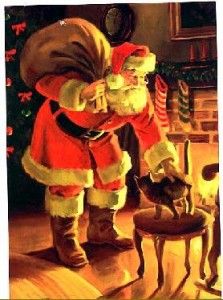
A Visit from St. Nicholas
by Clement Clark Moore

Image:public domain


Twas the night before Christmas, when all through the house
Not a creature was stirring, not even a mouse;
The stockings were hung by the chimney with care,
In hopes that St. Nicholas soon would be there;
The children were nestled all snug in their beds;
While visions of sugar-plums danced in their heads;
And mamma in her ‘kerchief, and I in my cap,
Had just settled our brains for a long winter’s nap.

When out on the lawn there arose such a clatter,
I sprang from my bed to see what was the matter.
Away to the window I flew like a flash,
Tore open the shutters and threw up the sash.
The moon on the breast of the new-fallen snow,
Gave a lustre of midday to objects below,
When what to my wondering eyes did appear,
But a miniature sleigh and eight tiny rein-deer,
With a little old driver so lively and quick,
I knew in a moment he must be St. Nick.

More rapid than eagles his coursers they came,
And he whistled, and shouted, and called them by name:
“Now, Dasher! now, Dancer! now Prancer and Vixen!
On, Comet! on, Cupid! on, Donner and Blitzen!
To the top of the porch! to the top of the wall!
Now dash away! dash away! dash away all!”
As leaves that before the wild hurricane fly,
When they meet with an obstacle, mount to the sky;
So up to the housetop the coursers they flew
With the sleigh full of toys, and St. Nicholas too—
And then, in a twinkling, I heard on the roof
The prancing and pawing of each little hoof.

As I drew in my head, and was turning around,
Down the chimney St. Nicholas came with a bound.
He was dressed all in fur, from his head to his foot,
And his clothes were all tarnished with ashes and soot;
A bundle of toys he had flung on his back,
And he looked like a pedler just opening his pack.
His eyes—how they twinkled! his dimples, how merry!
His cheeks were like roses, his nose like a cherry!
His droll little mouth was drawn up like a bow,
And the beard on his chin was as white as the snow;
The stump of a pipe he held tight in his teeth,
And the smoke, it encircled his head like a wreath;

He had a broad face and a little round belly
That shook when he laughed, like a bowl full of jelly.
He was chubby and plump, a right jolly old elf,
And I laughed when I saw him, in spite of myself;
A wink of his eye and a twist of his head
Soon gave me to know I had nothing to dread;
He spoke not a word, but went straight to his work,
And filled all the stockings; then turned with a jerk,
And laying his finger aside of his nose,
And giving a nod, up the chimney he rose;
He sprang to his sleigh, to his team gave a whistle,
And away they all flew like the down of a thistle.
But I heard him exclaim, ere he drove out of sight—

“Happy Christmas to all, and to all a good night!”


Happy Advent! (Fourth Sunday of Advent)

Photo:Public Domain

O come, O King of nations, bind
in one the hearts of all mankind.
Bid all our sad divisions cease
and be yourself our King of Peace

Rejoice! Rejoice!
Emmanuel shall come to thee, O Israel.

Today Christians celebrate the fourth and final Sunday in Advent. The liturgy will often include Old Testament readings from Micah (5:1-4) or Isaiah (7:10) that contain the prophecies about how God will send Jesus to come among the people and stop the enemies that are plaguing his people. A second reading, such as from Hebrews (10:5-10), will be used to show how Jesus came to fulfill God’s will and defeating the enemy that separates us from him. Finally, the Gospel, often from Luke about Mary visiting Elizabeth, will be read to show a parallel to the Ark of the Covenant. As the Ark contained the Ten Commandments-the word of God-Mary contains the son of God in her body. Elizabeth exclaims she is full of grace for the child she bears-the future John the Baptist-jumped with joy inside her when she greeted Mary.

The final days of Advent are thus to prepare for the great celebration of Christmas. Christians are asked to not only reflect on this great day of joy to come, but to also find Jesus in a very real way during this time. Perhaps it will come from service to others, donating food for families in need, or spending time with those who have no one close to be with during this time of year.

Journey to Bethlehem
Altus Fine Arts via Pinterest

Sources

Advent: Dates, Traditions, and History,” InfoPlease, last modified November 18, 2021, accessed November 29, 2025, https://www.infoplease.com/culture-entertainment/holidays/advent-dates-traditions-and-history.

Holcomb, Justin. “What Is Advent? The Season’s History, Meaning and Traditions.” Christianity.Com. Last modified October 29, 2025. Accessed November 29, 2025. https://www.christianity.com/wiki/holidays/what-is-advent.html.

“What Is Advent?,” USCCB, accessed November 29, 2025, https://www.usccb.org/prayer-worship/liturgical-year/advent.

Suggested Reading

Ave Maria Press, Away in a Manger: Daily Prayers for Advent and Christmas 2025, 2025.

Ferguson, Sinclair B. Love Came Down at Christmas: Daily Readings for Advent. Good Book Company, 2018.

Kohn, Harold E. Advent Devotional for Christmas: 25 Illustrated Daily Reflections to Prepare Your Heart for the Season. Independently published, 2025.

Grabill, Rebecca, and Stephen Grabill. The Joy of Advent: Family Celebrations for Advent and the Twelve Days of Christmas, 2024.

Santa, Thomas M. The Essential Advent and Christmas Handbook: A Daily Companion, 2000.

Saunders, William P. Celebrating a Merry Catholic Christmas: A Guide to the Customs and Feast Days of Advent and Christmas. Tan Books, 2018.

Titanic News Channel is a participant in the Amazon Services LLC Associates Program, an affiliate advertising program designed to provide a means for sites to earn advertising fees by advertising and linking to Amazon.com.

Happy Advent! Gaudete Sunday (3rd Sunday of Advent)

The first two Sundays of Advent are times of penance and reflection. On the third Sunday, it is time to remember both the joy to come with the birth of Jesus and his return. The third Sunday of Advent is called Gaudete Sunday or Rejoice Sunday. Gaudete is the Latin word for Rejoice so is commonly called that on traditional Christian liturgical calendars. The third Sunday is the joyful midpoint on our way towards Christmas, so we spend time reflecting on joy and hope.

Back in the Middle Ages, church leaders realized that if you have an entire season of repentance, you need to also celebrate joy and hope. Without that, its whole purpose would be lost. So, on Gaudete Sunday we take time to step back from the somber nature of the season and celebrate the joy and hope that is to come. Rather than the somber purple of penance, the liturgical color is rose or pink (priests or ministers can wear either one). And the advent candle for this day is one of those colors as well. Since we are lighting this candle on Gaudete Sunday, it is the candle of joy.

The scripture readings will also reflect this as well. Often St. Paul’s Letter to the Philippians is read in particular verses 4:4-7:

“Brothers and sisters: Rejoice in the Lord always. I shall say it again: rejoice! Your kindness should be known to all. The Lord is near. Have no anxiety at all, but in everything, by prayer and petition, with thanksgiving, make your requests known to God. Then the peace of God that surpasses all understanding will guard your hearts and minds in Christ Jesus.”

On this particular Sunday, you will see more joyful decorations in church with emphasis on joy. Colorful flowers, decorations, and banners may be displayed. Music will be joyful as well along with special prayers offered during the service. Families are encouraged to get together for a special meal on this Gaudete Sunday (often a brunch).

Sources

Advent: Dates, Traditions, and History,” InfoPlease, last modified November 18, 2021, accessed November 29, 2025, https://www.infoplease.com/culture-entertainment/holidays/advent-dates-traditions-and-history.

Holcomb, Justin. “What Is Advent? The Season’s History, Meaning and Traditions.” Christianity.Com. Last modified October 29, 2025. Accessed November 29, 2025. https://www.christianity.com/wiki/holidays/what-is-advent.html.

“What Is Advent?,” USCCB, accessed November 29, 2025, https://www.usccb.org/prayer-worship/liturgical-year/advent.

Suggested Reading

Ave Maria Press, Away in a Manger: Daily Prayers for Advent and Christmas 2025, 2025.

Ferguson, Sinclair B. Love Came Down at Christmas: Daily Readings for Advent. Good Book Company, 2018.

Kohn, Harold E. Advent Devotional for Christmas: 25 Illustrated Daily Reflections to Prepare Your Heart for the Season. Independently published, 2025.

Grabill, Rebecca, and Stephen Grabill. The Joy of Advent: Family Celebrations for Advent and the Twelve Days of Christmas, 2024.

Santa, Thomas M. The Essential Advent and Christmas Handbook: A Daily Companion, 2000.

Saunders, William P. Celebrating a Merry Catholic Christmas: A Guide to the Customs and Feast Days of Advent and Christmas. Tan Books, 2018.

Titanic News Channel is a participant in the Amazon Services LLC Associates Program, an affiliate advertising program designed to provide a means for sites to earn advertising fees by advertising and linking to Amazon.com.

Feast of Saint Lucy (Santa Lucia) 13 December

Saint Lucy by Domenico Beccafumi, 1521 AD.
Public domain via Wikimedia Commons

Saint Lucy of Syracuse (Santa Lucia) is observed as the bringer of light in the darkest times. Born in Syracuse possibly in 283 into a noble family, she devoted herself to God after her father’s death. Her mother suffering from an illness, set up an arranged marriage for her so her future would be secure. She prayed at the shrine of Saint Agatha and received a vision that her mother would be healed. When she was, she encouraged her and the family to give their wealth to the poor. However, the man she was betrothed to was angry and informed the authorities that she was a Christian.

Emperor Diocletian was intolerant of Christianity and led one the most severe persecutions against them. Lucy was asked to renounce her faith and refused. She was tortured and lost her eyes (though some sources say she did that herself) since the Roman governor did not want her seeing any more visions. Refusing to surrender her faith, she initially was to burn to death. However, the fire would not light, and she was killed by the sword steadfast in her faith till the end. She died in 303 AD.

Her devotion and martyrdom became well known. While many legends abound, it is clear she was a martyr for the faith and never wavered. Her feast day was set on December 13. On the old Julian calendar, that was the shortest day of the year when light was needed. Her day became symbol to mean return of the light. Although that day shifted when a new calendar was adopted, her feast day remains the same. Her feast day is celebrated in Scandinavian countries as a festival of light during the long winter night. A young girl in a white dress and red sash carries palms and wears a wreath of candles on head. Special rolls or cookies are made for the day and often handed out to the elderly. It is also celebrated in parts of Italy particularly in Sicily and in many places of the world today. There are many churches dedicated to her and the island of Santa Lucia in the Caribbean is named for her.

Saint Lucy is the patron saint of the blind, visually impaired, eye health, spiritual vision and discernment, protection during periods of hopelessness, and for those seeking clarity or guidance.

“O St. Lucy, Virgin and Martyr, you who sacrificed your life for Christ, intercede for us who seek your guidance. May your example of faith inspire us to walk in the light of Christ, and may your patronage bring healing to those who suffer from blindness, both physical and spiritual. Amen.” (Prayer of Saint Lucy)

Sources

“Saint Lucy,” Encyclopedia Britannica, last modified November 12, 2025, accessed December 2, 2025, https://www.britannica.com/biography/Saint-Lucy.

Catholic Online, “St. Lucy – Saints & Angels – Catholic Online,” Catholic Online, accessed December 2, 2025, https://www.catholic.org/saints/saint.php?saint_id=75.

“The Story of Saint Lucy: Her Life, Her Light, and Her Martyrdom,” Original Botanica, last modified December 1, 2025, accessed December 2, 2025, https://originalbotanica.com/blog/saint-lucy-story-martyrdom-light-prayer.

Rodriguez, Jaime. “Saint Lucia or Saint Lucy of Syracuse: History, Miracles and Much More.” Un Lugar Para Hablar De Religiones, Biblia, Jesucristo, Dios, Y Mas… Last modified February 14, 2024. Accessed December 2, 2025. https://hablemosdereligion.com/en/saint-lucia-or-saint-lucy-of-syracuse-history-miracles-and-much-more/.

Happy Advent! (Second Sunday of Advent)

2nd Advent Sunday
Photo: Clemens PFEIFFER, Vienna (Wikimedia Commons)


O come, O come, Emmanuel,
And ransom captive Israel,
That mourns in lonely exile here
Until the Son of God appears.
Rejoice! Rejoice!
Emmanuel shall come to thee, O Israel 


Advent History

Advent finds its roots not in Christmas but in the observance of the Epiphany where Jesus is baptized. In France during the early centuries there was a time of preparation for this feast, which included fasting and prayer. Initially this was for three weeks and extended to forty to imitate the Lent season. Since this started on November 11 and on the feast of St. Martin, it became known as St. Martin’s Lent. This became codified by the Council of Saragossa in 330 AD requiring a time of fasting and prayer before the Epiphany, Then, in 581 the Council of Macon extended this to all the dioceses in France. This would spread to England where this custom was observed as well.

Back in Rome though the feast of the Epiphany was not celebrated but Christmas was. There was no special preparatory period for it either but there was concern there should be one for Christmas. Pope Gregory 1 (590-604) created the Advent Season by composing prayers, antiphons, and psalms to be used. This became known as the Roman Rite of Advent that lasted four weeks. When France adopted this, it added an emphasis be made to the second coming of Jesus. This eventually got back to Rome, which added it to the Advent themes. This became the Advent Liturgical season that we know today.

This is why the first two weeks have scripture readings focusing on the return of Jesus, while the last two weeks are concerned with the birth. Both themes are connected, and the emphasis is on people to “be prepared.” It is this dynamic that makes Advent an important part of the Christian calendar and why it is the beginning of the liturgical year. Advent is the starting point which flows to all the feasts and important holy days to come and ends on the very last Sunday before Advent celebrating Christ the King. Advent is a spiritual journey that prepares both for the birth of the savior but also his return. That is why the readings of the prophet Isaiah are featured during Advent as he speaks often of Israel’s salvation. Music played for Advent such as “Come, O Come, Emmanuel (based on the 9th century Veni, Veni Emmanuel) match this preparation period.

Sources

Advent: Dates, Traditions, and History,” InfoPlease, last modified November 18, 2021, accessed November 29, 2025, https://www.infoplease.com/culture-entertainment/holidays/advent-dates-traditions-and-history.

Holcomb, Justin. “What Is Advent? The Season’s History, Meaning and Traditions.” Christianity.Com. Last modified October 29, 2025. Accessed November 29, 2025. https://www.christianity.com/wiki/holidays/what-is-advent.html.

“What Is Advent?,” USCCB, accessed November 29, 2025, https://www.usccb.org/prayer-worship/liturgical-year/advent.

Suggested Reading

Ave Maria Press, Away in a Manger: Daily Prayers for Advent and Christmas 2025, 2025.

Ferguson, Sinclair B. Love Came Down at Christmas: Daily Readings for Advent. Good Book Company, 2018.

Kohn, Harold E. Advent Devotional for Christmas: 25 Illustrated Daily Reflections to Prepare Your Heart for the Season. Independently published, 2025.

Grabill, Rebecca, and Stephen Grabill. The Joy of Advent: Family Celebrations for Advent and the Twelve Days of Christmas, 2024.

Santa, Thomas M. The Essential Advent and Christmas Handbook: A Daily Companion, 2000.

Saunders, William P. Celebrating a Merry Catholic Christmas: A Guide to the Customs and Feast Days of Advent and Christmas. Tan Books, 2018.

Titanic News Channel is a participant in the Amazon Services LLC Associates Program, an affiliate advertising program designed to provide a means for sites to earn advertising fees by advertising and linking to Amazon.com.

Today is the Feast of Saint Nicholas-The Real Santa Claus (6 Dec)

St. Nicholas
Vintage Christmas Card (unknown date, possibly later 19th or early 20th century).
Vintage Aloha/Pinterest

Today is the feast of St. Nicholas, the basis for what has become known as Santa Claus. He was born in the third century to a wealthy family in the village of Patara (now located on the southern coast of Turkey). At the time the area was mostly Greek. While he was young, his parents died during an epidemic. Raised as a Christian, he believed in obeying Jesus in giving his inheritance to those in need. He dedicated his life to serving God and was made Bishop of Myra while still quite young. He earned a reputation for being generous to those in need, his love for children, and concern for sailors and ships.

During the rule of the Roman Emperor Diocletian, Christians were ruthlessly persecuted, and Nicholas suffered for his faith by being exiled and imprisoned. Despite all the hardship he endured, he never wavered in his faith. He was released and attended the Council of Nicaea in 325 AD. He died on 6 December 343 AD in Myra and was buried. The anniversary of his death would become a celebration and still celebrated to this day (it is 19 December on the Julian calendar used by Eastern Orthodox churches).

His generous deeds and miracles attributed to him spread during the Middle Ages. Many sailors claimed him as a patron and told of him when they traveled. Churches dedicated to Nicholas appeared in many seaport cities. His name spread both east and west making him a very popular saint with many churches named after him in Austria, Belgium, England, Italy, Russia and Switzerland to name a few. His tomb became popular to visit but concerns over wars in the area cutting off access worried many. In 1087 sailors from Bari were able to retrieve his relics and bring them back. A church was built over his crypt so that pilgrims could visit. The shrine to St. Nicholas in Bari became a major pilgrimage center during medieval Europe. People still visit the shrine today at the Basilica di San Nicola in Bari.

The Roman Catholic Church, Eastern Orthodox, Greek Orthodox, Anglican, and Lutheran churches all have his feast day on their calendars. His generosity and compassion are seen as a model of Christian life. There is some confusion generated about how saint feasts days are celebrated in the Catholic church. Since there quite a fewsaints with feasts, it was decided that some saint feast days would be optional for a diocese to celebrate. Saint Nicholas became one of them. He was not stripped of his sainthood. In a diocese where he is popular, has churches or schools named after him, or perhaps the bishop believes he is model to be held up for veneration, his feast day will be celebrated. His feast day is celebrated throughout Europe and in Russia and children receive gifts on the day. Saint Nicholas’ feast day is usually the start of the Christmas season in Europe and elsewhere.

Saint Nicholas and Santa Claus
Saint Nicholas did not fare well during the Protestant Reformation. Saints, even revered ones, were removed to focus on Jesus. Some went so far as to nearly ban any public display of traditional religious customs related to saints or even Christmas (it was not a holiday for that reason in areas that groups like the Puritans dominated). Martin Luther wanted to shift the focus of Christmas to Jesus. The problem was that you cannot have a baby delivering gifts to children as Saint Nicholas did. He came up with the Christkind (Christkindl), a children’s gift giver. This angel, depicted as young girl, brings the gifts when the children are not present. In Nuremberg, the Christkind is selected every two years by vote and between the ages of 16-19. The Christkind opens the Christmas market. She also has her picture taken with kids, listens to what they want, visits kids in hospitals and the elderly as well amongst many other duties. The Christkind was also adopted by many German Catholics as well and spread into Latin America as well. In some cases, both the Christkind and Saint Nicholas deliver presents together.

Despite attempts to diminish Saint Nicholas using the Christkind, he remained popular except in England where many Christmas folk traditions were altered (especially under the rule of the Puritans and Oliver Cromwell). Puritans in America (and some others as well) forbade celebrating Christmas. German immigrants brought celebrating Christmas with them along with Saint Nicholas as well. It was believed the Dutch had brought Saint Nicholas to America, but recent scholarship indicates that was not likely (it is not mentioned in letters or records from the Dutch who lived in New Amsterdam at the time). It appears a series of fictional stories about Saint Nicholas (described as a jolly man with a clay piper) being celebrated by the early Dutch may have been the source.

The 19th century was one of change in America regarding Christmas-and elsewhere as well. Since it was not a sacred or public holiday in many places, it was not the time of carols and goodwill we think about today. Instead, it was a was a rowdy holiday where many got wildly drunk, gambled, and got riotous in some cases threatening people. In England, the Father Christmas figure was about adult merriment and feasting and had nothing to do with children. The actual celebration of Christmas seemed to be fading until books were published depicting Christmas as a time for family, children and faith were published in the 19th century. Washington Irving’s The Sketchbook of Geoffrey Crayon (1819) depicted the celebration of Christmas in England as a warm holiday where peasants were invited into the home to celebrate the holiday. And stories about a magical gift giver called Sante Claus began to appear. Books such as The Children’s Friend (1821) had a character delivering gifts to children on Christmas Eve. Flying a sleigh and living up north, this Sante Claus would form the basis of what is known today as Santa Claus.

The famous Clement Clark Moore poem A Visit from St. Nicholas would further cement the image of this Sante Claus. Books depicting Christmas began to appear and of course the most famous being A Christmas Carol by Charles Dickens in 1843. This came at a time in Britain when they were re-examining Christmas. This book and others would further help to make Christmas as a time for families, children, and caring about the less fortunate as well. Thomas Nast, the famous political cartoonist, illustrated him as a rotund figure with a beard, fur clothing, and with a clay pipe in 1863. He also changed the name to Santa Claus. His image, with some embellishments and refinements, has remained intact to our time. Christmas was becoming widely celebrated and by 1860 had already been adopted as a state holiday in fourteen states. In 1870, President Grant proclaimed Christmas Day as a federal holiday in the District of Columbia. Congress would pass legislation that made Christmas, New Years, Independence Day, and Thanksgiving as federal holidays (remember back then nearly all federal workers were in the District of Columbia). States would also make it a holiday as well.

Merry Old Santa Claus
Thomas Nast, 1881
Public Domain

By the start of the 1930’s, the American Santa had come full form thanks to various illustrators such as Norman Rockwell. Coca-Cola would use Santa in its advertising further establishing his identity in the commercial world. The jolly man with the red suit would be seen in magazines, billboards, shop counters, and greeting cards. A benign source of happiness and seemingly endorsing all kinds of commercial products, he became as American as apple pie (to coin a phrase). His image would spread out to the world competing with local versions (Father Christmas, Pere Noel, Babbo Natale, Sinter Klass, Julenesse etc.) Saint Nicholas still retains his place in Europe despite this.

Many people, seeing Santa as a commercial and pagan creation, are now reclaiming the saint for use in the holiday. Saint Nicholas brings a spiritual emphasis to the holiday, which Santa does not. Some have tried to ban Santa Claus because of his supposed connection to Saint Nicholas, except there is none. One is a revered saint and bishop, the other a complete concoction of writers, illustrators, and marketing departments. There is nothing Christian about Santa Claus. Movies like The Santa Clause, while entertaining, put him into a world of fantasy beings like Mother Nature, Cupid, and the Tooth Fairy. By returning focus to Saint Nicholas, we get closer to what the celebration is about which is the birth of Jesus.


Image:public domain

Sources

“Who Is St. Nicholas? – St. Nicholas Center,” St. Nicholas Center, accessed December 2, 2025, https://www.stnicholascenter.org/who-is-st-nicholas.

Straus, Jacob R. “Federal Holidays: Evolution and Current Practices.” Congress.Gov. Last modified July 1, 2021. Accessed December 2, 2025. https://www.congress.gov/crs-product/R41990.

Gree, John De. “A History of Christmas in America.” The Classical Historian. Last modified December 18, 2015. Accessed December 2, 2025. https://www.classicalhistorian.com/historyblog/a-history-of-christmas-in-america.

———. “History of Christmas – Origins, Traditions & Facts | HISTORY.” HISTORY. Last modified November 19, 2025. Accessed December 2, 2025. https://www.history.com/articles/history-of-christmas.

Suggested Reading

Hammond, Robert John. Saint Nicholas the Wonderworker: The Real Story of Santa Claus. Edited by Katherine Hyde. ? New Way Press, 2025.

Mikalatos, Matt. Praying With Saint Nicholas: A Christmas Devotional. Tyndale House Publishers, 2025.

Moore, Clement C. ’Twas the Night Before Christmas: A Visit From St. Nicholas. CSW Studios LLC, 2023.

Titanic News Channel is a participant in the Amazon Services LLC Associates Program, an affiliate advertising program designed to provide a means for sites to earn advertising fees by advertising and linking to Amazon.com.

Happy Advent! (First Sunday of Advent)

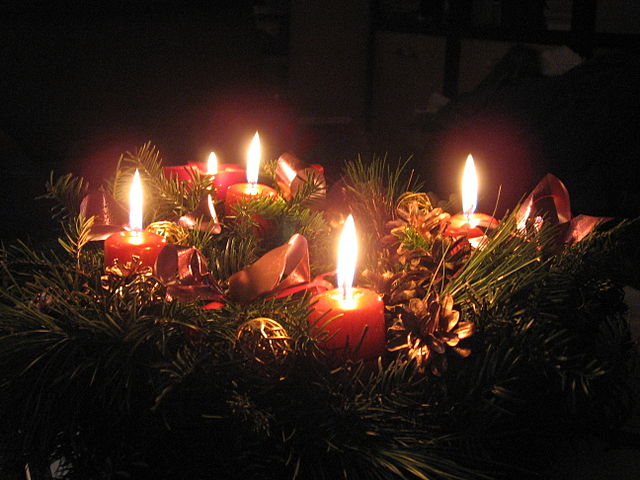
Advent Wreath (1st Sunday)
Photo :Micha L. Rieser(Wikimedia Comos)

O come, O come, Emmanuel,
And ransom captive Israel,
That mourns in lonely exile here
Until the Son of God appears.
Rejoice! Rejoice!
Emmanuel shall come to thee, O Israel.

Advent is the beginning of the liturgical year for Roman Catholics and many Christian denominations. It encompasses the four weeks (Sundays and weekdays) leading up to Christmas Day. Counting back four Sundays from Christmas Day will get you to the first Sunday of Advent. Depending on the calendar day Christmas falls on, Advent usually begins near the feast of St. Andrew the Apostle celebrated on 30 November. Eastern Orthodox, since it follows the Julian calendar, will start their Advent later as Christmas Day falls 13 days after the current Gregorian calendar.

Advent comes from the Latin word adventus, meaning coming or coming to, is a time of preparation for the birth of Christ and a reminder that Jesus will return. During this period, Christians are reminded not to be weighed down or distracted by the cares of this world. Like Lent, Christians are called to reflect on our actions and seek penance. We also should prepare our hearts for the full joy of Christmas. We should not allow our souls to be burdened with predictions of events yet to come, but to be alert and ready. During this period, Catholic priests wear violet vestments, except on the Third Sunday of Advent (Gaudete Sunday) when rose may be worn. Altars will be less decorated than usual during this time as well.

One of the symbols of Advent is the Advent wreath. This wreath has four candles (battery operated ones are acceptable) and are lit for each Sunday in Advent. Usually, a prayer is also spoken while lighting the prayer and often families will do it together. Most candles are purple, but one will either be white or rose for Gaudete Sunday. The popular Advent calendar is to not only marks down the days till Christmas, but also days of devotion during the season. A Christmas novena is also done. The traditional one is the St. Andrew Christmas Novena which begins on 30 November (the feast day of St. Andrew) and runs till Christmas Eve. A nine -day novena begins on December 16 and goes till Christmas Eve. Many Latin American countries celebrate this as Las Posadas, and it is popular in the Philippines as well (called Sambang Gabi).

There is specific music for the Advent season that is often played in Catholic and Christian churches during religious services. Music such as Silent Night, Adeste Fidelis, Hark! The Herald Angels Sing will not be heard until Christmas Eve and Christmas Day services. Secular songs such as White Christmas, Rudolph the Red Nosed Reindeer are reserved for Christmas concerts (which are sometimes held in churches) are not sung at all during religious services. While Christmas decorations may be outside the church, you will not see Christmas trees in the main area of the church where mass is celebrated during Advent. This has nothing to do with any connotation that a Christmas tree is pagan but rather that during Advent we must be solemn in observing it. So, a lighted Christmas tree is often near the entry or just inside the entry (if they have one). This has been the tradition that Saint Pope John Paul II started when he got a Christmas tree from his native country of Poland. Christmas decorations are generally put up usually on the Fourth Sunday of Advent and it is then you may see Christmas trees inside the church.

Flowers and wreaths are acceptable near the altar and not on it. Advent wreaths are often placed near the altar and lighted before the service begins. A Christmas crib or nativity scene may also be displayed as well.

Sources

“Advent: Dates, Traditions, and History,” InfoPlease, last modified November 18, 2021, accessed November 29, 2025, https://www.infoplease.com/culture-entertainment/holidays/advent-dates-traditions-and-history.

Holcomb, Justin. “What Is Advent? The Season’s History, Meaning and Traditions.” Christianity.Com. Last modified October 29, 2025. Accessed November 29, 2025. https://www.christianity.com/wiki/holidays/what-is-advent.html.

“What Is Advent?,” USCCB, accessed November 29, 2025, https://www.usccb.org/prayer-worship/liturgical-year/advent.

Suggested Reading

Ave Maria Press, Away in a Manger: Daily Prayers for Advent and Christmas 2025, 2025.

Ferguson, Sinclair B. Love Came Down at Christmas: Daily Readings for Advent. Good Book Company, 2018.

Kohn, Harold E. Advent Devotional for Christmas: 25 Illustrated Daily Reflections to Prepare Your Heart for the Season. Independently published, 2025.

Grabill, Rebecca, and Stephen Grabill. The Joy of Advent: Family Celebrations for Advent and the Twelve Days of Christmas, 2024.

Santa, Thomas M. The Essential Advent and Christmas Handbook: A Daily Companion, 2000.

Saunders, William P. Celebrating a Merry Catholic Christmas: A Guide to the Customs and Feast Days of Advent and Christmas. Tan Books, 2018.

Titanic News Channel is a participant in the Amazon Services LLC Associates Program, an affiliate advertising program designed to provide a means for sites to earn advertising fees by advertising and linking to Amazon.com.


Today is Eastern Orthodox Christmas Day (7 Jan)

The Adoration of the Shepherds (Gerard van Honthorst 1590–1656)
Image: Public Domain (Wikipedia)

Most Eastern Orthodox Christians celebrate Christmas Day on 7 January as they follow the Julian calendar rather than the Gregorian for liturgical feasts and occasions such as Christmas. When Pope Gregory XIII proclaimed it in a Papal Bull in 1582 proclaiming the new calendar, it took a long while for it to be full implemented (over 300 years). Some of it was due to countries being Protestant and not wanting to adopt a calendar proclaimed by a pope. Other reasons include local customs and traditions, and in some cases, governments just being slow to implement a major change (it meant resetting the calendar back 13 days when implemented). No one doubted the accuracy of the new calendar as it corrected the problems of the old Julian.

For Eastern Orthodox, it was a bit more complicated. First it was not exactly welcomed by the Eastern Orthodox bishops that the new calendar was issued by Pope Gregory XIII. It came with some additional items that Eastern Orthodox bishops did not agree with. In the end, it was decided while they had no problems with the calendar itself, the additional items Pope Gregory attached to his Papal Bull, they had to reject it. In 1923 the Congress of Constantinople attempted to correct it with a Revised Julian Calendar. This calendar synchronized with the Gregorian for nearly all the important dates (except Easter). The Orthodox Churches of Constantinople, Alexandria, Antioch, Greece, Cyprus, Romania, Poland, and Bulgaria accepted this. However, the Orthodox Churches of Jerusalem, Russia, Serbia, Ukraine, and Georgia rejected it. Easter poses a problem as well due to its calculations. The Revised Julian Calendar churches follow a different formula for Easter which all of the Eastern Orthodox churches that follow the Julian reject.

For Further Information

Christmas Worldwide, “Eastern Orthodox Christmas: Celebrations in Russia, Greece, and Ukraine – Christmas Worldwide,” Christmas Worldwide, last modified October 18, 2024, https://christmases.net/eastern-orthodox-christmas-celebrations-in-russia-greece-and-ukraine/.

“A Papal Calendar?,” Orthodox Church in America, last modified January 3, 2017, https://www.oca.org/reflections/fr.-lawrence-farley/a-papal-calendar.

“Explanation of the Julian Calendar,” St Andrew Fool for Christ Orthodox Church, https://www.standrewfoolforchrist.org/explanation-of-the-julian-calendar.html.

“Church Calendar – OrthodoxWiki,” https://orthodoxwiki.org/Church_Calendar.

“Revised Julian Calendar – OrthodoxWiki,” https://orthodoxwiki.org/Revised_Julian_Calendar.