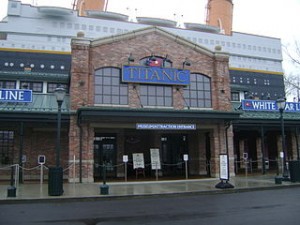
Credit: TitanicPigeonForge.com
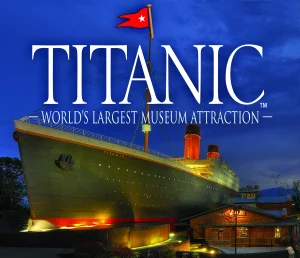
John Joslyn had an interesting career before he became fascinated with Titanic and founding the Titanic Museum in Pigeon Forge. He started out in Hollywood putting out two-minute entertainment clips that television stations would buy and use in their newscasts. It became widely syndicated. Then he decided to produce opening Al Capone’s safe live on air. That was where they had Geraldo Rivera breathlessly reporting every minute of the event. Except it was empty except for the dust. Then he discovered Titanic, and it changed his life forever.
“They came up said ‘John, take a look at this.’ I got down in that port hole and all of a sudden comes the bow of the ship. I’m seeing the lower part and looking up, and you can’t see the top of the ship,” Joslyn said, describing how hard it was to see in the dim light. That was the moment that changed the trajectory of his career in a major way. Joslyn said seeing the ship itself sparked an interest he couldn’t shake. In the early 2000s, he set out on a business adventure, working with a new partner: his wife, Mary Kellogg. Their first location was in Branson, Missouri.
Morgan-Rumsey, C. (2024, June 14). ‘It was thrilling’ | Titanic Museum founder remembers trip to shipwreck that sparked idea for Pigeon. . . https://www.wvlt.tv. https://www.wvlt.tv/2024/06/14/it-was-thrilling-titanic-museum-founder-remembers-trip-shipwreck-that-sparked-idea-pigeon-forge-attraction/
=

Becky Kagan Schott, OceanGate
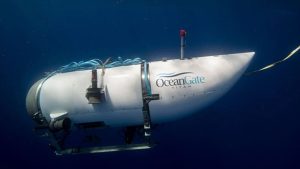
The Independent looked back recently at the demise of Titan and its reverberations in the world. Up until its demise, it was seen mostly in favorable light. Those who had gone down previously were impressed. What few knew was that behind the scenes there were those who thought Rush Stockton cut corners. Employees who questioned what they thought were questionable decisions were fired. Stockton himself was very confident of the submersible and likely would not have piloted it himself if he thought otherwise. In the wake of the tragedy, OceanGate has for the most part shut down. But hope of deep diving tourism remain though many may not want to sign up for it now.
Flynn, S. (2024, June 17). One year ago OceanGate’s Titan sub imploded, taking 5 lives with it. The Independent. https://www.independent.co.uk/news/world/americas/titan-submersible-implosion-oceangate-titanic-b2564167.html
=
Lynnewood Hall in Elkins Park, Pennsylvania was built to be like an American Versailles in 1897 by Peter AB Widener. He made a fortune in the butcher and transportation industries. The 34-acre estate was built for his two sons and their families. Alas his son George and his grandson Harry both died on Titanic though Eleanor, George’s wife, survived. It was a devastating loss for the family and Peter would die in 1915. His son Joseph inherited the estate and his family lived there until 1934. After that it went through several different owners until it was acquired by the First Korean Church of New York. They put it up for sale in 2014.
Then people started entering the property calling themselves “Urban Explorers” and filming what they found. What they found could no longer be akin to the famous Versailles but one could still how grand it once was. Pictures show mostly empty rooms that still display some of its prior majesty. Other areas, like the pool area and staircases, show neglect and ruin. Since it was used as a seminary, some areas were used for studying and eating. A former ballroom was turned into a chapel and looked well preserved when photographed in 2019.
The church itself ran into legal issues. The local board would not grant a waiver allowing him to operate a church in a residential neighborhood which resulted in a lawsuit that this violated the constitution. The church would end up losing its tax-exempt status later and the property was put up for sale. It sat empty and buyers were turned away until finally he agreed to sell it to the Lynnewood Hall Preservation Foundation for $9 million. Now the foundation is working to remodel, restore, and then likely rent it out for charity and education uses down the road. This once grand building will likely be open for public tours as well to generate revenue. So, in the end the building built by a millionaire for his family, some lost when Titanic sank, will have a new lease on life.
Lloyd, A. (2024, June 17). See inside a $300 million Gilded Age mansion built for heirs who died on the Titanic that sat abandoned for years. Business Insider. https://www.businessinsider.com/lynnewood-hall-photos-gilded-age-mansion-with-tragic-titanic-ties-2024-6
Lynnewood Hall Preservation Foundation. (2023, July 1). OUR PLAN | Lynnewood Hall Preservation Foundation, Inc. Lynnewood Hall Preservation Foundation, Inc. https://lynnewoodhallpreservation.org/our-plan/
Southeast, A. (2023, September 30). Lynnewood Hall. Abandoned Southeast. https://abandonedsoutheast.com/2021/08/09/lynnewood-hall/
=
Suggested Reading
Brewster, H. (2013). Gilded Lives, Fatal Voyage: The Titanic’s First-Class Passengers and Their World. National Geographic Books.
Marshall, L. (2019). Sinking of the Titanic: The Greatest Disaster At Sea – Special Edition with Additional Photographs. Independently Published.
Rossignol, K. (2012). Titanic 1912: The Original News Reporting of the Sinking of the Titanic. Createspace Independent Publishing Platform.
Wilson, A. (2012). Shadow of the Titanic: The Extraordinary Stories of Those Who Survived. Simon and Schuster.
Titanic News Channel is a participant in the Amazon Services LLC Associates Program, an affiliate advertising program designed to provide a means for sites to earn advertising fees by advertising and linking to Amazon.com.
 A supposed transcript distributed via YouTube and TikTok not long after the Titan submersible tragedy in June 2023 claimed to be the log from the doomed expedition has deemed a fraud. While many did put disclaimers as to its authenticity, Snopes marked it as “unconfirmed.” Now it has been deemed a fake
 “Is the Titanic Museum in Pigeon Forge Worth It? A Local Weighs In.” The Smokies, 2 Jan. 2024,