The Cost of Appeasement (Munich Pact, 30 Sep 1938)

The Munich Conference of 1938 saw both Britain and France abandon its ally Czechoslovakia forcing them to cede part of their territory to Germany to avoid war. Let’s look at what the situation was in 1938 and why this happened.

“Those who cannot remember the past are condemned to repeat it”(George Santayana-1905)

Nevile Chamberlain, Édouard Daladier, Hitler, Benito Mussolini, Count Ciano
29 Sep 1938 (German Federal Archives)

By 1938 there was no doubt anymore about the intentions of Germany’s Third Reich and Adolf Hitler. European nations were generally worried about a major war and to that end the two biggest powers in Europe -France and Great Britain- sought to avert it. It was based on the experience of the First World War in which millions had died. The aftermath of that war was a sentiment that total war must be averted at all costs. So far all of Hitler’s violations of treaties, such as occupying the Rhineland in 1936, had caused no major retribution even if it was a major violation of the Treaty of Versailles that Germany had agreed to in 1918. Nor had rearming Germany, also a violation of the treaty, caused any significant reaction.

While worldwide opinion of their open antisemitism was negative, they successfully held the 1936 Olympics in Germany. This despite the fact Germany was a fully authoritarian state ruled by the Nazi Party. All private schools (including religious ones) were shuttered forcing all children to go to the public school. All major corporations and businesses that were controlled by Jews were systematically targeted and forced to sell to Germans backed by the Nazi Party. All media was likewise controlled and could only report exactly what the Reich Propaganda Ministry told them to report. Movies, radios, and newspapers repeated only what was allowed to be reported or dramatized. American movies, in order to be shown in Nazi Germany, had to comply with Nazi rules which prohibited showing Jews in a positive light, criticize German policy in any way, or show any theme the Nazi Party objected to.

As Germany re-armed, it looked to expand its frontiers and bring into being a Greater Germany. Hitler was Austrian and both countries had close ties sharing a common language and culture. Many in Austria already supported such an idea long before the Nazi’s came into power. The Nazi’s had tried in 1934 in supporting a coup attempt, but it failed. By 1938 Germany was in a better position. Politicians and groups sympathetic to Hitler and unification in Austria were loudly calling for it. Austrian chancellor Kurt Schuschnigg hoped that a referendum on the issue set for 13 March 1938 would resolve it. Hitler instead threatened to invade and through his agents asked him to resign. The referendum was canceled and on 12 Mar 1938, German troops entered Austria and were unopposed. The long-wanted Anschluss had finally occurred. Neither Great Britain nor France was willing to offer any assistance to stop it from happening. In fact, many supported it in those countries.
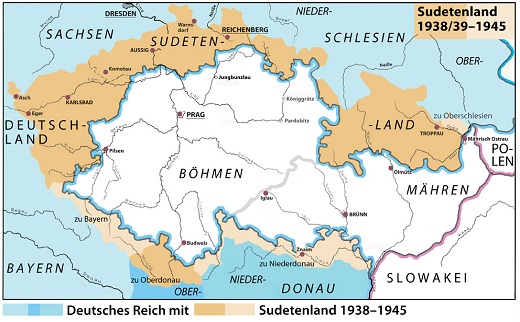
Sudetenland 1938-1945
Stamp Collecting World (via Wikipedia)

About the same time, Hitler was also claiming that German-speaking people living in the Sudeten region of Czechoslovakia wanted closer ties with Germany. And that if this land was not given to Germany, it would have to be done by force. Needless to say, the Czechoslovakian government was alarmed especially after what happened to Austria. Leaders in both Britain and France were becoming alarmed that this could spiral into a general war. The position of both governments was to avoid total war; they did not want another World War I that devastated Europe. This policy of appeasement had many supporters in politics, academia, and the media. Those who argued against it were called warmongers, or worse. The problem was that both countries had signed treaties with Czechoslovakia that if they were attacked, their enemy became theirs. Hitler knew this and stepped up the pressure.

Hitler ordered his generals to come up with a plan to attack Czechoslovakia. It was set to commence in October. Meanwhile Czechoslovakia tried to gauge the support it had and found Poland would only assist if the French did. And the French were reluctant to support Czechoslovakia if it meant direct conflict with Germany. Britain was also cool on the idea and forced President Benes to accept an arbitrator. Benes, feeling he had no choice, gave in to the idea. Lord Runciman was sent to Prague on 3 August 1938 to persuade Benes to accept a plan for Sudeten Germans. In public both powers appeared to support Czechoslovakia but in private made it clear they would not go to war with Germany over the Sudetenland. As German forces appeared to be poised to invade, it was clear to both London and Paris something would have to give.

Hitler continued upping the pressure by giving speeches that blamed the crisis in Sudetenland on Czechoslovakia. He denounced the state as illegitimate, that it was targeting the German speaking people for extermination, and many other things as well. German media was full of stories that depicted the heroic German people in Sudetenland as suffering and that other nationalities would be targeted as well. Hitler made it clear that the situation could no longer be tolerated, and that Germany was prepared to resolve it if either Czechoslovakia or the other powers involved failed to stop the atrocities. German troops were poised to resolve the situation. And Hitler surmised both the British and French would deal to avoid war.

With Europe seemingly on the edge of war, this precipitated the Munich Conference of September 1938. Without consulting with Czechoslovakia, British leader Neville Chamberlain and French president Edouard Daladier decided to resolve this situation by agreeing that any territory in the Sudetenland that had over fifty percent German speaking people would be given to Germany. Italian dictator Benito Mussolini, also at the conference, argued for a German military presence along with an international commission to resolve disputes (this was a German proposal but felt that it was better made by the Italians).

It was formally agreed to on 30 Sep 1938. Czechoslovakia was presented with this agreement and had no choice but to accept or face immediate invasion. Czechoslovakia found itself totally alone and the two powers-Britain and France-who had pledged to protect them now abandoned them to their fate. They had no choice but to accept but left an awful taste in their mouths knowing they had been betrayed. It would end with President Benes resigning in October knowing his country was to be invaded by Germany. This would occur in March 1939. The Germans would hold the Sudetenland until 1945. Chamberlain would proclaim later, upon arrival in Britain, that he delivered “peace for our time.” Daladier concurred and later France would sign a nonaggression pact with Germany.

Aftermath

Prime Minister Neville Chamberlain waving to enthusiastic crowds of his triumph upon returning to Britain. Waving a paper signed by Hitler, he pronounced peace in our time. Hitler later chuckled that the agreement he signed with Chamberlain meant nothing.
Image: winstonchurchill.org

Germany acquired not only territory but the industrial resources that it needed (raw ore, steel and iron production, electrical plants). Czechoslovakia was diminished as a result. While many in public in Britain and France heralded the agreement as avoiding war, there were warnings it was wrong. Winston Churchill was critical of the deal and how they had abandoned Czechoslovakia to Hitler. The British Labor Party opposed the deal as well. A view began to emerge and would continue long after, that Britain and France wanted to get out of the military pact as they were not ready for war. Was Hitler bluffing or not also is discussed as well. The evidence is that Germany could have invaded but got what it wanted without firing a shot. And it was handed to Hitler on a platter by two powers that in the last war had been Germany’s enemies. It could not have been a greater present for Hitler.

Czechoslovakia was doomed by the pact. In October 1938, it was forced to hand over under the Vienna Award territory in its south to Hungary and a small concession to Poland. In March 1939, after Slovakia seceded to become a pro-German state, Hitler demanded Czechoslovakia accede to German occupation, which it did. Czechoslovakia then became a protectorate of the Third Reich. Churchill’s warning had come true. With his policy of appeasement now deemed a total failure, Neville Chamberlain realized that it was time to mobilize for war. The French would likewise prepare (but so entrenched as the avoidance of total war doctrine failed to act when it had the option to do so when most of the German army was invading Poland). In September 1939, World War II would officially begin with the invasion of Poland and declaration of war by Britain and France on Germany.

Both Chamberlain and his French counterpart would live to see how badly it would turn out. After war broke out, Chamberlain’s popularity fell and would resign as Prime Minister on 10 May 1940 and be replaced by Winston Churchill though remained in the Cabinet. He would die in November 1940. Édouard Daladier, who was under no illusions as to Hitler’s goals (but knew support for standing up to Hitler was thin), had resigned his position in March 1940 but was still minister of defense when Germany invaded. He would be arrested and charged with treason by the German supported Vichy government and imprisoned. He would be imprisoned in several places, including the Buchenwald concentration camp and ended up in Itter Castle in Tyrol with other French dignitaries until liberated on 5 May 1945 after the Battle of Itter . He would return to the Chamber of Deputies after the war, served as mayor of Avignon, and died in Paris in 1970.

Sources

“Munich Agreement.” Encyclopedia Britannica. Last modified September 26, 2026. Accessed September 29, 2026. https://www.britannica.com/event/Munich-Agreement.

“Munich Pact Signed | September 30, 1938 |.” HISTORY. Last modified May 27, 2025. Accessed September 29, 2026. https://www.history.com/this-day-in-history/September-30/munich-pact-signed.

“History and Major Facts About the Munich Agreement Signed in 1938 – World History Edu.” World History Edu – The Future Lies In History, June 5, 2024. Accessed September 29, 2026. https://worldhistoryedu.com/history-and-major-facts-about-the-munich-agreement-signed-in-1938/.

“Munich Agreement.” The Treaty Archive. Accessed September 29, 2026. https://thetreatyarchive.com/treaty/munich-agreement.

Monday Titanic News (28 Sep 2026)

September is nearly over and October is just itching to get started. Already signs of autumn are everywhere. Pumpkins are now available, both large and small (and in-between) at most grocery stores. The pumpkin spice flavoring, which began in late August and early September, now comes into full bloom. And all kinds of spooky items start showing up in stores from costumes to outdoor decorations. Haunted houses and hayrides are now back in style as well. And of course online streaming is screaming about the Halloween movies ready for you to watch. Then of course all the candies. The downside is that they are more expensive and some are not quite the same anymore (looking at you Reese’s Peanut Butter Cups).  And now for the Titanic news….

Judge Rules in Salvage Case

Judge Gavel
George Hodan
publicdomainpictures.net

U.S. District Judge Rebecca Beach Smith has ruled that RMS Titanic Inc, which sought to sell a certain part of the recovered artifacts, specifically the items in the French Collection, cannot be sold. RMS Titanic had sought to sell them arguing they were not under the jurisdiction of the U.S. federal court but a French one. The judge ruled that the salvage award covered this collection and it must be kept as part of the whole artifact collection retrieved from the wreck. Many groups opposed the sale from Titanic groups, museums, and even governments that are party to the current treaty in place to protect the wreck.

Judge Smith has also ordered a complete inventory of the collection for the court to review. In a previous decision, it was ruled that any sale would be for the total collection and not piecemeal, and that the buyer would have to commit to specific conservation requirements. An attempted sale some years ago resulted in no successful bids. Most experts valued the collection in very high figures making it out of the reach for most museums to purchase.

Boleman, Jason. “Norfolk Judge Blocks Titanic Relics Auction.” Virigina Lawyers Weekly. Last modified September 15, 2026. https://valawyersweekly.com/2026/09/15/norfolk-judge-enjoins-auction-titanic-relics-eastern-district/.

In Other News

The RMS Carpathia was also a passenger ship. But unlike the glittering Titanic, that brand-new floating 5-star hotel and pride of the prestigious White Star Line, Cunard’s Carpathia did yeoman’s service in the transatlantic trade. While Titanic catered to millionaire travelers, Carpathia was its blue-collar cousin. For nine years it had shuttled mostly poor immigrants between the Old and New Worlds. It wasn’t glamorous, but it was profitable and helped keep Cunard afloat during several lean years.

RMS Carpathia (date unknown)
Image: public domain

“The Ship That Tried to Save the Titanic | Holy Cow! History.” Santa Maria Times. Last modified September 19, 2026. https://santamariatimes.com/opinion/the-ship-that-tried-to-save-the-titanic-holy-cow-history/article_07839356-c1b4-4811-825c-9c950c07886a.html.

=

Just in time for Halloween 

Jack-o-lantern Pumpkins Glowing in the Dark
Petr Kratochvil, publicdomainpictures.net

“When I was looking at the Titanic archives, I noticed that there were a number of interesting tales of omens. There was a mum who had dreamed that her son shouldn’t go on Titanic and he didn’t, for example. That was what first inspired me and I discovered lots of omens and coincidences and things. I think there are bound to be when dealing with a tragedy like that when lots of people have died in one place in such unusual circumstances. “

Reddin, Lorelei. “New Book Tells Some of the Ghost Stories of RMS Titanic.” Daily Echo, September 17, 2026. https://www.dailyecho.co.uk/news/26547574.new-book-tells-ghost-stories-rms-titanic/.

=

Collapsible lifeboat D photographed by passenger on Carpathia on the morning of 15 April 1912.
Public Domain(Wikipedia)

Completing this unique architectural ensemble, the mausoleum belonging to one of the few Spanish survivors of the Titanic tragedy stands opposite the pyramid. The heritage value of this funerary structure takes on a new dimension once you learn about its creator: the architect Eduardo de Adaro. Not only did he design the final resting place for the shipwreck survivor, but he was also responsible for designing and constructing one of the capital’s most important institutional buildings, the iconic Bank of Spain building.

Mos, Lucia. “The Tomb of a Spanish Woman Who Survived the Titanic Is Hidden in the San Isidro Cemetery: It Was Designed by the Architect of the Bank of Spain and Stands Opposite a Pyramidal Tomb.” Madrid Secreto. Last modified September 16, 2026. https://madridsecreto.co/en/the-grave-of-a-spanish-woman-who-survived-the-titanic-lies-hidden-in-the-cemetery/.

=

Two lots light fittings salvaged from RMS Olympic are to be offered at Anderson & Garland’s Country House and Fine Interiors auction on Thursday October, 1, held at Anderson House in Newcastle. Lot 447, estimated at £5,000 to £8,000, is a fine brass three branch ceiling light fitting of scrolling form with cut glass acorn shades, each measuring 46cm wide overall. It is believed to have been removed from the ship’s First Class Smoking Lounge.

RMS Olympic First Class Lounge (1912)
Photo: Robert John Welch (1859-1936), official photographer for Harland & Wolff
Public Domain/Wikimedia Commons

Fitzhugh, Hannah. “Titanic Sister Ship Fittings Removed From Northumberland Home to Be Auctioned.” Northumberland Gazette. Last modified September 15, 2026. https://www.northumberlandgazette.co.uk/heritage-and-retro/heritage/titanic-sister-ship-fittings-removed-from-northumberland-home-to-be-auctioned-9056651.

Suggested Titanic Reading
[Disclosure: As an Amazon Associate, I earn from qualifying purchases. This post may contain affiliate links, which means I may receive a small commission at no extra cost to you.]

Archbold, Rick, and Dana McCauley. Last Dinner on the Titanic Menus and Recipes From the Great Liner. Hachette Books, 1997.

Behe, George TITANIC: SAFETY, SPEED AND SACRIFICE, Transportation Trails, Polo, IL 1997

Behe, G. (2012). On board RMS Titanic: Memories of the Maiden Voyage. The History Press.

Behe, George. Voices From the Carpathia: Rescuing RMS Titanic, 2015.

Behe, George. The Triumvirate: Captain Edward J. Smith, Bruce Ismay, Thomas Andrews and the Sinking of Titanic.History Press, 2024.

Behe, George. Fate Deals a Hand: The Slippery Fortunes of Titanic’s Professional Gamblers. History Press, 2023.

Ballard, Robert D. Exploring the Titanic. Reprint. Madison Press Books, 2014.

Ballard, Robert D., and Rick Archbold. The Discovery of the Titanic. New York, N.Y.?: Warner Books, 1987.

Ballard, Robert D., Lost Liners: From the Titanic to the Andrea Doria the Ocean Floor Reveals Its Greatest Lost Ships(Hyperion, 1998).

Brewster, H. (2013). Gilded Lives, Fatal Voyage: The Titanic’s First-Class Passengers and Their World. National Geographic Books.

Cameron, Stephen. Titanic: Belfast’s Own. Colourpoint, 2011.

Eaton John P. & Haas Charles, TITANIC TRIUMPH AND TRAGEDY, SECOND EDITION, W.W. Norton & Company, New York, New York, 1995 First American Edition

Fitch, Tad, J. Kent Layton, and Bill Wormstedt. On a Sea of Glass: The Life & Loss of the RMS Titanic. Reprint. Amberley Publishing, 2015.

Lord, Walter, A NIGHT TO REMEMBER, Holt Rinehart and Winston, New York, New York, 1955. Multiple revisions and reprints, notably Illustrated editions (1976,1977,1978 etc.)

Lord, Walter, THE NIGHT LIVES ON, Willian Morrow and Company, New York, New York, 1986 (First Edition)

Lynch, Don & Marshall Ken, TITANIC AN ILLUSTRATED HISTORY, Madison Press Books, Toronto, Ontario Canada, 1992

Marshall, L. (2019). Sinking of the Titanic: The Greatest Disaster At Sea – Special Edition with Additional Photographs. Independently Published.

Rossignol, K. (2012). Titanic 1912: The Original News Reporting of the Sinking of the Titanic. Createspace Independent Publishing Platform.

Wade, Wyn Craig. The Titanic, End of a Dream, 1979.

Wilson, A. (2012). Shadow of the Titanic: The Extraordinary Stories of Those Who Survived. Simon and Schuster.

Today is the Autumnal Equinox

Summer officially ends with the Autumnal Equinox that generally occurs between 20-23 September. An equinox, unlike the solstice, is when the sun is almost directly over the equator (the solstice is when the sun is the farthest north or south). Since the Earth is tilted, this allows our planet to receive more or less sunlight during certain times of the year. There are two equinoxes: the Autumnal Equinox in September and the Vernal Equinox in March. The Autumnal Equinox ends summer and begins autumn in the Northern Hemisphere but the opposite in the southern. For them it is the Vernal Equinox beginning spring. For the Northern Hemisphere, the Autumn Equinox for 2026 is 8:04 P.M. EDT. Check timeanddate.com for it to begin in your region.

The transition from summer to autumn begins a period where days begin to get shorter and the nights longer. While summer warmth will linger in some places, much cooler nights are to be expected. Harvests take place during the fall and preparation for storing food for winter also begins. There are many wonderful harvest festivals that take place during this time and since Halloween is not far off, pumpkins begin appearing in large numbers along with haunted hayrides and haunted houses. Oktoberfest, a major event in Germany, starts in September and lasts until early October (with many cities around the world having their own as well).

The full moon nearest the equinox is called the Harvest Moon and in the old days its illumination would help farmers harvest at night for several days. As less daylight occurs, leaves on trees begin changing color resulting in spectacular displays in many places. Some journey far and wide to see the breathtaking images that can occur at this time of year. If you grew up in an area with lots of trees, then another custom was often observed: raking up leaves! Piling them allowed for some creative fun with family members (and pets). Fall foliage comes into full bloom while other plants and trees begin to slow down in preparation for winter. Bird migrations (along with butterflies) begin as they follow the Sun south.

Bridge In Autumn Forest
Lilla Frerichs
publicdomainpibtures.net

Halloween 2026 will not only be the last day of October but also Daylight Savings Time in the United States (and other places it is observed) as clocks are switched back an hour on November 1 at 2 A.M. Usually this occurs on the first Sunday after Halloween but since the first Sunday is the next day in 2026, we set clocks back one hour that night. This will not occur again until 2037.

Photo:David Wagner(publicdomainpictures.net)

For More Information

Boeckmann, Catherine. “When Is the First Day of Fall? Autumnal Equinox 2026.” Almanac.Com. Last modified September 18, 2026. Accessed September 21, 2026. https://www.almanac.com/content/first-day-fall-autumnal-equinox.

“Autumnal Equinox | Definition, Dates, & Facts,” Encyclopedia Britannica, last modified July 12, 2025, accessed September 21 2026, https://www.britannica.com/science/autumnal-equinox.

Ashim. “September Equinox 2026: All You Need to Know – Space & Telescope.” Space & Telescope, September 21, 2026. Accessed September 21, 2026. https://spaceandtelescope.com/september-equinox-2026/.

“When Is Fall 2026 & 2027?,” accessed September 21, 2026.
https://www.timeanddate.com/calendar/autumnal-equinox.html.

Titanic Saucers Fetch £46,800 at Auction

Three Titanic saucers made for RMS Titanic have been sold at auction for £46,800 ($62,593). Made for First Class passengers, the Copeland Spode demitasse saucers were made to be used on Titanic but were never put on board for its maiden voyage. Cheffins estimated they would sell between £1,000-2,000 but a California based Titanic collector paid extra to secure the saucers.

Saucer sold at auction.
Image: Screenshot taken from BBC news story.

Tony Probst, an avid collector of Titanic memorabilia who bought the saucers, said that when they came up for auction “I suppose I really didn’t have much choice.” Brett Tryner, director at Cheffins speculates that these saucers were part of a reserve made by White Star. “We can only assume that some china was kept back in reserve to then top up supplies should there have been breakages en route.” Probst states he intends to publicly display the saucers along with the rest of his collection.

Source

Burchell, Helen. “Titanic Saucers Sell for Almost £48,000 at Cambridge Auction.” Last modified September 21, 2026. https://www.bbc.com/news/articles/cqrm9pdvepl9o

Remembering the Victims of the SS Noronic (17 September 1949)

On September 17, 1949, the SS Noronic while docked in Toronto, Canada suffered a catastrophic fire that killed at least 119 people that ended the golden era of Great Lakes passenger cruise ships.

The SS Noronic was launched in 1913 for the Canadian Steamship Company. It was built for passenger and freight service on the Great Lakes. With five decks and the capacity to hold 800 passengers and 200 crew, and 360 feet (110 meters) long, she was the largest and fastest ship on the Great Lakes when launched. And she had many luxuries that other ships did not have. She had her own ice plant, wireless telegraph, bandstands, restaurants, bars, decks lined with mahogany and lounge chairs upholstered with Spanish leather earning her the nickname Queen of the Great Lakes. With fourteen lifeboats in case of emergency, she was considered quite safe as well after the Titanic sinking. However the only entrances and exits to the ship were on the bottom E deck, a fact that would play a major role in the disaster of 1949

She began a seven-day pleasure cruise of Lake Ontario on September 14, 1949. She was carrying 524 passengers and 171 crew. Most of the passengers were American and only twenty Canadians. This voyage would be the last voyage of the season as the ship would be laid up for winter. The captain for this voyage was Wiliam Taylor. Pulling into Toronto Harbor on September 16, she docked at Pier 9 at 7 pm and was scheduled to depart the following day. Many passengers and crew, including the captain, spent the evening in Toronto. Most passengers had returned to the ship before the fire broke out. Only fifteen crew members were aboard the ship that night as many had gone ashore to be with family or friends.

Around 2:30 am (some sources say 1:30 am) passenger Don Church saw smoke on C deck and followed the smell to a locked linen closet. After finding smoke coming from it, he informed bellboy Earnest O’Neill. O’Neil did not raise an alarm and instead went to the steward’s office on D deck to get the keys. Upon opening the closet, fire exploded into the hallway spreading quickly. Church ran to get his family. Meanwhile O’Neill and another bellboy along with another passenger attempted to put out the fire. Unfortunately, the fire equipment did not work. He notified Captain Taylor of the fire, and the ship’s whistle was ordered to be blown. Unfortunately, either because of the fire or some other reason, the whistle only gave one blast. By 2:38 a.m., half of the ship’s decks were ablaze and noticed by people ashore alerting the fire department. However, no ship officer or crew member called them. Additionally there was no attempt by the crew to awaken the sleeping passengers.

Donald Williamson, aged twenty-seven, was the first rescuer. He had just come off a late shift and, as a former freighter deckhand, wanted to see the Noronic. He arrived just as the whistle sounded and could see the fire was spreading. He could also see people were frantically trying to get off the ship and jumping into the water. Acting quickly, he moved a large painters’ raft to the port bow and was able to pull people from the water onto the raft. Two police constables who arrived on the scene saw the ship ablaze and encountered survivors in shock and suffering from injuries and burns. Constable Ronald Anderson stripped off his uniform and assisted Williamson on the raft. Fireboats soon arrived to help rescue people in the water. Firefighting equipment arrived at the dock along with ambulances and other police to assist survivors and put out the raging fire.

Noronic Burns
Photo by Norman James, September 17, 1949
Public Domain in US/Canada via Wikimedia Commons

Aboard the ship, people were desperate to get out. Portholes were broken by either crew members or passengers to get off the ship. Since the crew had failed to awaken the passengers, most only found out something was wrong when they heard screaming and running in the corridors. With most of the stairwells on fire, few could reach E-deck to escape using the gangplanks. Panic ensued and many were trampled to death. Many used ropes to climb down or to jump into the water. Those trapped on the upper decks–some on fire–jumped to the pier below and died. Others were unable to escape their cabins as the fire consumed the ship rapidly.

Noronic fire September 17, 1949
Unknown Author
City of Toronto Archives via Wikimedia Commons
Public Domain US/Canada

Attempts to get people off by rescue ladders were not always successful. One ladder was extended to the B deck and was swamped with passengers causing it to snap in two resulting in them being rescued by a lifeboat. Other ladders to C deck were successful and held up as people were able to get off. Despite a tremendous amount of water used to fight the fire, it was quickly realized that the fire would not extinguish. The high amounts of water used though, temporarily caused the ship to list to the pier resulting in firefighters having to retreat until it corrected itself.

By 5 am, the fire had gone out and an astonishing 1.7 million gallons of water had been used by 37 hoses. The ship was cool enough by 8 am to be boarded. Firefighters and others accompanying them found gruesome scenes. The fire burned so hot that instead of corpses they found mostly skeletons with little, or no flesh left. Some were found embracing each other while others were found in their beds. Identification of the remains proved difficult and a new technique, dental forensics was used. Additionally, all the glass fittings were melted, steel fittings warped, and only the bow stairwell survived. Due to a lack of records, the exact death toll is unknown, it is estimated between 119-139 may have died, Suffocation was the main cause of death for most, followed by severe burns, being trampled to death in the corridors, jumping to the pier, and one drowning. Initially it was 118 dead by one crewmember would die later from burns suffered on her body bringing the estimated death toll to 119.

Evening Star (Washington, D.C.), September 17, 1949, Library of Congress
Public Domain

The disaster was well covered in the Toronto newspapers and on the American side as well since most of the passengers were American. The question everyone wanted answered was simple: how did this happen? The answers came from the official inquiry that took place later. Investigation showed that the fire had started on the linen closet on C deck and spread rapidly when it was opened by the bellboy. What started the fire is uncertain. A report that some laundry staff were seen smoking near the linen closet led some to believe that a carelessly dropped cigarette was the cause. Interviews of the crew members did not confirm this. The Canadian Steamship believed it was arson. Another one of their ships a year later would have a similar fire in a linen closet but it was contained, and no loss of life occurred. The inquiry found that several major issues contributed to how the fire spread so quickly and was so hot. The mahogany wood deck linings had been coated with lemon-oil which the flames fed upon. Additionally, the structure of the ship-as the ship decks were placed close together-spread the fire fast. Improperly maintained fire equipment and extinguishers meant little water could be used on the ship to put it out.

The crew failed to alert the passengers as most were asleep. The one blast of the ship’s whistle before it died was not enough. Many did not know how serious the situation was until they were awakened by noise in the corridors. Some of the crew just fled rather than assist. The lack of clear exit signage and what to do was another factor. Passengers had to make their way down, if they could, to the E deck where two planks were available to exit the ship. The rapid movement of the fire made that difficult and later impossible leading to mass panic. Without other exits, many were simply trapped forcing them to find whatever means they could. The fact that the crew mostly abandoned the ship and never had any emergency drills brought condemnation down on both the line owner, Canadian Steamship Lines, and Captain Taylor. Taylor had his master’s license revoked for a year; he would resign before it was made active. The company was sued in court and ended up paying out over two million Canadian dollars.

New regulations were enacted by both Canada and the United States to ensure this would never happen again. Ship design was altered, and new safety regulations were put in place regarding the use of flammable materials aboard passenger ships. Many ships were taken out of service as the cost of retrofitting was too high. The days of the Great Lakes luxury cruises came to an end as a result. With fewer passengers, there was not much profit anymore. Knowing that the Canadian Steamship had allowed ships to sail without properly maintained fire equipment and a crew that did nothing to help the passengers, all contributed to the demise. By late 1960’s the last of these old passenger cruise ships were retired from service never to return.

As for the Noronic, it was partially disassembled at the pier and the rest of it towed away to be scrapped. A memorial was erected in the cemetery where many were interred and a memorial plaque put up near where the disaster had occurred. It remains to this day one of the deadliest fires in Toronto history.

SS Noronic Memorial at Mount Pleasant Cemetery, Toronto
Photo: Nick Number, 9 September 2024
Wikimedia Commons


Sources

Dimri, Bipin. “The SS Noronic: Death in Toronto Harbor.” Historic Mysteries. Last modified December 29, 2023. Accessed September 16, 2026. https://www.historicmysteries.com/history/noronic/30544/.

CraigBaird. “The SS Noronic Fire.” Canadian History Ehx, May 27, 20252. Accessed September 16, 2026. https://canadaehx.com/2025/05/27/the-ss-noronic-fire/.

“THE WAY WE WERE: 119 Tragically Killed in SS Noronic Inferno 70 Years Ago.” Toronto Sun. Last modified September 21, 2019. Accessed September 16, 2026. https://torontosun.com/opinion/columnists/the-way-we-were-119-tragically-killed-in-ss-noronic-inferno-70-years-ago.

Ontario Heritage Trust. “Noronic Disaster, The.” Ontario Heritage Trust. Last modified February 19, 2026. Accessed September 16, 2026. https://www.heritagetrust.on.ca/plaques/noronic-disaster.

“Noronic Disaster Historical Plaque.” Accessed September 16, 2026. https://torontoplaques.ca/Pages/Noronic_Disaster.

“Steamship Noronic Memorial.” Find a Grave. Last modified July 8, 2000. Accessed September 16, 2026. https://www.findagrave.com/memorial/10440/steamship_noronic_memorial.

Videos

Fascinating Horror. “Crew Flees Fire, 118 Passengers Die: The SS Noronic | Fascinating Horror.” Video. YouTube, June 14, 2022. https://www.youtube.com/watch?v=04MZa2YNowM.

gorngreen. “The News Parade of the Year 1949 HD Castle Films 16mm S.S. Noronic Disaster Indi 500 Earthquake NATO.” Video. YouTube, June 22, 2022. https://www.youtube.com/watch?v=1XVT1lgMVU4.

Wednesday Titanic News (16 Sept 2026)

Titanic Captain Edward J Smith, 1911
Author unknown. Published after sinking in 1912
Public Domain/Wikipedia Commons

Barrett suggested that while Smith was a capable sailor, he was not used to handling a ship of the Titanic’s vast size. He pressed on at speed despite repeated warnings of ice ahead. Nor did he coordinate the evacuation well, with officers interpreting his orders in different ways. ‘There doesn’t appear to be much management going on during the lifeboat loading,’ Barrett said. ‘The first officer on one side of the ship, William Murdoch, who’s the one that actually hit the iceberg, and the second officer, Charles Lightoller, on the other side, had both been given this order: load the lifeboats with women and children first.

Palmer, Joseph. “Who’s Really to Blame for the Titanic Disaster? New Buried Evidence Podcast Revisits the Infamous Sinking With Bestselling Author Duncan Barrett to Ask Whose Fateful Decisions Cost the Most Lives.” Daily Mail, September 11, 2026. https://www.dailymail.com/crime-desk/article-16120929/titanic-disaster-blame-buried-evidence-podcast-duncan-barrett.html.

=

Screenshot Titanic:Artifact Exhibition Great Lakes Website
9 Sept 2026 by Mark Taylor

The exhibition, which was supposed to close in January, is now running through April 27 of next year and includes around 200 authentic artifacts from the ship’s wreckage, reconstruction of some of the ship’s rooms and also a virtual reality experience. “The exhibition has resonated with our guests,” Kirsten Ellenbogen, president & CEO of Great Lakes Science Center said in a statement. “The artifacts create a powerful connection to the passengers and crew of RMS Titanic. We are excited to be able to extend its run here in Cleveland.”

Information about admission, days and hours of operation can be found at https://greatscience.com/titanic

“Want to See Titanic Artifacts? Big Exhibit Is Extending Run in Cleveland.” Fox8. Last modified September 9, 2026. Accessed September 15, 2026. https://fox8.com/news/want-to-see-titanic-artifacts-big-exhibit-is-extending-run-in-cleveland/.

=

Houston is getting a new way to revisit one of the most talked-about stories in modern history. Titanic: An Immersive Voyage brings the world of RMS Titanic down to human scale, with more than 300 artifacts, recreated interiors, archival records, and immersive media tracing the ship’s journey from construction and departure to the wreck resting more than 2.5 miles beneath the Atlantic. There’s plenty to take in, but the details are what stick with you: messages, photographs, testimony, and the stories of the people who were actually on board.

 The event begins in October 2026. To be put on a waitlist to buy tickets and for other information, click here.

 Scrumptious, Harriet. “‘An Immersive Voyage’: You Can Now Walk Through the Titanic in Houston — a Massive 90-minute Indoor Experience Featuring Over 300 Real Historical Artifacts.” Secret Houston. Last modified September 9, 2026. Accessed September 15, 2026. https://secrethouston.com/titanic-an-immersive-voyage-exhibition-houston/.

=

The Grand Staircase of the RMS Olympic
Photo:Public Domain (Wikipedia)

The first phase of Titanic Belfast’s events space investment scheme has been completed as it prepares to host 60 local and international events before the end of the year. The works centred on the Titanic Suite, which features a replica Grand Staircase, with local firm Garuda Design drawing on other elements of the famed vessel for the project. Subsequent phases of investment will focus on other levels of the building

Sabri, Abdullah. “Titanic Belfast Sees Major Refurbishment of Events Space Featuring Replica Grand Staircase.” Belfast Telegraph. Last modified September 9, 2026. Accessed September 15, 2026. https://www.belfasttelegraph.co.uk/news/titanic-belfast-sees-major-refurbishment-of-events-space-featuring-replica-grand-staircase/a/161187956.html.

=

Suggested Video

Grave Visitations. “Inside the TITANIC MAUSOLEUM – REMAINS EXPOSED.” Video. YouTube, April 16, 2025. https://www.youtube.com/watch?v=4mD91mt5oZY.

Suggested Titanic Reading
[Disclosure: As an Amazon Associate, I earn from qualifying purchases. This post may contain affiliate links, which means I may receive a small commission at no extra cost to you.]

Archbold, Rick, and Dana McCauley. Last Dinner on the Titanic Menus and Recipes From the Great Liner. Hachette Books, 1997.

Behe, George TITANIC: SAFETY, SPEED AND SACRIFICE, Transportation Trails, Polo, IL 1997

Behe, G. (2012). On board RMS Titanic: Memories of the Maiden Voyage. The History Press.

Behe, George. Voices From the Carpathia: Rescuing RMS Titanic, 2015.

Behe, George. The Triumvirate: Captain Edward J. Smith, Bruce Ismay, Thomas Andrews and the Sinking of Titanic.History Press, 2024.

Behe, George. Fate Deals a Hand: The Slippery Fortunes of Titanic’s Professional Gamblers. History Press, 2023.

Ballard, Robert D. Exploring the Titanic. Reprint. Madison Press Books, 2014.

Ballard, Robert D., and Rick Archbold. The Discovery of the Titanic. New York, N.Y.?: Warner Books, 1987.

Ballard, Robert D., Lost Liners: From the Titanic to the Andrea Doria the Ocean Floor Reveals Its Greatest Lost Ships(Hyperion, 1998).

Brewster, H. (2013). Gilded Lives, Fatal Voyage: The Titanic’s First-Class Passengers and Their World. National Geographic Books.

Cameron, Stephen. Titanic: Belfast’s Own. Colourpoint, 2011.

Eaton John P. & Haas Charles, TITANIC TRIUMPH AND TRAGEDY, SECOND EDITION, W.W. Norton & Company, New York, New York, 1995 First American Edition

Fitch, Tad, J. Kent Layton, and Bill Wormstedt. On a Sea of Glass: The Life & Loss of the RMS Titanic. Reprint. Amberley Publishing, 2015.

Lord, Walter, A NIGHT TO REMEMBER, Holt Rinehart and Winston, New York, New York, 1955. Multiple revisions and reprints, notably Illustrated editions (1976,1977,1978 etc.)

Lord, Walter, THE NIGHT LIVES ON, Willian Morrow and Company, New York, New York, 1986 (First Edition)

Lynch, Don & Marshall Ken, TITANIC AN ILLUSTRATED HISTORY, Madison Press Books, Toronto, Ontario Canada, 1992

Marshall, L. (2019). Sinking of the Titanic: The Greatest Disaster At Sea – Special Edition with Additional Photographs. Independently Published.

Rossignol, K. (2012). Titanic 1912: The Original News Reporting of the Sinking of the Titanic. Createspace Independent Publishing Platform.

Wade, Wyn Craig. The Titanic, End of a Dream, 1979.

Wilson, A. (2012). Shadow of the Titanic: The Extraordinary Stories of Those Who Survived. Simon and Schuster.

Remembering 9/11/2001

The northeast face of Two World Trade Center (south tower) after being struck by plane in the south face.
September 11, 2001
Source: Robert (Flickr(

It was a day that changed America. Planes hijacked by terrorists flew into the North and South towers of the World Trade Center. Another plane would crash into the Pentagon. And a fourth plane that was destined for a target in Washington D.C. crash-landed into a field in Pennsylvania. The extreme heat caused by the fires from the impact of the planes would cause the collapse of the two towers.

Picture of the World Trade Center on 9/11 shortly after the WTC1 had collapsed.
September 11, 2001
Source: Wally Gobetz

Firefighters and police raced to the towers trying to rescue those trapped inside the burning buildings. Stories of their heroism in getting people out are extraordinary examples of courage that are both remarkable and breathtaking. Things were so dire at one point that some jumped out of windows to the shock of people watching. And when the buildings collapsed, many of these brave firefighters and police were killed. As the rubble was cleared later, every body of a fallen firefighter and police officer was removed with great care and respect.

Ground Zero, New York City, N.Y. (Sept. 17, 2001)
Source: U.S.Navy
Public Domain

More than 3,000 people were killed (including 400 police and firefighters). Over 10,000 were wounded during the attacks on 9/11. Some suffered long term effects due to smoke inhalation and toxic chemicals that were burning at the time. The attacks of 9/11 was the most devastating foreign attack on American soil since the attack on Pearl Harbor on December 7, 1941.

We take time today to remember the fallen of 9/11. They went to work, got on planes, and did countless other things not knowing the evil that was about to take place. Countless lives were changed that day. Families were shattered with the loss of a husband or wife, beloved son or daughter. Friends were never seen again having perished in the towers, the Pentagon, or a passenger on the planes used as weapons.

We cannot forget those who perished on this day. And the heroic sacrifices of first responders- firefighters and police-who tried to save lives cannot be forgotten either.

We ask you in your goodness
to give eternal light and peace
to all who died here—
the heroic first-responders:
our fire fighters, police officers,
emergency service workers, and Port Authority personnel,
along with all the innocent men and women who were victims of this tragedy
simply because their work or service
brought them here on September 11, 2001.

We ask you, in your compassion
to bring healing to those
who, because of their presence here that day,
suffer from injuries and illness.
Heal, too, the pain of still-grieving families
and all who lost loved ones in this tragedy.
Give them strength to continue their lives with courage and hope.

(Part of Pope Benedict XVI prayer from his visit to New York Ground Zero in 2008.)

Siege of Leningrad Begins (8 September 1941)

On 8 Sep 1941, German forces began their siege of Leningrad that would last 872 days making it one of the most grueling sieges in modern warfare.


The fire of anti-aircraft guns deployed in the neighborhood of St. Isaac’s cathedral during the defense of Leningrad (now called St. Petersburg, its pre-Soviet name) in 1941.
Public Domain via Wikimedia Commons

Leningrad, known previously as St. Petersburg and the Russian capital before the Communist Revolution of 1918, was a major industrial center. As the second largest Russian city, it was a strategic city for the Germans to conquer. When war started with Germany in 1941, most of the industrial plants and their workers were relocated to safer areas to prevent capture. However, this left approximately two million to face the rapidly moving German army. Everyone from old to young was conscripted to build anti-tank fortifications around the city. In July, the railway to Moscow was cut off and German forces began besieging the outer fortifications. By September 8, they were outside the city but unable to enter due to both the fortifications and about 200,000 Red Army soldiers. German bombers destroyed warehouses and other infrastructure making holding out more difficult. With all highways and rail lines cut off, the city was encircled with Finnish forces supporting the Germans.

Food had to be carefully rationed with most eating one slice of bread a day causing widespread starvation. And it was one of the coldest winters on record. Many still worked to build arms to defeat the Germans despite the intense deprivations of both warmth and food. Everything that could be eaten –cats and dogs, animals from the city zoo, wallpaper paste, leather boiled to make edible jelly–was used. Various plants, grasses, and even weeds were consumed to add vitamins. And, taking a page from the unfortunate Donner Party,  many started cannibalizing the dead as well. This was such a major issue that the police department had to create a special unit to handle this. Some supplies were able to be brought over Lake Ladoga, but the amounts were small and unable to alleviate the situation. Some evacuations of elderly and children were able to be done, but most starved or died. Thankfully by June 1943, Soviet forces were able to break the German blockade and establish a better supply line to Lake Ladoga.

This helped the inhabitants and with an oil pipeline and electricity being supplied as well during the siege, things were better than at the outset. Also, with spring there came the use of land to grow produce that would help many as well. Finally, by January 1944 the German Army was forced to retreat ending the siege. However, the death toll was staggering with at least one million dead. It would not be until the 1960’s when the population reached pre-siege levels of three million. Those who survived were all awarded the Order of Lenin. Today the city has fully recovered and there is no trace of this dark period in its history. It is a very popular tourist destination not only for Russians but others as well. The city is very spread out requiring the use of cars for even the shortest of destinations.

Saint Petersburg, Russia. View from the visitor’s gallery at the Colonnade of the St. Isaac’s Cathedral.
2012
A.Savin via Wikimedia Commons

Interesting Information

An old travel guide before 1918, advised people to pack warm clothing for the nights. While spring and summer days are often pleasant, cool nighttime temperatures require warm clothing. Raingear is recommended as well. As for the winter, bring lots of warm clothing. Also, it advised people to make sure you knew there was a significant calendar change. Russia, until 1918, used the Julian calendar. And that meant you needed to subtract 13 days for the correct date in old Russia when you crossed the border. Christmas was not on December 25th, but on January 6. Today that is not a problem since Russia now uses the Gregorian, but the other advice is still sound. And to avoid getting into vodka challenges especially if it involves lots of caviar as well.

In history circles, there is a sort of a trivia game that is played over the city name. The city has had three names. It was St. Petersburg from 1703 to 1914. Because of its German sounding name, it was changed to Petrograd in 1914. Up until the Communist Revolution of 1918, the city was the cultural center as well as the capital of Russia. After that, the capital was moved to Moscow primarily to prevent any invasion that would take down the government. When Lenin died in 1924, the city was again renamed to Leningrad. After the fall of Communism, in 1991 the citizens decided in a referendum to restore the original name to St. Petersburg. So, the game is this: what is the real name of the old Russian capital? Is it St. Petersburg, Petrograd, or Leningrad? To make it tougher, sometimes a year is used: “What was the name of the former Russian capital in 1922 (or 1941)? The Jeopardy answer, if no year is specified, is all three.

Sources

“Siege of Leningrad.” Encyclopedia Britannica. Accessed September 8, 2026. https://www.britannica.com/event/Siege-of-Leningrad.

“Siege of Leningrad Begins | September 8, 1941 |.” HISTORY. Last modified January 31, 2025. Accessed September 8, 2026. https://www.history.com/this-day-in-history/september-8/siege-of-leningrad-begins.

Dean, Mack. “Siege of Leningrad | World War 2 Facts.” World War 2 Facts, October 21, 2020. Accessed September 8, 2026. https://www.worldwar2facts.org/siege-of-leningrad.html.

Titanic News for Labor Day (7 September 2026)

Labor Day Postage Stamp (1956)
United States Post Office
Public Domain

Labor Day is a U.S. federal holiday observed on the first Monday in September. It became a federal holiday in 1894 to celebrate workers and their achievements. It has also become the unofficial end of summer as schools have reopened, and summer vacations have ended. As a federal holiday, all federal offices are closed as are banks and the stock market. All states celebrate it as well, so state, county, and city offices are closed as well. Nearly all professional offices are closed, and most construction workers have the day off as well. Retail and fast-food employees do not get the day off except in areas where due to the holiday they get virtually no business.

In Titanic News

Personal belongings of Irish Titanic victim Mary Mangan are now featured at Titanic Belfast as part of a complimentary temporary pop-up exhibition dedicated to her and the Addergoole Fourteen. The display showcases a rare gold pocket watch with its case, both bearing the Co. Mayo woman’s initials, along with a yellow metal linked chain featuring a 9-carat gold clasp and a framed, glazed hand-colored portrait photograph of the third-class passenger.

Do Bang, Aina. “Irish Titanic Victim’s ‘Rare’ Possessions Now on Display at Titanic Belfast.” Irish Star. Last modified September 6, 2026. Accessed September 7, 2026. https://www.irishstar.com/news/ireland-news/irish-titanic-victims-rare-possessions-37625181.

=

Colorised photo of Ned Parfett, best known as the “Titanic paperboy”, holding a large newspaper about the sinking, standing outside the White Star Line offices at Oceanic House on Cockspur Street near Trafalgar Square in London SW1, April 16, 1912.
Public Domain via Wikimedia Commons

But who was this boy, stood outside the White Star Line’s offices on Cockspur Street, just off Trafalgar Square in London, the following day, holding a placard reading “Titanic Disaster, Great Loss of Life”? For most of the 20th century, he was simply known as “the newsboy.” In fact, his name was Edward John Parfett – known to his friend as Ned. And unfortunately, this would not be the only time in his life that he was associated with tragedy. It took researchers and Parfett’s own descendants, including his great-nephew Dominic Walsh, to finally identify Ned in the late Nineties; a soldier who’d been mentioned in dispatches and decorated for bravery, and who died in a war only a few years after the Titanic sank. Oceanic House, where the picture was taken, is now home to a Tex-Mex restaurant. And the photographer? We still have no idea who they were.

May, Tom. “The Most Famous Face of the Titanic Disaster Belongs to a Newsboy Nobody Thought to Name &Ndash; Taken by a Photographer….” Digital Camera World. Last modified September 5, 2026. https://www.digitalcameraworld.com/photography/photojournalism/the-most-famous-face-of-the-titanic-disaster-belongs-to-a-newsboy-nobody-thought-to-name-taken-by-a-photographer-nobody-credited-either.

=

Titanic at the docks of Southampton, 10 April 1912
Unknown Author
Public Domain via Wikimedia Commons

Finding the long-lost ship wasn’t a simple task. For one, sonar scanning didn’t work, so Michel and Ballard decided instead to look for the debris that had spilled out of the Titanic, guessing (correctly) that this would cover a much wider area than the actual wreck. After a week of seeing nothing, the Titanic’s boiler was spotted on September 1st, and the researchers followed the debris trail back to the ship.

Nield, David. “40 Years Ago, Oceanographers Found the Wreckage of the RMS Titanic.” Nautilus. Last modified September 3, 2026. Accessed September 7, 2026. https://nautil.us/40-years-ago-oceanographers-found-the-wreckage-of-the-rms-titanic-1284740.

=

This exhibition marks the permanent return of Titanic’s legacy to Liverpool and restores Liverpool’s status, alongside Belfast, as the city with the strongest connection to the vessel. The project involves collaboration with organisations and specialists including White Star Memories Ltd, The British Titanic Society, the Titanic Boat Train Heritage Trust, and deep-sea explorer Dik Barton. Barton, who served for nine years as Director of Operations for RMS Titanic, has completed 22 dives to the wreck and coordinated the recovery of more than 6,500 artefacts, including the famous ‘Big Piece’.

“Titanic’s Legacy Returns to Liverpool With New Permanent Exhibition.” The Guide Liverpool. Last modified September 2, 2026. Accessed September 7, 2026. https://theguideliverpool.com/titanics-legacy-returns-to-liverpool-with-new-permanent-exhibition/.

=

The old White Star Line ticket office now holds Titanic Experience Cobh, focused on the passengers who boarded here. Go early if the ship’s story is your reason for coming. The town’s compact size makes the history feel close, not museum-bound. But Cobh is not frozen in 1912. Cruise ships still berth in town, mainly in summer, so a busy pier can interrupt the mood. The trade-off is useful: this is Ireland’s only dedicated cruise terminal, which explains why the harbor still feels like a working arrival point. You’ll also find the Cobh Heritage Centre in the former railway station. Its Queenstown Story follows emigration, the Great Famine, deportations, Titanic, and Lusitania. More than 2.5 million Irish people left from this port between the mid-19th century and 1950.

John. “Locals Remember This Irish Harbor Town as Titanic’s Last Stop for 123 Passengers.” World Day. Last modified August 29, 2026. https://www.journee-mondiale.com/en/locals-remember-this-irish-harbor-town-as-titanics-last-stop-for-123-passengers/.

Suggested Titanic Reading
[Disclosure: As an Amazon Associate, I earn from qualifying purchases. This post may contain affiliate links, which means I may receive a small commission at no extra cost to you.]

Archbold, Rick, and Dana McCauley. Last Dinner on the Titanic Menus and Recipes From the Great Liner. Hachette Books, 1997.

Behe, George TITANIC: SAFETY, SPEED AND SACRIFICE, Transportation Trails, Polo, IL 1997

Behe, G. (2012). On board RMS Titanic: Memories of the Maiden Voyage. The History Press.

Behe, George. Voices From the Carpathia: Rescuing RMS Titanic, 2015.

Behe, George. The Triumvirate: Captain Edward J. Smith, Bruce Ismay, Thomas Andrews and the Sinking of Titanic.History Press, 2024.

Behe, George. Fate Deals a Hand: The Slippery Fortunes of Titanic’s Professional Gamblers. History Press, 2023.

Ballard, Robert D. Exploring the Titanic. Reprint. Madison Press Books, 2014.

Ballard, Robert D., and Rick Archbold. The Discovery of the Titanic. New York, N.Y.?: Warner Books, 1987.

Ballard, Robert D., Lost Liners: From the Titanic to the Andrea Doria the Ocean Floor Reveals Its Greatest Lost Ships(Hyperion, 1998).

Brewster, H. (2013). Gilded Lives, Fatal Voyage: The Titanic’s First-Class Passengers and Their World. National Geographic Books.

Cameron, Stephen. Titanic: Belfast’s Own. Colourpoint, 2011.

Eaton John P. & Haas Charles, TITANIC TRIUMPH AND TRAGEDY, SECOND EDITION, W.W. Norton & Company, New York, New York, 1995 First American Edition

Fitch, Tad, J. Kent Layton, and Bill Wormstedt. On a Sea of Glass: The Life & Loss of the RMS Titanic. Reprint. Amberley Publishing, 2015.

Lord, Walter, A NIGHT TO REMEMBER, Holt Rinehart and Winston, New York, New York, 1955. Multiple revisions and reprints, notably Illustrated editions (1976,1977,1978 etc.)

Lord, Walter, THE NIGHT LIVES ON, Willian Morrow and Company, New York, New York, 1986 (First Edition)

Lynch, Don & Marshall Ken, TITANIC AN ILLUSTRATED HISTORY, Madison Press Books, Toronto, Ontario Canada, 1992

Marshall, L. (2019). Sinking of the Titanic: The Greatest Disaster At Sea – Special Edition with Additional Photographs. Independently Published.

Rossignol, K. (2012). Titanic 1912: The Original News Reporting of the Sinking of the Titanic. Createspace Independent Publishing Platform.

Wade, Wyn Craig. The Titanic, End of a Dream, 1979.

Wilson, A. (2012). Shadow of the Titanic: The Extraordinary Stories of Those Who Survived. Simon and Schuster.

The Great Fire of London (2-6 September 1666)

The Great Fire of London in 1666 would decimate London, result in its rebuilding, and changes in how buildings and streets were laid out in the city.

The Great Fire of London by anonymous 1675
Public Domain via Wikimedia Commons

 In 1666, London was a huge city and the capital of Britain. While many of the important homes and buildings were often made of stone, most homes and buildings were made of oak and often used tar to waterproof them. Streets were also narrow with buildings close together making it hard for people and carts to move about on narrow streets. Sanitation was also poor since many people tossed their garbage-and chamber pots-into the street. The modern toilet had not been invented so most bodily waste went into these pots. Add to it horse manure on the streets, and most cities like London had some unpleasant odors especially in summertime.

Firefighting was also different back then. It consisted mainly of local bucket brigades and primitive water pumps on trucks. Since fire was considered a serious threat, people were told to be vigilant and make sure their homes were safe. However, as it turns out, people were not always so careful. On the evening of 1 September 1666 Thomas Farrinor, a baker employed by King Charles II on Pudding Lane, went to bed not making sure that the fire in his oven was properly extinguished. Sometime during the night sparks from the dying embers in the oven ignited firewood lying nearby. Not long after the house would soon become engulfed in flames. Farrinor and his family would flee and survive the fire. Sadly, a maid in the home did not survive as she did not want to jump out of the window.

Sparks from the fire would spread across the street to the Star Inn. It ignited the straw in the stables along with other combustibles and soon the inn was ablaze. The fire would spread from there to Thames Street. Warehouses on the riverfront would soon ignite as well. Full of candles, lamp oil, tallow and coal, the fire would grow larger and begin to spread. The local fire brigade was quickly overwhelmed and had to retreat. The primitive water fighting trucks of the time could barely navigate the streets. Panic ensued as people raced to the Thames with everything they owned. Attempts at using firebreaks by tearing down homes and buildings was tried but the fire overwhelmed them. The fire got so bright it could be seen 30 miles away. Finally on 5 September it started dying out and on the next day it was put out. There was one flare up in the Temple district but when a building containing gunpowder blew up with a powerful bang, the last remnants of the fire was over.

Four-fifths of London was destroyed and remarkably only 16 died. But 100,000 were homeless. The fire burned down the historic St. Paul’s Cathedral along with scores of other churches, buildings, and historic landmarks. King Charles II had a massive task to rebuild the city. He commissioned noted architect Sir Christopher Wren to rebuild St. Paul’s which still stands to this day. New homes and buildings had to be built with bricks and stones; wood was not allowed. And walls had to be thicker and buildings not so close together. Also, streets were widened and the old narrow streets and alleys banned. Access to the river was made easier as well by restricting housing that would block access. The homeless were suggested to go to other cities, towns, and villages outside of London to resettle. Economically it would take many years for London to recover. Most businesses had lost their premises and whatever goods were stored. The commercial district lost a lot of its businesses as they relocated elsewhere. London’s access to shipping routes and that it was the capital kept the city from completely losing its place in the world.

One of the more disturbing aftereffects was the strong anti-Catholic and anti-foreign sentiment that emerged. While most reasoned after studying how the fire began it was an accident, there were many who believed Catholics, Dutch, and French were involved. Opponents of pro- Catholic King Charles II made it an issue. That is why the Monument that was put up in 1670’s had an inscription on it blaming the disaster on the “treachery and malice of the Popish faction.” This was removed in 1830 but at one time practicing Catholicism in England was forbidden and those who refused to recognize the sovereignty of the monarch over the Pope would be executed usually by the horrific method of being hung, drawn, and quartered.

Sadly, the rebuilding scheme did not reshape London as it was originally hoped. They kept pretty much the old layout. Had some of the plans suggested, such as Wren’s, London would have rivaled Paris. Insurance companies were born out of this disaster to help aid those who lost homes or buildings to fire. They began to hire private firemen and to promote safety measures with their clients. This did lead to conflicts with local fire brigades and the private firemen hired by these insurance companies. Ultimately it led a combined fire unit called the London Fire Brigade in 1832, which began the process of permanent fire departments being established to put out fires.

As for the man who started the fire, Thomas Farriner, he would rebuild his shop on Pudding Lane and continue baking until he passed away in 1670. Members of the Worshipful Company of Bakers in 1986 apologized for the fire and put up a plaque on Pudding Lane that one of their own had caused the Great Fire of 1666.

Sources

“Great Fire of London.” Encyclopedia Britannica. Last modified August 26, 2026. Accessed September 1, 2026. https://www.britannica.com/event/Great-Fire-of-London.

“Great Fire of London Begins | September 2, 1666.” HISTORY. Last modified September 15, 2025. Accessed September 1, 2026. https://www.history.com/this-day-in-history/september-2/great-fire-of-london-begins.

Rideal, Rebecca. “Thomas Farriner: The Man Who Started Great Fire of London.” The History Reader. Last modified May 29, 2025. Accessed September 1, 2026. https://www.thehistoryreader.com/world-history/thomas-farriner/.